Skip to content

The Latest on the Blockade of Qatar

Aug. 02, 2017
6 min read
The Latest on the Blockade of Qatar
The cards we feature here are from partners who compensate us when you are approved through our site, and this may impact how or where these products appear. We don’t cover all available credit cards, but our analysis, reviews, and opinions are entirely from our editorial team. Terms apply to the offers listed on this page. Please view our advertising policy and product review methodology for more information.

Since June 5, several Gulf nations including Bahrain, the United Arab Emirates and Saudi Arabia together with Egypt cut ties with the peninsular nation of Qatar, which led to a complete blockade of all land, sea and air borders between the four nations and Qatar. In addition to the immediate suspension of flights between Qatar and its hostile neighbors, they implemented an additional blockade by banning all Qatari-registered aircraft from their airspace as well as flight information regions, or airways (which can be thought of as the freeways of the sky).

It may sound unusual that a country (or group of countries) can simply decide to completely close off its airspace to another country's aircraft — and it generally is. There are United Nations agreements already in place and signed by the majority of the countries in the world that are designed to prevent this kind of situation from taking place.
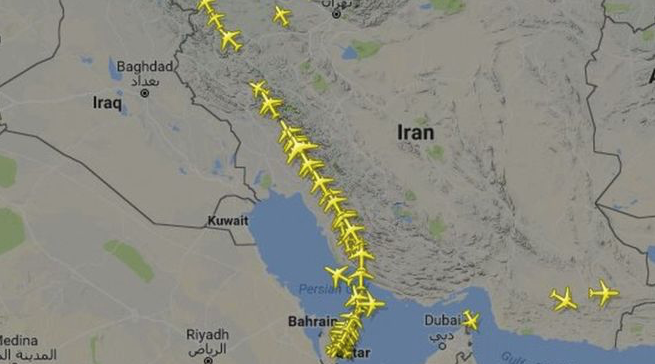
During the past few weeks, in the midst of the political rift in the Gulf region, officials from Qatar have been meeting with the International Civil Aviation Organization (ICAO) which is the UN body pertaining to global aviation. It's an organization that tends to stay out of politics — it mainly issues directives relating to things such as aviation safety, the electronics ban and more. However, ICAO also negotiated the treaties that regulate the "freedom of the skies."

These treaties essentially form the basis of today's laws governing aviation internationally — two that are especially relevant to Qatar and its ongoing crisis are the Chicago Convention on International Civil Aviation and The International Air Services Transit Agreement. The State of Qatar has been meeting with ICAO in hopes of finding a solution to the airspace closure, since many Qatar Airways flights now must add significant distance and time to avoid flying through the closed airspace.

For Qatar, the closure of Bahrain and the United Arab Emirates' airspace has been the most critical. Qatar's own airspace is tiny, and thus the airline relies on traveling through Bahrain's comparatively vast airspace.
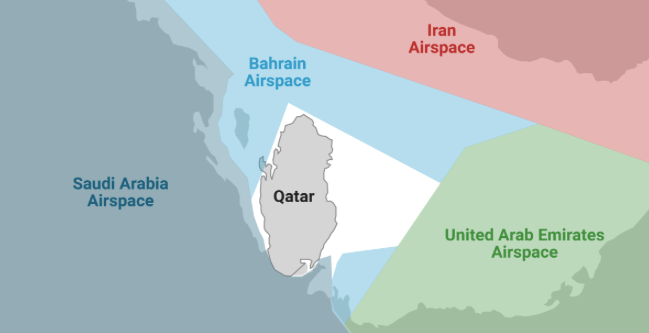
Image courtesy of ICAO.

Qatar even signed another, separate agreement with Bahrain stating that it would always need to use Bahrain's airspace, as it's quite literally the only way out of the country via air. With Qatar having such little airspace, you can see why it's so important that ICAO agreements such as the Transit Agreement exist in the first place. However, ICAO hasn't dealt with a crisis like this in its 70 years of existence, and a complete closure of airspace like what we're seeing now is unprecedented.

Qatar has urged ICAO to remind the countries blocking its flights of the two aforementioned treaties that they've all signed, which, according to Qatar, renders the airspace closure illegal. While ICAO as such can't enforce anything, it can issue directives. Its 191 member countries have always respected and upheld these directives, and enforce them as standards for international aviation.

Here's a rundown of what happened at a recent meeting between ICAO and Qatar:

Qatar's argument centered around the two treaties mentioned above — the Chicago Convention and the Transit Agreement. The Chicago Convention confirms the exclusive sovereignty of all states in the airspace above their territory, and is signed by nearly all of the world's countries with a civil aviation industry. It also states that in the event of a humanitarian crisis, an airline would be able to negotiate permission to enter the airspace of a given country in order to operate a rescue flight or similar. All of the nations that have imposed the blockade of Qatar are parties to this convention. This treaty doesn't really establish any strong ground in this particular case, other than highlighting the ownership of airspace. However, when looked at together with the Transit Agreement, things change a bit.

Daily Newsletter
Reward your inbox with the TPG Daily newsletter
Join over 700,000 readers for breaking news, in-depth guides and exclusive deals from TPG’s experts

The Transit Agreement is a multilateral agreement that allows overflights, which means that international aircraft can pass through any country's airspace. It's an agreement that's heavily relied upon, as it means airlines will benefit from taking the most direct route, and saves airlines from having to negotiate separately with several different countries if they are going to fly through their airspace. Three of the four nations imposing the blockade (Bahrain, Egypt and the UAE) are signatories of this agreement which means they have committed to permitting scheduled flights from the State of Qatar to overfly their airspace. Since the diplomatic crisis started, these countries have chosen to ignore the Transit Agreement altogether. However, since Saudi Arabia hasn't signed the Transit Agreement, it has no obligation to allow Qatar Airways to access its airspace.

After a long hearing at ICAO's headquarters in Montreal, the following was announced:

ICAO also issued a directive for the involved countries to adhere to the Transit Agreement (the one signed by UAE, Bahrain and Egypt.)
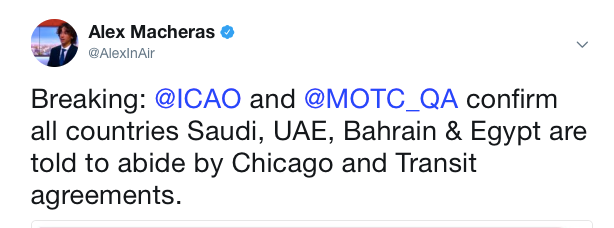
This is the first clear directive from ICAO stating that Bahrain, Egypt and the UAE are bound to uphold the Transit Agreement. This is particularly good news for Qatar, as there is now an external, official body firmly re-stating the importance of these treaties, even though ICAO can't actually enforce them. Following the ICAO directive, Qatar is expected to have access to routes over international airspace (Bahrain, Egypt and the UAE) in early August — great news for passengers, as flight times should be slightly shorter again.

Bottom Line

Travel and aviation are, unfortunately, sometimes affected by political controversy, and this has a disproportionate effect on passengers. Open skies are important to the growth and continued operation of the aviation industry, and with the latest move by ICAO, Qatar has made a relevant step toward easing the airspace bans against it.

TPG featured card

Best for dining at restaurants
TPG Editor‘s Rating
4 / 5
Go to review
Apply for American Express® Gold Card
at American Express's secure site

Rewards

1 - 4X points

Intro offer

As High As 100,000 points. Find Out Your Offer.

Annual Fee

$325

Recommended Credit

Excellent to Good

Why We Chose It

There’s a lot to love about the Amex Gold. It’s a fan favorite thanks to its fantastic bonus-earning rates at restaurants worldwide and at U.S. supermarkets. If you’re hitting the skies soon, you’ll also earn bonus Membership Rewards points on travel. Paired with up to $120 in Uber Cash annually (for U.S. Uber rides or Uber Eats orders, card must be added to Uber app and you can redeem with any Amex card), up to $120 in annual dining statement credits to be used with eligible partners, an up to $84 Dunkin’ credit each year at U.S. Dunkin Donuts and an up to $100 Resy credit annually, there’s no reason that foodies shouldn’t add the Amex Gold to their wallet. These benefits alone are worth more than $400, which offsets the $325 annual fee on the Amex Gold card. Enrollment is required for select benefits. (Partner offer)

Pros

  • 4 points per dollar spent on dining at restaurants worldwide and U.S. supermarkets (on the first $50,000 in purchases per calendar year; then 1 point per dollar spent thereafter and $25,000 in purchases per calendar year; then 1 point per dollar spent thereafter, respectively)
  • 3 points per dollar spent on flights booked directly with the airline or with amextravel.com
  • Packed with credits foodies will enjoy
  • Solid welcome bonus

Cons

  • Not as useful for those living outside the U.S.
  • Some may have trouble using Uber and other dining credits
  • You may be eligible for as high as 100,000 Membership Rewards® Points after you spend $6,000 in eligible purchases on your new Card in your first 6 months of Card Membership. Welcome offers vary and you may not be eligible for an offer. Apply to know if you’re approved and find out your exact welcome offer amount – all with no credit score impact. If you’re approved and choose to accept the Card, your score may be impacted.
  • Earn 4X Membership Rewards® points per dollar spent on purchases at restaurants worldwide, on up to $50,000 in purchases per calendar year, then 1X points for the rest of the year.
  • Earn 4X Membership Rewards® points per dollar spent at US supermarkets, on up to $25,000 in purchases per calendar year, then 1X points for the rest of the year.
  • Earn 3X Membership Rewards® points per dollar spent on flights booked directly with airlines or on AmexTravel.com.
  • Earn 2X Membership Rewards® points per dollar spent on prepaid hotels and other eligible purchases booked on AmexTravel.com.
  • Earn 1X Membership Rewards® point per dollar spent on all other eligible purchases.
  • $120 Uber Cash on Gold: Add your Gold Card to your Uber account and get $10 in Uber Cash each month to use on orders and rides in the U.S. when you select an American Express Card for your transaction. That’s up to $120 Uber Cash annually. Plus, after using your Uber Cash, use your Card to earn 4X Membership Rewards® points for Uber Eats purchases made with restaurants or U.S. supermarkets. Point caps and terms apply.
  • $84 Dunkin' Credit: With the $84 Dunkin' Credit, you can earn up to $7 in monthly statement credits after you enroll and pay with the American Express® Gold Card at U.S. Dunkin' locations. Enrollment is required to receive this benefit.
  • $100 Resy Credit: Get up to $100 in statement credits each calendar year after you pay with the American Express® Gold Card to dine at U.S. Resy restaurants or make other eligible Resy purchases. That's up to $50 in statement credits semi-annually. Enrollment required.
  • $120 Dining Credit: Satisfy your cravings, sweet or savory, with the $120 Dining Credit. Earn up to $10 in statement credits monthly when you pay with the American Express® Gold Card at Grubhub, The Cheesecake Factory, Goldbelly, Wine.com, and Five Guys. Enrollment required.
  • Explore over 1,000 upscale hotels worldwide with The Hotel Collection and receive a $100 credit towards eligible charges* with every booking of two nights or more through AmexTravel.com. *Eligible charges vary by property.
  • No Foreign Transaction Fees.
  • Annual Fee is $325.
  • Terms Apply.
Apply for American Express® Gold Card
at American Express's secure site
Terms & restrictions apply. See rates & fees
Best for dining at restaurants
TPG Editor‘s Rating
4 / 5
Go to review

Rewards Rate

4XEarn 4X Membership Rewards® points per dollar spent on purchases at restaurants worldwide, on up to $50,000 in purchases per calendar year, then 1X points for the rest of the year.
4XEarn 4X Membership Rewards® points per dollar spent at US supermarkets, on up to $25,000 in purchases per calendar year, then 1X points for the rest of the year.
3XEarn 3X Membership Rewards® points per dollar spent on flights booked directly with airlines or on AmexTravel.com.
2XEarn 2X Membership Rewards® points per dollar spent on prepaid hotels and other eligible purchases booked on AmexTravel.com.
1XEarn 1X Membership Rewards® point per dollar spent on all other eligible purchases.
  • Intro Offer

    As High As 100,000 points. Find Out Your Offer.
  • Annual Fee

    $325
  • Recommended Credit

    Excellent to Good

Why We Chose It

There’s a lot to love about the Amex Gold. It’s a fan favorite thanks to its fantastic bonus-earning rates at restaurants worldwide and at U.S. supermarkets. If you’re hitting the skies soon, you’ll also earn bonus Membership Rewards points on travel. Paired with up to $120 in Uber Cash annually (for U.S. Uber rides or Uber Eats orders, card must be added to Uber app and you can redeem with any Amex card), up to $120 in annual dining statement credits to be used with eligible partners, an up to $84 Dunkin’ credit each year at U.S. Dunkin Donuts and an up to $100 Resy credit annually, there’s no reason that foodies shouldn’t add the Amex Gold to their wallet. These benefits alone are worth more than $400, which offsets the $325 annual fee on the Amex Gold card. Enrollment is required for select benefits. (Partner offer)

Pros

  • 4 points per dollar spent on dining at restaurants worldwide and U.S. supermarkets (on the first $50,000 in purchases per calendar year; then 1 point per dollar spent thereafter and $25,000 in purchases per calendar year; then 1 point per dollar spent thereafter, respectively)
  • 3 points per dollar spent on flights booked directly with the airline or with amextravel.com
  • Packed with credits foodies will enjoy
  • Solid welcome bonus

Cons

  • Not as useful for those living outside the U.S.
  • Some may have trouble using Uber and other dining credits
  • You may be eligible for as high as 100,000 Membership Rewards® Points after you spend $6,000 in eligible purchases on your new Card in your first 6 months of Card Membership. Welcome offers vary and you may not be eligible for an offer. Apply to know if you’re approved and find out your exact welcome offer amount – all with no credit score impact. If you’re approved and choose to accept the Card, your score may be impacted.
  • Earn 4X Membership Rewards® points per dollar spent on purchases at restaurants worldwide, on up to $50,000 in purchases per calendar year, then 1X points for the rest of the year.
  • Earn 4X Membership Rewards® points per dollar spent at US supermarkets, on up to $25,000 in purchases per calendar year, then 1X points for the rest of the year.
  • Earn 3X Membership Rewards® points per dollar spent on flights booked directly with airlines or on AmexTravel.com.
  • Earn 2X Membership Rewards® points per dollar spent on prepaid hotels and other eligible purchases booked on AmexTravel.com.
  • Earn 1X Membership Rewards® point per dollar spent on all other eligible purchases.
  • $120 Uber Cash on Gold: Add your Gold Card to your Uber account and get $10 in Uber Cash each month to use on orders and rides in the U.S. when you select an American Express Card for your transaction. That’s up to $120 Uber Cash annually. Plus, after using your Uber Cash, use your Card to earn 4X Membership Rewards® points for Uber Eats purchases made with restaurants or U.S. supermarkets. Point caps and terms apply.
  • $84 Dunkin' Credit: With the $84 Dunkin' Credit, you can earn up to $7 in monthly statement credits after you enroll and pay with the American Express® Gold Card at U.S. Dunkin' locations. Enrollment is required to receive this benefit.
  • $100 Resy Credit: Get up to $100 in statement credits each calendar year after you pay with the American Express® Gold Card to dine at U.S. Resy restaurants or make other eligible Resy purchases. That's up to $50 in statement credits semi-annually. Enrollment required.
  • $120 Dining Credit: Satisfy your cravings, sweet or savory, with the $120 Dining Credit. Earn up to $10 in statement credits monthly when you pay with the American Express® Gold Card at Grubhub, The Cheesecake Factory, Goldbelly, Wine.com, and Five Guys. Enrollment required.
  • Explore over 1,000 upscale hotels worldwide with The Hotel Collection and receive a $100 credit towards eligible charges* with every booking of two nights or more through AmexTravel.com. *Eligible charges vary by property.
  • No Foreign Transaction Fees.
  • Annual Fee is $325.
  • Terms Apply.