JetBlue begins flying new "tag" routes in order to comply with CARES Act

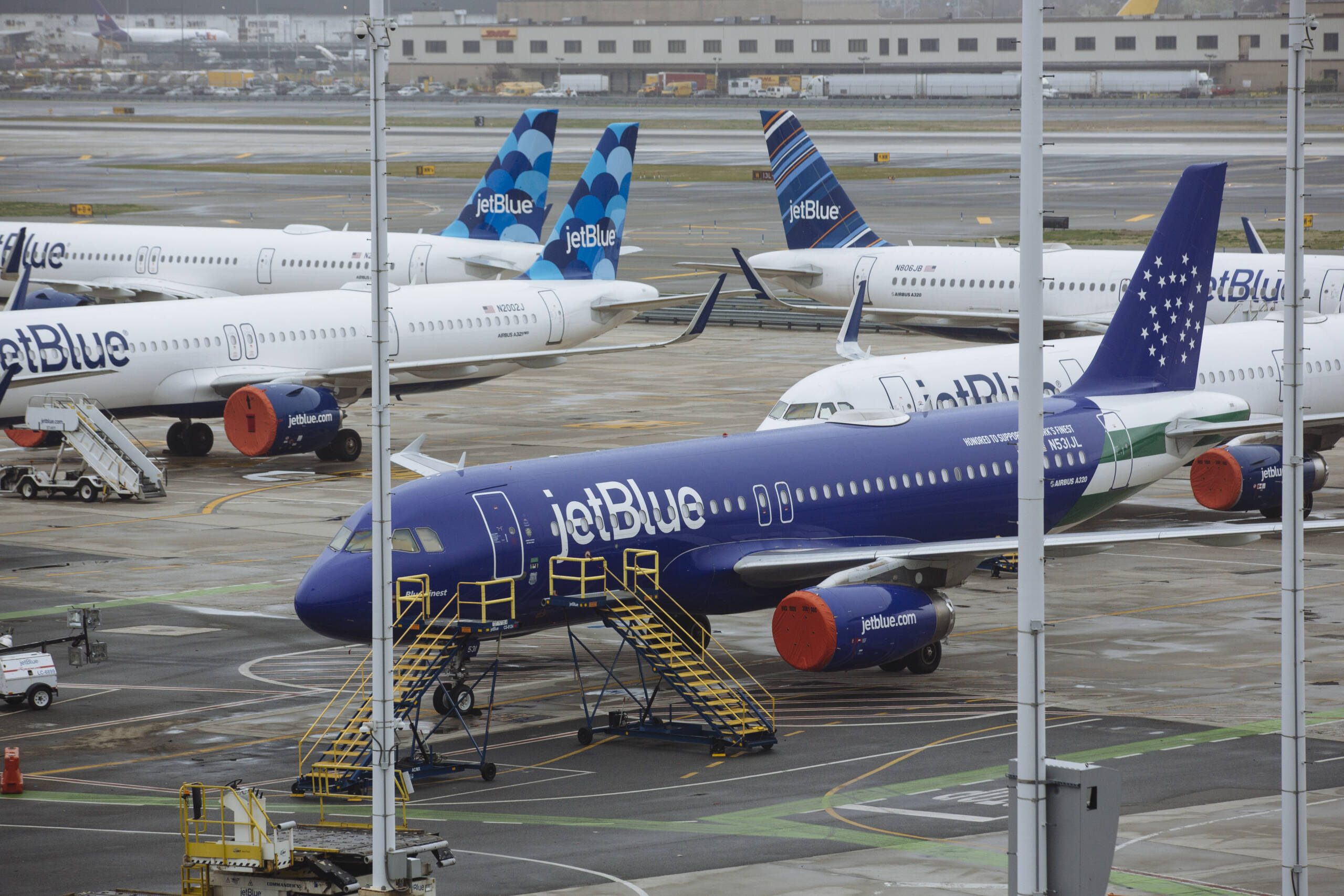
Call it a sign of the times.
As a condition of receiving federal money under the CARES Act, airlines must maintain "a minimum level of service" between city pairs that were served before the coronavirus pandemic broke out, reducing the demand for air travel to practically nothing.
For more TPG news delivered each morning to your inbox, sign up for our daily newsletter.
JetBlue, instead of maintaining nonstop service between its major hubs and other cities on its route map, will fly flights with "tag" segments connecting the origin to the final destination, according to Paxex.Aero. This means that flyers will have the opportunity to fly routes that did not exist on the carrier's pre-coronavirus route map.
For example, instead of flying separate nonstop flights between New York-JFK and Chicago-O'Hare (ORD) and Minneapolis (MSP), JetBlue will temporarily fly JFK-ORD-MSP. This way, it can (try to) combat the almost complete lack of demand, reduce costs for the airline and satisfy the criteria spelled out in the CARES Act.
Some of the other routes with "tag" segments include:

- Boston (BOS) - Denver (DEN) - Albuquerque (ABQ)
- Boston - New Orleans (MSY) - Houston (IAH)
- Boston - Las Vegas (LAS) - San Diego (SAN)
- Boston - Seattle (SEA) - Portland (PDX)
- Long Beach (LGB) - Palm Springs (PSP) - New York-JFK
- Long Beach - Salt Lake City (SLC) - Bozeman (BZN)
- New York-JFK - Denver - Albuquerque
- New York-JFK - New Orleans - Houston
- New York-JFK - Las Vegas - San Diego
- New York-JFK - Seattle - Portland
- New York-JFK - San Francisco (SFO) - Sacramento (SMF)
- New York-JFK - Orlando (MCO) - Sarasota (SRQ)
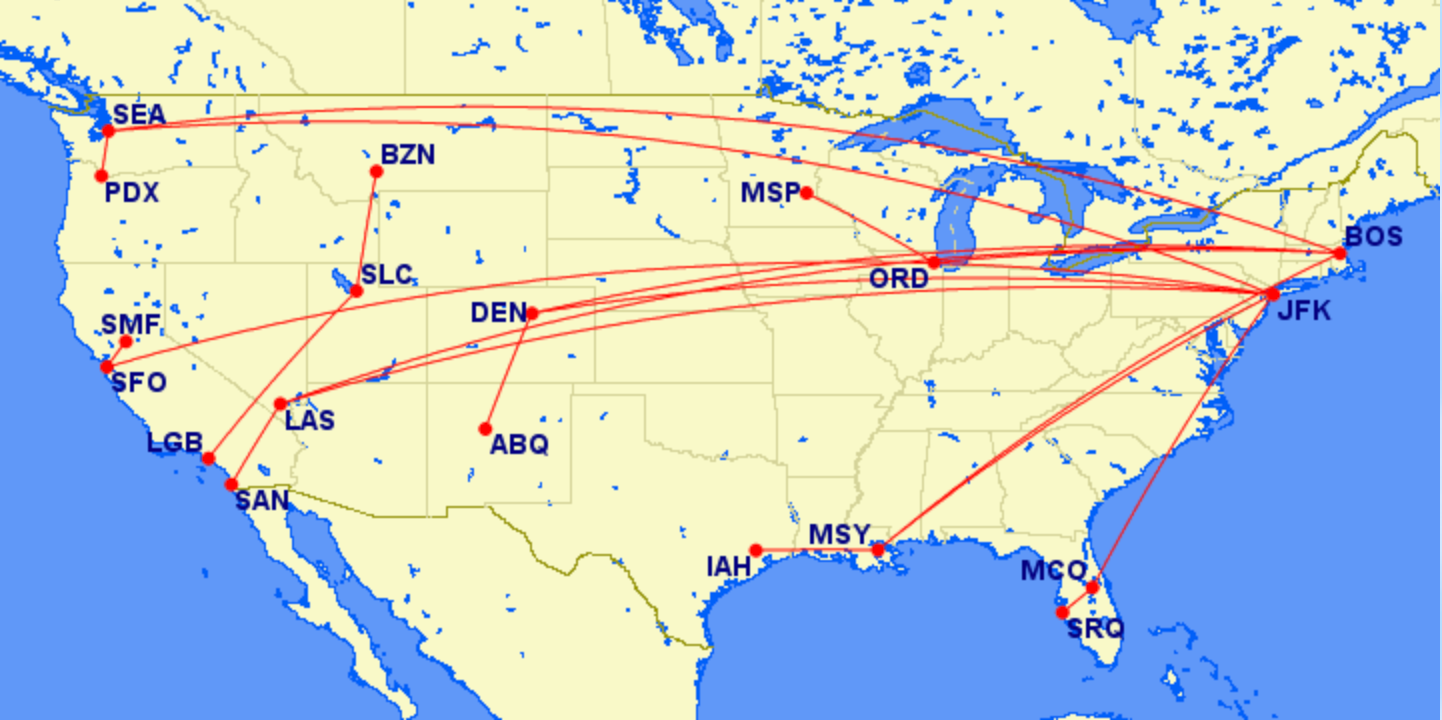
Some of the transcontinental premium routes like BOS-LAS, JFK-LAS and JFK-SFO will maintain the airline's lauded Mint service up front, but when those aircraft continue on their "tag" segments, there won't be Mint service.
Bottom line
From a purely AvGeek perspective, it's interesting to see JetBlue piece together these routes, and there are certainly some routes (looking at you, Denver-Albuquerque) that we'd love to fly if we weren't still in the middle of a global pandemic.
However, the reality of these new routings is that they underpin an airline -- in fact an entire industry -- that's in survival mode. Getting around the country isn't going to be as convenient or as quick as it was before the US began to shelter in place, and it's certainly logical that airlines are beginning to approach their route maps this way to guarantee service while minimizing cost during a time where every carrier is burning cash at a rate that was almost unfathomable before.
TPG featured card
at American Express's secure site
Terms & restrictions apply. See rates & fees.
| 4X | Earn 4X Membership Rewards® points per dollar spent on purchases at restaurants worldwide, on up to $50,000 in purchases per calendar year, then 1X points for the rest of the year. |
| 4X | Earn 4X Membership Rewards® points per dollar spent at US supermarkets, on up to $25,000 in purchases per calendar year, then 1X points for the rest of the year. |
| 5X | Earn 5X Membership Rewards® points on prepaid hotel stays booked through AmexTravel.com or the Amex Travel App™. |
| 3X | Earn 3X Membership Rewards® points on flights booked through AmexTravel.com, the Amex Travel App™, or purchased directly from airlines. |
| 2X | Earn 2X Membership Rewards® points on prepaid car rentals booked through AmexTravel.com or the Amex Travel App™ and cruises booked and paid through AmexTravel.com. |
| 1X | Earn 1X Membership Rewards® point per dollar spent on all other eligible purchases. |
Pros
- Valuable dining and food-related credits
- Flexible rewards with airline and hotel transfer partners
- Multiple travel and purchase protections
- No foreign transaction fees
- Access to Amex Offers for additional savings (enrollment required)
Cons
- Not as useful for those living outside the U.S.
- Some may have trouble using Uber and other dining credits
- You may be eligible for as high as 100,000 Membership Rewards® Points after you spend $8,000 in eligible purchases on your new Card in your first 6 months of Card Membership. Welcome offers vary and you may not be eligible for an offer. Apply to know if you’re approved and find out your exact welcome offer amount – all with no credit score impact. If you’re approved and choose to accept the Card, your score may be impacted.
- Earn 4X Membership Rewards® points per dollar spent on purchases at restaurants worldwide, on up to $50,000 in purchases per calendar year, then 1X points for the rest of the year.
- Earn 4X Membership Rewards® points per dollar spent at US supermarkets, on up to $25,000 in purchases per calendar year, then 1X points for the rest of the year.
- Earn 5X Membership Rewards® points on prepaid hotel stays booked through AmexTravel.com or the Amex Travel App™.
- Earn 3X Membership Rewards® points on flights booked through AmexTravel.com, the Amex Travel App™, or purchased directly from airlines.
- Earn 2X Membership Rewards® points on prepaid car rentals booked through AmexTravel.com or the Amex Travel App™ and cruises booked and paid through AmexTravel.com.
- Earn 1X Membership Rewards® point per dollar spent on all other eligible purchases.
- Pay It® lets you tap in the American Express® App to quickly pay for small purchase amounts throughout the month and still earn rewards the way you usually do. Plan It® gives you the option to split up big purchases into equal monthly payments with a fixed fee. You’ll know upfront exactly how much you’ll pay.
- $120 Dining Credit: Earn up to a total of $10 in statement credits monthly when you pay with the Gold Card at Grubhub (including Seamless), Buffalo Wild Wings, Five Guys, The Cheesecake Factory, and Wonder. This can be an annual savings of up to $120. Enrollment required.
- $100 Resy Credit: Get up to $100 in statement credits each calendar year at over 10,000 qualifying U.S. Resy restaurants after you pay for eligible purchases with the American Express® Gold Card. That’s up to $50 in statement credits semi-annually. Enrollment required.
- $84 Dunkin' Credit: Earn up to $7 in monthly statement credits after you pay with the American Express® Gold Card at U.S. Dunkin’ locations. Enrollment required.
- $120 Uber Cash on Gold: Enjoy up to $120 in Uber Cash annually with your Gold Card. Just add your Card to your Uber account and you'll get $10 in Uber Cash each month to use on orders and rides in the U.S. when you select an Amex Card for your transaction.
- Enjoy complimentary Hertz Five Star® Status benefits like skipping the counter at select locations, adding an additional driver at no additional cost*, and vehicle upgrades**. Benefit enrollment and Hertz Gold+ registration are required. *Additional drivers must meet standard rental qualifications and must be a spouse or domestic partner to qualify as complimentary. Other additional drivers subject to fees. **Benefits are subject to availability and vary by location. Additional Hertz program Terms and Conditions including age restrictions apply.
- Book two nights or more with The Hotel Collection through AmexTravel.com or the Amex Travel App™ and receive a $100* credit towards eligible charges at over 1,400 upscale hotels worldwide. *Eligible charges vary by property.
- Book your travel through the Amex Travel App™ with added peace of mind – backed by American Express® service and support. Only for American Express® Card Members.
- Whenever you need us, we're here. Our Member Services team will ensure you are taken care of. From lost Card replacement to statement questions, we are available to help 24/7.
- No Foreign Transaction Fees.
- Annual Fee is $325.
- Terms Apply.