The technical challenges of flying near-empty planes
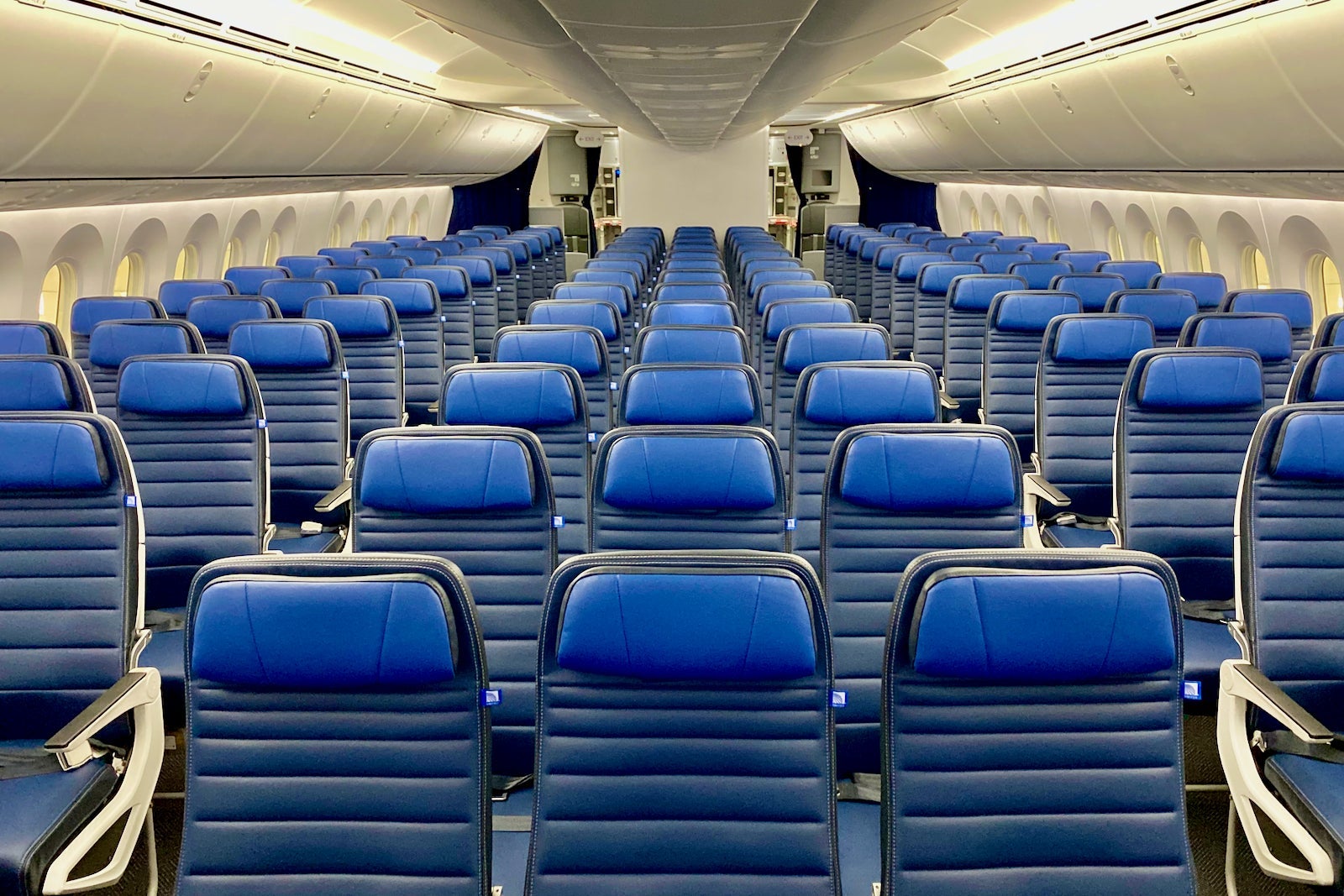
Airlines are flying very few passengers and near-empty aircraft these days, courtesy of the COVID-19 pandemic.
A captain for a large international carrier told me he recently flew a Boeing 787 Dreamliner to Los Angeles. His aircraft normally seats 255 passengers, but there were only 25 on board. Separately, a first officer for a U.S. carrier said in an email there were three passengers on her most recent flight.
In an era where airlines have typically 85% of their seats full with paying passengers, these numbers are unheard of. But revenue aside, flying empty or near-empty planes requires operational changes due to physics. It's all because of weight and balance.
When an airplane flies so light on passengers (and their luggage), passengers are either moved around the cabin or extra ballast is added to the baggage hold to make sure it all balances out.
For more travel tips and news, sign up for TPG's daily email newsletter
Airplanes function like a giant seesaw. By design, the center of gravity of the aircraft is near the main landing gear. But the center of gravity is not constant because fuel, passengers, baggage and cargo differ on each flight and for each airplane. The center of gravity even changes during flight.
"An operator calculates takeoff weight by adding the operational empty weight of the aircraft, the weight of the passengers, cargo payload, and the weight of fuel. The objective is to calculate the takeoff weight and center of gravity of an aircraft as accurately as possible," according to the Federal Aviation Administration.
"The center of gravity moves backwards as we burn fuel," said Carolina Larsson, a first officer with a regional airline flying Embraer E175 around North America. Her airplane has a forward center of gravity due to its engines being mounted forward of the wings.
Captain Chris Brady, a commercial pilot who runs the Boeing 737 Technical Site, explained that typically an airline's dispatcher gives the pilots a form with the number of passengers and which third of the cabin — front, middle, or rear — they are seated in. The form also has the number of bags and cargo and where it's physically loaded on the plane.

"We then input that data along with the fuel load and various other factors — such as flap setting — into the computer and it spits out both the balance data and takeoff speeds. With the balance data, we set the stabilizer trim so that the aircraft is in trim for the take off," Brady explained, referring to the control surfaces on the tail that keep an airplane longitudinally stable.
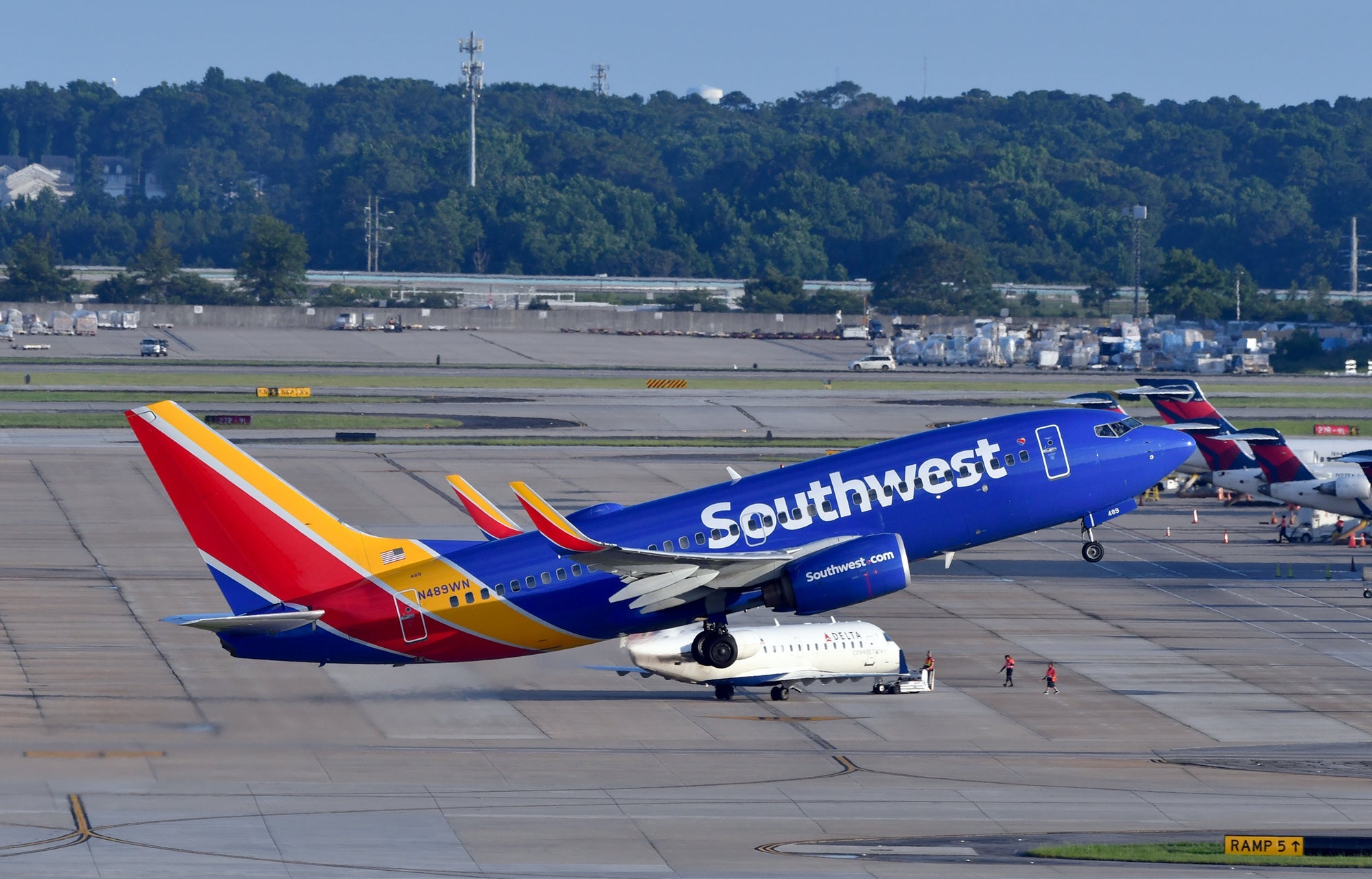
"For the Boeing 737 and Airbus A320 families there is no weight and balance problem flying empty or nearly empty as long as the passengers are evenly distributed throughout the cabin. The aircraft will be in balance. This is of course all checked before departure by the pilots," Brady said.
Still, "if the balance calculation shows that the aircraft is out of allowable trim limits for takeoff or landing, then we will instruct the cabin crew to move passengers so that the aircraft is in balance — but this is a very rare occurrence," Brady said.
It's less rare for pilots on smaller regional jets.
"We move passengers around every four flights or so," Larsson, the Embraer E175 pilot, said, noting that it happens even when planes are flying with more passengers.
"The E175 is tail-heavy. And sometimes, the rear of the cabin is full of economy passengers but the front of the cabin is not. When we plug in the passenger loads, the flight computer will inform us that we need to move a certain number of passengers from the rear section to the middle or the front. For example, it will say to take either four passengers from the rear to the front cabin or six passengers from the middle to the front. Those that bought an economy ticket might be in for a bump up to business class," she said. "We call up the flight attendants and they move the passengers, often asking for volunteers, without specifying why or where they will get seated."
While the E175 is tail-heavy, despite having a forward center of gravity, other regional jets such as the CRJ series made by Bombardier are nose-heavy. Those planes have a baggage section at the rear of the aircraft to compensate. But still, weight must sometimes be shifted around or added.
For some aircraft and under some circumstances such as an already light fuel load, the ground crew will load 50-pound sandbags, sometimes more than a dozen. The ballast can consist of bags of sand or pebbles, ballast blocks or bars. The bags are loaded into either the forward or the rear baggage hold, depending on the specific aircraft. Larsson said that she's never had to ask for ballast to be added for her flights. Captain Brady concurs: "I only ever had to use ballast on air test flights which are post maintenance check flights when we needed a high fuel load but had zero passengers. The ballast was whatever the engineers had handy—usually spare tires."
All of the calculations generated by the flight computer are based on certain standard weights, originally devised by the FAA. For many years, those weights increased from time to time as the flying public grew, well, larger.
Here are the standard weights published in 2005, the last time the table was updated. The figures include the estimated weight of a passenger's luggage as well.
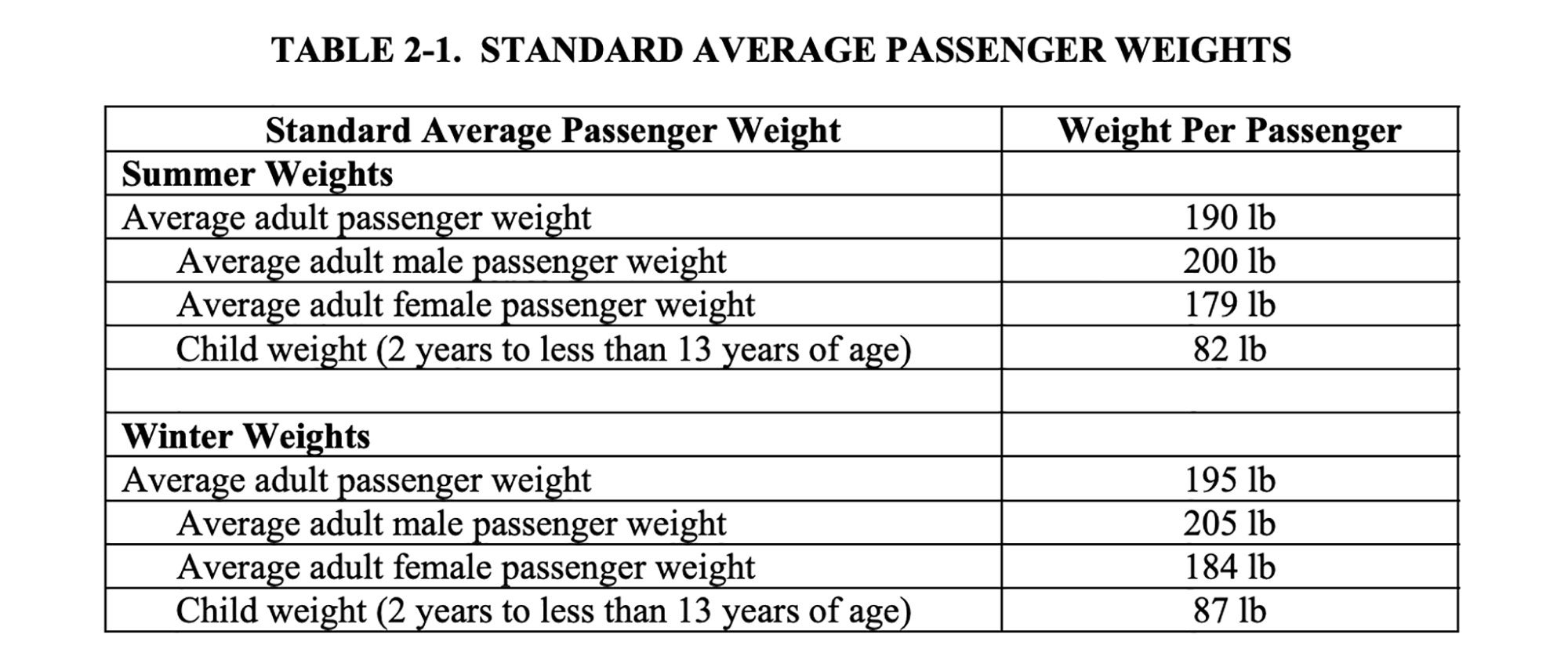
Nowadays, the FAA simply releases methods to calculate the weights of passengers rather than specify standard weights.
For the record, I'm trying to do my part to help the airlines by losing a few pounds.
Mike Arnot is the founder of Boarding Pass NYC, a New York-based travel brand and a marketing consultant to airlines, none of which appear in this article. Featured image The empty economy-class cabin of a United Boeing 787, by Zach Griff / The Points Guy
TPG featured card

at Capital One's secure site
Terms & restrictions apply. See rates & fees.
| 5X miles | Earn 5X miles on hotels, vacation rentals and rental cars booked through Capital One Travel |
| 2X miles | Earn unlimited 2X miles on every purchase, every day |
Pros
- Stellar welcome offer of 75,000 miles after spending $4,000 on purchases in the first three months from account opening. Plus, a $250 Capital One Travel credit to use in your first cardholder year upon account opening.
- You'll earn 2 miles per dollar on every purchase, which means you won't have to worry about memorizing bonus categories
- Rewards are versatile and can be redeemed for a statement credit or transferred to Capital One’s transfer partners
Cons
- Highest bonus-earning categories only on travel booked via Capital One Travel
- LIMITED-TIME OFFER: Enjoy $250 to use on Capital One Travel in your first cardholder year, plus earn 75,000 bonus miles once you spend $4,000 on purchases within the first 3 months from account opening - that’s equal to $1,000 in travel
- Earn unlimited 2X miles on every purchase, every day
- Earn 5X miles on hotels, vacation rentals and rental cars booked through Capital One Travel
- Miles won't expire for the life of the account and there's no limit to how many you can earn
- Receive up to a $120 credit for Global Entry or TSA PreCheck®
- Use your miles to get reimbursed for any travel purchase—or redeem by booking a trip through Capital One Travel
- Enjoy a $50 experience credit and other premium benefits with every hotel and vacation rental booked from the Lifestyle Collection
- Transfer your miles to your choice of 15+ travel loyalty programs
- Top rated mobile app