Delta CEO says industry nears 'bottom' of coronavirus crisis, recovery a ways off


Delta Air Lines CEO Ed Bastian thinks the industry is near the worst of the novel coronavirus pandemic that has reduced the demand for air travel to near zero.
"I think we're pretty close to the bottom," Bastian told employees during an April 8 webinar viewed by TPG. "You can't get much lower than where it's at today."
Atlanta-based Delta is pulling in less than 10% of its normal daily revenues — on average $129 million a day in 2019 — with planes about a quarter full, according to Bastian and airline data.
Get Coronavirus travel updates. Stay on top of industry impacts, flight cancellations, and more.
The bottom would be welcome news for an industry hit hard by the coronavirus. Airlines were among the first to see customer demand collapse as the first cases of COVID-19 in the U.S. were confirmed at the end of February. The industry, which is deemed essential by the government, has fought to cut capacity fast enough as travelers have all but disappeared.
Today, it is not unusual to see nearly empty flights. Most of the people still flying do so because they need to, for example critical healthcare workers and government officials, and not because they want to.
The number of people passing through Transportation Security Administration checkpoints fell from nearly 2.3 million on March 1, the first Sunday in March, to 122,029 on April 5, the first Sunday in April, according to the agency. The screening data includes certain airline staff.
The number of screenings fell below 100,000 for the first time in the TSA's history on April 7. That's equivalent to the number of of people who flew on a daily basis more than 60 years ago in 1954.
Related: How long will US airlines' cash last? Between 4 months and a year

U.S. traffic numbers appear to be stabilizing at down roughly 96% compared to the same seven-day period in 2019, according to an Airlines for America (A4A) update on April 9. However, net bookings were down 101% on a weekly basis at the end of the March. In other words, more reservations are being cancelled than being made.
"With bookings almost nil and cancelations high – and with half the world (including 95% of the U.S. population) subject to stay-at-home orders – we continue to see these already-depressed passenger volumes worsen," A4A chief economist John Heimlich told TPG. The organization represents 10 U.S. airlines, including Delta.
Carriers have responded to this unprecedented drop in both traffic and revenue by slashing capacity. Delta has cut its schedule by more than 80% but continues to serve all of the U.S. destinations on its map, albeit on a greatly reduced basis. Other airlines have made similarly drastic reductions, some even consolidating routes or temporarily dropping cities entirely from their maps.
The U.S. government is providing more than $50 billion in aid to airlines through the coronavirus stimulus package, officially known as the CARES Act. Delta and at least eight other airlines have applied for the $25 billion in compensation grants available under the package.
Related: Delta CEO reassures staff as it shrinks operations, cuts hours
The one thing no one claims to know is how long COVID-19, and the recession caused by the near shut down of the U.S. economy, will put a damper on travel demand. Wall Street analysts and the International Air Transport Association (IATA) expect some recovery in the second half of 2020, though they anticipate passenger numbers at least a fifth lower than 2019 next year.
"I think this industry is going to be smaller for some period of time here as we build back, and I don't know what that pace of recovery will be," Bastian told employees. "It will really be dictated based on when customers feel safe to travel again in large numbers."
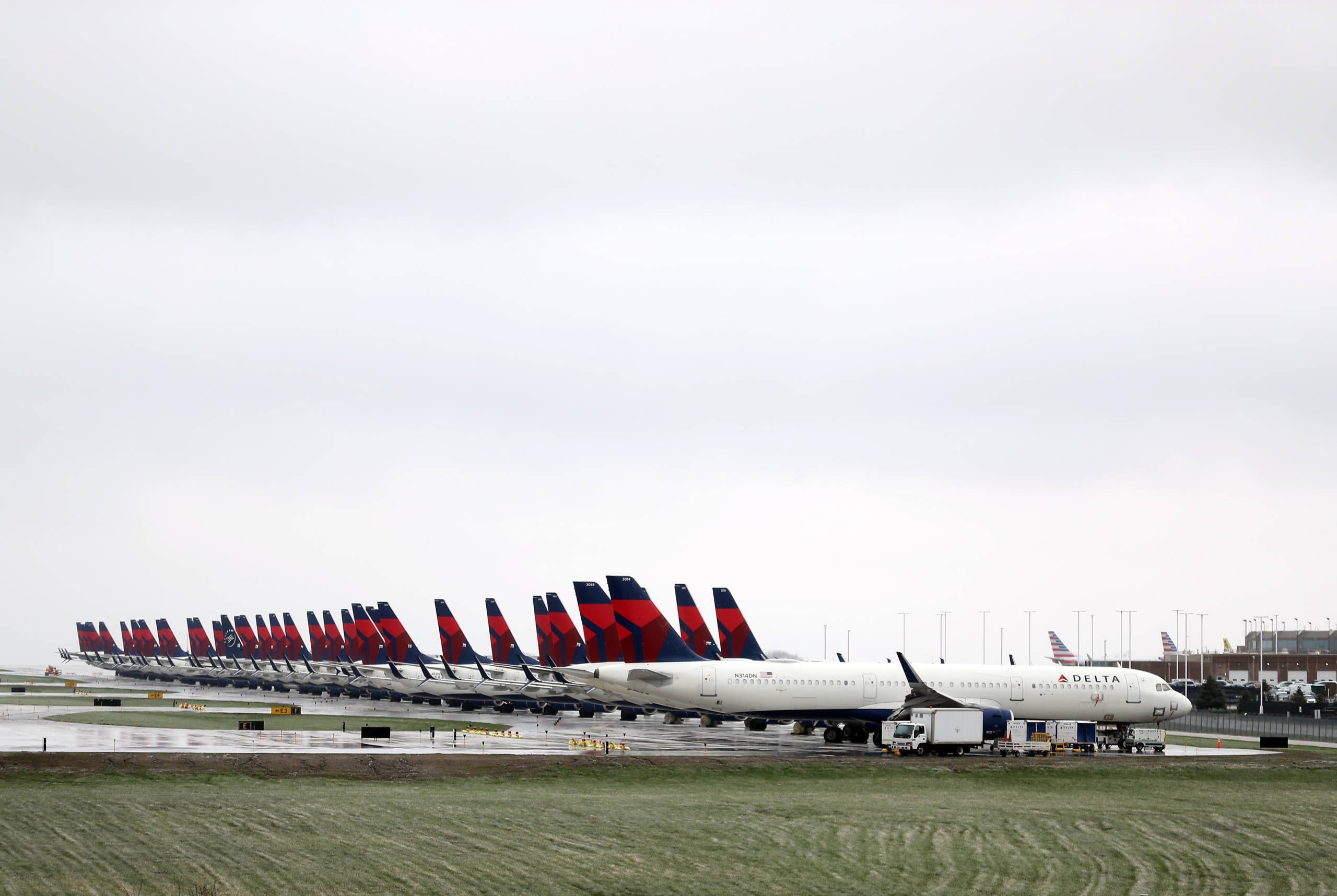
Delta is already preparing to emerge smaller. The carrier has parked more than 600 jets and is evaluating what models will not return to service. To date, it has only confirmed that its 77 McDonnell Douglas MD-88s and MD-90s will be retired.
In the next several months, Bastian and Delta's leadership team will look at the airline like a "white sheet of paper" in order to visualize what it will look post-crisis.
"We're still going to be Delta, but how we do it is going to be different," he said.
Related: How will airlines rebuild their route maps after the coronavirus?
TPG featured card
at American Express's secure site
Terms & restrictions apply. See rates & fees.
| 4X | Earn 4X Membership Rewards® points per dollar spent on purchases at restaurants worldwide, on up to $50,000 in purchases per calendar year, then 1X points for the rest of the year. |
| 4X | Earn 4X Membership Rewards® points per dollar spent at US supermarkets, on up to $25,000 in purchases per calendar year, then 1X points for the rest of the year. |
| 5X | Earn 5X Membership Rewards® points on prepaid hotel stays booked through AmexTravel.com or the Amex Travel App™. |
| 3X | Earn 3X Membership Rewards® points on flights booked through AmexTravel.com, the Amex Travel App™, or purchased directly from airlines. |
| 2X | Earn 2X Membership Rewards® points on prepaid car rentals booked through AmexTravel.com or the Amex Travel App™ and cruises booked and paid through AmexTravel.com. |
| 1X | Earn 1X Membership Rewards® point per dollar spent on all other eligible purchases. |
Pros
- Valuable dining and food-related credits
- Flexible rewards with airline and hotel transfer partners
- Multiple travel and purchase protections
- No foreign transaction fees
- Access to Amex Offers for additional savings (enrollment required)
Cons
- Not as useful for those living outside the U.S.
- Some may have trouble using Uber and other dining credits
- You may be eligible for as high as 100,000 Membership Rewards® Points after you spend $8,000 in eligible purchases on your new Card in your first 6 months of Card Membership. Welcome offers vary and you may not be eligible for an offer. Apply to know if you’re approved and find out your exact welcome offer amount – all with no credit score impact. If you’re approved and choose to accept the Card, your score may be impacted.
- Earn 4X Membership Rewards® points per dollar spent on purchases at restaurants worldwide, on up to $50,000 in purchases per calendar year, then 1X points for the rest of the year.
- Earn 4X Membership Rewards® points per dollar spent at US supermarkets, on up to $25,000 in purchases per calendar year, then 1X points for the rest of the year.
- Earn 5X Membership Rewards® points on prepaid hotel stays booked through AmexTravel.com or the Amex Travel App™.
- Earn 3X Membership Rewards® points on flights booked through AmexTravel.com, the Amex Travel App™, or purchased directly from airlines.
- Earn 2X Membership Rewards® points on prepaid car rentals booked through AmexTravel.com or the Amex Travel App™ and cruises booked and paid through AmexTravel.com.
- Earn 1X Membership Rewards® point per dollar spent on all other eligible purchases.
- Pay It® lets you tap in the American Express® App to quickly pay for small purchase amounts throughout the month and still earn rewards the way you usually do. Plan It® gives you the option to split up big purchases into equal monthly payments with a fixed fee. You’ll know upfront exactly how much you’ll pay.
- $120 Dining Credit: Earn up to a total of $10 in statement credits monthly when you pay with the Gold Card at Grubhub (including Seamless), Buffalo Wild Wings, Five Guys, The Cheesecake Factory, and Wonder. This can be an annual savings of up to $120. Enrollment required.
- $100 Resy Credit: Get up to $100 in statement credits each calendar year at over 10,000 qualifying U.S. Resy restaurants after you pay for eligible purchases with the American Express® Gold Card. That’s up to $50 in statement credits semi-annually. Enrollment required.
- $84 Dunkin' Credit: Earn up to $7 in monthly statement credits after you pay with the American Express® Gold Card at U.S. Dunkin’ locations. Enrollment required.
- $120 Uber Cash on Gold: Enjoy up to $120 in Uber Cash annually with your Gold Card. Just add your Card to your Uber account and you'll get $10 in Uber Cash each month to use on orders and rides in the U.S. when you select an Amex Card for your transaction.
- Enjoy complimentary Hertz Five Star® Status benefits like skipping the counter at select locations, adding an additional driver at no additional cost*, and vehicle upgrades**. Benefit enrollment and Hertz Gold+ registration are required. *Additional drivers must meet standard rental qualifications and must be a spouse or domestic partner to qualify as complimentary. Other additional drivers subject to fees. **Benefits are subject to availability and vary by location. Additional Hertz program Terms and Conditions including age restrictions apply.
- Book two nights or more with The Hotel Collection through AmexTravel.com or the Amex Travel App™ and receive a $100* credit towards eligible charges at over 1,400 upscale hotels worldwide. *Eligible charges vary by property.
- Book your travel through the Amex Travel App™ with added peace of mind – backed by American Express® service and support. Only for American Express® Card Members.
- Whenever you need us, we're here. Our Member Services team will ensure you are taken care of. From lost Card replacement to statement questions, we are available to help 24/7.
- No Foreign Transaction Fees.
- Annual Fee is $325.
- Terms Apply.