Chase Is Sending Customers New Tax Forms Reporting Points as Income


Over the past couple of weeks, Chase has sent letters to some cardholders informing them that the bank will soon be sending Form 1099-MISC for their 2018 tax return. Some cardholders are getting an amended 1099-MISC form while others are receiving a form for the first time — despite the January 31, 2019 due date for filing this form. IRS Form 1099-MISC is used to report "miscellaneous income" paid by one taxpayer to another.
The letter from Chase doesn't indicate the reason for reporting this income. However, it seems that Chase is reporting income to cardholders who received points as compensation for successful credit card referrals.
If Chase previously sent you a 1099-MISC but is providing a corrected form, the letter starts:
We reported an incorrect income amount on the IRS Form 1099-MISC (Miscellaneous Income) we sent you in late January. We apologize and will mail you the appropriate corrected form with the correct amount for tax year 2018 by July 30th.
Cardmembers who didn't receive a 1099-MISC in January — but Chase has now determined that they should have received one — are getting letters saying:
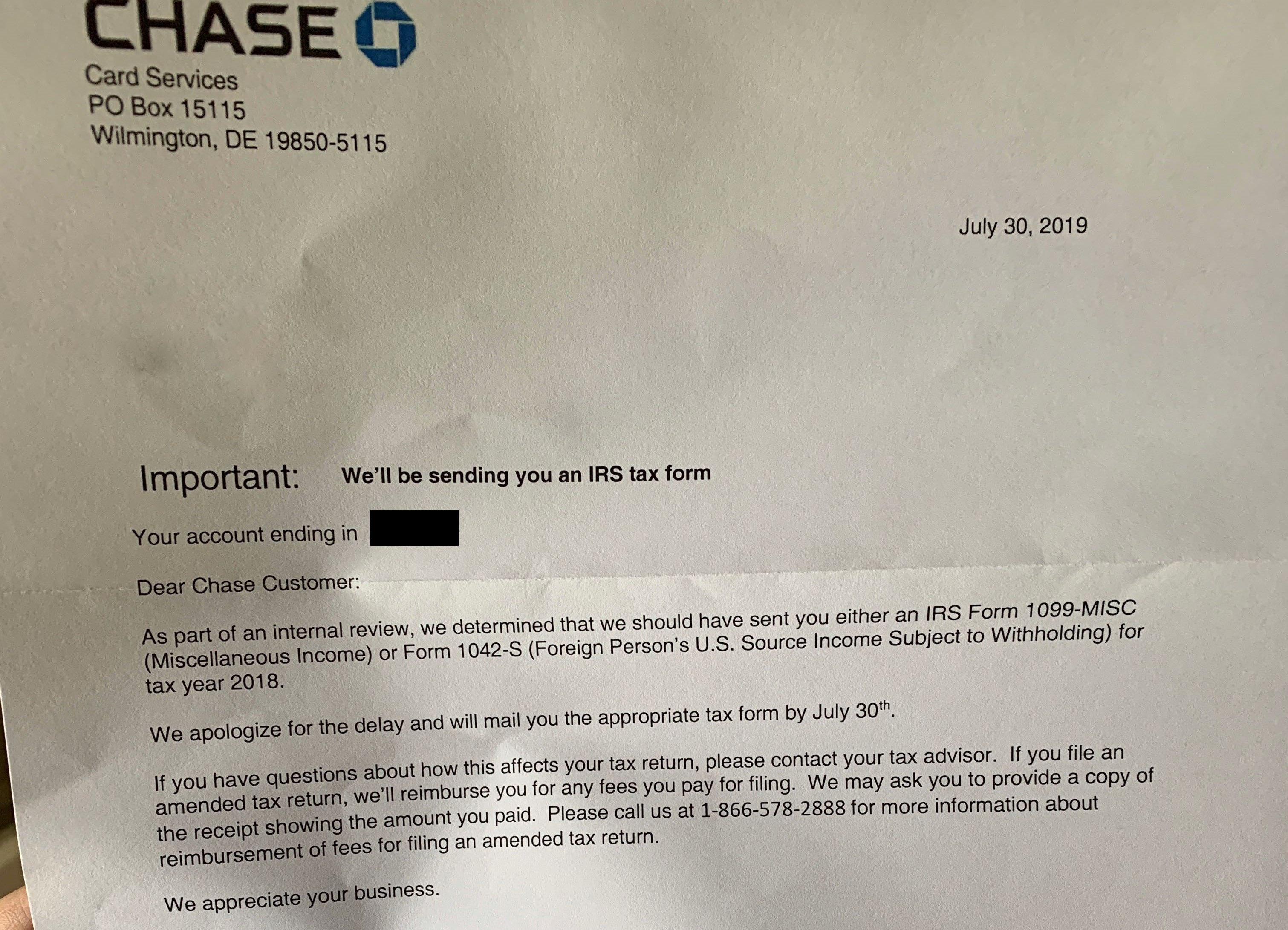
As part of an internal review, we determined that we should have sent you either an IRS Form 1099-MISC (Miscellaneous Income) or Form 1042-S (Foreign Person's U.S. Source Income Subject to Withholding) for tax year 2018. We apologize for the delay and will mail you the appropriate tax form by July 30th.
Both letters conclude:
If you have questions about how this affects your tax return, please contact your tax advisor. If you file an amended tax return, we'll reimburse you for any fees you pay for filing. We may ask you to provide a copy of the receipt showing the amount you paid. Please call us at 1-866-578-2888 for more information about reimbursement of fees for filing an amended tax return.
TPG's Summer Hull was one of the cardholders who received a letter saying that Chase "should have sent" her a form. The letter is dated July 30, 2019, yet the letter indicates that Chase will mail her "the appropriate tax form by July 30th":
If you also received one of these letters, here's what you need to know:
Why Am I Getting This?
Technically, you've received compensation (points) for work (referral), and the tax law says that "income from whatever source derived" is taxed unless there's law that excludes it from being taxed. As the payee of compensation, Chase is required by law to report to the IRS the amount of income paid to you, and could face significant penalties for failing to file such forms. For practicality sake, the IRS doesn't require payments under $600 to be reported on a Form 1099-MISC.

Why Are These Points Taxable When Others Aren't?
Credit card sign-up bonuses have historically been excluded from income. The argument is that the bonus is treated as a rebate of the amount you paid to earn the bonus. While that argument breaks down for credit cards that offer a bonus after just making one purchase, the IRS hasn't chosen to wade into this potential minefield.
However, there's no rebate argument that can be made for bonuses earned through bank account sign-ups and credit card referrals. There's a prolonged tax law explanation on why these points probably aren't actually taxable yet. But, in the absence of solid guidance from the IRS, it seems that Chase wants to be conservative and file the form now rather than risking large penalties for failure to file.
What if I don't agree with the valuation of the points?
It's probably not worth fighting the valuation for this small amount of income. If you want to go down that path, you'll want to talk with a tax professional about how to do so without prompting a notice from the IRS.
What This Means If You've Filed Your 2018 Tax Return
You're going to need to amend your tax return by filing a Form 1040X to report the additional income. Chase says that it will "reimburse you for any fees you pay for filing." However, you're going to be responsible for the additional taxes, as well as any interest that's charged on the additional taxes.
What This Means If You Haven't Filed Your 2018 Tax Return
If you filed an extension for your 2018 tax return and haven't filed yet, you should wait until you receive the Form 1099-MISC from Chase before filing. Again, although Chase is claiming that it "will mail you the appropriate tax form by July 30th," cardholders are just now receiving these notification letters in August. Hopefully, the corrected or original 1099-MISC form will be mailed soon, so it won't hold up the filing of your tax return.
Can I just ignore the 1099?
You could, but I wouldn't recommend it. As this form will be filed with the IRS, you're expected to report this income on your personal tax return. Ignoring it will almost certainly net you a "matching notice" letter from the IRS noting the discrepancy.
What This Means for Chase
Chase is substantially late in sending out these forms. It's legally required to provide these forms to both the payee and the IRS by January 31, 2019. The bank is going to be subject to fines from the IRS for this flagrant violation. There's a reason that Chase is claiming that it "will mail you the appropriate tax form by July 30th." It's surely trying to meet the August 1 cutoff before the IRS penalties will substantially increase:
- By August 1: $100 per return or statement, up to $1,637,500 maximum
- After August 1: $270 per return or statement, up to $3,275,500 maximum
This penalty is collected by the IRS and unfortunately the taxpayer getting the late form doesn't receive any compensation for the late filing.
The author is a Certified Public Accountant (CPA) in Georgia. However, information in this article has been prepared for informational purposes only, and is not intended to provide — and should not be relied on as — tax advice. Please consult your tax professional.
TPG featured card
at American Express's secure site
Terms & restrictions apply. See rates & fees.
| 4X | Earn 4X Membership Rewards® points per dollar spent on purchases at restaurants worldwide, on up to $50,000 in purchases per calendar year, then 1X points for the rest of the year. |
| 4X | Earn 4X Membership Rewards® points per dollar spent at US supermarkets, on up to $25,000 in purchases per calendar year, then 1X points for the rest of the year. |
| 5X | Earn 5X Membership Rewards® points on prepaid hotel stays booked through AmexTravel.com or the Amex Travel App™. |
| 3X | Earn 3X Membership Rewards® points on flights booked through AmexTravel.com, the Amex Travel App™, or purchased directly from airlines. |
| 2X | Earn 2X Membership Rewards® points on prepaid car rentals booked through AmexTravel.com or the Amex Travel App™ and cruises booked and paid through AmexTravel.com. |
| 1X | Earn 1X Membership Rewards® point per dollar spent on all other eligible purchases. |
Pros
- Valuable dining and food-related credits
- Flexible rewards with airline and hotel transfer partners
- Multiple travel and purchase protections
- No foreign transaction fees
- Access to Amex Offers for additional savings (enrollment required)
Cons
- Not as useful for those living outside the U.S.
- Some may have trouble using Uber and other dining credits
- You may be eligible for as high as 100,000 Membership Rewards® Points after you spend $8,000 in eligible purchases on your new Card in your first 6 months of Card Membership. Welcome offers vary and you may not be eligible for an offer. Apply to know if you’re approved and find out your exact welcome offer amount – all with no credit score impact. If you’re approved and choose to accept the Card, your score may be impacted.
- Earn 4X Membership Rewards® points per dollar spent on purchases at restaurants worldwide, on up to $50,000 in purchases per calendar year, then 1X points for the rest of the year.
- Earn 4X Membership Rewards® points per dollar spent at US supermarkets, on up to $25,000 in purchases per calendar year, then 1X points for the rest of the year.
- Earn 5X Membership Rewards® points on prepaid hotel stays booked through AmexTravel.com or the Amex Travel App™.
- Earn 3X Membership Rewards® points on flights booked through AmexTravel.com, the Amex Travel App™, or purchased directly from airlines.
- Earn 2X Membership Rewards® points on prepaid car rentals booked through AmexTravel.com or the Amex Travel App™ and cruises booked and paid through AmexTravel.com.
- Earn 1X Membership Rewards® point per dollar spent on all other eligible purchases.
- Pay It® lets you tap in the American Express® App to quickly pay for small purchase amounts throughout the month and still earn rewards the way you usually do. Plan It® gives you the option to split up big purchases into equal monthly payments with a fixed fee. You’ll know upfront exactly how much you’ll pay.
- $120 Dining Credit: Earn up to a total of $10 in statement credits monthly when you pay with the Gold Card at Grubhub (including Seamless), Buffalo Wild Wings, Five Guys, The Cheesecake Factory, and Wonder. This can be an annual savings of up to $120. Enrollment required.
- $100 Resy Credit: Get up to $100 in statement credits each calendar year at over 10,000 qualifying U.S. Resy restaurants after you pay for eligible purchases with the American Express® Gold Card. That’s up to $50 in statement credits semi-annually. Enrollment required.
- $84 Dunkin' Credit: Earn up to $7 in monthly statement credits after you pay with the American Express® Gold Card at U.S. Dunkin’ locations. Enrollment required.
- $120 Uber Cash on Gold: Enjoy up to $120 in Uber Cash annually with your Gold Card. Just add your Card to your Uber account and you'll get $10 in Uber Cash each month to use on orders and rides in the U.S. when you select an Amex Card for your transaction.
- Enjoy complimentary Hertz Five Star® Status benefits like skipping the counter at select locations, adding an additional driver at no additional cost*, and vehicle upgrades**. Benefit enrollment and Hertz Gold+ registration are required. *Additional drivers must meet standard rental qualifications and must be a spouse or domestic partner to qualify as complimentary. Other additional drivers subject to fees. **Benefits are subject to availability and vary by location. Additional Hertz program Terms and Conditions including age restrictions apply.
- Book two nights or more with The Hotel Collection through AmexTravel.com or the Amex Travel App™ and receive a $100* credit towards eligible charges at over 1,400 upscale hotels worldwide. *Eligible charges vary by property.
- Book your travel through the Amex Travel App™ with added peace of mind – backed by American Express® service and support. Only for American Express® Card Members.
- Whenever you need us, we're here. Our Member Services team will ensure you are taken care of. From lost Card replacement to statement questions, we are available to help 24/7.
- No Foreign Transaction Fees.
- Annual Fee is $325.
- Terms Apply.