Airport Security Is Done Very Differently in Australia

The security agent at Brisbane airport looks me up and down. I'm walking through security with no bags, boarding pass or even my ID.
He smiles and asks, "On pickup duty today?"
I smile and nod, trying to minimize my white lie. Actually, I'm not picking up anyone today. Instead I'm testing out whether or not you can go through security in Australia without a boarding pass, airside pass or even identification. Sure enough, I found that it's true.
As it turns out, airport security is done quite a bit differently for domestic flights in Australia. Here's how:
Terminals Open to the Public
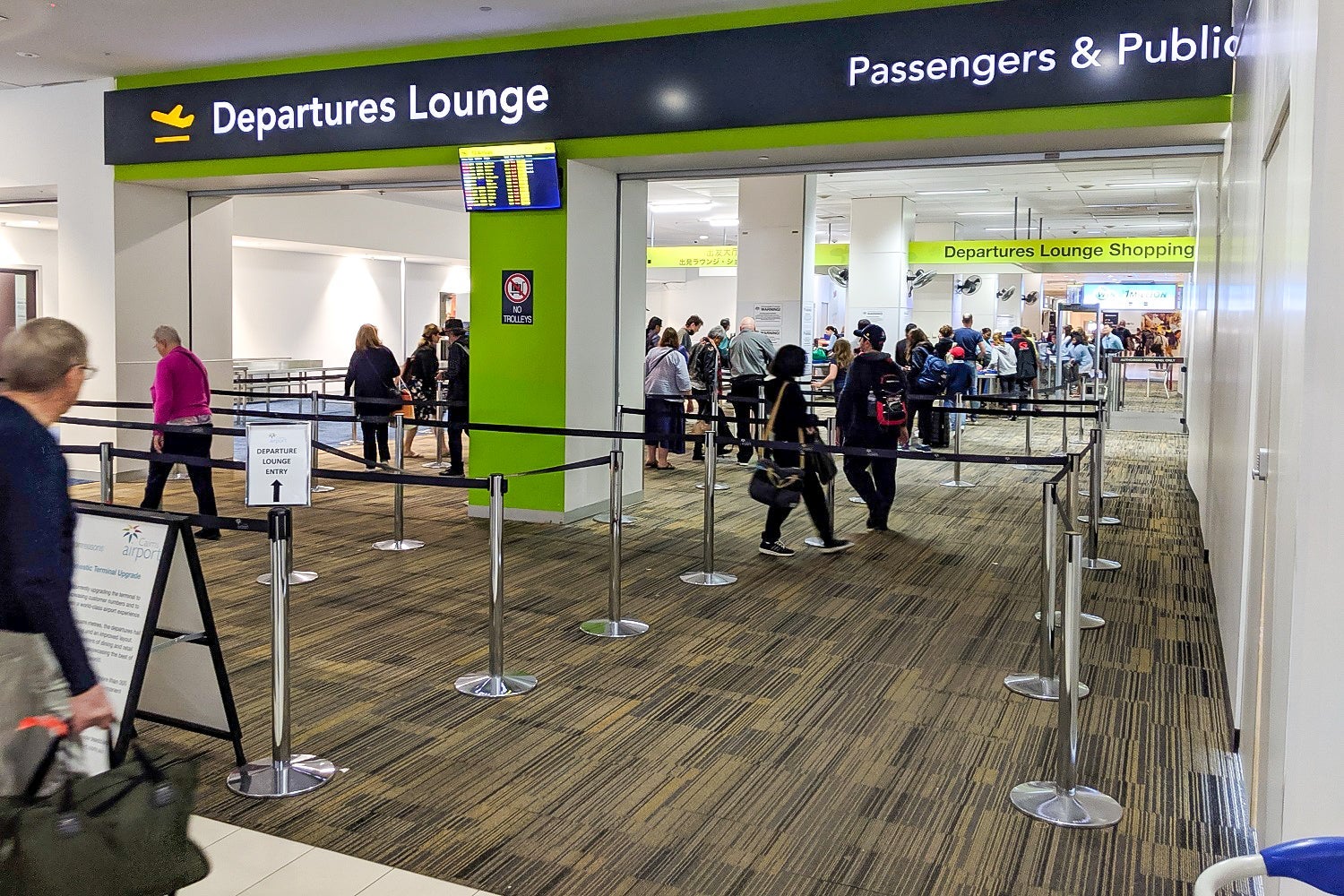
Domestic airport terminals in Australia are completely open to the public. As the security agent alluded to when I was unnecessarily going through security in Brisbane, that means that you can pass through security to meet a friend or family member at the gate -- just like you used to be able to do in the US before 9/11. This public access is even clearly stated at the entrance to security in Cairns:
While US airports are starting to open the airside to non-passengers again, there's only a couple airports that are doing this, and they require you to sign up ahead of time, be approved and get issued an airside pass. At Tampa International Airport, the airside pass is limited to Saturdays from 8am to 8pm, you can only visit one airside terminal and there's a limit of just 25 non-passengers per day per terminal. Due to these limits, the waiting list has quickly grown to months long.
None of that hassle is necessary in Australia. Non-passengers can just line up for security and go through with everyone else.
Bring All Your Liquids
This is something that I discovered the last time I was in Australia. As I was going through security checks in Sydney's domestic terminal, I realized that I still had water in my Nalgene bottle and quickly chugged it before sending my bag through security. The security agent looked at me like I had three heads. I didn't realize at the time, but soon learned, that passengers can take full-size liquids on-board with them.
In flights since, I've noticed that some passengers will separate their liquids into a separate bin for security. But that's not necessary. I was able to pass through security with a full half-liter bottle of liquid medicine and a full liter of water both in my bag.

Everyone is Quasi-PreCheck
In the US, PreCheck passengers can clear through a metal detector security with their (under three-ounce) liquids in their bag, shoes on and electronics kept in their bag. As we discussed, Australia is fine with everyone carrying liquids through security. In addition that, everyone can keep their shoes on and there's only a metal detector screening. So, everyone is pretty much treated like a US PreCheck passenger. The one difference: everyone needs to remove their laptops.
RELATED: The Top Credit Cards for Global Entry and TSA PreCheck
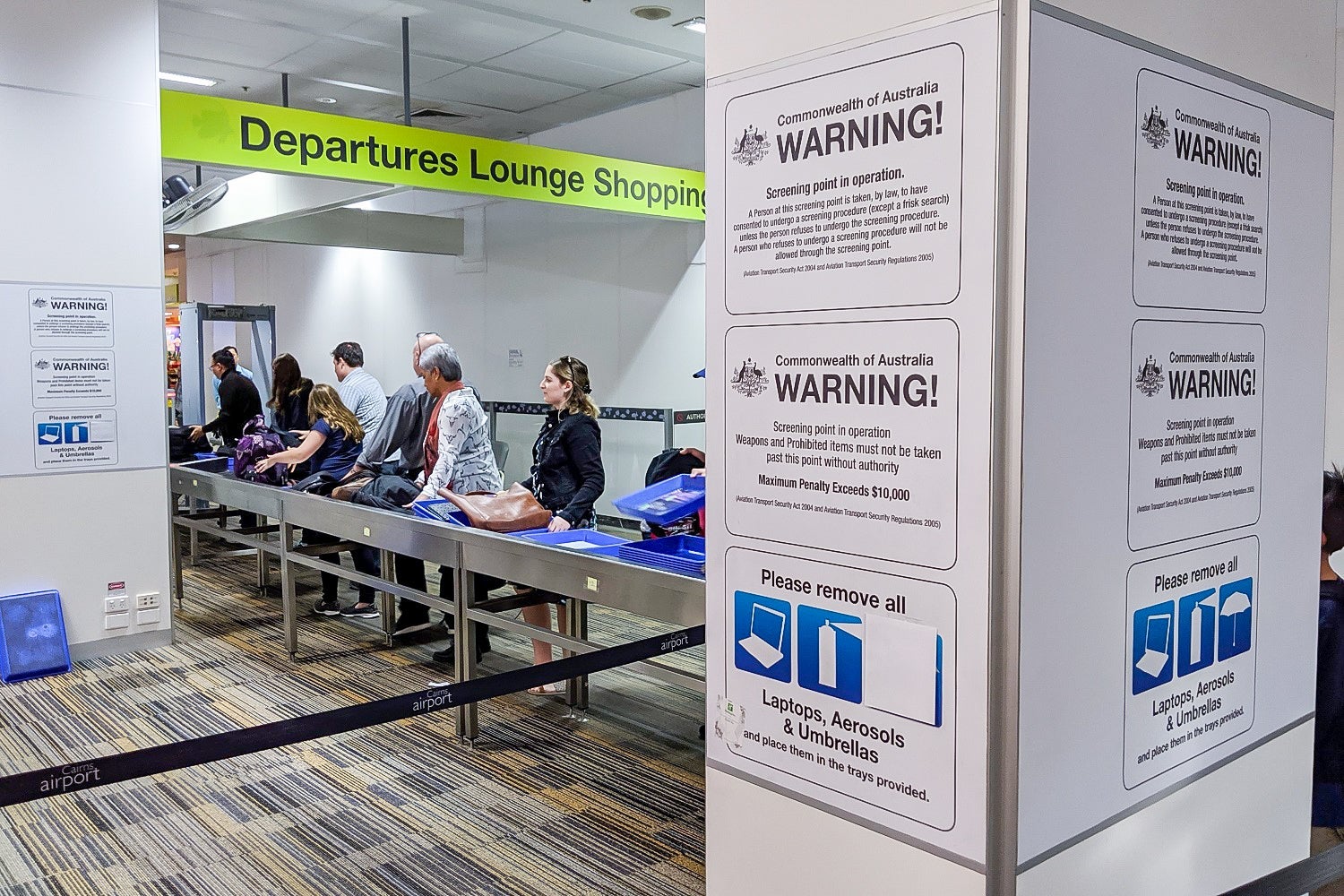
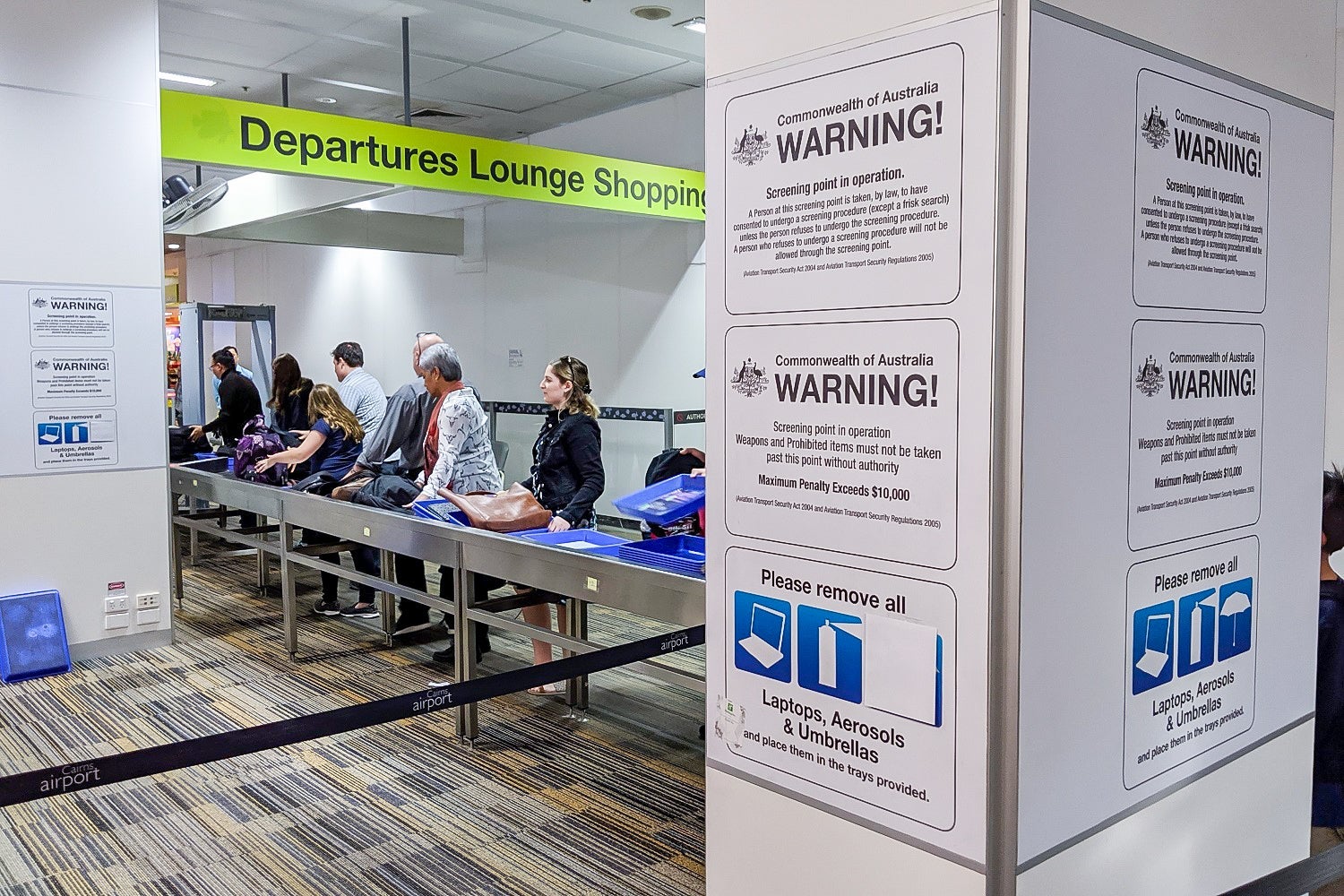
Per a sign in Cairns, aerosols also need to be removed from your bag. However, the jury is still out on umbrellas:
There May Be no ID Checks
In each of our four domestic Qantas segments this trip, we didn't need to show our identification a single time. For three of the four flights, we used a Qantas kiosk to check in, collect our boarding passes and an automated system to check our bags. Not once in the process did we need to present our ID. When we checked in for our flight in Cairns with an agent, we figured that we'd be asked for ID. Instead, we were just asked for our "family name." (To be sure, you may be asked for ID for doomestic flights at Australian airports, but it never happened to us. Of course, for flying internationally you will need a passport.)
Since there's no boarding pass check at security, there's no identification check there either. Finally, at the boarding door, the gate agents are only concerned that you have a valid boarding pass for this flight. Throughout the whole process, we weren't asked for our identification once.
Great Use of Miles
While we're focusing on the security aspect in this piece, we'd be remiss if we didn't share how we flew Qantas domestically: American Airlines miles. If you can find award availability, flights anywhere in Australia cost 10,000 miles in economy or 20,000 miles in business class.
That's for everything from short hops between Sydney and Melbourne or Brisbane to 5-hour transcontinental flights between Sydney and Perth. The latter of these is operated using Airbus A330 with lie-flat seating in business class.
Even better, you can maximize the British Airways award chart for short hops between Sydney and Brisbane or Melbourne for just 6,000 Avios in economy or 12,500 in business class. Or, you can fly between Brisbane and Melbourne or Cairns for 9,000 Avios in economy or 16,500 Avios in business class.
While the cash rates in economy on many domestic routes are reasonable -- especially on low-cost carriers like Jetstar or Tigerair -- we used our miles since our AA elite status allowed us access into the excellent Qantas lounges and have flexibility if we wanted to change up our plans. That said, make sure to check cash prices before redeeming for economy flights to make sure you're getting the best use out of your miles.
All photos by the author.
TPG featured card

at Capital One's secure site
Terms & restrictions apply. See rates & fees.
| 5X miles | Earn 5X miles on hotels, vacation rentals and rental cars booked through Capital One Travel |
| 2X miles | Earn unlimited 2X miles on every purchase, every day |
Pros
- Stellar welcome offer of 75,000 miles after spending $4,000 on purchases in the first three months from account opening. Plus, a $250 Capital One Travel credit to use in your first cardholder year upon account opening.
- You'll earn 2 miles per dollar on every purchase, which means you won't have to worry about memorizing bonus categories
- Rewards are versatile and can be redeemed for a statement credit or transferred to Capital One’s transfer partners
Cons
- Highest bonus-earning categories only on travel booked via Capital One Travel
- LIMITED-TIME OFFER: Enjoy $250 to use on Capital One Travel in your first cardholder year, plus earn 75,000 bonus miles once you spend $4,000 on purchases within the first 3 months from account opening - that’s equal to $1,000 in travel
- Earn unlimited 2X miles on every purchase, every day
- Earn 5X miles on hotels, vacation rentals and rental cars booked through Capital One Travel
- Miles won't expire for the life of the account and there's no limit to how many you can earn
- Receive up to a $120 credit for Global Entry or TSA PreCheck®
- Use your miles to get reimbursed for any travel purchase—or redeem by booking a trip through Capital One Travel
- Enjoy a $50 experience credit and other premium benefits with every hotel and vacation rental booked from the Lifestyle Collection
- Transfer your miles to your choice of 15+ travel loyalty programs
- Top rated mobile app