Are Fuel Surcharges Legal? A Consumer Advocate Weighs In.

Alongside devaluations, Fuel surcharges are the bane of all award travel enthusiasts, and as someone who has made a career out of being a savvy award traveler, there's little that irks me more than when airlines nickel and dime customers by imposing these bogus (and sometimes deceptive) charges. Today TPG Contributor Jason Steele discusses the legality (or illegality) of fuel surcharges, and how flyers can help keep these extra costs in check.
As award travelers, we'd love to use our points and miles to travel completely free, but most of us accept having to pay the taxes and fees that must be passed along to government entities, since those charges are levied equally against both paid and award tickets. However, there's a big difference between these mandatory fees and the so-called fuel surcharges that many carriers impose on award reservations, which are really just funds that the airlines pocket.
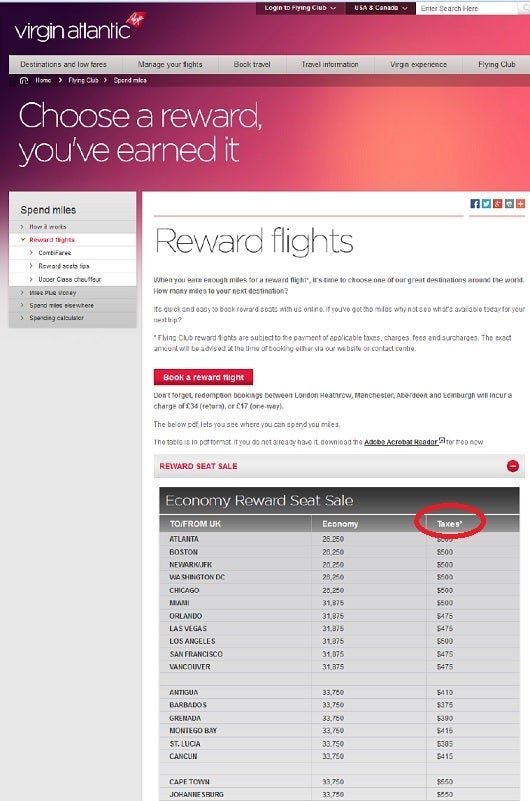
Even worse is when carriers attempt to lump these funds together with the taxes that they must collect and remit, deceptively labeling the whole amount "taxes." For example, while researching a post on How to Find Award Chart Sweet Spots, I realized that the Virgin Atlantic award chart showed a column labeled "Taxes*" for each city it serves. Not only were the amounts greater than even the hefty taxes that Great Britain imposes on airline travel, but also they varied from city to city, even within the same country. (The text the asterisk refers to only explained the terms of the reduced mileage promotion, not that the carrier includes its own surcharges within this amount).
Complaining to the DOT
Clearly, Virgin Atlantic was willing to have customers believe that the fuel surcharges it chooses to impose and profit from are actually just "taxes" that the government collects, and that those charges were outside of the airline's control. I brought this to the attention of attorney and consumer advocate Ben Edelman, who is an associate professor at the Harvard Business School.
Realizing that these misrepresentations of airline charges are not just unfair, but also a violation the of law, Edelman has made it his personal mission as a consumer advocate to call out carriers on these practices by reporting them to the Department of Transportation (DOT). After I contacted him, Edelman was able to quickly file a complaint with the DOT.
According to Edelman's site, "Beginning on January 26, 2012, new DOT rules (14 CFR 399.84(a)) require that the first price advertised for air travel must include all taxes, government-imposed fees, and mandatory airline- and ticket agent-imposed fees. An advertised price may include an itemization of taxes, government-imposed fees, and carrier-imposed fees, but these descriptions cannot be false or misleading. If a carrier elects to separate carrier-imposed fees from the base fare, the DOT requires that such fees must accurately represent the actual cost of the item for which the cost is accessed, and the carrier must substantiate the fee with a brief description."
How it all started
I recently had a chance to speak with Edelman and learn more about this issue. It turns out that he's a frequent business traveler himself, and has filed several similar complaints over the last three years. It all started when he realized that American Airlines had been lying to him about fees that the airline consistently referred to as taxes. This happened with taxes on round-the-world tickets and more, such as refunds and re-routings. He found that the misrepresentation was systematic, and was perpetrated by telephone customer service representatives, those who responded to emails, and those who composed the American Airlines website.

As an Executive Platinum member in the AAdvantage frequent flyer program, he wrote a letter to the then general counsel outlining the issue and requesting a refund of the fees mislabeled as taxes. In response, he received what he describes as a very lawyerly letter, leading him to file a complaint with the DOT, which ultimately resulted in American Airlines being fined $60,000 last year.
In his most recent complaint against Virgin Atlantic, the airline's official response alleges among other things, that "Mr. Edelman has developed a cottage industry of trolling carrier websites in search of the slightest error in any display, often seeking remedies which he knows are beyond the Department's authority to order." But Edelman denies ever receiving a dime of compensation for any of the DOT complaints he has filed against various airlines, and he never received any portion of the DOT fine issued against American Airlines in the original case.
As to the substance of Virgin's response claiming that their violations were "minor" and "inadvertent," Edelman didn't consider a few hundred dollars to be minor, and the defense that the violation was inadvertent is not much of a defense at all.

Why this matters
According to Edelman, filing these complaints is a way of gauging the DOTs willingness to enforce regulations prohibiting unfair and deceptive trade practices. Edelman pointed out, "If this clear-cut statement, indisputably literally false, made uniformly to all passengers, isn't unfair and deceptive… then good luck to anyone with a more subtle allegation of violation."
There's also no doubt that government fines (like the DOT's $60,000 fine against American) are meant to send a clear signal to other airlines that there are consequences for deceiving customers.
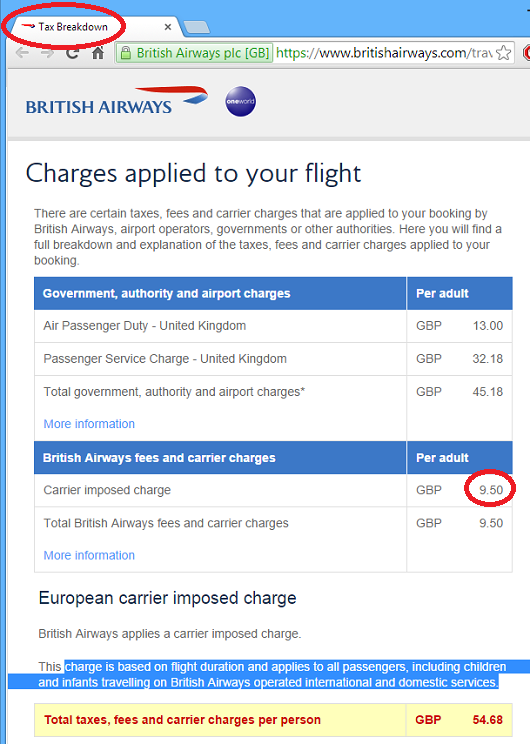
Other problems with fuel surcharges include the fact that they don't represent any genuine recent increase in the cost of fuel. Edelman has documented cases where British Airways - perhaps the carrier that imposes the highest fuel surcharges - lists fuel as being 70% of the cost of the fare. In response, airlines such as BA have started referring to their fuel surcharges as "carrier imposed charges," which it now describes in most places as a charge "based on flight duration and applies to all passengers." Nevertheless, there are still other portions of its site that refer specifically to fuel surcharges.
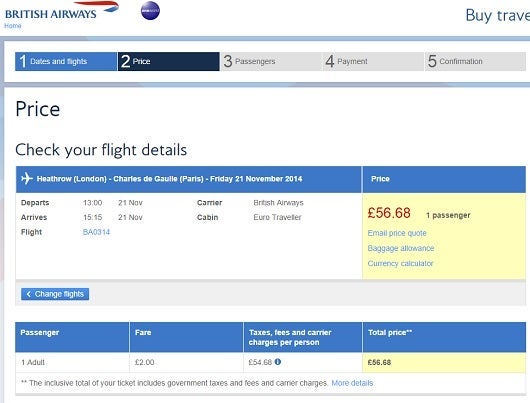
I found even more egregious surcharges on a BA flight to Paris, where the "Carrier imposed charge" is 475% of the base fare, so you can see how ridiculous this practice has become.
Here you can see the base fare of just 2 Pounds:
Clicking on "More details" reveals a "Carrier imposed charge" of 9.50 GBP on a page titled "Tax Breakdown":
Edelman also notes that airlines have been caught colluding on fuel surcharges, a practice that is strictly forbidden when it comes to setting base fares. He also points out that these surcharges cheat customers who have negotiated a discount on their fares, which is then only taken off of the base rate. Travel agents that are commissioned based on base fares are also harmed, not to mention frequent flyers who believe that the "award tickets" they earned are not just partially discounted fares.
Finally, Virgin Atlantic and other carriers have argued in response to Edelman's complaints that these mislabeled fuel surcharges do not cause any actual harm, since customers end up paying the advertised fare anyways. In response, Edelman contends that the general public is more likely to complain to their government if they are told that these exorbitant fuel surcharges and other airline fees are actually taxes.
In addition, there are cases like my summer trip to Italy, where I was rerouted from Iberia flights (for which my daughter and I paid $139 each in taxes and fuel surcharges) to ones operated by American Airlines that would have only incurred nominal TSA charges. American initially denied my request for a refund, and I only succeeded in securing it by emailing American Airlines CEO Doug Parker and threatening a DOT complaint.
Edelman suggests that travelers affected by deceptive practices should first submit a DOT complaint, so that others can benefit from regulatory decisions in their favor. He recommends that affected consumers click on the Docket pages on regulations.gov , and then click Comment Now to report their experiences and their views. "I believe DOT is interested in simple first-person explanations of what happened and how consumers found it deceptive or harmful – what consumers regretted buying, what extra costs consumers incurred, how they felt shortchanged or tricked. This need not be fancy or overly formal – just a simple narrative and explanation," said Edelman.
If you find other instances of airlines trying to pass off their own charges as "taxes," please contact Ben Edelman and let him know.
TPG featured card

at Capital One's secure site
Terms & restrictions apply. See rates & fees.
| 5X miles | Earn 5X miles on hotels, vacation rentals and rental cars booked through Capital One Travel |
| 2X miles | Earn unlimited 2X miles on every purchase, every day |
Pros
- Stellar welcome offer of 75,000 miles after spending $4,000 on purchases in the first three months from account opening. Plus, a $250 Capital One Travel credit to use in your first cardholder year upon account opening.
- You'll earn 2 miles per dollar on every purchase, which means you won't have to worry about memorizing bonus categories
- Rewards are versatile and can be redeemed for a statement credit or transferred to Capital One’s transfer partners
Cons
- Highest bonus-earning categories only on travel booked via Capital One Travel
- LIMITED-TIME OFFER: Enjoy $250 to use on Capital One Travel in your first cardholder year, plus earn 75,000 bonus miles once you spend $4,000 on purchases within the first 3 months from account opening - that’s equal to $1,000 in travel
- Earn unlimited 2X miles on every purchase, every day
- Earn 5X miles on hotels, vacation rentals and rental cars booked through Capital One Travel
- Miles won't expire for the life of the account and there's no limit to how many you can earn
- Receive up to a $120 credit for Global Entry or TSA PreCheck®
- Use your miles to get reimbursed for any travel purchase—or redeem by booking a trip through Capital One Travel
- Enjoy a $50 experience credit and other premium benefits with every hotel and vacation rental booked from the Lifestyle Collection
- Transfer your miles to your choice of 15+ travel loyalty programs
- Top rated mobile app