Are airlines and airports doing enough to accommodate travelers with disabilities?


Over the past two years, 25.6 million travelers with disabilities have taken a total of 76.9 million trips and have spent almost $50 billion on travel per year. When you add their travel companions to the equation, this group spends over $100 billion per year on travel.
This data comes from a 2024 market study from the Open Doors Organization, a Chicago-based group that advocates for accessible services and goods.
Despite all that traveling and spending, ODO's study found that in the past two years, more than 80% of travelers with disabilities have encountered obstacles when dealing with airlines and airports.
The problems include difficulty navigating narrow aircraft aisles, problems hearing announcements, long distances between gates, difficulty navigating terminals and lack of adequate seating areas.
And that doesn't even address the jarring statistics of how often airlines lose or damage medical equipment and wheelchairs.
It wasn't until December 2018 that the U.S. Department of Transportation began requiring airlines to report the total number of enplaned scooters and wheelchairs as well as the total number of scooters and wheelchairs mishandled.
Now, the DOT's data shows that for every 100 wheelchairs or scooters transported on domestic flights, at least one is damaged, delayed or lost.
In October 2024, the DOT announced a $50 million fine against American Airlines for mishandling thousands of wheelchairs and failing to offer prompt wheelchair assistance — along with various other "serious violations" documented between 2019 and 2023.
"These problems are not unique to American Airlines," the DOT said in a statement. It noted that it currently has "active investigations" into similar violations at other U.S. airlines.

Marcela Marañon — a Dallas-based travel creator, accessibility advocate and wheelchair user who documents her travels as the Journey of a Brave Woman — is familiar with many of the documented problems for travelers who use wheelchairs.
"Airline wheelchair assistance personnel and even some flight attendants aren't properly trained in handling people with disabilities," she said. "And most airplane cabins are not designed with wheelchair accessibility in mind. Aisles are narrow, lavatories are difficult to access, and travelers must be transferred to an aisle chair to board and disembark, which can be risky and uncomfortable."
Federal changes
New federal rules, evolving airline programs and innovative technology may bring improvements. So far this year, federal rules were set to go into effect that offer new protections for air travelers who use wheelchairs, though it remains to be seen whether the government continues this push under the incoming Trump administration.
This change sets standards for assistance and requires hands-on training for airline employees as well as any contractors who physically assist passengers with disabilities and handle passengers' wheelchairs.
For example, the rule requires that airlines provide "prompt enplaning, deplaning, and connecting assistance" and return all checked wheelchairs and other assistive devices to passengers "in the condition in which they are received."
Airlines must also notify passengers — before they deplane — whether their wheelchair or scooter has been unloaded from the cargo compartment; they must provide appropriate loaner equipment if a wheelchair or scooter is mishandled.
Airport- and airline-specific changes
On their own, airlines and airports have been making progress in serving passengers with a wide range of disabilities.
Fort Wayne International Airport (FWA) in Indiana is working on becoming the most accessible airport. It incorporates universally "rolled" curbs to floor-level baggage scales, couches without armrests to better accommodate travelers with mobility issues, and a tactile cane trail with ribbed tiles that runs from the check-in counters through the security checkpoint to the gates.
In France and 20 other countries, Air France offers a "bespoke" program called Saphir to provide assistance to travelers with disabilities.
In 2023, United Airlines became the first airline to add Braille markings on aircraft rows and inside lavatories. The full mainline fleet should have Braille signage by 2026.
More than three dozen domestic airports offer sensory rooms where neurodivergent travelers and their families will find furnishings, interactive activities and, in some cases, real airplane cabin seats that can help alleviate preflight anxiety.
And the list keeps growing. George Bush Intercontinental Airport (IAH) in Houston opened its second sensory area in early November 2024, and San Francisco International Airport (SFO) opened its first sensory room in mid-December.
Airports are also adding hearing loops that allow travelers with hearing disabilities to connect their hearing aids to an airport public address system. This helps them better hear announcements for gate changes, boarding and other flight information.
Many airports also offer access to Aira — an app that provides people who are blind or have low vision with a live visual interpreter to help them navigate their surroundings — for free.
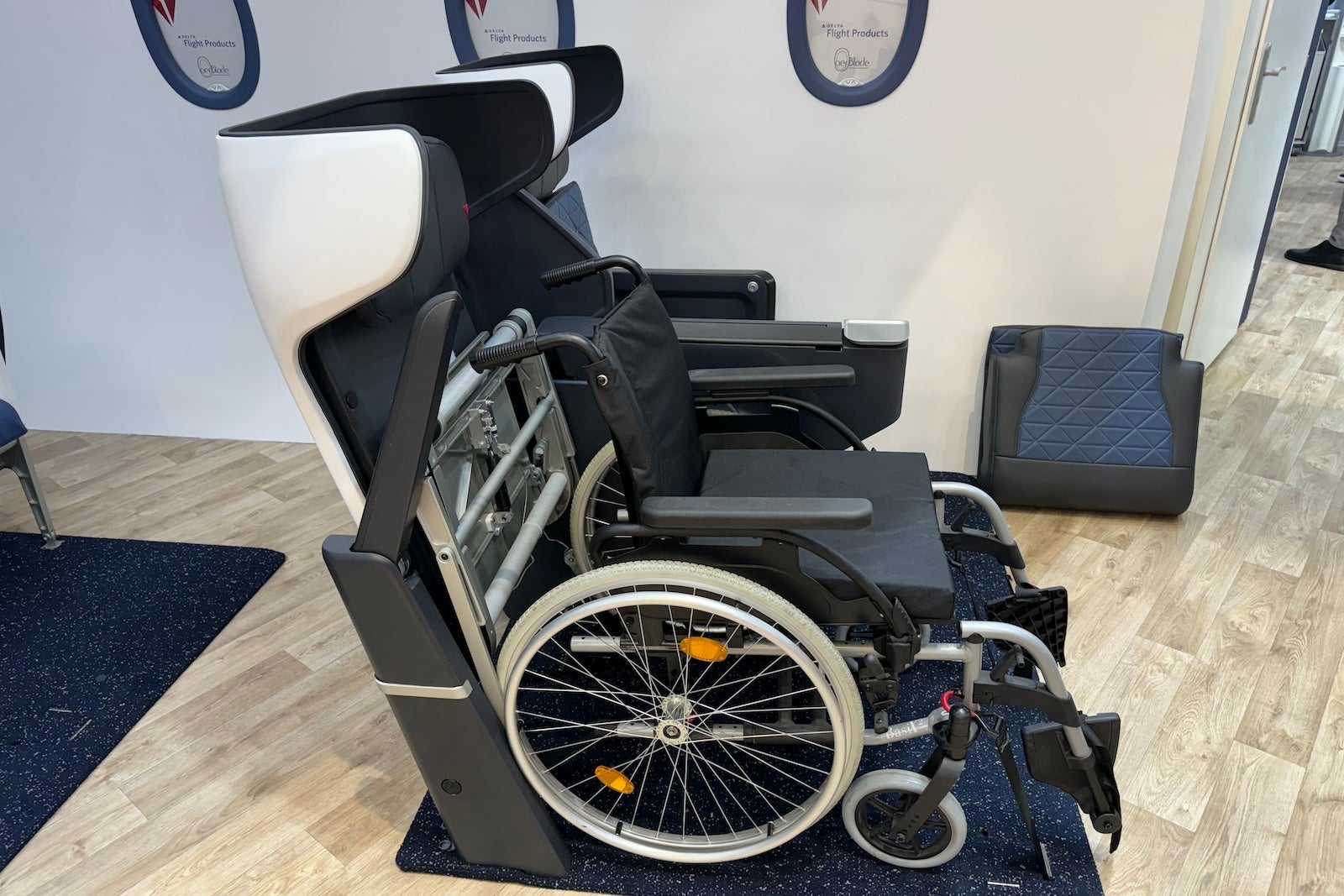
Delta Air Lines' Flight Product division is working on a prototype for seating that will allow passengers to use their own wheelchairs on a plane.
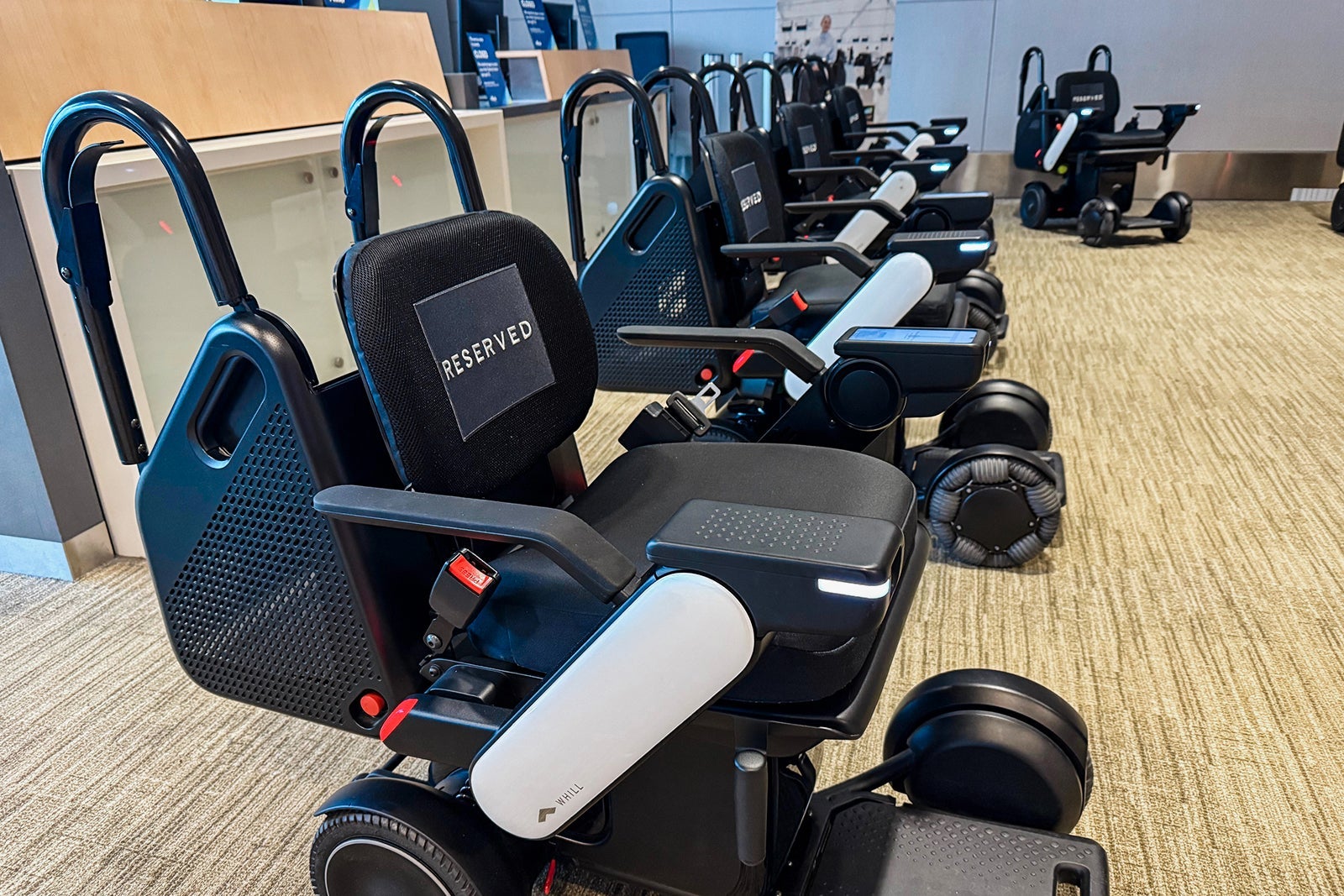
American Airlines and its subsidiary Envoy Air currently offer travelers the use of autonomous, self-driving wheelchairs from Whill at a growing list of international and domestic airports; the list includes Tokyo's Haneda Airport (HND) and Narita International Airport (NRT), Miami International Airport (MIA), and Los Angeles International Airport (LAX).
Amsterdam Airport Schiphol (AMS) is currently testing the wheelchairs, and Seattle-Tacoma International Airport (SEA) is using them to supplement Alaska Airlines' traditional, nonmotorized "pusher" wheelchair service.
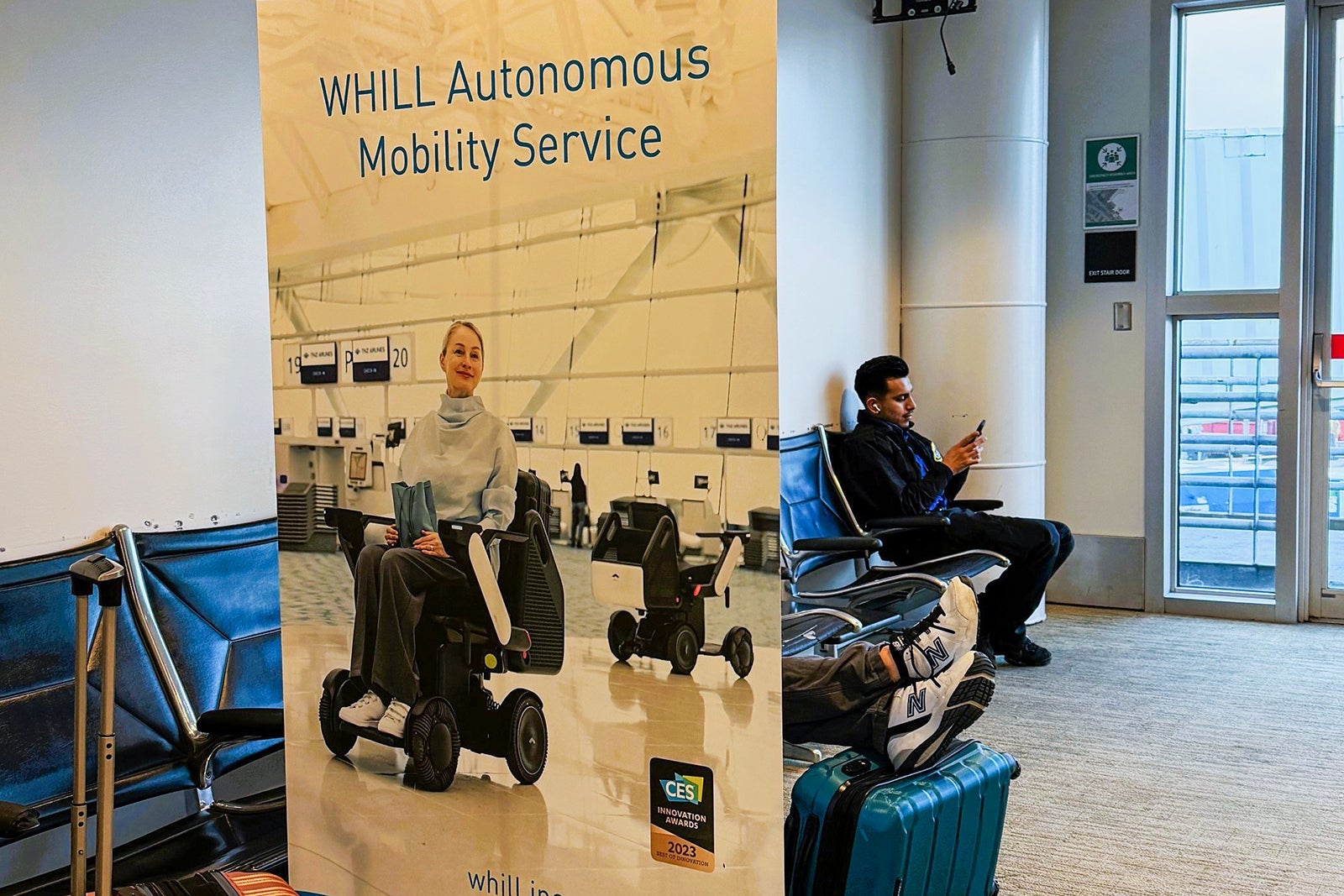
Since August, more than 4,200 passengers at SEA have used autonomous wheelchairs, which drive themselves back to the base after delivering passengers to their gates.
Marañon said these and other programs offered by airlines and airports show progress, but "many aspects of air travel remain problematic for people with disabilities."
She noted that Delta Air Lines has improved its staff training on handling mobility equipment and that many airports have made "commendable" progress in addressing accessibility needs. Still, she'd like to see airlines and airports better address ongoing damage to mobility devices, staff training, aircraft design, policies for service animals "and so much more."
Globally, air travel accessibility is getting attention as well. It was recently the topic of a symposium held by the International Civil Aviation Organization, Airports Council International and the International Air Transport Association.
"It is no secret that accessibility poses challenges for a significant number of our passengers who have disabilities," IATA's Director General Willie Walsh said in a statement. "Linking disparate approaches into a practical global outcome that will deliver for travelers without disappointment is the goal."
Related reading:
TPG featured card

at American Express's secure site
Terms & restrictions apply. See rates & fees.
| 3X | Earn 3X Miles on Delta purchases. |
| 1X | Earn 1X Miles on all other eligible purchases. |
Pros
- Delta SkyClub access when flying Delta
- Annual companion ticket for travel on Delta (upon renewal)
- Ability to earn MQDs through spending
- Various statement credits for eligible purchases
Cons
- Steep annual fee of $650
- Other Delta cobranded cards offer superior earning categories
- Earn 100,000 Bonus Miles after you spend $6,000 or more in purchases with your new Card within the first 6 months of Card Membership and an additional 25,000 bonus miles after you make an additional $3,000 in purchases on the Card within your first 6 months, starting from the date that your account is opened. Offer Ends 04/01/2026.
- Delta SkyMiles® Reserve American Express Card Members receive 15 Visits per Medallion® Year to the Delta Sky Club® when flying Delta and can unlock an unlimited number of Visits after spending $75,000 in purchases on your Card in a calendar year. Plus, you’ll receive four One-Time Guest Passes each Medallion Year so you can share the experience with family and friends when traveling Delta together.
- Enjoy complimentary access to The Centurion® Lounge in the U.S. and select international locations (as set forth on the Centurion Lounge Website), Sidecar by The Centurion® Lounge in the U.S. (see the Centurion Lounge Website for more information on Sidecar by The Centurion® Lounge availability), and Escape Lounges when flying on a Delta flight booked with the Delta SkyMiles® Reserve American Express Card. § To access Sidecar by The Centurion® Lounge, Card Members must arrive within 90 minutes of their departing flight (including layovers). To access The Centurion® Lounge, Card Members must arrive within 3 hours of their departing flight. Effective July 8, 2026, during a layover, Card Members must arrive within 5 hours of the connecting flight.
- Receive $2,500 Medallion® Qualification Dollars with MQD Headstart each Medallion Qualification Year and earn $1 MQD for each $10 in purchases on your Delta SkyMiles® Reserve American Express Card with MQD Boost to get closer to Status next Medallion Year.
- Enjoy a Companion Certificate on a Delta First, Delta Comfort, or Delta Main round-trip flight to select destinations each year after renewal of your Card. The Companion Certificate requires payment of government-imposed taxes and fees of between $22 and $250 (for itineraries with up to four flight segments). Baggage charges and other restrictions apply. Delta Basic experiences are not eligible for this benefit.
- $240 Resy Credit: When you use your Delta SkyMiles® Reserve American Express Card for eligible purchases with U.S. Resy restaurants, you can earn up to $20 each month in statement credits. Enrollment required.
- $120 Rideshare Credit: Earn up to $10 back in statement credits each month after you use your Delta SkyMiles® Reserve American Express Card to pay for U.S. rideshare purchases with select providers. Enrollment required.
- Delta SkyMiles® Reserve American Express Card Members get 15% off when using miles to book Award Travel on Delta flights through delta.com and the Fly Delta app. Discount not applicable to partner-operated flights or to taxes and fees.
- With your Delta SkyMiles® Reserve American Express Card, receive upgrade priority over others with the same Medallion tier, product and fare experience purchased, and Million Miler milestone when you fly with Delta.
- Earn 3X Miles on Delta purchases and earn 1X Miles on all other eligible purchases.
- No Foreign Transaction Fees. Enjoy international travel without additional fees on purchases made abroad.
- $650 Annual Fee.
- Apply with confidence. Know if you're approved for a Card with no impact to your credit score. If you're approved and you choose to accept this Card, your credit score may be impacted.
- Terms Apply.
- See Rates & Fees