JT is a location-independent digital nomad traveling 250,000+ miles each year with his wife Katie.
November 25, 2019 • 18 min read
The cards we feature here are from partners who compensate us when you are approved through our site, and this may impact how or where these products appear. We don't cover all available credit cards, but our analysis, reviews, and opinions are entirely from our editorial team. Terms apply to the offers listed on this page. Please view our advertising policy and product review methodology for more information.Editorial disclaimer: Opinions expressed here are the author's alone, not those of any bank, credit card issuer, airline or hotel chain, and have not been reviewed, approved or otherwise endorsed by any of these entities.
Comments
By commenting, you agree to our Community Guidelines to help create a positive space for conversation. The responses below are not provided or commissioned by the bank advertiser, our partners, or The Points Guy (“TPG”). They have not been reviewed, approved, or otherwise endorsed by any of these parties. All responses are submitted by individual contributors, and neither the bank advertiser, our partners, nor TPG are responsible for ensuring that all posts and/or questions are answered.
Related stories
Quick summary
American Airlines uses Elite Qualifying Dollars (EQD) as a key metric for elite status qualification, upgrade priority and award mileage calculation.
EQDs are earned based on the amount paid for AA-marketed flights, excluding government-imposed taxes and fees, while partner flights use distance and fare class for EQD calculation.
Upgrade priority now favors higher-spending travelers within each elite tier, making EQD a crucial tiebreaker for upgrades.
EQD earning rates vary significantly by fare class and airline, with premium economy often providing strong value compared to business or first class on partner airlines.
What to consider
EQD requirements must be met in addition to mileage or segment thresholds for elite status; there are no waivers for this requirement.
Certain fare classes on partner airlines earn no EQDs, and EQD earning rates can differ widely between airlines and fare types.
Some credit cards offer a way to earn additional EQDs through spending, which can help bridge gaps for elite status qualification.
What you'll miss from the article
Detailed charts and examples showing how to maximize EQD earnings across different airlines, fare classes and booking methods.
Generated by AI with support from our editorial team.
Update: Some offers mentioned below are no longer available. View the current offers here.
As part of its transition to a revenue-based program in August 2016, American Airlines introduced a new metric: Elite Qualifying Dollars (EQD). This measurement for spending is now important for three reasons: elite status, upgrade priority and award mileage earnings on American Airlines-marketed flights.
But, as with AA's Elite Qualifying Miles (EQM), EQDs aren't as straightforward as you might assume. Although you might expect to earn 600 EQD from spending $600 on a flight, you'll almost certainly earn less. Or — if the flight is booked through a partner — you might earn more than 600 EQD.
Let's dive into the wacky world of American Airlines Elite Qualifying Dollars (EQD):
How many EQDs are needed for elite status?
American Airlines flyers have two ways of qualifying for elite status: by earning enough EQM or enough Elite Qualifying Segments (EQS). However, in addition to getting enough EQM or EQS, you're going to have to earn enough EQD. There's no waiver or way to get around this requirement.
To earn status in 2019 and beyond, you'll need to meet the following requirements:
Elite status level
Elite Qualifying Dollars (EQD)
Elite Qualifying Miles (EQM)
Elite Qualifying Segments (EQS)
AAdvantage Gold
3,000
and
25,000
or
30
AAdvantage Platinum
6,000
and
50,000
or
60
AAdvantage Platinum Pro
9,000
and
75,000
or
90
AAdvantage Executive Platinum
15,000
and
100,000
or
120
How EQDs factor into upgrade priority
In the past, American Airlines used to prioritize upgrades on a first-request basis. After grouping requests by elite status, the upgrade would be granted to the first traveler who requested the upgrade. This was great for travelers who booked flights in advance but was a bane for business travelers who often were paying significantly more for their last-minute flights.
Although EQD may seem further down the list at first glance, it's often the primary tiebreaker. As it's very rare that two elites at the same level and using the same type of upgrade would have the same 12-month rolling EQD, the last two tiebreakers rarely factor into the decision. That means upgrade requests are effectively sorted as follows with EQD being the tiebreaker within each group:
Status Level
Type of Ticket
Concierge Key
Systemwide and mileage award upgrades
Concierge Key
500-mile upgrades on purchased tickets
Concierge Key
500-mile upgrades on award tickets
Executive Platinum
Systemwide and mileage award upgrades
Executive Platinum
500-mile upgrades on purchased tickets
Executive Platinum
500-mile upgrades on award tickets
Platinum Pro
Systemwide and mileage award upgrades
Platinum Pro
500-mile upgrades on purchased tickets
Platinum
Systemwide and mileage award upgrades
Platinum
500-mile upgrades on purchased tickets
Gold
Systemwide and mileage award upgrades
Gold
500-mile upgrades on purchased tickets
Put another way, you're going to need to be the highest-spending traveler at your elite level on the flight to get an upgrade. This works to incentivize frequent flyers to continue giving their business to AA even after reaching a particular elite status level.
AAdvantage award miles, EQM and EQD earnings are based on the airline "marketing" the flight. For domestic flights on AA, this isn't going to be complicated. If you're flying on an American Airlines-operated flight and booking through American Airlines, you're surely booking an AA flight number.
However, it gets more complicated when you consider international itineraries. American Airlines has codeshares on many Oneworld and non-alliance partners -- and vice versa. So, you're going to need to pay attention to the flight numbers when booking a flight.
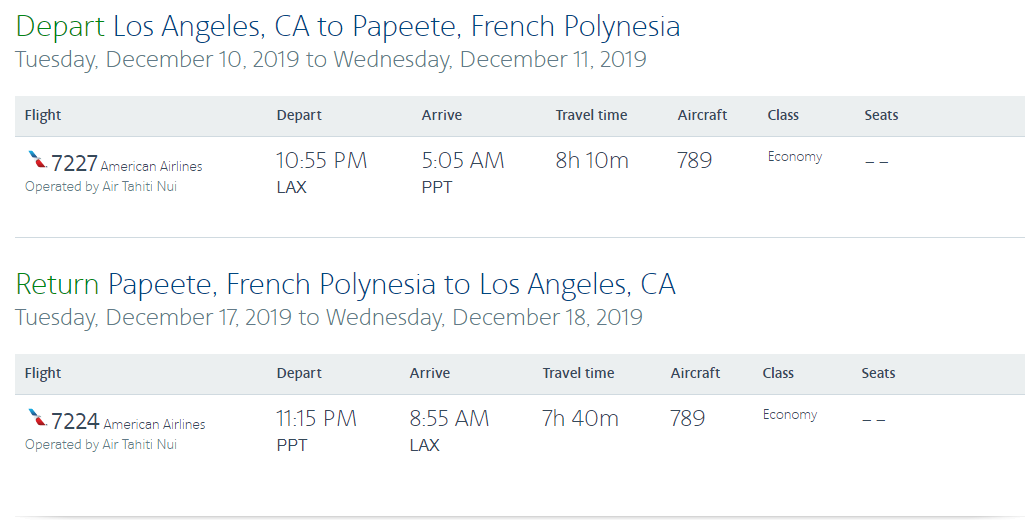
For example, while American Airlines doesn't operate flights to Tahiti, you can book American Airlines flight 7227 from Los Angeles (LAX) to Papeete (PPT) — which is a flight operated by Air Tahiti Nui.
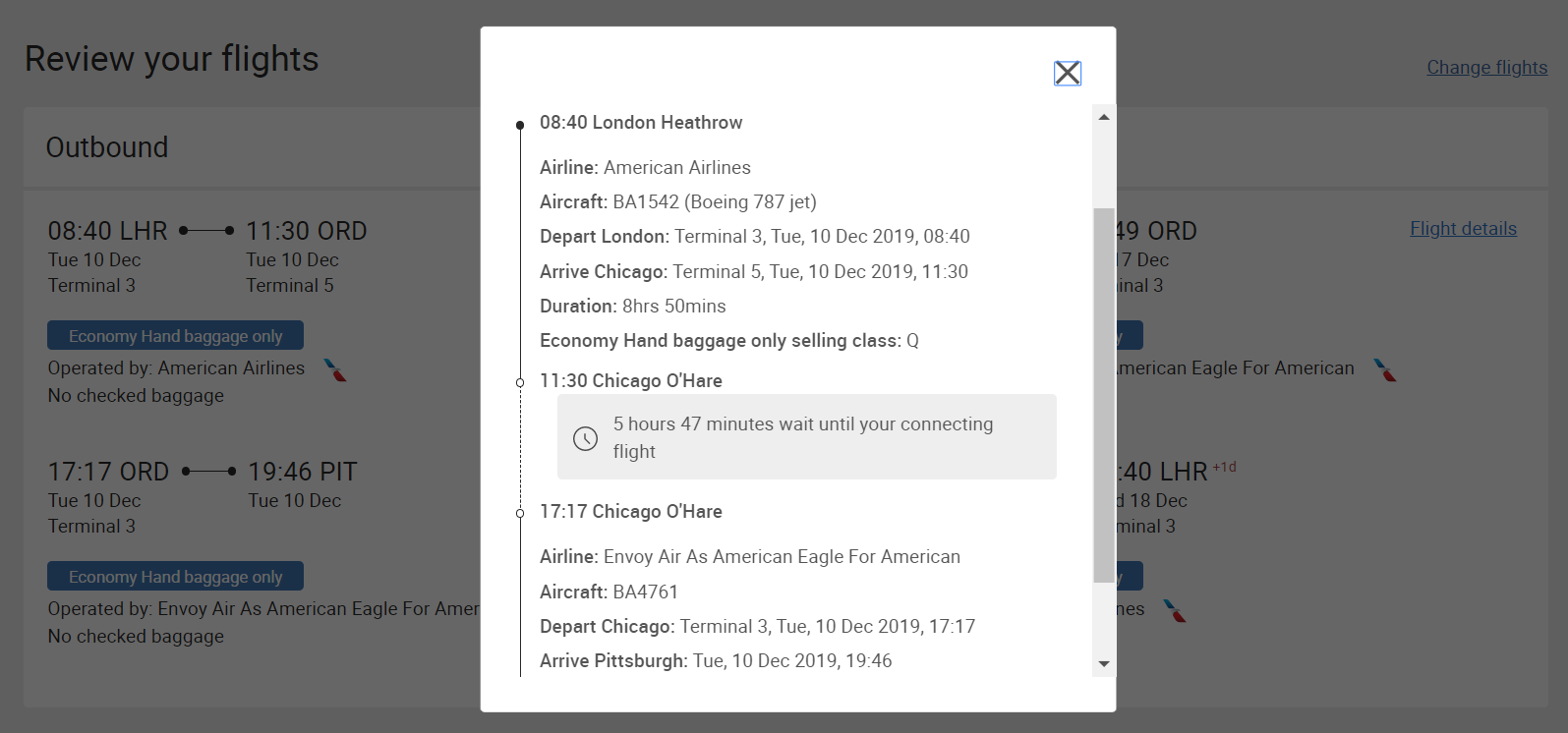
Similarly, you can fly between Chicago O'Hare (ORD) and Pittsburgh (PIT) on British Airways flight 4761 — which is a flight operated by American Airlines.
When it comes to AAdvantage award mileage, EQM and EQD earnings, the most important aspect is the airline in the flight number. This is referred to as the airline "marketing" the flight, and it can differ from the airline operating the flight or the airline that sold you the ticket.
In the first example, you'd earn miles based on the American Airlines earning scheme despite flying on Air Tahiti Nui as the booking has AA flight numbers. However, in the second example, your mileage earnings are based on the British Airways partner chart since you booked with BA flight numbers — despite flying American Airlines aircraft the entire way from London to Pittsburgh.
Earning EQD and award miles from flying American Airlines
When it comes to AA-marketed flights, you're going to earn Elite Qualifying Dollars (EQD) based on the amount you pay for the flight — excluding government-imposed taxes and fees.
No other spending on American Airlines counts toward EQDs. That means that checked baggage fees, seat selection fees, mileage upgrade copays, pet fees, lounge memberships or anything else you might pay the airline isn't going to help you toward elite status or award mileage earnings.
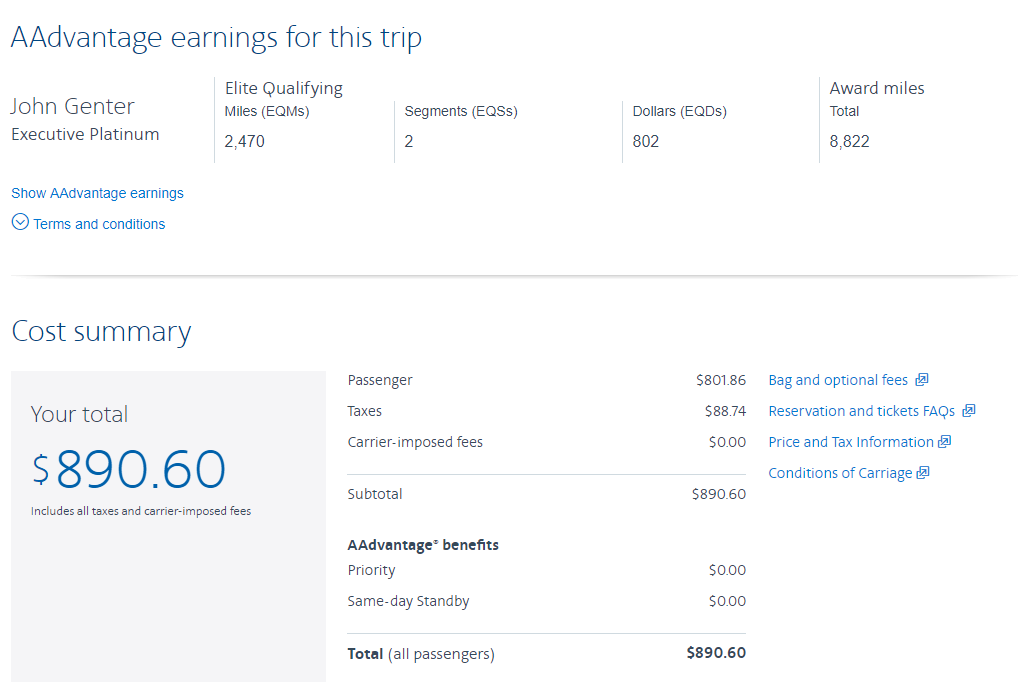
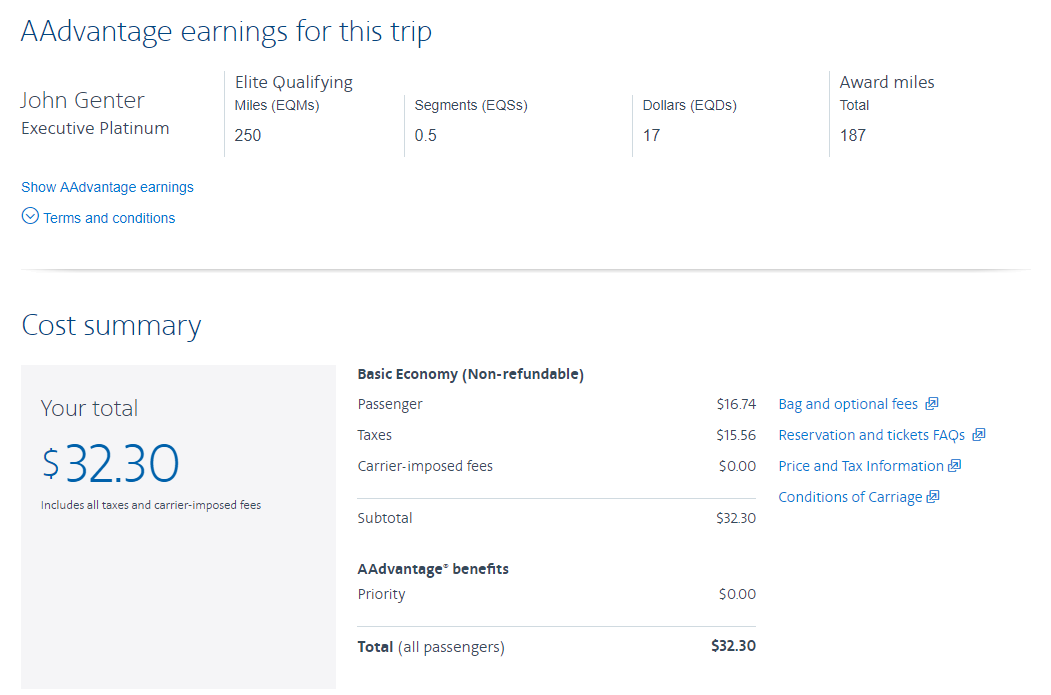
If you book an American Airlines-marketed flight through AA's website, you won't need to do any math; AA will tell you how many EQM, EQS and EQD will be earned from the trip on the review and payment page:
Unlike with EQM earnings, it doesn't matter what cabin you fly. The only thing that matters is the actual cost. That means that you could potentially earn more EQDs from a basic economy fare than a business class ticket.
Also, unlike AA's policy that all flights earn a base of 500 EQM, there's no minimum amount of EQD that you can earn from a flight. For example, I found this basic economy flight from Las Vegas (LAS) to Phoenix (PHX) for $33 that earns just 17 EQD after you exclude taxes:
Between the exclusion of government taxes and these additional fees, travelers who exclusively book American Airlines-marketed flights are going to end up spending well over $15,000 with American Airlines to earn the 15,000 EQD required to get top-tier Executive Platinum elite status.
In addition to helping you toward elite status and upgrades, EQDs are important to all AA flyers as it's the metric used to calculate how many award miles you'll earn from an AA-marketed flight. To figure out how many award miles you'll earn, EQDs are multiplied by a different earning rate based on the traveler's elite status:
Earning Elite Qualifying Dollars from partner airlines
While earning EQD on American Airlines is based on how much you spend, earning EQDs on partners is solely based on how far you fly and the relevant EQD earning rate for the airline fare class you booked into.
The good news is that you'll earn EQDs on most Oneworld partner tickets. However, there's a different award chart for each partner airline and the EQD earning rates can get complicated. As of publishing, you can earn American Airlines EQD on the following Oneworld partner airlines:
American Airlines has several non-alliance partners on which you can earn AAdvantage award miles: China Southern Airlines, Etihad Airways, Fiji Airways and Hawaiian Airlines. However, you won't earn any EQDs on any of AA's non-alliance partners unless you book the flight with an American Airlines flight number.
Economy fares
If you're looking for EQM and EQD earnings, there are several partner economy fare classes that you'll want to avoid. The following partner fare classes earn zero EQDs -- no matter the distance of the flight:
Cathay Pacific: K, M, L, V, Q, S, G, N
Malaysia Airlines: N, O, Q
Royal Jordanian: N, O, G
S7 Airlines: P, W, G, Z
Sri Lankan Airlines: G
Except for the fares listed above, all other Oneworld economy booking classes are going to earn at least 5% of the flight miles as EQDs.
For example, a cheap deal on Iberia is likely to book into either fare class O or Q. Flights between New York-JFK and Madrid (MAD) are 3,589 miles each way. That means a round-trip is going to earn 359 EQDs (3,589 miles each way x 2 ways x 5% earning rate).
If you booked a cheap flight, it's likely that you booked into one of these fare classes — which almost all earn 5% EQDs:
Airline
Purchased fares booked in
EQDs per mile flown
British Airways
G, O, Q
5%
Finnair
A, G, N, O, Q, R, S, W, Z
5%
Iberia
O, Q
5%
Japan Airlines
(international flights)
N, Q
6%
LATAM
S, N, Q, O, G, A
5%
Qantas (other)
N, G, O, Q
and S on non-U.S. flights
5%
Qatar
G, N, S, Q, O, T, W
5%
For travelers who end up having to pay extraordinarily high fares for full-fare economy (fare classes Y and sometimes B), the good news is that you'll earn 20% of the flight miles as EQD:
Airline
Purchased fares booked in
EQDs per mile flown
British Airways, Finnair, Iberia, Japan Airlines (international), Malaysia Airlines, Qantas, S7 Airlines
Y, B
20%
Cathay Pacific, Japan Airlines (domestic), LATAM, Qatar, Royal Jordanian, Sri Lankan
Y
20%
For the other fare codes between the "deep discount" and full-fare classes, earn rates range between 5% and 15% of flight miles as EQD.
Premium economy fares
The real sweet spot in the partner EQD earning chart is in premium economy. All Oneworld partner premium economy tickets earn at least 20% of flight miles as EQD. While LATAM premium economy "W" fares earn 25% of miles as EQD, all other Oneworld partner fares earn either 20% or 22%:
Airline
Purchased fares booked in
EQDs per mile flown
British Airways
W
22%
British Airways
E, T
20%
Cathay Pacific
W
22%
Cathay Pacific
R, E
20%
Finnair
E*
20%
Iberia
W
22%
Iberia
E, T
20%
Japan Airlines
W, R, E
20%
LATAM
W
25%
LATAM
P
22%
Qantas
W
22%
Qantas
R, T
20%
*Finnair doesn't operate premium economy on its own aircraft. However, you can book American Airlines, British Airways or Iberia premium economy through Finnair as part of the partnership between these airlines.
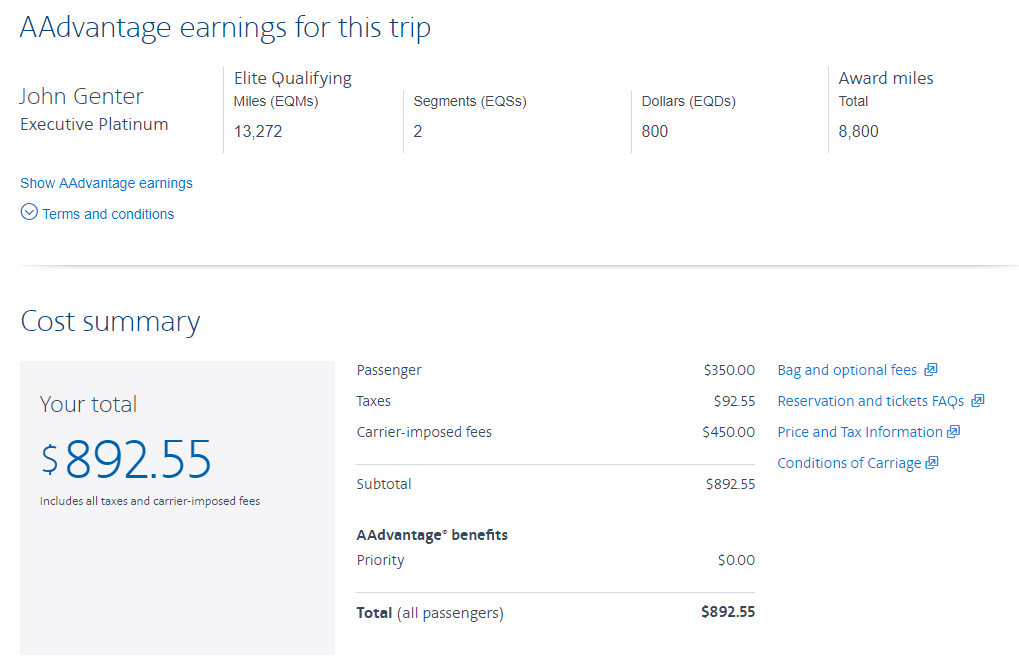
The ability to book AA flights through partners can be particularly useful for earning extra EQDs on the same flights. For example, take an American Airlines premium economy flight between Miami (MIA) and Madrid, Spain (MAD) for $893 round-trip. Booked through American Airlines, you'd earn 800 EQD — as well as 13,272 EQM and 4,000 award miles before elite bonuses:
However, if you book the same exact flights through British Airways (BA flights 1558 and1559), Finnair or Iberia (IB flights 4610 and 4611), you'll pay the same amount ($893), and the flights will earn at the following rates:
EQD: 20% of flight miles
EQM: 1.5x flight miles
Award miles: 100% of flight miles
As the round-trip covers 8,848 flight miles, that means you'll earn 1,770 EQD and 8,848 award miles (before elite bonuses) — as well as the same 13,272 EQM as booking through AA.
While premium economy is a sweet spot across the board, EQD earnings on business-class fares vary widely — from as little as 14% of flight miles up to 45% of flight miles.
Japan Airlines "I" fare class flights earn just 14% of flight miles as EQDs. If that sounds low, you're right. That's less than the 20% EQD earning rate in premium economy, and you're surely paying more for these business-class fares. Meanwhile, you can earn as much as 45% on Qantas "J" and "C" fare classes between the U.S. and Australia or New Zealand. However, those fares are likely to be quite expensive.
Most of the other Oneworld partner EQD earning rates fall between 20% and 30% of flight miles — with only Finnair and LATAM having exceptions. As you can see, the business-class EQD-earning chart generally isn't much higher than the premium economy EQD chart:
Airline
Purchased fares booked in
EQDs per mile flown
British Airways
J, C, D, I, R
25%
Cathay Pacific
C, D, I, J
25%
Finnair
J, D, C
40%
Finnair
I
25%
Iberia
J, C, D, I, R
25%
Japan Airlines (domestic)
J
22%
Japan Airlines (domestic)
I
17%
Japan Airlines (international)
J, C, D, X
25%
Japan Airlines (international)
I
14%
LATAM
J, C
40%
LATAM
D
30%
LATAM
I
25%
LATAM
Z
20%
Malaysia Airlines
F, A, P
30%
Malaysia Airlines
J, D, C
25%
Malaysia Airlines
Z
20%
Qantas (non-US)
J, C, D, I
25%
Qantas (US-AU/NZ)
J, C
45%
Qantas (US-AU/NZ)
D
30%
Qantas (US-AU/NZ)
I
25%
Qatar
J, C, D
25%
Qatar
R, I
20%
Royal Jordanian
J
30%
Royal Jordanian
C, D, Z
25%
Royal Jordanian
I
20%
S7 Airlines
J, C, D
25%
Sri Lankan
J
30%
Sri Lankan
C
25%
Sri Lankan
D, I
20%
First-class fares
Unfortunately for those travelers paying for first-class tickets, the earning rate doesn't get much better. Almost all Oneworld partner first-class fares earn just 30% of flight miles as EQD -- which is surely to be a fraction of the actual price paid. That means you're probably going to be much better off booking first-class tickets with an American Airlines flight number than a partner flight number where possible.
This card isn't available to apply for directly. Instead, you’ll need to have the AAdvantage Aviator Red World Elite Mastercard for at least 90 days before you can call Barclays and request an upgrade to the Aviator Silver card. And the EQD-earning rules on this card depend on when you converted to this card.
The information for the AAdvantage Aviator Red World Elite Mastercard has been collected independently by The Points Guy. The card details on this page have not been reviewed or provided by the card issuer.
Cardholders that upgraded between Jan. 1 and Oct. 31, 2018 can earn up to 6,000 EQD in 2019: 3,000 EQDs after spending $25,000 and another 3,000 EQDs after spending a total of $50,000. In 2020 and beyond, these cardholders can only earn 3,000 EQD for spending a total of $50,000 in purchases.
Cardholders that upgraded before Jan. 1, 2018 and since Nov. 1, 2018 can earn 3,000 EQD for spending $50,000 in purchases in a calendar year in 2019 and beyond.
The other card that offers EQD earnings is the Barclaycard AAdvantage Aviator Business Mastercard. You can earn 3,000 EQDs for spending $25,000 in a calendar year. Additional perks include a free checked bag (with limitations), preferred boarding, 25% back on food and drinks purchased on AA flights and 2x miles on AA flights, telecom, office supply and car rental purchases.
The information for the Barclaycard AAdvantage Aviator Business Mastercard has been collected independently by The Points Guy. The card details on this page have not been reviewed or provided by the card issuer.
By commenting, you agree to our Community Guidelines to help create a positive space for conversation. The responses below are not provided or commissioned by the bank advertiser, our partners, or The Points Guy (“TPG”). They have not been reviewed, approved, or otherwise endorsed by any of these parties. All responses are submitted by individual contributors, and neither the bank advertiser, our partners, nor TPG are responsible for ensuring that all posts and/or questions are answered.