The Points Guy believes that credit cards can transform lives, helping you leverage everyday spending for cash back or travel experiences that might otherwise be out of reach. That's why we publish a variety of editorial content and card comparisons: to help you find a great card to turn your goals into reality.
Our site may earn compensation when a customer clicks on a link, when an application is approved, or when an account is opened with our partners, and this may impact how or where these products appear. While we don't cover all available credit cards, our editorial team creates and maintains all of the analysis of these cards, and our content is not influenced nor subject to review by any credit card company, bank or partner prior to (or after) publication. Please view our advertising policy and product review methodology for more information.
Advertiser disclosure
The Points Guy believes that credit cards can transform lives, helping you leverage everyday spending for cash back or travel experiences that might otherwise be out of reach. That's why we publish a variety of editorial content and card comparisons: to help you find a great card to turn your goals into reality.
Our site may earn compensation when a customer clicks on a link, when an application is approved, or when an account is opened with our partners, and this may impact how or where these products appear. While we don't cover all available credit cards, our editorial team creates and maintains all of the analysis of these cards, and our content is not influenced nor subject to review by any credit card company, bank or partner prior to (or after) publication. Please view our advertising policy and product review methodology for more information.
Summer Hull has been covering (and using) travel tips, rewards credit cards and loyalty programs for over a decade. She has flown close to a million miles, often on points and miles and with her family in tow.
Jennifer is a contributing writer to The Points Guy where she focuses on family travel. She is also the founder of Deals We Like where she helps her readers travel on a deal.
also contributed to this story
February 21, 2025 • 10 min read
The cards we feature here are from partners who compensate us when you are approved through our site, and this may impact how or where these products appear. We don't cover all available credit cards, but our analysis, reviews, and opinions are entirely from our editorial team. Terms apply to the offers listed on this page. Please view our advertising policy and product review methodology for more information.Editorial disclaimer: Opinions expressed here are the author's alone, not those of any bank, credit card issuer, airline or hotel chain, and have not been reviewed, approved or otherwise endorsed by any of these entities.
Comments
By commenting, you agree to our Community Guidelines to help create a positive space for conversation. The responses below are not provided or commissioned by the bank advertiser, our partners, or The Points Guy (“TPG”). They have not been reviewed, approved, or otherwise endorsed by any of these parties. All responses are submitted by individual contributors, and neither the bank advertiser, our partners, nor TPG are responsible for ensuring that all posts and/or questions are answered.
Related stories
Quick summary
Ski vacations can be costly, with lift tickets, lessons and on-mountain meals adding up quickly at major resorts.
How ski purchases are categorized varies by resort and vendor, often posting as either travel or entertainment, which impacts which payment method is most rewarding.
Using a card with a flat rewards rate is generally the safest strategy, as it ensures consistent value regardless of how charges are coded.
Some cards offer elevated rewards for travel, dining or entertainment purchases, but results may differ depending on how each transaction is processed.
What to consider
Purchase codes for ski-related expenses are inconsistent and may vary even at the same resort or vendor.
On-mountain dining usually codes as dining, but exceptions occur, so using a card strong for dining is often effective.
Some offers mentioned in the article are no longer available; always check for current details before planning.
What you'll miss from the article
Detailed comparisons of how different cards perform for ski expenses and specific examples of purchase coding at various resorts.
Generated by AI with support from our editorial team.
Comments
By commenting, you agree to our Community Guidelines to help create a positive space for conversation. The responses below are not provided or commissioned by the bank advertiser, our partners, or The Points Guy (“TPG”). They have not been reviewed, approved, or otherwise endorsed by any of these parties. All responses are submitted by individual contributors, and neither the bank advertiser, our partners, nor TPG are responsible for ensuring that all posts and/or questions are answered.
Update: Some offers mentioned below are no longer available. View the current offers here.
Skiing usually makes for an expensive family vacation, and some of the biggest purchases are lift tickets and lessons.
Although $35-plus daily lift tickets still exist at some smaller mountains, you can expect to spend anywhere from $100 to upward of $200 per day on lift tickets at some of the most prominent mountain resorts in the U.S. One alternative to the hefty per-day costs is a multi-mountain season pass, such as the Epic or Ikon passes, which cost $600 to $1300-plus per adult per season.
Need ski school? That runs more than $200 per day at major resorts, and private lessons are several times that amount.
SUMMER HULL/THE POINTS GUY
Those are (very) painful numbers for most of us to swallow. The silver lining is that you can earn many points on these big-ticket winter vacations with your rewards credit cards.
So, which card is the best one for your ski trip?
Bonus categories for lift tickets and lessons
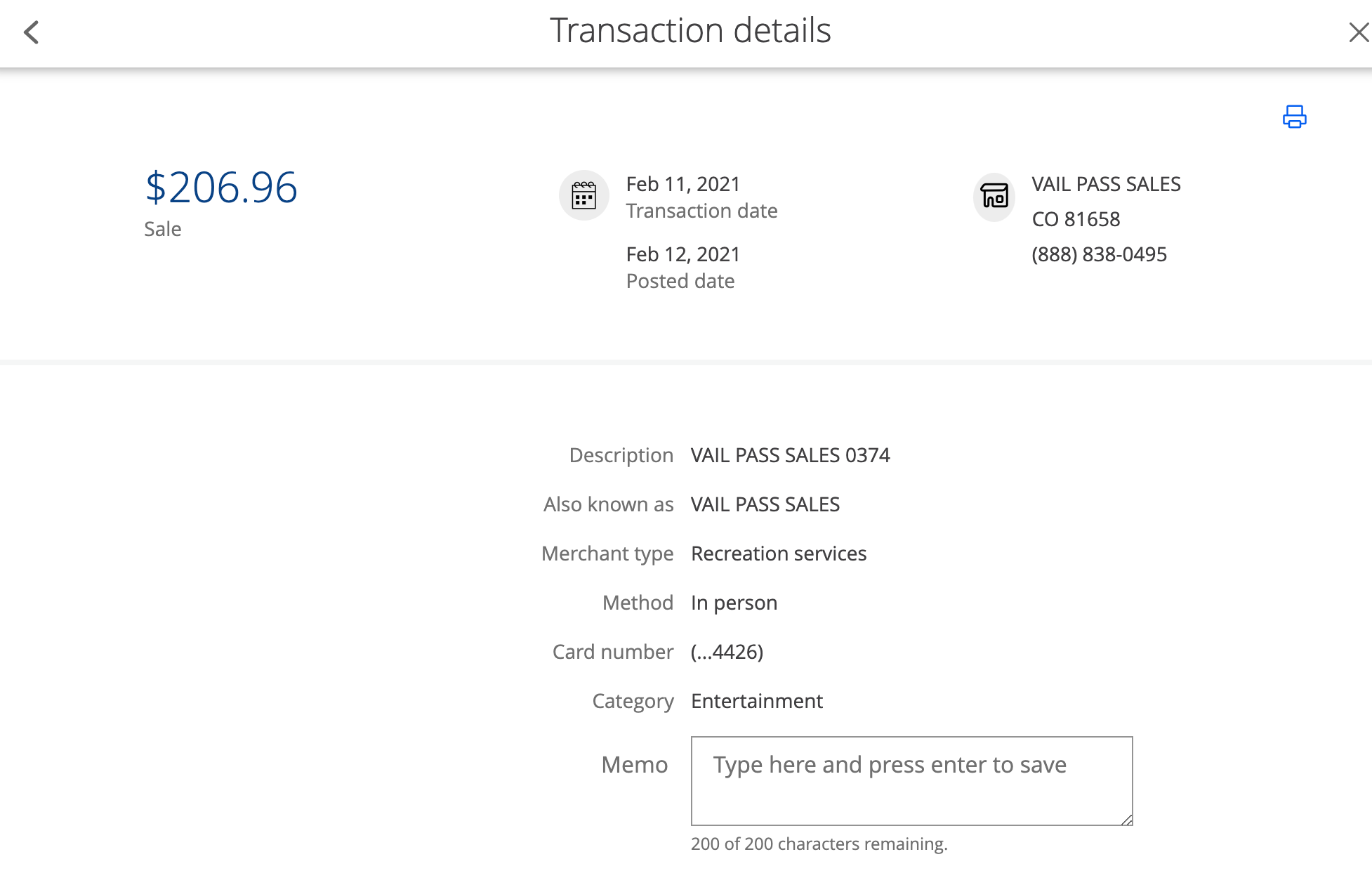
The purchases may code differently depending on how and where you buy your lift tickets and lessons. Unfortunately, you won’t know how these purchases will code until the charges are posted. But to help you make an educated guess, here are some ski purchase examples from TPG staffers and readers:
Coded as entertainment
Epic Pass
Mountain Collective season pass
Liftopia lift tickets
Breckenridge lift tickets and ski school
Keystone lift tickets, ski school and tubing
Heavenly ski school
Deer Valley lessons and tickets
Crotched Mountain lift ticket
Telluride lift ticket
Vail lift ticket
SUMMER HULL/THE POINTS GUY
Coded as travel
Whitefish Mountain advance-purchase lift tickets
Tremblant lift tickets and rentals
Copper Mountain season pass and day lift ticket
See what we mean by the absence of consistent purchase codes? This is harder than deciding between the Simba and Poppyfields runs at Vail.
Overall best credit card for ski charges
Since ski lift tickets and lessons tend to code either as travel or entertainment, your safest bet is to use a card that offers a flat rewards rate. For example, the Capital One Venture Rewards Credit Card awards 2 miles per dollar on all purchases.
It’s also a pretty good card for all other purchases since you’ll always earn 2 miles per dollar plus, Capital One Venture miles are transferable to Capital One's 15-plus transfer partners.
According to TPG's February 2025 valuation of Capital One miles at 1.85 cents each, you're getting a solid return of 3.7% across every purchase you make with this card.
Or, you may decide to opt for your Chase Sapphire Reserve® your ski charges may post as travel or even dining (depending on what/where you buy) and earn you 3 points per dollar spent. In this case, you could be looking at a return of 6.15% since Ultimate Rewards points are worth 2.05 cents each.
But if your ski expenses don’t charge in those categories and instead code as entertainment, you’ll earn just 1 point per dollar for every dollar spent. This happened to Summer Hull, a TPG senior director of content, with a pricey Vail ticket charged to her Sapphire Reserve.
Earn a one-time $200 cash bonus after spending $500 on purchases in the first three months from account opening.
3% back on dining, entertainment and popular streaming services, and at grocery stores (excluding superstores like Walmart® and Target®)
5% Cash Back on hotels, vacation rentals and rental cars booked through Capital One Travel
8% Cash Back on Capital One Entertainment purchases
1% back on everything else
$0
U.S. Bank Cash+ Visa Signature Card
Earn $200 after spending $1,000 in the first 90 days from account opening.
5% cash back on your first $2,000 in combined eligible purchases each quarter on two categories you choose
2% cash back on a category you choose each quarter, such as gas stations and EV charging stations, grocery stores or restaurants
$0
The information for the U.S. Bank Cash+ Visa Signature Card has been collected independently by The Points Guy. The card details on this page have not been reviewed or provided by the card issuer.
Cards that offer bonus points on on-mountain meals and dining
When you spend the day skiing or boarding, you will get very hungry. Sadly, on-mountain meals often come at a pretty steep markup. But again, the small upside of higher prices is more points.
STELLA SHON/THE POINTS GUY
Although our results are not 100% consistent, most on-mountain dining usually codes as dining/food and drink. We have occasionally seen on-mountain meals code as general merchandise instead of dining, but for the most part, I’d use the card in your wallet that is best for dining.
This may be the [applyLink pid="6344" overridetext="American Express® Gold Card" position="1"], which offers 4 points per dollar spent at restaurants worldwide (on up to $50,000 in purchases per calendar year, then 1 point per dollar after that) or the Chase Sapphire Reserve or Bilt Mastercard®, with these last two each offering 3 points per dollar spent on dining. Note that Bilt cardholders must use the card five times each statement period to earn points.
The information for the Bilt Mastercard has been collected independently by The Points Guy. The card details on this page have not been reviewed or provided by the card issuer.
If you know for sure a ski charge will post as travel (and that’s likely with bundled lodging and lift ticket packages), below are the best cards to use for that expense. Another idea to encourage your ski expenses to code as travel is to purchase your lift tickets or passes via Undercover Tourist. It doesn’t have all ski resorts available, but purchases on that site typically code as a travel charge. (We often use it for Disney, too.)
Card
Category bonus: Travel
TPG's February 2025 valuation
Return (based on TPG’s February 2025 valuations)
Annual fee
Chase Sapphire Reserve
3 points per dollar
2.05 cents
6.15 %
$550
Chase Sapphire Preferred® Card (see rates and fees)
2 points per dollar
2.05 cents
4.1%
$95
Bilt Mastercard
2 points per dollar (or 4 points per dollar spent on travel purchases the first of every month, up to 1,000 bonus points per month). Cardholders must use the card 5 times each statement period to earn points.
2.05 cents (if you also have a premium Ultimate Rewards card)
3.07 cents (with a premium Ultimate Rewards card)
$0
Additionally, the Bilt Mastercard — a strong credit card for your travel and dining purchases — offers 2 points per dollar spent on all purchases made on the first of the month (except rent), up to 1,000 bonus points per month. This means if you time your lift ticket purchase to the first of the month, you could ultimately earn 2 points for each dollar you spend on this purchase. With Bilt Points worth 2.05 cents per point, this will give you a 4.1% return.
We found that the Capital One Venture Rewards Credit Card is the overall best credit card for ski trips, thanks to its bonus miles on all charges. However, if you make your ski trip purchase on the first of the month, then the Bilt Mastercard is also a strong contender.
Although most of our ski-related charges are coded as entertainment, your results may vary based on where you ski and where you purchase your lift tickets, ski school, etc. Plus, any necessary flights and lodging required for your ski trip will likely code as travel, so you can maximize your spending power by using a card that earns elevated reward rates in this category.
For rates and fees for the Blue Business Plus card, click here.