Airbus A321LR versus the Boeing 787 Dreamliner: Which do pilots prefer for transatlantic flights?


Last month, JetBlue launched its inaugural flight between New York-JFK and London Heathrow (LHR) on an A321LR aircraft. Narrowbody aircraft are nothing new to transatlantic travel, but JetBlue's entry into the highly competitive New York to London route caused quite a stir.
For travelers sitting in the cabin, the experience is comparable with other transatlantic carriers, with lie-flat seats in business class and mood lighting and amenity kits for passengers in the back. But how does transatlantic flying in an A321 differ from a 787 Dreamliner for the people sitting farthest forward — the pilots?
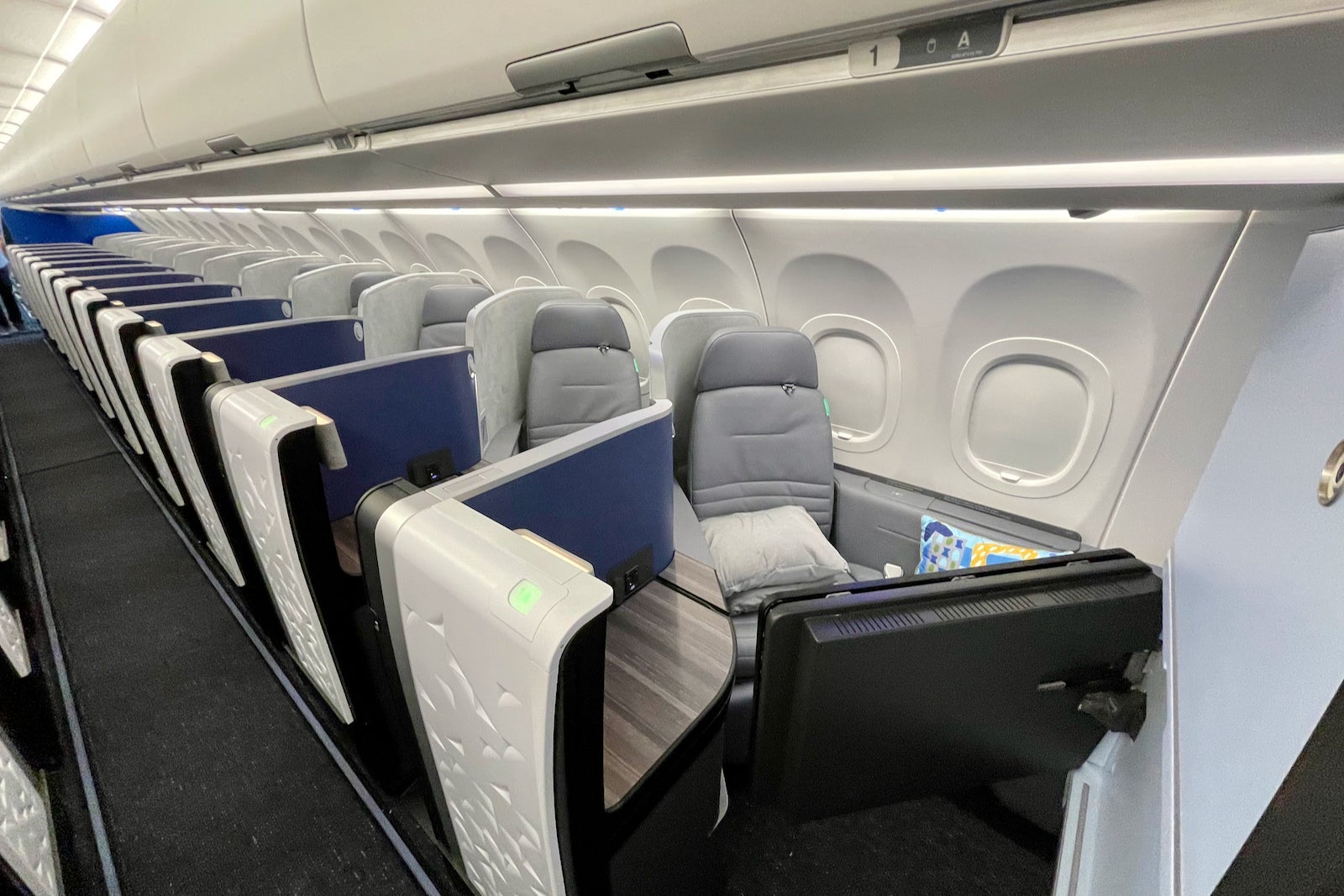
In my career, I've spent just over 3,000 hours flying the A321 (7,000 hours total with the A320 family) and nearly 4,000 hours flying the 787 Dreamliner. As a result, I feel I'm in a good position to compare and contrast how it feels to fly the two aircraft, particularly on routes with longer flight times.
Each aircraft has its own little quirks, some of which many pilots like, others which pilots may not prefer. It's like the difference between driving a Mercedes and BMW: They both offer quite a different driving experience, but ultimately either will get you safely to your destination.
Airbus A321LR versus the Boeing 787 Dreamliner
787 Dreamliner
Starting with my current ride, the 787 was made for long-haul flight with a range of 7,500 nautical miles. It was the aircraft selected by Qantas to fly the first-ever direct flight between Australia and the U.K., a 17-hour epic from Perth Airport (PER) to London Heathrow.
The 787 is a widebody aircraft, meaning there's enough space in its 18-foot-wide cabin for two aisles. It has a wingspan of 197 feet and has a length of between 187 feet for the 787-8 to 223 feet for the 787-10. It has three fuel tanks, enabling it to carry more than 100 tons of fuel, allowing it to fly nonstop journeys between cities such as Perth and London and Sydney and New York.
Airbus A321LR
The A321LR is a descendent of the original A321, a variant of one of the most popular aircraft ever built for the short-haul market, the A320.
By adding extra fuel tanks, it has a range of 4,000 nautical miles, meaning it is able to comfortably fly routes such as London to New York City, and Miami to most of South America. As a result, it is an extremely attractive option for not only established long-haul carriers but also short-haul airlines looking to expand into lucrative intercontinental routes.
One of the main advantages for airlines is that it requires very little extra training for their crew. Pilots already rated to fly the A320 family can fly an A321LR without the need for the long (often three-month) conversion course required to move onto a larger aircraft like the 787.

The A321 is considered a narrowbody aircraft, meaning that the 12-foot-wide cabin is only wide enough for a single aisle. It is also somewhat smaller than the 787 with a length of 144 feet and a wingspan of 118 feet.
Ergonomics
To the outsider, the flight deck of an A321 and a B787 are quite similar. However, when you spend thousands of hours sitting in them, you become very aware of the similarities and differences.
The most obvious difference is that the A321 has migrated to using a sidestick located outboard from the pilot, whereas the B787 still has a traditional control column situated between the pilot's feet.
Both have their advantages, but I'm going to get off the fence here and declare that I prefer the Airbus setup, particularly for long flights.
The flight deck of an aircraft is basically our office. Not only is it our office, but it's also our dining room and our lounge. It's where we can sit for nine to 10 hours in a single stretch, so the more ergonomically designed and comfortable it is, the better we will perform.
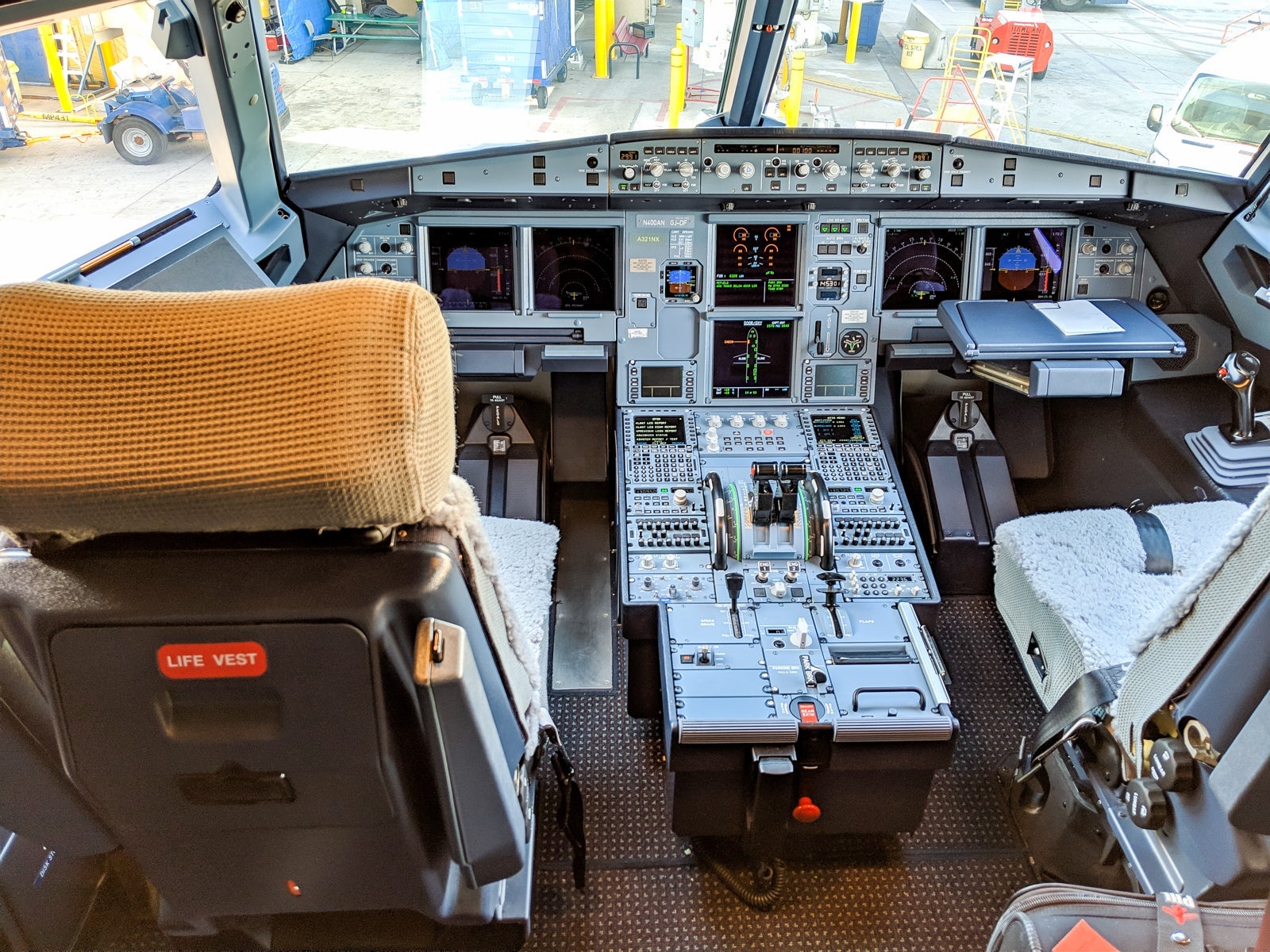
The control column on the 787 is great for flying the aircraft, but most of the time we engage the autopilot a couple of minutes after takeoff and then leave it engaged until a few minutes before landing. With the autopilot engaged, we have no use for the control column. This would be fine on a short flight, but when we're sitting for hours on end, it just gets in the way.
You'll see most Boeing pilots with a clipboard for their inflight paperwork. This is because there are few places to store it and, more to the point, it is difficult to write with the control column in the way. As a result, we use a clipboard to keep the paperwork together and to provide a flat surface on which to keep a track of our route and fuel status.
It is also difficult to eat your food properly as you can't fit the tray onto your lap without moving the seat back away from the controls. As a result, to ensure that one pilot is able to reach the controls at all times, we sometimes have to take it in turns eating.
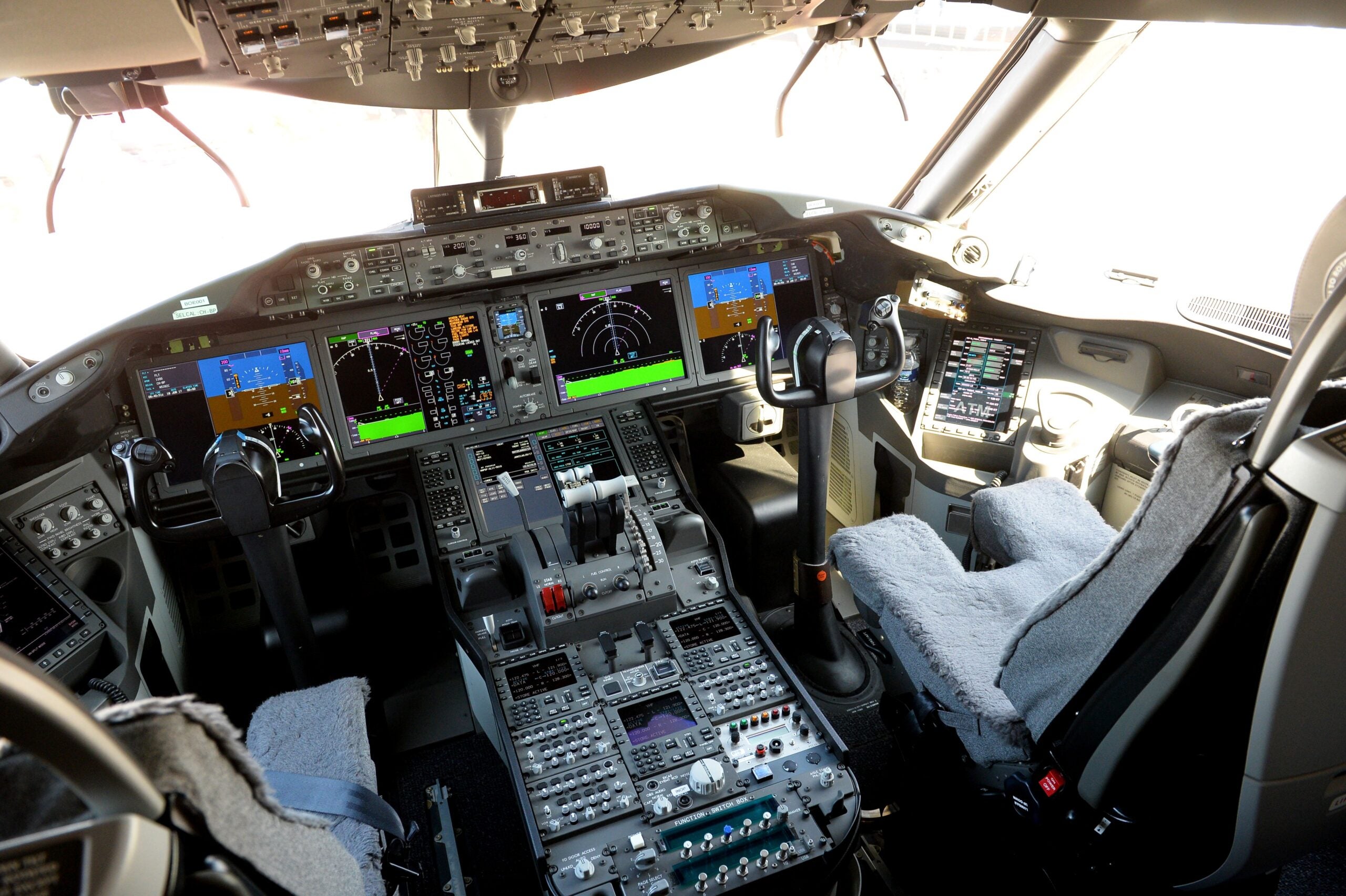
On the A321 however, the position of the control stick to the side of the pilot means Airbus has been able to install a fold-away tray table. Once airborne with the autopilot engaged, just like on the 787, the pilots are able to pull out the table and use it to complete their paperwork and eat their meal, just like being at a proper desk or table.
The absence of the control column also means it's much easier to get comfortable in the seat as we are not restricted as to where our legs can go.
Winner: Airbus A321LR
Ride Comfort
We've all been there: Just as the meal service starts, the bumps begin. As you try to take a sip of your red wine, a jolt forces the glass against your chin and its contents into your lap. For most people, turbulence is just an inconvenience, while for others it's a real fear.
Turbulence is caused by variations in the wind speed and direction hitting the aircraft and affecting the lift over the wings. An increase in wind speed creates more lift, a decrease created less lift. Multiply this hundreds of times a second and you get what you experience as turbulence.
In order to counter this, designers at Boeing utilized a number of sensors around the 787, which detect and measure changes in angular velocity and air pressure. Lateral gusts of turbulence causing wind are recorded by gyroscopic sensors and vertical movement is recorded by accelerometers. Changes in air pressure around the aircraft are also detected.
All this information is sent to central processing computers which, in a fraction of a second, calculate not only what is happening to the aircraft but also what needs to be done to counteract those movements. The computers then send electrical signals to the actuators powering the control surfaces on the wings and tail to counteract the forces the aircraft is experiencing.
The result is that, as the aircraft instantly reacts to the turbulence-creating forces, the bumps you feel in your seat are reduced and feel much less significant than they would on, say, the A321.
Winner: Boeing 787
Air Quality
The A312 uses what is known as 'bleed air' to pressurize the cabin. As part of the engine operation, some air is 'bled' out of the high-pressure compression stage and then fed into the air conditioning system. This air is then used to pressurize the aircraft and keep the cabin at a comfortable temperature.
This is a tried and tested method that works well across all aircraft types, ever since the first pressurized aircraft took to the skies. But on the B787, things are different.

Instead of taking air from the engines, fresh air is drawn in directly from outside the aircraft, forward of the engines, by two dedicated inlets on either side of the aircraft. This means the air that we breathe inside the aircraft is fresh from outside and hasn't been through the engine.
Not only does this mean that inside the cabin the air is of much better quality, but it also means there are savings to be made externally. As high-pressure air in the engines is not feeding the air conditioning system, all of it can be used to generate thrust. This means that the engines are not wasting airflow, making them much more fuel-efficient and thus reducing carbon emissions.
Winner: Boeing 787
Performance
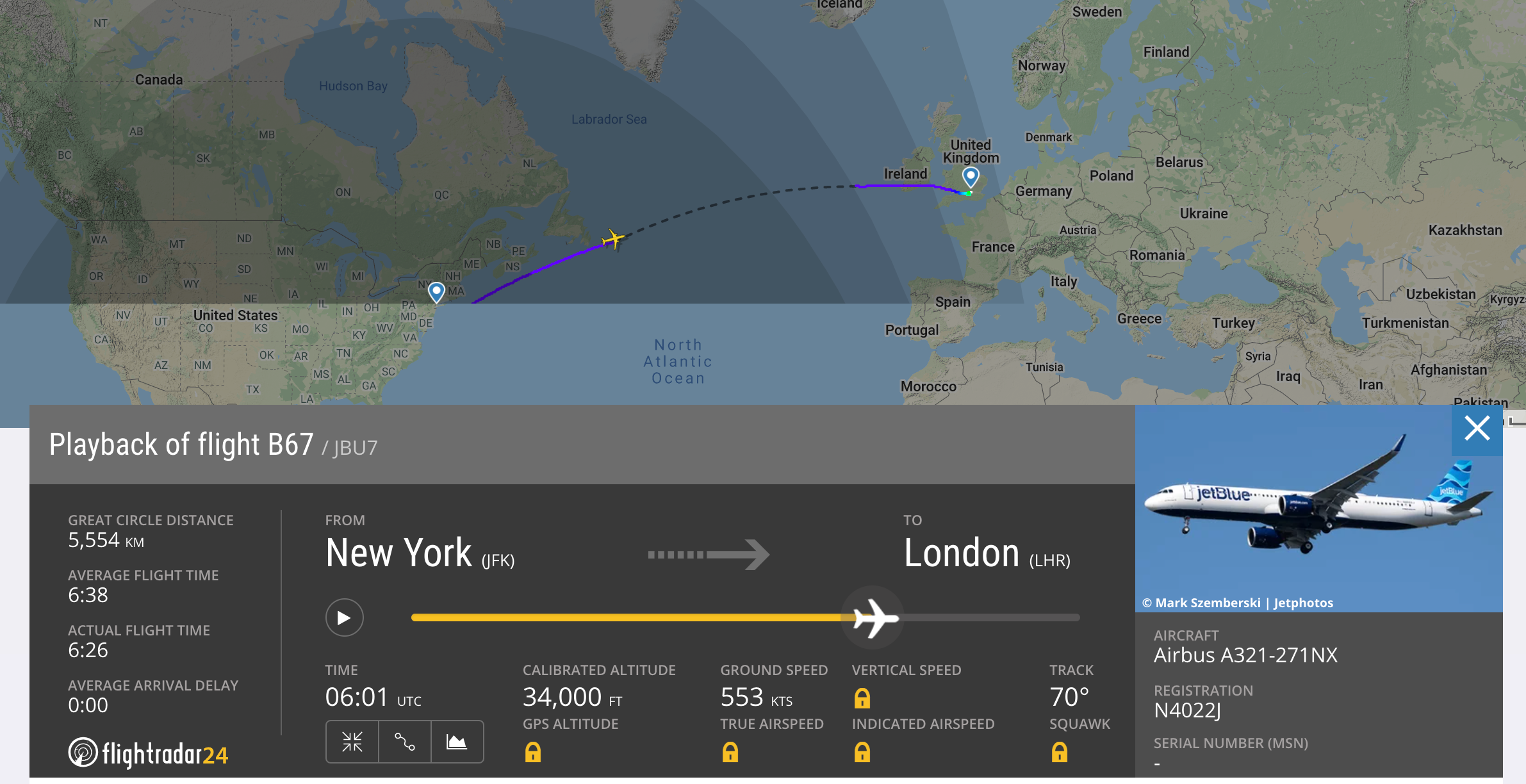
Whilst the range of the A321LR has been increased by the addition of extra fuel tanks and tweaks to the wingtips, the wing on the A321LR is very similar to that of the original A321. As a result, particularly at heavy weights, the aircraft is quite limited to how high it can climb, as can be seen in the image below.
However, the wing on the 787 is an incredible feat of engineering. If you watch the video below, you'll have noticed just how much the wings flex as they are creating lift. This design enables the aircraft to climb to higher altitudes for a given weight than most other aircraft types.
This benefits us in a couple of ways. First, it means we can often fly above turbulence. There has been many a night flying across the Atlantic where pilots in aircraft below us at 33,000 to 37,000 feet have complained about the bumpy flying conditions while above them, at 43,000 feet, we've had a smooth ride.
Secondly, by flying higher than most other traffic, it means we are more likely to get shortcuts. As air traffic is a giant three-dimensional puzzle for Air Traffic Control (ATC), when you have more aircraft at a certain altitude, there's less opportunity for them to deviate from their planned route.
When there are fewer aircraft at your altitude, ATC can often let you fly more direct routes. This not only saves fuel but also time.
Winner: Boeing 787
Technology
Whilst the A321LR is a relatively new aircraft, it is a variation of the original A321. As a result, most of the flight deck technology is very similar to that of the original creation. However, the 787 is an aircraft designed for the 21st century and therefore has a number of technological advances which help improve flight safety.
One of the most useful features is the Head-Up Display, or HUD.
Part of learning to fly a jet aircraft is mastering the ability to flick between scanning the vital flight parameters such as altitude and speed inside the flight deck and viewing the visual picture outside the aircraft. During an approach, a pilot's eyes will constantly be darting between the two.

However, for a while now, technology has existed in military aircraft that allows pilots to continue scanning the flight parameters whilst still looking outside — it's called a Head-Up Display. A projector is fixed to the ceiling above the pilot's head and from it projects an image of the Primary Flight Display (PFD) onto a piece of glass in front of the pilot.
Whilst this feature is great during most stages of flight, it really becomes important during the approach and landing. Some approaches require pilots to fly tight turns very close to the ground, often in marginal weather conditions. The approach to Runway 13L at New York's JFK is a great example of this.
When we fly this approach, we need to keep our eyes on the runway as much as possible. The HUD enables us to do this whilst still scanning our altitude and airspeed as we fly the tight turn around the corner, as can be seen in the video taken in the simulator below.
Winner: Boeing 787
Bottom Line
Whilst both aircraft are capable of flying long-haul routes, as a pilot, my preference would be to do so in a 787 Dreamliner over an A321.
The flight deck of the A321 is definitely more practical for longer flights with the tray table making the flight deck much more comfortable and usable as both an office and dining room.
However, the A321 is still very much a short-haul aircraft updated for long-haul flying.
The 787, on the other hand, was designed specifically for long-haul routes. The performance of the wing and features such as the gust suppression system and non-bleed air conditioning mean the entire experience of a long flight is made much more comfortable for everyone on board.
As a result, both passengers and crew get off the aircraft feeling much more refreshed and less tired than they would expect.
TPG featured card
at American Express's secure site
Terms & restrictions apply. See rates & fees.
| 4X | Earn 4X Membership Rewards® points per dollar spent on purchases at restaurants worldwide, on up to $50,000 in purchases per calendar year, then 1X points for the rest of the year. |
| 4X | Earn 4X Membership Rewards® points per dollar spent at US supermarkets, on up to $25,000 in purchases per calendar year, then 1X points for the rest of the year. |
| 5X | Earn 5X Membership Rewards® points on prepaid hotel stays booked through AmexTravel.com or the Amex Travel App™. |
| 3X | Earn 3X Membership Rewards® points on flights booked through AmexTravel.com, the Amex Travel App™, or purchased directly from airlines. |
| 2X | Earn 2X Membership Rewards® points on prepaid car rentals booked through AmexTravel.com or the Amex Travel App™ and cruises booked and paid through AmexTravel.com. |
| 1X | Earn 1X Membership Rewards® point per dollar spent on all other eligible purchases. |
Pros
- Valuable dining and food-related credits
- Flexible rewards with airline and hotel transfer partners
- Multiple travel and purchase protections
- No foreign transaction fees
- Access to Amex Offers for additional savings (enrollment required)
Cons
- Not as useful for those living outside the U.S.
- Some may have trouble using Uber and other dining credits
- You may be eligible for as high as 100,000 Membership Rewards® Points after you spend $8,000 in eligible purchases on your new Card in your first 6 months of Card Membership. Welcome offers vary and you may not be eligible for an offer. Apply to know if you’re approved and find out your exact welcome offer amount – all with no credit score impact. If you’re approved and choose to accept the Card, your score may be impacted.
- Earn 4X Membership Rewards® points per dollar spent on purchases at restaurants worldwide, on up to $50,000 in purchases per calendar year, then 1X points for the rest of the year.
- Earn 4X Membership Rewards® points per dollar spent at US supermarkets, on up to $25,000 in purchases per calendar year, then 1X points for the rest of the year.
- Earn 5X Membership Rewards® points on prepaid hotel stays booked through AmexTravel.com or the Amex Travel App™.
- Earn 3X Membership Rewards® points on flights booked through AmexTravel.com, the Amex Travel App™, or purchased directly from airlines.
- Earn 2X Membership Rewards® points on prepaid car rentals booked through AmexTravel.com or the Amex Travel App™ and cruises booked and paid through AmexTravel.com.
- Earn 1X Membership Rewards® point per dollar spent on all other eligible purchases.
- Pay It® lets you tap in the American Express® App to quickly pay for small purchase amounts throughout the month and still earn rewards the way you usually do. Plan It® gives you the option to split up big purchases into equal monthly payments with a fixed fee. You’ll know upfront exactly how much you’ll pay.
- $120 Dining Credit: Earn up to a total of $10 in statement credits monthly when you pay with the Gold Card at Grubhub (including Seamless), Buffalo Wild Wings, Five Guys, The Cheesecake Factory, and Wonder. This can be an annual savings of up to $120. Enrollment required.
- $100 Resy Credit: Get up to $100 in statement credits each calendar year at over 10,000 qualifying U.S. Resy restaurants after you pay for eligible purchases with the American Express® Gold Card. That’s up to $50 in statement credits semi-annually. Enrollment required.
- $84 Dunkin' Credit: Earn up to $7 in monthly statement credits after you pay with the American Express® Gold Card at U.S. Dunkin’ locations. Enrollment required.
- $120 Uber Cash on Gold: Enjoy up to $120 in Uber Cash annually with your Gold Card. Just add your Card to your Uber account and you'll get $10 in Uber Cash each month to use on orders and rides in the U.S. when you select an Amex Card for your transaction.
- Enjoy complimentary Hertz Five Star® Status benefits like skipping the counter at select locations, adding an additional driver at no additional cost*, and vehicle upgrades**. Benefit enrollment and Hertz Gold+ registration are required. *Additional drivers must meet standard rental qualifications and must be a spouse or domestic partner to qualify as complimentary. Other additional drivers subject to fees. **Benefits are subject to availability and vary by location. Additional Hertz program Terms and Conditions including age restrictions apply.
- Book two nights or more with The Hotel Collection through AmexTravel.com or the Amex Travel App™ and receive a $100* credit towards eligible charges at over 1,400 upscale hotels worldwide. *Eligible charges vary by property.
- Book your travel through the Amex Travel App™ with added peace of mind – backed by American Express® service and support. Only for American Express® Card Members.
- Whenever you need us, we're here. Our Member Services team will ensure you are taken care of. From lost Card replacement to statement questions, we are available to help 24/7.
- No Foreign Transaction Fees.
- Annual Fee is $325.
- Terms Apply.