How pilots deal with fuel leaks

This time in 2001, an Air Transat A330 pushed back from the gate in Toronto for a routine flight to Lisbon. Just a few hours later, it would run out of fuel mid-Atlantic and be forced to glide 75 miles and land at Lajes in the Azores. All onboard evacuated the aircraft safely.
During the cruise, the crew had noticed an imbalance between the wing fuel tanks and took action to remedy the problem. Unfortunately, this would end up causing both tanks to run dry, resulting in both engines shutting down.
So how did a modern airliner manage to get into such a frightening situation and how do we as pilots stop this from happening?
Air Transat flight 236
Just before 9 p.m. Toronto time, the two-year-old A330 took off from Toronto with 293 passengers and 13 crew. In the fuels tanks was 46.9 tons of fuel, more than enough to complete the trans-Atlantic flight safely.
Around four hours into the flight, whilst cruising at 39,000 feet, unbeknown to the crew, a fuel leak began in the pipe taking fuel from the right-hand wing tank to the right-hand engine.
A few minutes later, the crew noticed low oil temperature and high oil pressure indications in the right hand (number two) engine. At this stage, there was no indication that these were the result of a fuel leak so the crew reported these as spurious to the maintenance control center who asked the crew to monitor the situation.
Related: Suitcases, dogs, avocados and coffins: What's really traveling in the cargo hold?

Around 30 minutes later, the aircraft monitoring system alerted the crew to a fuel imbalance - the fuel in the right-wing tank was lower than the fuel in the left. Thinking that there was just an imbalance and not a leak, the crew actioned the fuel imbalance checklist, without reference to the QRH (quick reference handbook).
This procedure involves turning on the fuel crossfeed system and turning off the fuel pumps on the side where there is less fuel -- the right-hand side. This results in fuel flowing from the left hand tank to feed the right-hand engine. Unfortunately, all this did was to allow even more fuel to escape through the leak in the pipe.

Realizing the gravity of the situation, the crew decided to initiate a diversion to Lajes in the Azores. Half an hour later, as the fuel in both tanks ran out, one engine shut down, shortly followed by the other.
By this point, the aircraft was close enough to the Azores to allow the crew to glide the aircraft down to the runway, ensuring the safety of all those on board.
How we manage fuel
Before I continue, I must make it clear that the number of times a commercial airliner has run out of fuel are incredibly small. I can only think of one other, where a fuel loading error on an Air Canada Boeing 767 caused the aircraft to run out of fuel. They, too, glided to a runway and landed safely.
The reason why this event is so unlikely to happen is partly from lessons learned from these two incidents. Aviation is one of the best industries in the world at learning from mistakes and doing all that is possible to stop them from happening again.
Before departure
Before we report for duty, the planning department in the airline's operations center will create a flight plan specific to our flight. They will take into consideration atmospheric conditions, airspace restrictions and aircraft performance factors, to name just a few variables.
From this information, they can create the most fuel-efficient route for that flight on that date. This is why you may notice that your geographic route may often be different if you fly regularly between two cities.
Once the route has been decided, the fuel required to get there is then calculated. For a given distance, this will vary depending on aircraft weight, planned cruising altitudes, wind velocity and air temperatures. This magic number is known as the "trip fuel" or the "burn." In other words, the amount of fuel which the aircraft will use just to take off from the departure point and land at the destination.
Related: How pilots deal with radiation and flights over the North Pole
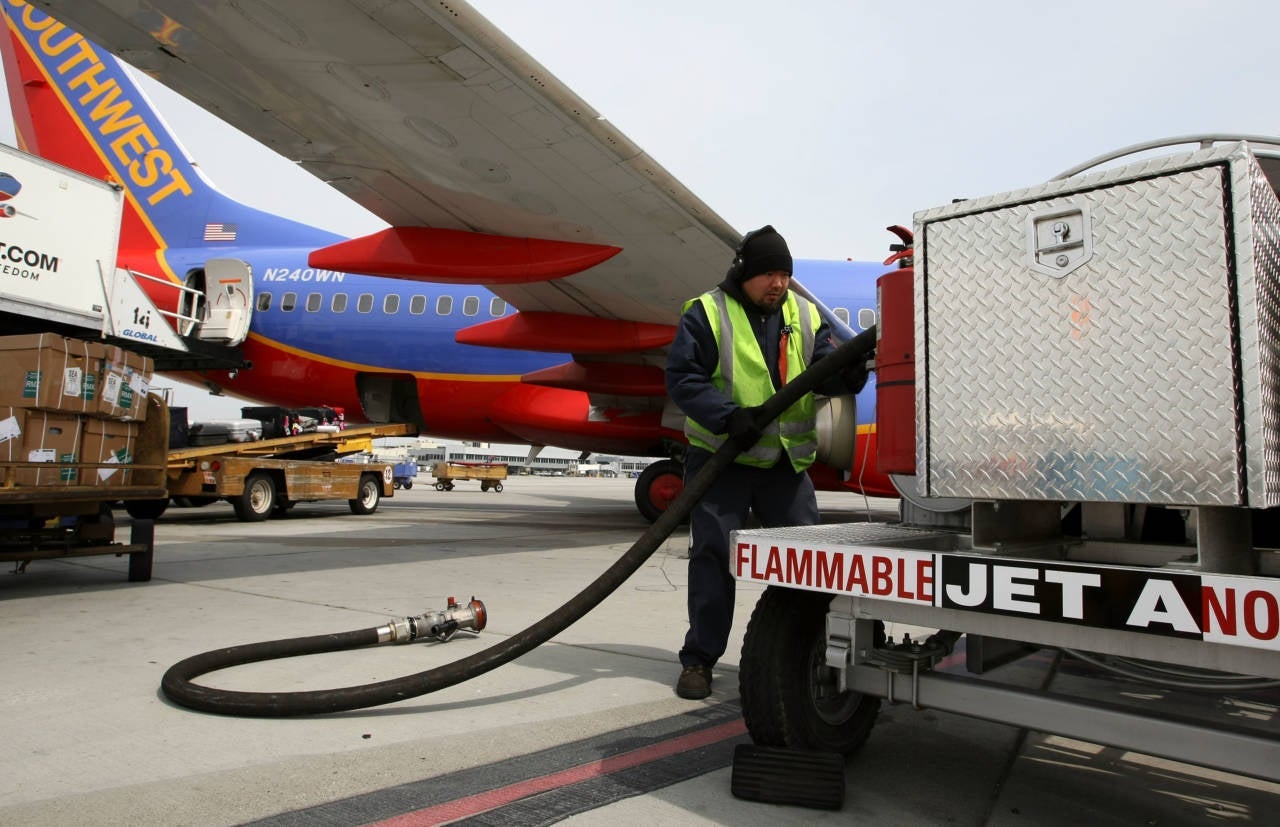
However, errors are always possible and as the pilots, we are the final layer of protection to prevent an error becoming an accident. As a result, we always carry out a gross-error check on the fuel figure published on the flight plan.
The Boeing 787 Dreamliner uses roughly five tons for fuel for every hour of flight. If the flight time is 10 hours, we should need roughly 50 tons of fuel.
With the fuel loaded into the tanks and the en route winds loaded, we then check that the predicted fuel on arrival, as calculated by the flight management computer, ties up with the figure printed on our paperwork. This way we ensure that we get airborne with enough fuel to complete the flight.
In-flight fuel checks
It will normally take around 30 minutes for a heavy 787 Dreamliner to climb from the runway to its initial cruising altitude. During this time, we normally do very little except concentrate on flying the aircraft and talking to ATC. Once level in the cruise, we can start to divert our attention onto other tasks. The first is to make a fuel check.
As part of our preflight procedure, we check the flight plan issued to us by the company's operations department. Not only does this gives us information as to how much fuel we will need for the entire flight, but it also breaks it down into how much fuel we require at any given stage of the flight.
Passing the first waypoint after the top of the climb, it is the pilot monitoring's (PM) job to make a fuel check. They will look at the fuel system display and write down on the flight plan what the actual fuel on board is.
Related: Your next flight could be a pilot's final test before making captain

By comparing the amount of fuel actually in the tanks against what we need to reach our destination as per the flight plan, we can calculate how much fuel we expect to land with. The time check also enables us to see whether or not the flight is progressing as expected. Losing time may indicate that the tail winds are not as strong as expected.
Fuel and time checks are then completed every 30 minutes for the rest of the flight. By keeping a vigilant eye on the fuel we can determine if we are using fuel faster than expected. If so, we need to work out why.
Quite often, it's because of stronger headwinds or because ATC is keeping us at an altitude lower than our optimum. For these fairly regular cases, we always carry a certain amount of contingency fuel.
Rarely -- and I mean very rarely -- a discrepancy in the fuel checks may be the result of a fuel leak. In this situation, there is a regimented checklist that we must follow to ascertain if there is indeed a fuel leak.
Dealing with a potential fuel leak
If the fuel checks start to show a discrepancy either between the fuel tanks or in the estimated fuel on arrival, we must take prompt action to rectify the situation. There may be a legitimate cause for the discrepancy, for example, one engine being older than the other and using more fuel per hour. Or, the APU (which uses fuel from the left tank) has been left running for the flight for technical reasons.
Whatever the cause, we must understand why there is a discrepancy and take action to ensure the safety of the aircraft and its occupants. This may even involve diverting to a nearby airport.
Fuel imbalance
The first sign of a fuel leak will most likely be an imbalance between the two main wing tanks. The fuel system on the 787 Dreamliner is quite straightforward. There is one center tank and then one main tank in each wing.
The fuel from the center tank is used first before the main tanks continue to feed their respective engine. If the fuel quantity between the two main tanks differs by a certain amount, the FUEL IMBALANCE alert message is shown.
The fuel balancing system is designed to pump fuel from the tank with the higher quantity into the tank with the lower quantity. However, before doing this, we must make sure that the imbalance is not due to a fuel leak.

The fuel imbalance checklist alerts us that a fuel leak should be suspected if any one of the following is true:
- The total fuel remaining is less than the planned fuel from our in-cruise fuel checks.
- An engine has excessive fuel flow.
- The totalizer fuel (sum of the individual tank quantities) is less than the calculated fuel (fuel in tanks on engine start minus fuel used).
If a fuel leak is suspected, attempting to balance the tanks could result in even more fuel being lost through the leak, as happened in the Air Transat case. Instead of continuing with the fuel imbalance checklist, we must instead go straight to the fuel leak checklist
Fuel leak
The fuel leak checklist acts as a logic tree to initially ascertain if we do indeed have a leak. From here we can then narrow down exactly where the leak is coming from -- the center tank, the main wing tank or from the engine. (By "engine" I mean anywhere in the pipework after leaving the main tank).
The first step in the checklist is to turn off the balance switch and crossfeed switches if they were already on for any reason. This isolates the individual tanks and stops any extra fuel from being lost through a potential leak.
The center tank pumps are then switched off so that each wing tank is feeding its respective engine. We then note the fuel quantity in each tank and the time.
If there is a change in fuel imbalance between the two main wing tanks of 1,110 lb in 30 minutes or less, a leak on the side with less fuel can be confirmed. However, we still don't know if the leak is from the tank itself or from the pipework to the engine.

Once we have confirmed the leak, we can then shut down the engine on that side to prevent any further fuel loss, if it is indeed an engine leak. The aircraft will continue to fly safely on the other engine, however, we may have to descend to a lower altitude to be able to maintain a safe speed.
As we have now confirmed a leak but do not know the severity of it, at this stage we will begin a diversion to a suitable nearby airport to land.
With the engine shut down, we can now determine whether the leak was from the engine or from the tank itself. Instead of looking at the totals in the tanks themselves, we now look at the totalizer and calculated fuel figures in the flight management computer (FMC) mentioned above.
As a potential leak from the engine has been ruled out due to it being shut down, if the difference between these two values continues to increase, it means that the fuel is leaking from the tank. If the difference does not change, the leak is from the engine.
This brings us to a useful conclusion. If the leak is from the engine, all the remaining fuel in that tank can be used for the remaining engine. To do this, we use the fuel imbalance checklist again.
However, if the leak is from the tank, we can restart the engine to expedite our diversion to land. As all the fuel will be eventually lost anyway, it makes sense to use what we have whilst we can.
Bottom line
Once we are airborne, we only have a finite amount of fuel. There's no in-flight refueling for commercial airliners. As a result, we must monitor our fuel usage and quantity closely throughout the flight.
If we notice any discrepancies in the fuel levels, either between the tanks or to our estimated fuel on arrival, we must handle the situation carefully and methodically. When diagnosing the problem, it's better to try and prove that we do not have a fuel leak rather than prove that we do have one.
If we decide to start transferring fuel from one tank to another, and particularly from one tank to the other engine in the case of a crossfeed, we must be absolutely sure that there is no leak.
The misfortune of the Air Transat crew losing both engines due to a fuel leak has improved the safety of airline operations around the world today.
TPG featured card

at Capital One's secure site
Terms & restrictions apply. See rates & fees.
| 5X miles | Earn 5X miles on hotels, vacation rentals and rental cars booked through Capital One Travel |
| 2X miles | Earn unlimited 2X miles on every purchase, every day |
Pros
- Stellar welcome offer of 75,000 miles after spending $4,000 on purchases in the first three months from account opening. Plus, a $250 Capital One Travel credit to use in your first cardholder year upon account opening.
- You'll earn 2 miles per dollar on every purchase, which means you won't have to worry about memorizing bonus categories
- Rewards are versatile and can be redeemed for a statement credit or transferred to Capital One’s transfer partners
Cons
- Highest bonus-earning categories only on travel booked via Capital One Travel
- LIMITED-TIME OFFER: Enjoy $250 to use on Capital One Travel in your first cardholder year, plus earn 75,000 bonus miles once you spend $4,000 on purchases within the first 3 months from account opening - that’s equal to $1,000 in travel
- Earn unlimited 2X miles on every purchase, every day
- Earn 5X miles on hotels, vacation rentals and rental cars booked through Capital One Travel
- Miles won't expire for the life of the account and there's no limit to how many you can earn
- Receive up to a $120 credit for Global Entry or TSA PreCheck®
- Use your miles to get reimbursed for any travel purchase—or redeem by booking a trip through Capital One Travel
- Enjoy a $50 experience credit and other premium benefits with every hotel and vacation rental booked from the Lifestyle Collection
- Transfer your miles to your choice of 15+ travel loyalty programs
- Top rated mobile app