Richard Kerr is a veteran naval officer and founder of the Award Travel 101 Facebook community. He’s one of the foremost experts in points and miles strategy, featured in Forbes, US News, Money Magazine, Kiplinger Personal Finance and presented at #SXSW 2017. Richard has visited over 45 countries, lived in England and Japan, and spends his spare time dissecting loyalty program award charts to maximize the value of points and miles. Richard holds a BBA in International Business and has his wife and two small children in tow for his travels as often as possible.
Credit card writer Danyal Ahmed is an avid traveler, averaging about 100,000 aeronautical miles per year. He regularly applies that knowledge and his expertise in credit cards to his role as a credit card writer at TPG.
also contributed to this story
December 4, 2024 • 9 min read
The cards we feature here are from partners who compensate us when you are approved through our site, and this may impact how or where these products appear. We don't cover all available credit cards, but our analysis, reviews, and opinions are entirely from our editorial team. Terms apply to the offers listed on this page. Please view our advertising policy and product review methodology for more information.Editorial disclaimer: Opinions expressed here are the author's alone, not those of any bank, credit card issuer, airline or hotel chain, and have not been reviewed, approved or otherwise endorsed by any of these entities.
Comments
By commenting, you agree to our Community Guidelines to help create a positive space for conversation. The responses below are not provided or commissioned by the bank advertiser, our partners, or The Points Guy (“TPG”). They have not been reviewed, approved, or otherwise endorsed by any of these parties. All responses are submitted by individual contributors, and neither the bank advertiser, our partners, nor TPG are responsible for ensuring that all posts and/or questions are answered.
Related stories
Quick summary
Many travel and standard credit cards offer lesser-known protections such as travel accident and emergency evacuation insurance.
Travel accident insurance can provide financial support in the event of death, loss of limb or eyesight while using public transportation, with coverage often extending to family members if the trip is paid for with the card.
Emergency evacuation insurance covers transportation to the nearest appropriate medical facility during a covered event, but requires coordination through a benefits administrator and may have country or condition exclusions.
Coverage details, eligible beneficiaries and payout amounts vary by card, so it is essential to review each card’s benefits guide for specific terms.
What to consider
Eligibility for these protections typically requires paying for the trip with the card and following strict coordination procedures with the benefits administrator.
Some policies exclude preexisting conditions, certain countries or specific activities such as professional sports or racing.
Coverage is limited to transportation and does not replace medical insurance for care received after evacuation.
What you'll miss from the article
A detailed comparison of coverage limits, eligible scenarios and step-by-step guidance on how to activate these protections in case of emergency.
Generated by AI with support from our editorial team.
Update: Some offers mentioned below are no longer available. View the current offers here.
I’ll explain a couple of lesser-known benefits that you hopefully won’t have to use but, if needed, can protect you from extreme financial hardship and ensure your family and loved ones are provided for if something happens to you.
You can easily find the coverage and terms of any protection your travel credit card offers by doing a quick web search for the card’s updated benefits guide. These benefits are not exclusive to travel credit cards, and many standard credit cards come with travel protection and insurance.
Travel accident insurance
Often called common carrier insurance, this policy pays in case of death, loss of eyesight or loss of limb(s) while on a plane, train, ship or bus licensed to carry passengers and available to the public.
A few cards also have travel accident insurance that offers protection for the entire duration of a trip (up to 31 days long) but pays out less than the common carrier insurance policies. To be eligible, you must typically pay for the entire fare with your eligible credit card.
LEEYIUTUNG/GETTY IMAGES
Different credit cards have different payment tables for how much your beneficiary would receive in case of death, losing one limb, losing two limbs, losing sight in one eye or becoming legally blind. Coverage is also typically extended to authorized users on the account, spouses, domestic partners and dependent children of the cardholder on trips paid for with the card.
By default, the beneficiaries in order of precedence are spouses, children and then estate. You can submit a letter to the card issuer to establish another beneficiary.
Emergency evacuation insurance
In the past, when traveling to remote destinations like the Maldives and Fiji, I bought third-party emergency medical evacuation insurance, not realizing the cards I already had would have covered me. There are a few crucial aspects of emergency evacuation insurance offered by credit cards that you need to understand and follow so you don’t compound your medical situation with the stress of financial hardship:
Everything must be approved and coordinated through a benefits administrator. This is who you or your companions should call when things first start to look like you’ll need assistance. You will not be reimbursed for anything that you decide to pay for on your own.
Evacuation does not mean repatriation. If you’re far overseas, you won’t be evacuated back to the U.S. Most policies state you’ll be moved to the nearest medical facility capable of proper care.
Preexisting conditions may lead to your request for evacuation at the credit card provider’s expense being denied. Read your credit card’s full terms and benefits guide to see which excludes these conditions and the credit card’s definition of a preexisting condition.
The coverage is only for the cost of evacuation and medical care during transportation. Once you’re back on the ground, you still need medical insurance to pay the doctors and staff who provide care.
Some cards have country exclusions, so don’t expect to head into Syria or Afghanistan and rely on your credit card benefits administrator to get you to a hospital.
CHALABALA/GETTY IMAGES
To get all the relevant information, download and read the entire section of the benefits guide pertaining to these coverages. Here are a few cards offering travel accident and/or emergency evacuation insurance.
The Platinum Card from American Express
The Platinum Card® from American Express offers among the most generous emergency evacuation insurance of any card.
There’s no cost cap, and benefits are extended to immediate family and children under 23 (or under 26 if enrolled full-time in school). Best of all, you don’t even have to use the card to pay for the trip.
BEN SMITHSON/THE POINTS GUY
You must be on a trip less than 90 days in length and at least 100 miles away from your residence. A Premium Global Assist (PGA) administrator must coordinate everything to not incur any cost.
The benefit will also pay economy airfare for a minor under 16 to be returned home if left unattended, pay for an escort to accompany that minor if required to get them home and get a family member to the place of treatment if hospitalization of more than 10 consecutive days is expected.*
Other American Express cards offer access to the Premium Global Assist Hotline. However, anything they coordinate will be at your expense. Make sure you read your Amex card’s benefits guide carefully.
*Eligibility and benefit level varies by card. Terms, conditions and limitations apply. Visit americanexpress.com/benefitsguide for details. If approved and coordinated by Premium Global Assist Hotline, emergency medical transportation assistance may be provided at no cost. In any other circumstance, cardmembers are responsible for the costs charged by third-party service providers.
Apply here: Amex Platinum
Chase Sapphire Reserve and Chase Sapphire Preferred cards
The Chase Sapphire Reserve® (see rates and fees) offers two travel accident insurance benefits: common carrier travel accident insurance and 24-hour travel accident insurance. The former applies while riding as a passenger in, entering or exiting any common carrier. The latter applies any time during your trip — but you cannot be paid out on both the common carrier and 24-hour policies.
People eligible for coverage include yourself, plus "[a] spouse, and parents thereof; sons and daughters, including adopted children and stepchildren; parents, including stepparents; brothers and sisters; grandparents and grandchildren; aunts or uncles; nieces or nephews; and Domestic Partner and parents thereof, including domestic partners and spouses of any individual of this definition.”
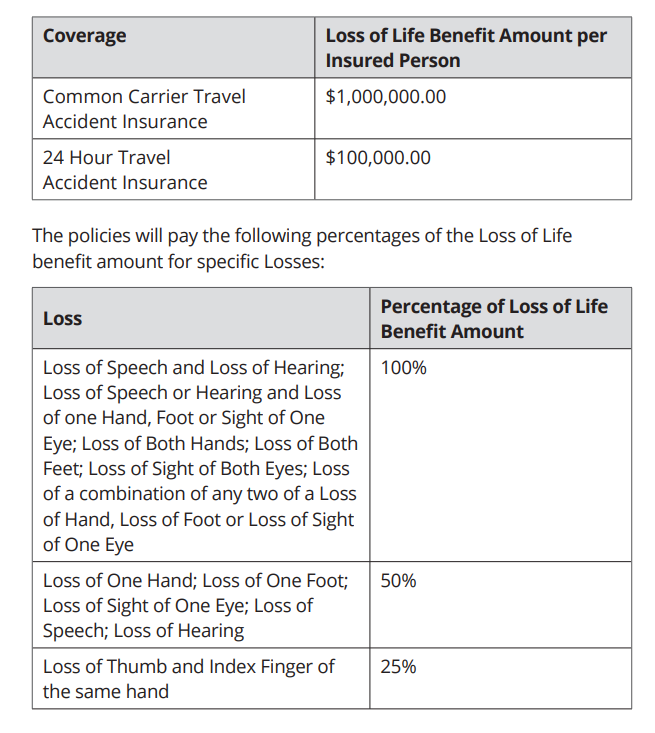
Chase pays up to $1,000,000 for a common carrier loss and up to $100,000 for a 24-hour policy loss based on the following table:
CHASE.COM
Some interesting exclusions with Chase that would prevent a payout include the insured person participating in a motorized vehicular race or speed contest, the insured person participating in any professional sporting activity for which they received a salary or prize money, skydiving or if the insured person traveling or flying on any aircraft engaged in flight on a rocket-propelled or rocket-launched aircraft.
The Chase Sapphire Reserve also offers emergency evacuation insurance. If you or an immediate family member paid for at least a portion of your trip with the card, you’re eligible for up to $100,000 in emergency medical evacuation.
Your covered trip must last between five and 60 days and be at least 100 miles from your residence. If you are hospitalized for more than eight days, the benefits administrator can arrange for a relative or friend to fly round-trip in economy class to your location.
If your original ticket cannot be used, you can also be reimbursed for the cost of an economy ticket home. In a worst-case situation, the benefit also pays up to $1,000 to repatriate your remains.
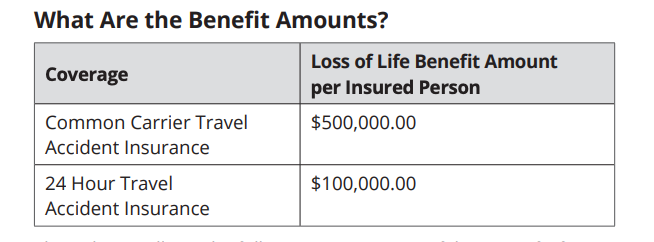
The Chase Sapphire Preferred® Card (see rates and fees) offers travel accident insurance as well, but with lower payouts on the common carrier policy. The benefits pay up to $500,000 for a common carrier loss and up to $100,000 for a 24-hour policy loss based on the following table:
CHASE.COM
Make sure to carefully read through your guide to benefits so that you know what your Chase Sapphire card does and does not cover.
Apply here: Chase Sapphire Reserve and Chase Sapphire Preferred
United Club Card
The top-tier United Club℠ Card (see rates and fees) offers travel accident and emergency evacuation insurance. The travel accident insurance benefits pay up to $500,000 for a common carrier loss.
The card also carries emergency evacuation coverage, so you can rest assured knowing that you're covered in case of eligible medical events. Keep in mind that the United Club Card's benefits may have terms that differ from other Chase cards, so read through your card's guide to benefits for more information.
We hope none of us ever have to worry about either of these policies, but it’s nice to have peace of mind if you or your family need emergency assistance. This reassurance is one more reason to ensure one of these cards is always in your wallet when traveling.
The benefit guides of all cards are updated regularly, so make sure you don’t toss them in the trash when updates show up in the mail and read the online guides for the latest terms and conditions.
By commenting, you agree to our Community Guidelines to help create a positive space for conversation. The responses below are not provided or commissioned by the bank advertiser, our partners, or The Points Guy (“TPG”). They have not been reviewed, approved, or otherwise endorsed by any of these parties. All responses are submitted by individual contributors, and neither the bank advertiser, our partners, nor TPG are responsible for ensuring that all posts and/or questions are answered.