Sleek finishes, incredible tech and seat doors that (will eventually) close: Korean Air business class review

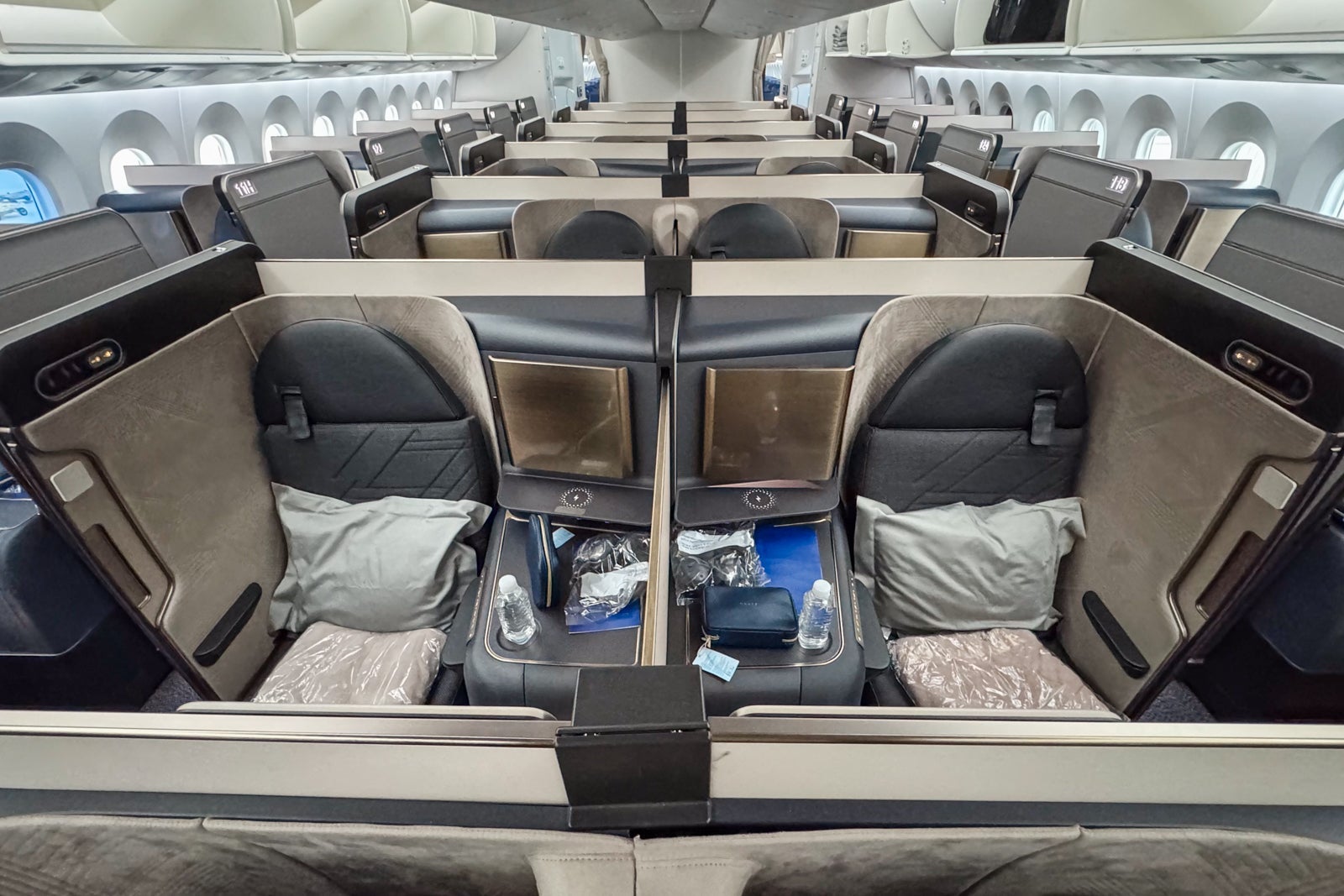
Quick take: Korean Air's Prestige Suites 2.0 business-class seats have all the current technological bells and whistles. Now we just have to wait for their doors to actually close.
Pros
- Sleek suites with doors that will eventually close.
- Tasty inflight dining, including meals you can order ahead of time.
- Great entertainment options on a huge screen.
Cons
- Suites are only on a limited number of planes and routes so far.
- A seat cover or mattress pad would be a nice addition to the bedding.
- Unless you have Korean Air SkyPass miles, there's no easy way to redeem points or miles for awards at a good value.
Korean Air has been on a news spree lately. In mid-March, the airline unveiled sweeping design changes to its logo and livery as well as new inflight and lounge dining options and upgraded first-class amenities like Frette bedding.
A few days later, the airline followed that up with the announcement that it would be installing premium economy cabins on some of its Boeing 777s and revamping its lounges at Los Angeles International Airport (LAX) and John F. Kennedy International Airport (JFK).
However, it was a bit of news from last July that most intrigued me. That was when the airline unveiled its new Prestige Suites 2.0 business class — suite-style seats with privacy doors and a host of technological updates.
Ever since details were released, I've been looking for a way to experience the new seats myself. I finally had the chance to do so on a recent flight from Incheon International Airport (ICN) to Vancouver International Airport (YVR).
Here's how the experience went.
How much does it cost to book Korean Air business class?
The cost of a Korean Air business-class ticket will depend on your origin and destination, the time of year, and whether you are flying one-way or round-trip.

For my one-way itinerary from Seoul, South Korea, to Los Angeles via Vancouver, British Columbia, flights were pricing out at $2,300-$2,800. I ended up paying $2,871 because of the date I was flying, though it had previously been available for just under $2,400.
I booked this through Amex Travel because I have The Business Platinum Card® from American Express and I can get 35% of my points back for flights on my selected qualifying airline (up to 1,000,000 points back per calendar year). So all told, it cost me 186,622 points — not an amazing redemption, but worth it to try this new product, and it would let me earn Delta SkyMiles and Medallion Qualification Dollars toward elite status to boot.
Unfortunately, it's not as easy as it once was to accrue Korean Air SkyPass miles. A long time ago, the program was a transfer partner of Chase Ultimate Rewards, but that's not been the case for many years. Then, last June, Marriott and Korean Air ended their longstanding transfer partnership. So now, your best bet for earning SkyPass miles is to fly Korean and its partners and to open one of its cobranded credit cards. Short of that, expect to pay cash for your ticket. However, if you do have SkyPass miles, award availability is terrific and priced at just 62,500 miles one-way.
As for flying in the Prestige Suites 2.0, keep in mind that they are currently only aboard the airline's Boeing 787-10s, though its 777-300ERs should be retrofitted with them eventually as well. For that reason, I chose one of the routes where the 787-10 is in service every day. I could have flown to Seattle instead, but that route operates with a 787-9 on a lot of days and I was too anxious about a potential aircraft swap to chance it. Always double-check that your specific route and flight number will be operated with a 787-10. I'd recommend checking on surrounding days as well to make sure that the route doesn't have numerous aircraft types that make a swap more likely.
Want to check out our trip reviewing every cabin on a different Korean Air flight?
Checking in to and boarding Korean Air business class
Korean Air business-class passengers can enjoy the following priority services at the airport:
| Priority check-in? | Yes, Sky Priority and business-class counters |
|---|---|
Luggage allowance | Two checked bags of up to 32 kilograms (70 pounds) each |
Lounge access? | Yes, Korean Air and partner lounges |
Does the airline participate in TSA PreCheck? | Yes |
Priority boarding | First, after preboarding |
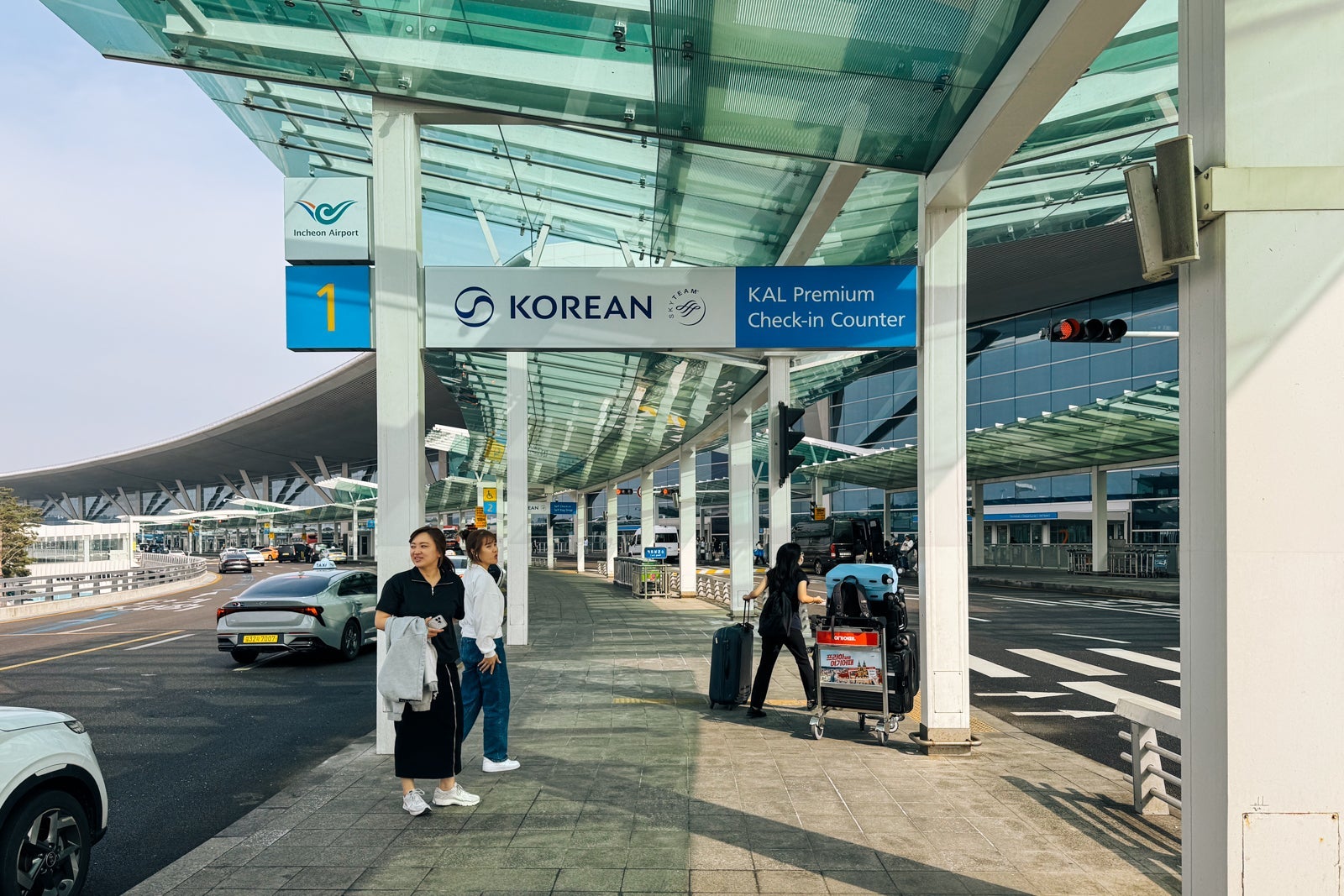
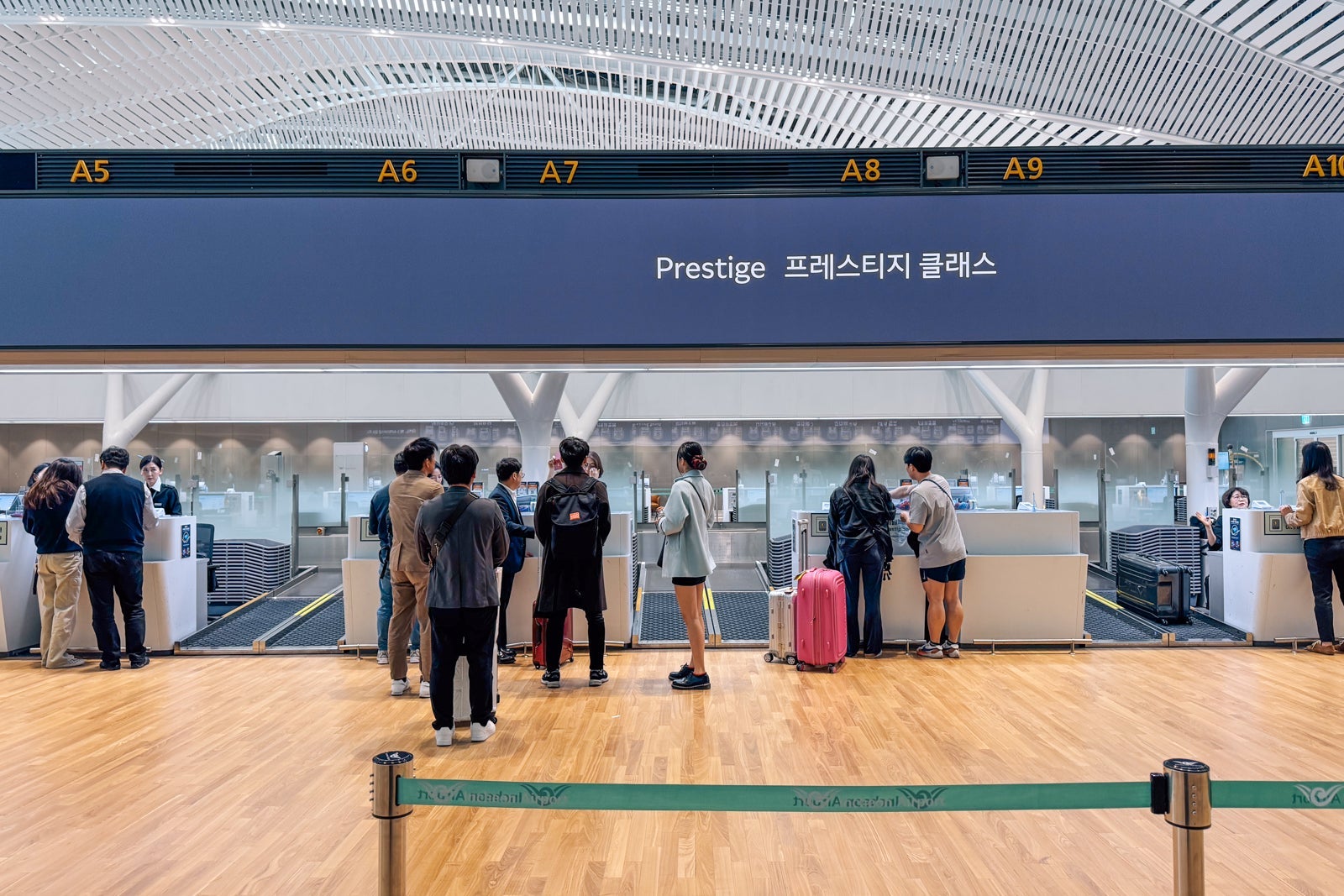
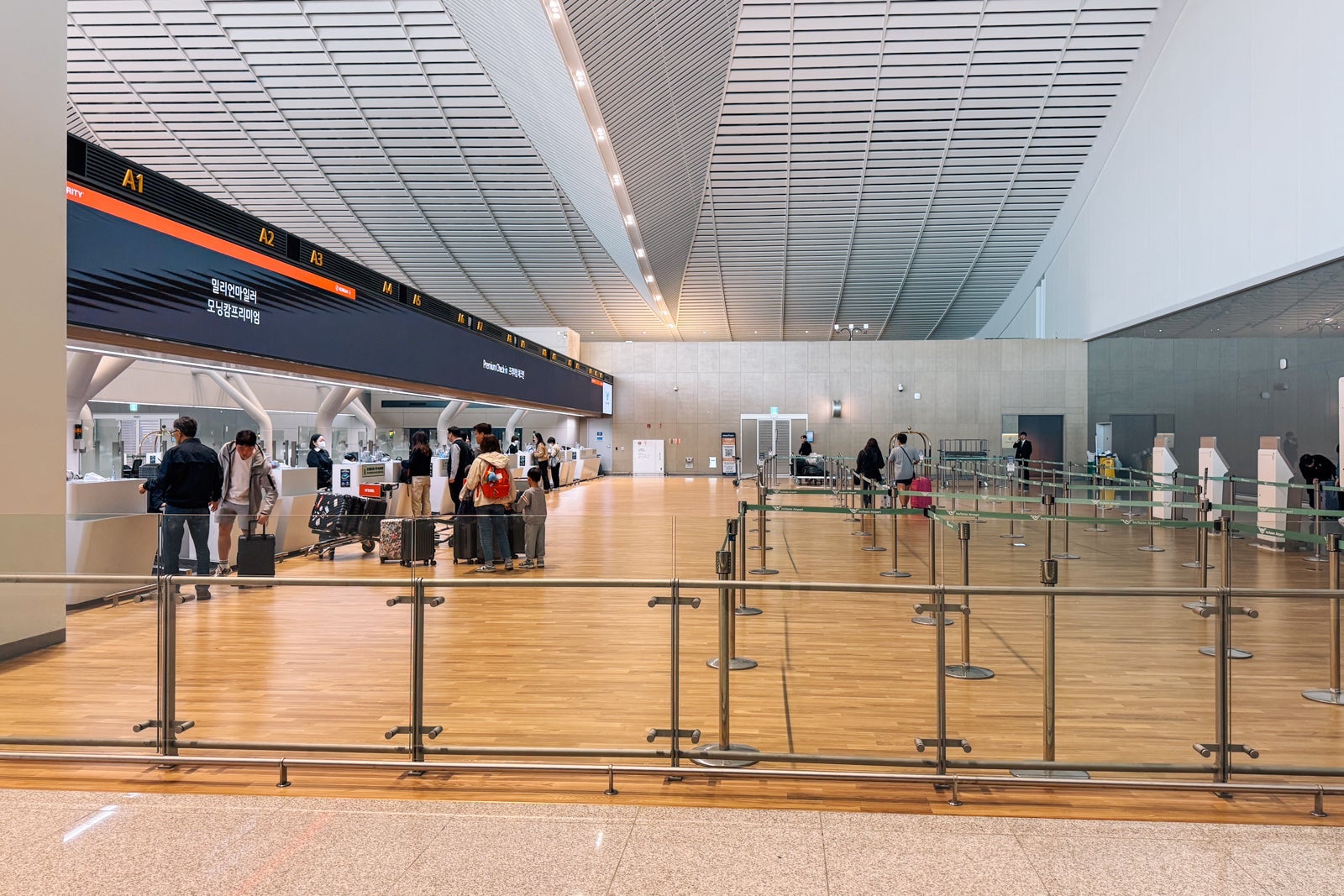
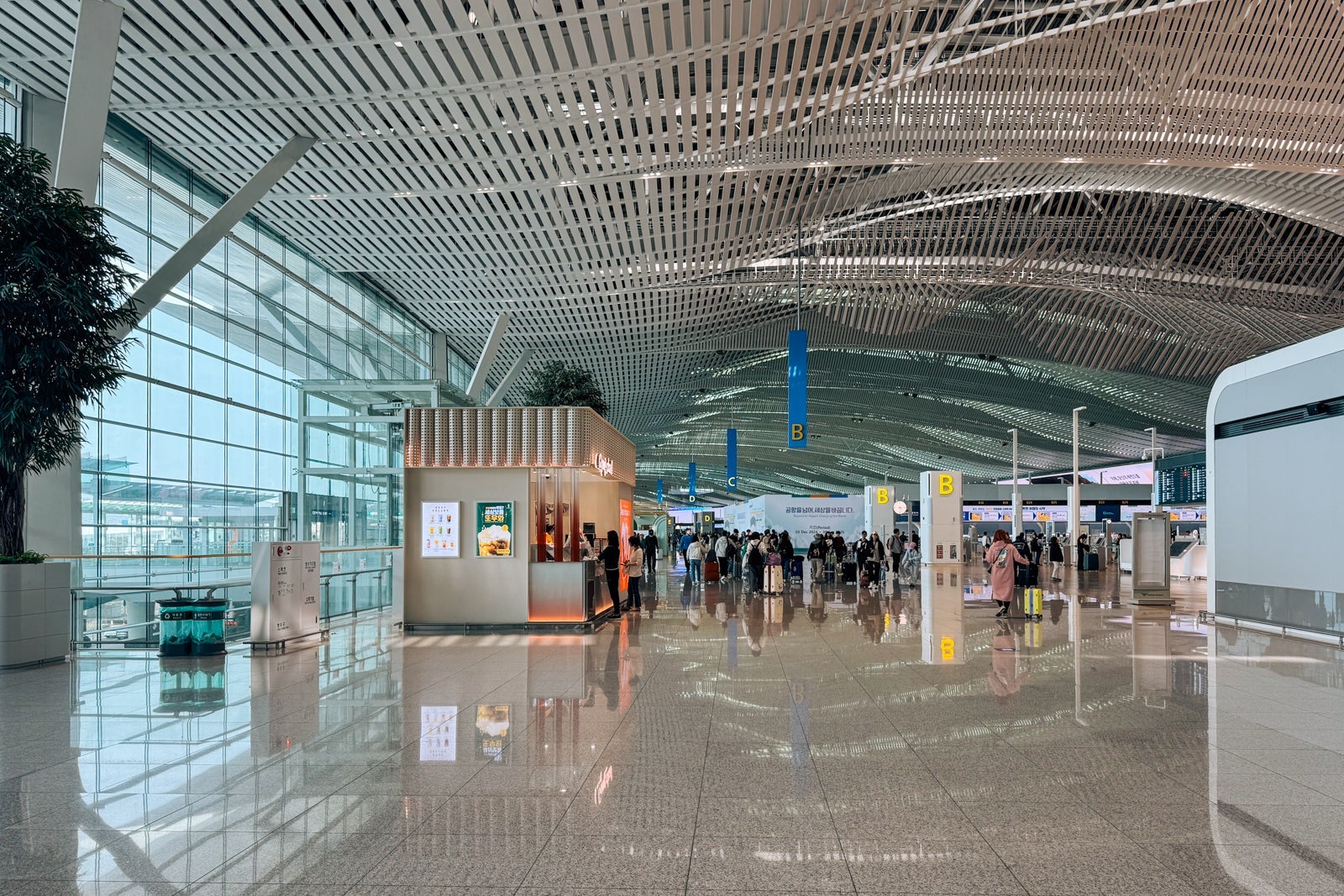
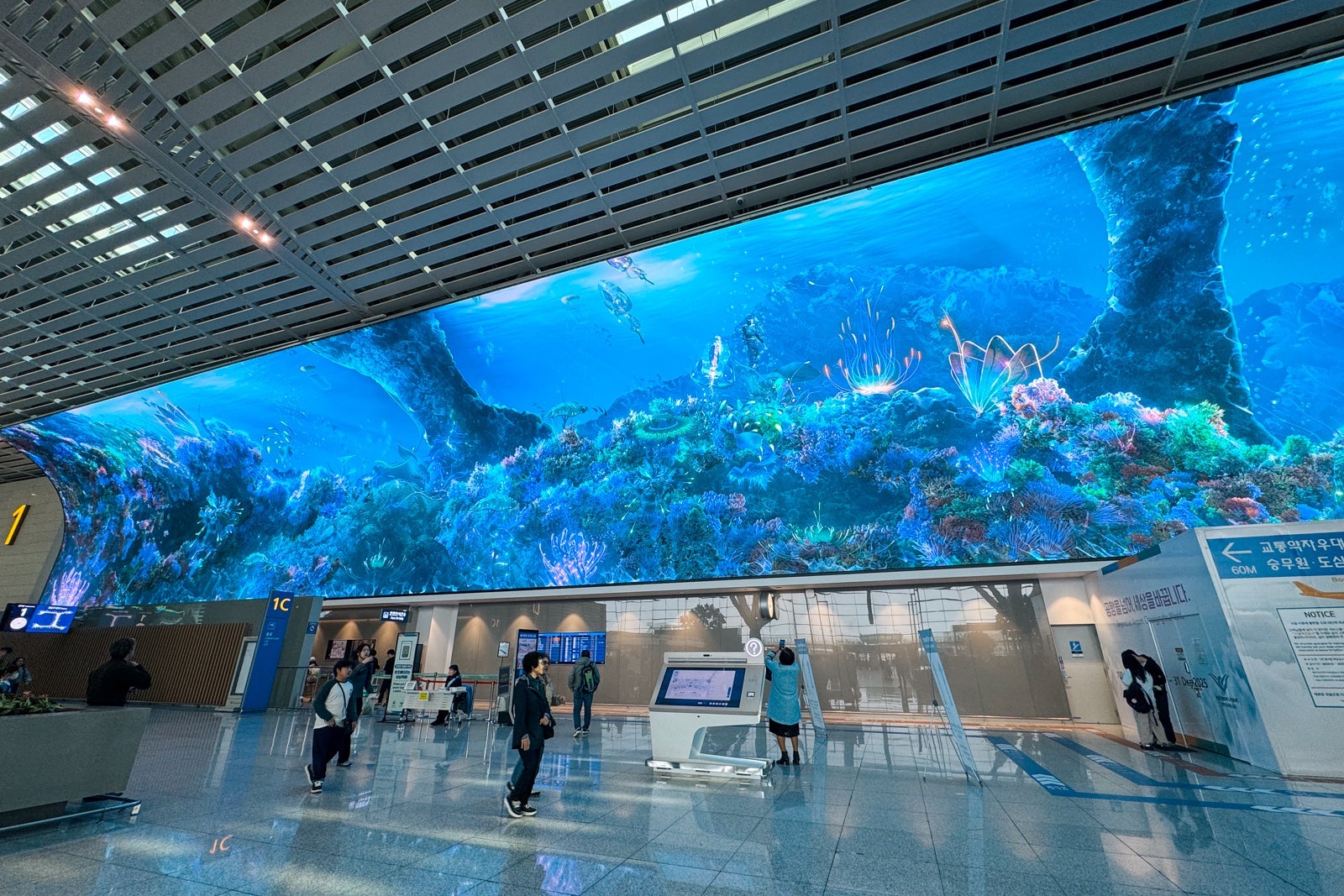
Korean Air operates out of Terminal 2 at Incheon International Airport, and there is a separate section for premium passengers to check in at one end of the terminal.
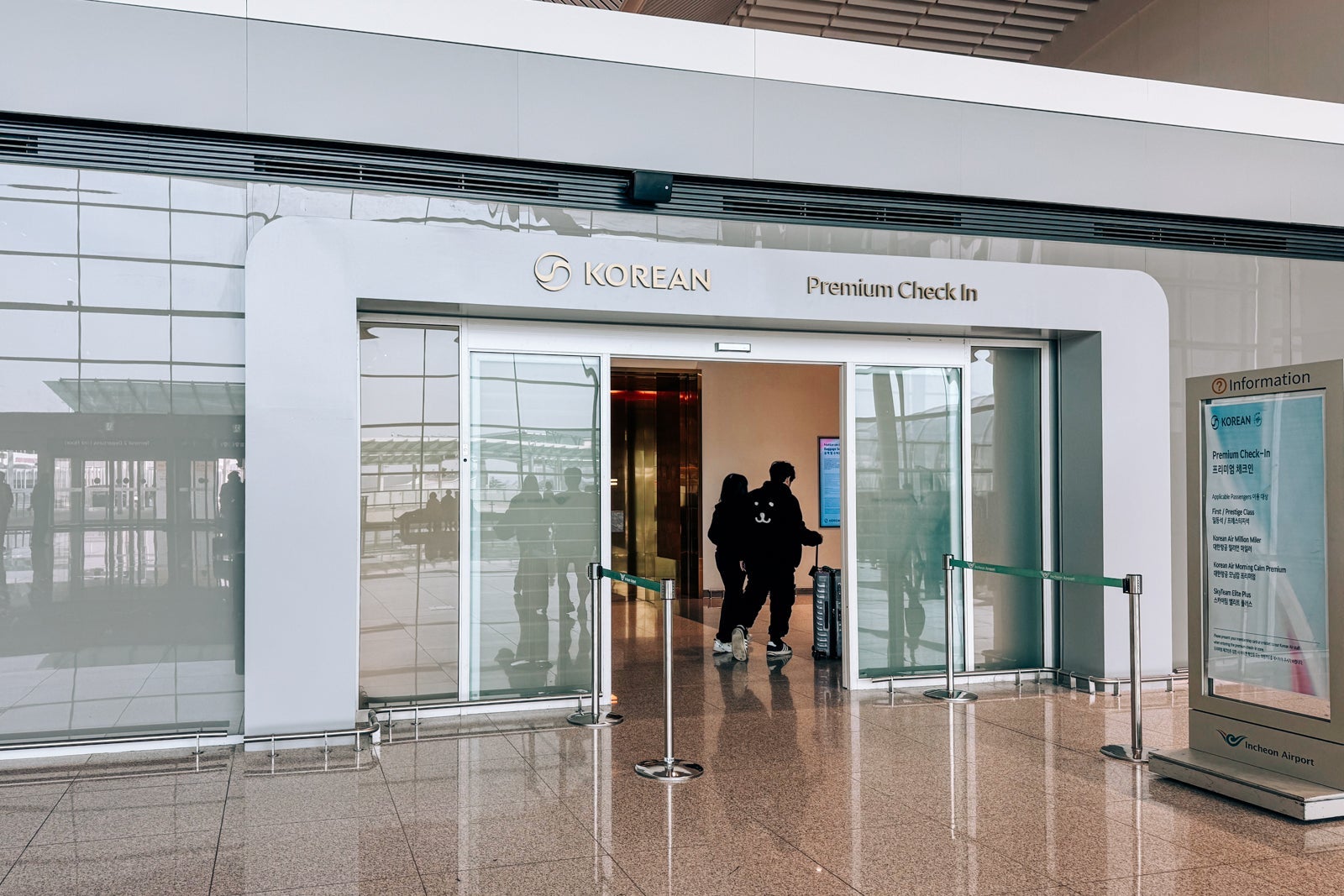
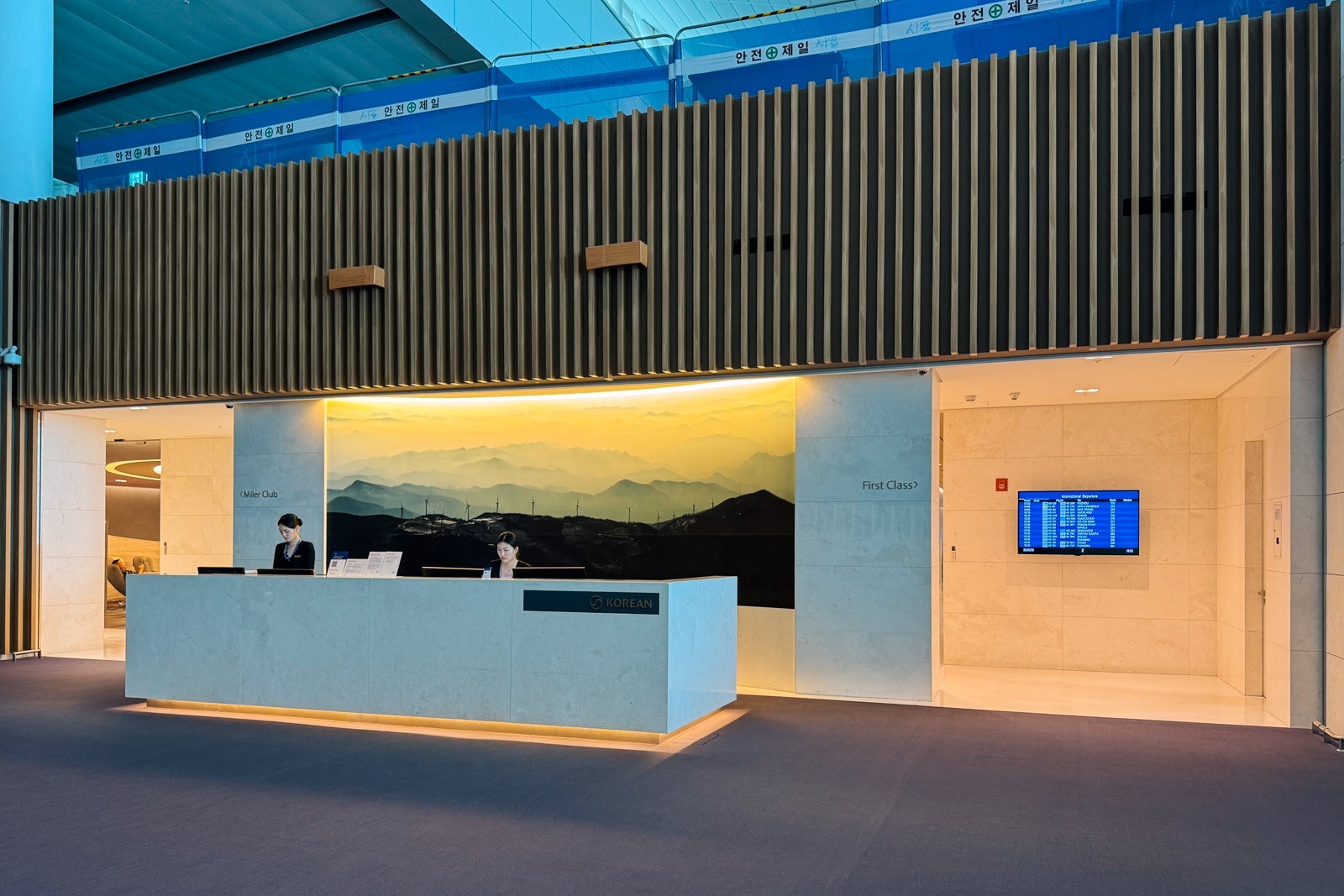
There were plenty of agents ready to help customers and I did not have to wait in line. The only downside is that this area is a bit of a hike to immigration and security. I had been given access to the airline's Miler Club lounge for high-tier elite members rather than one of its business-class lounges. It is actually a dual lounge — to one side is the Miler Club area and to the other is the first-class lounge.
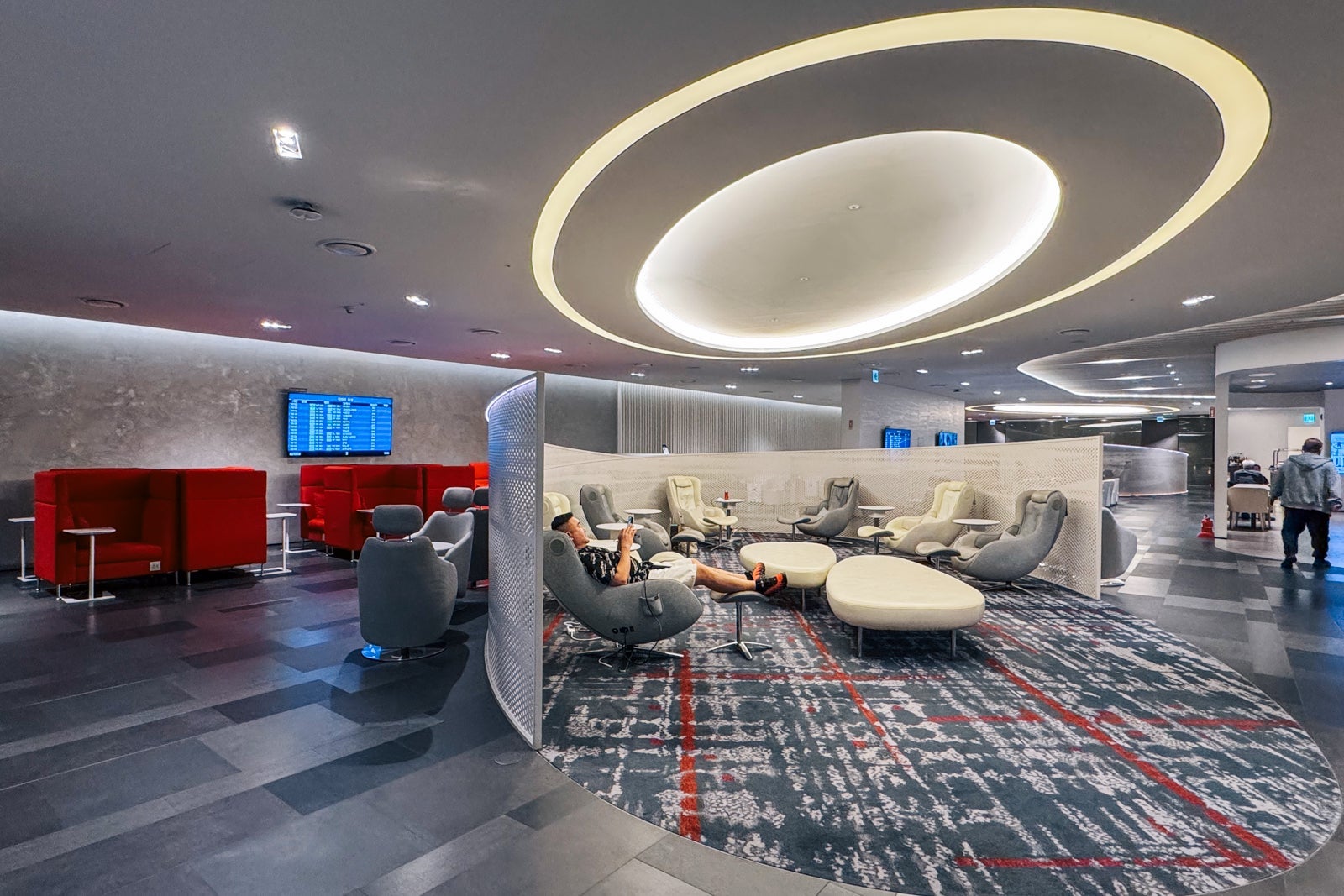
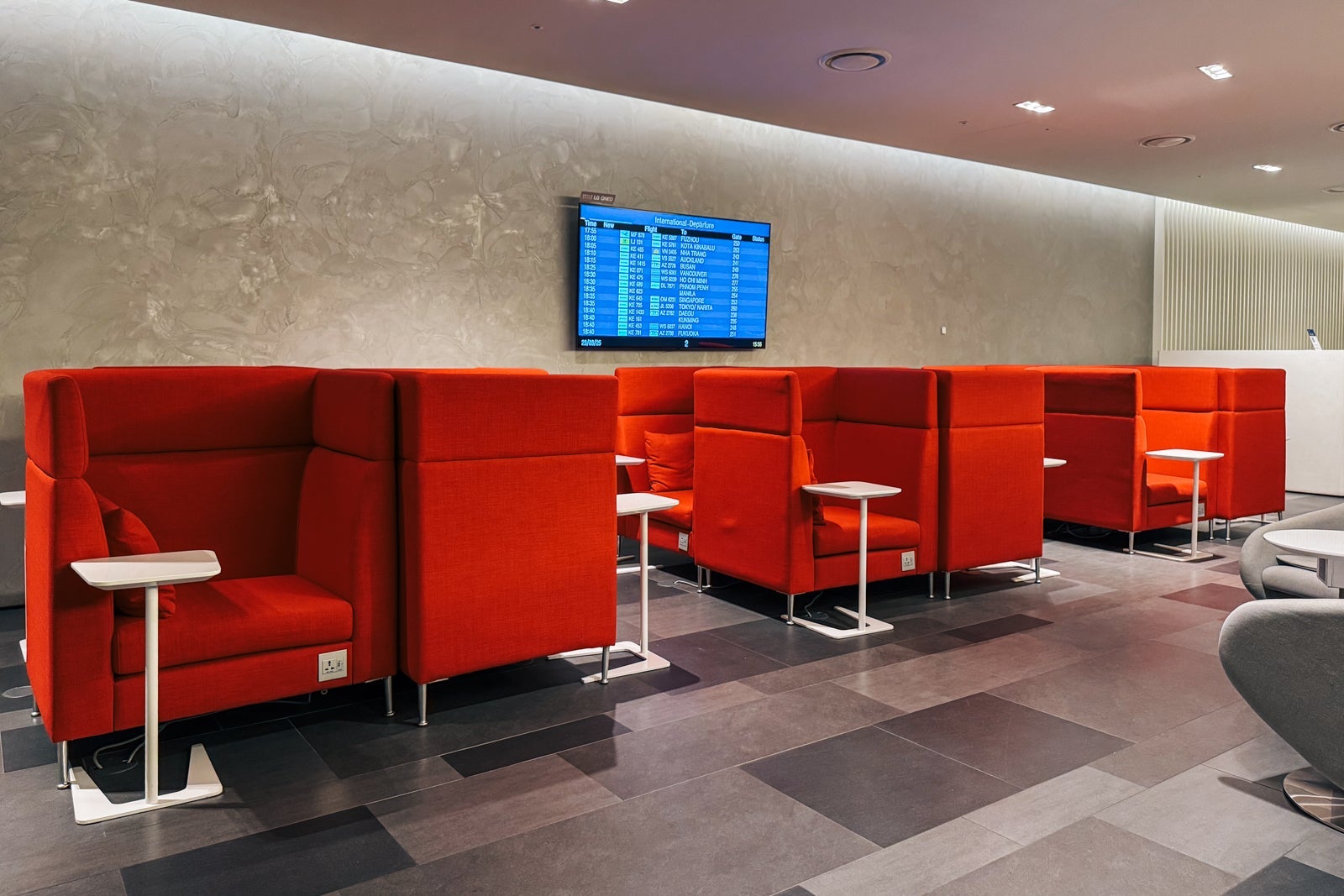
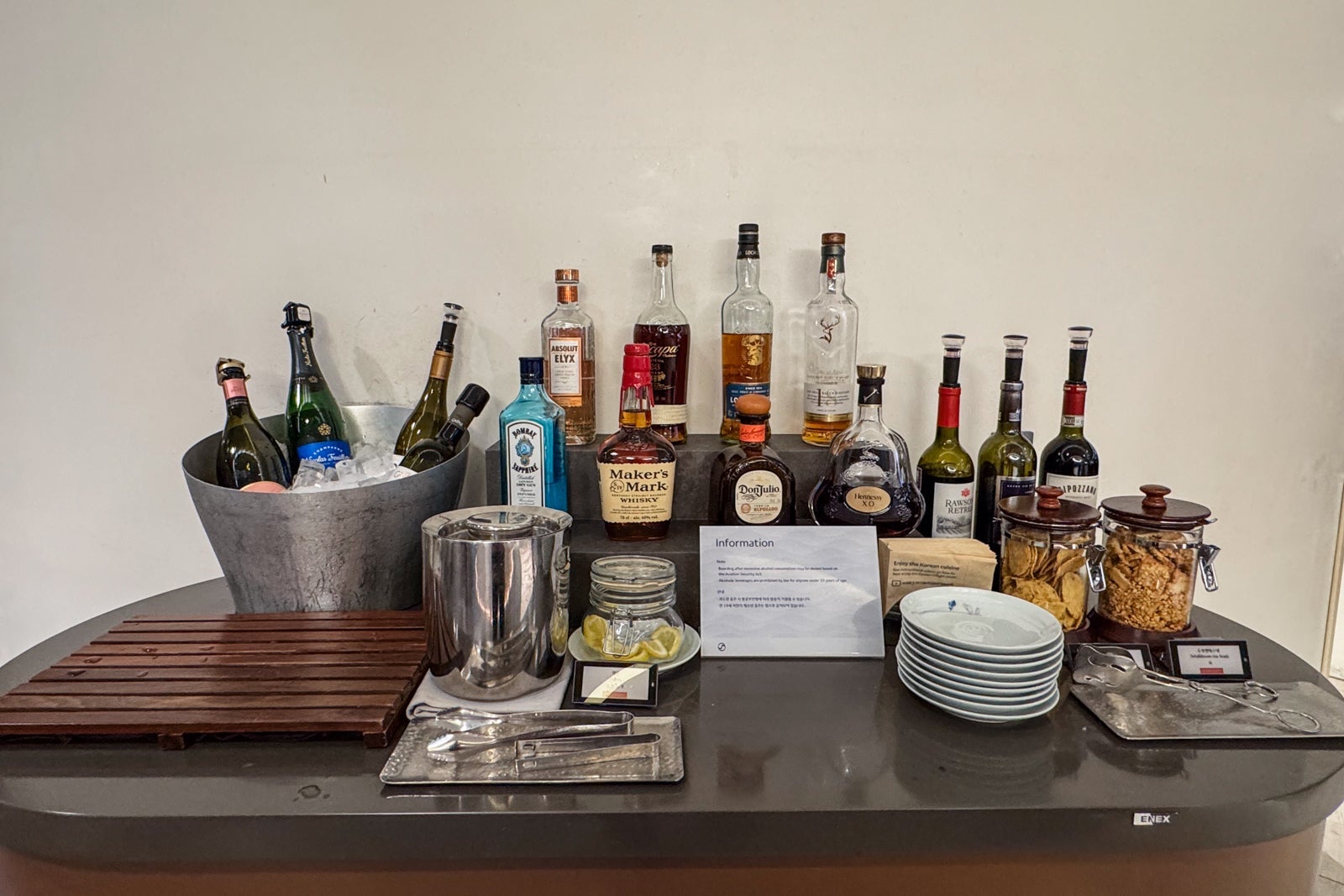
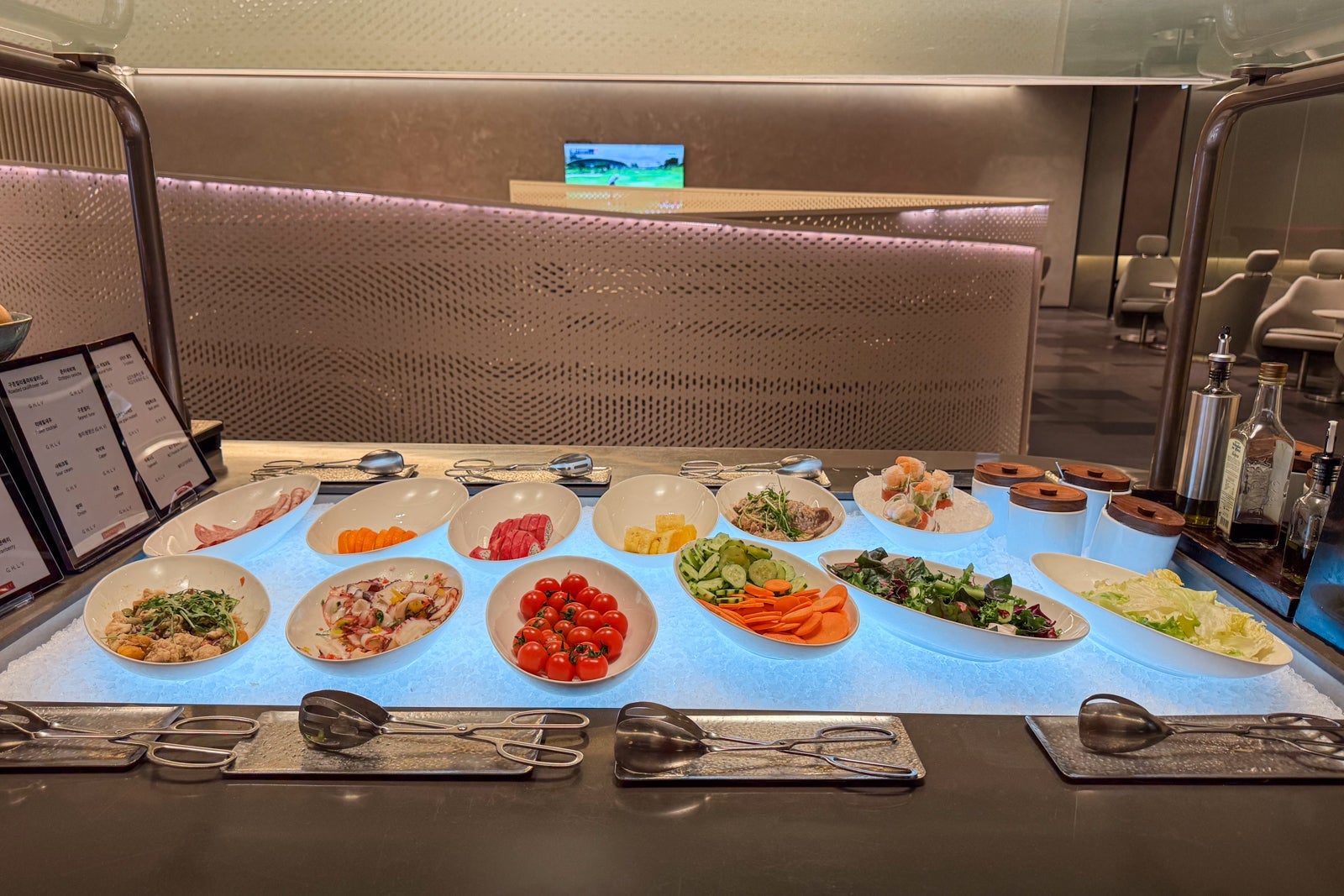
The space was small but well laid out with several different seating areas, including spaces with lounge chairs, areas with chairs and small desks for working, and some restaurant-style tables. There was a small buffet with hot and cold Western and Asian dishes, plus a salad bar and self-serve drinks.
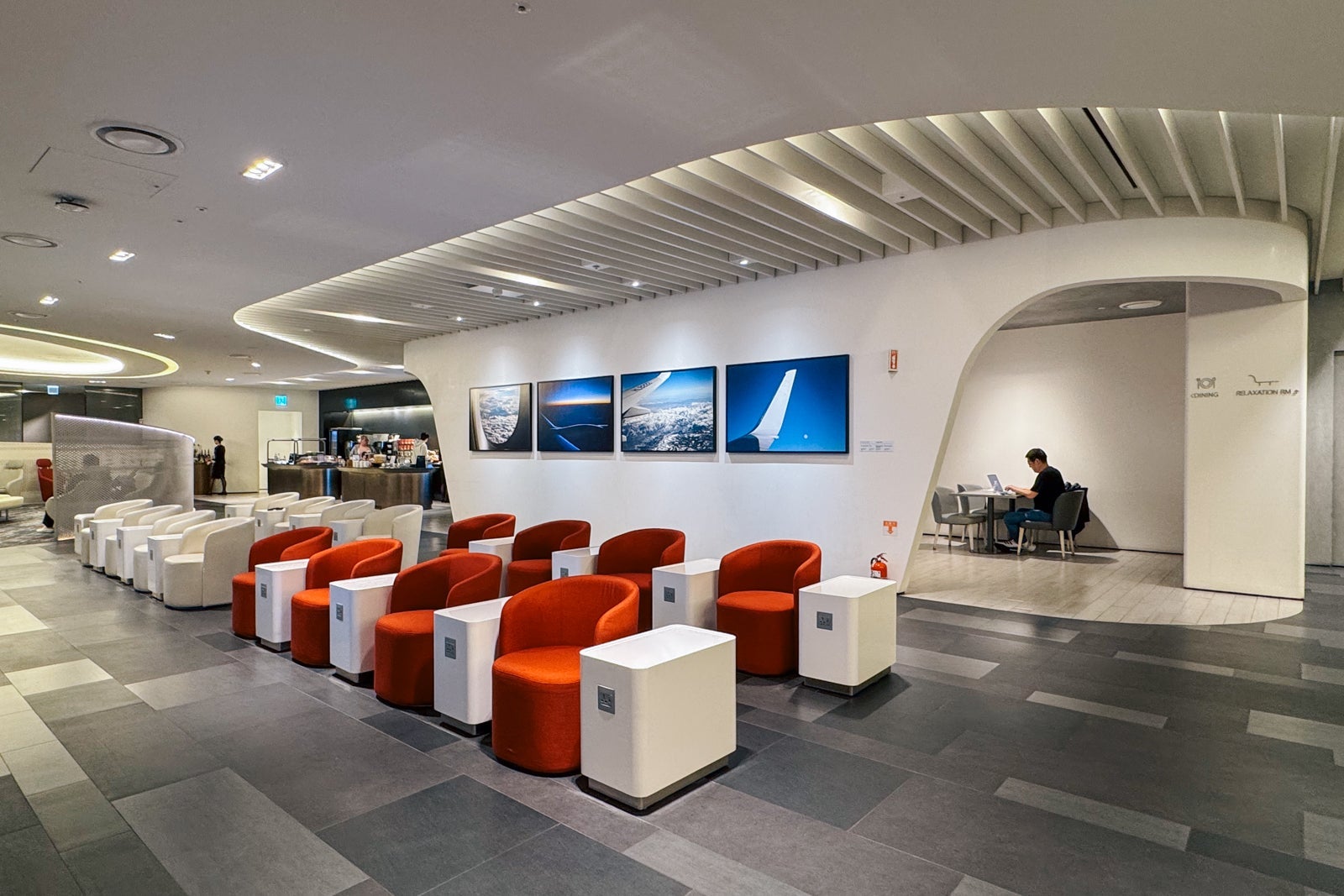
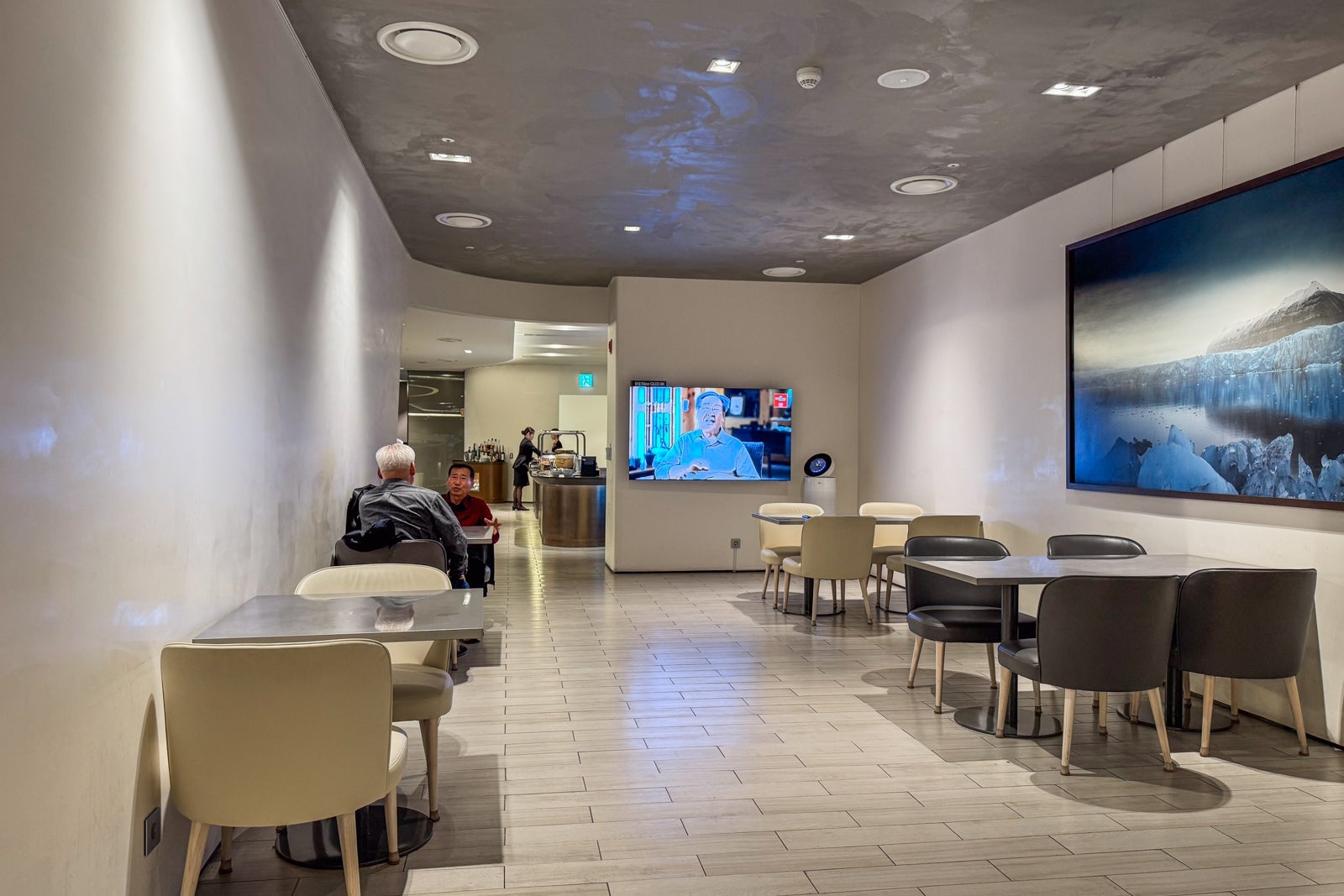
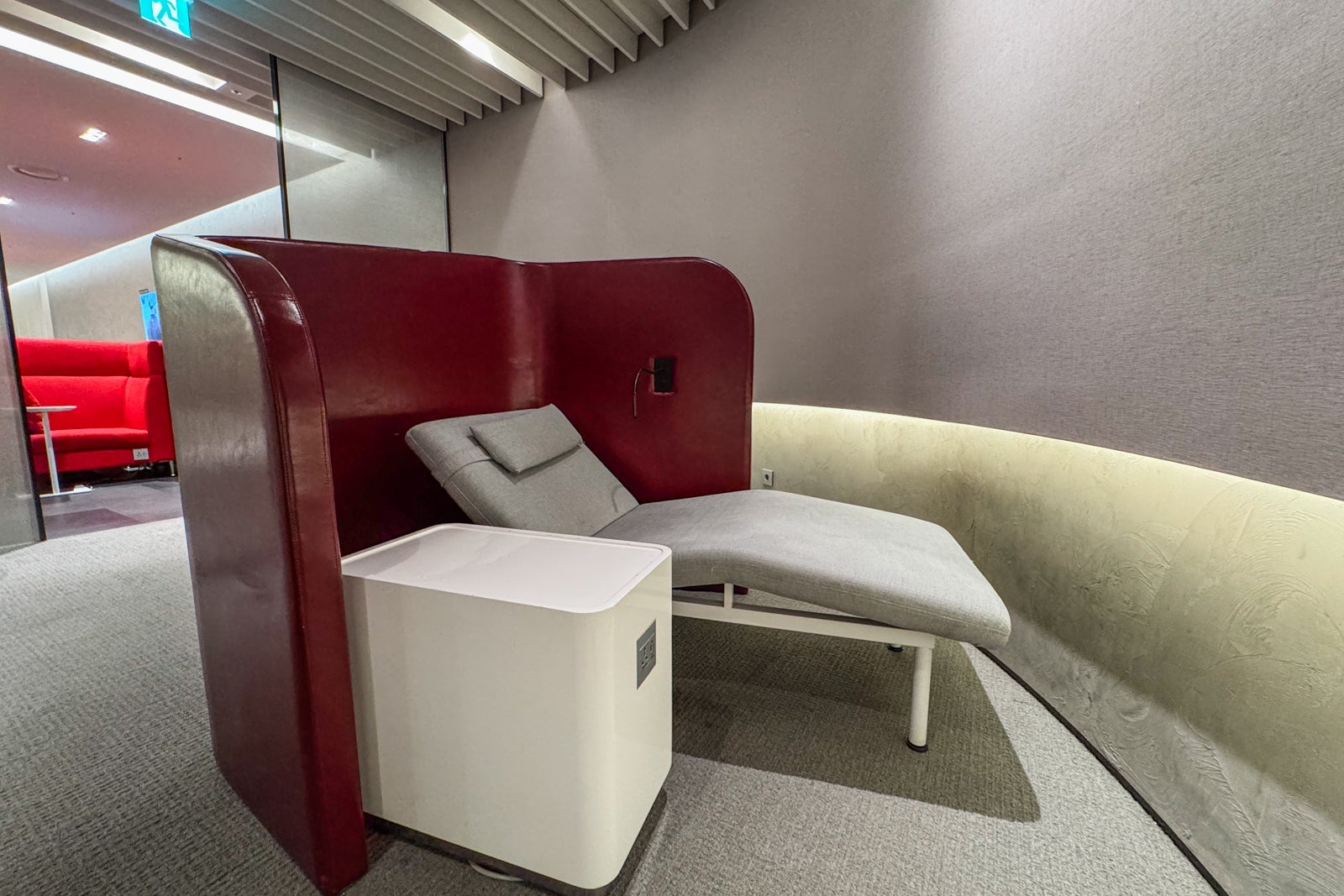
There were also shower and bathroom facilities. I used the free Wi-Fi to work for a bit and then made the trek over to my gate 30 minutes before boarding was set to begin.
How comfortable is Korean Air business class?
The business-class section of Korean Air's Boeing 787-10 is in a single cabin at the front of the plane.
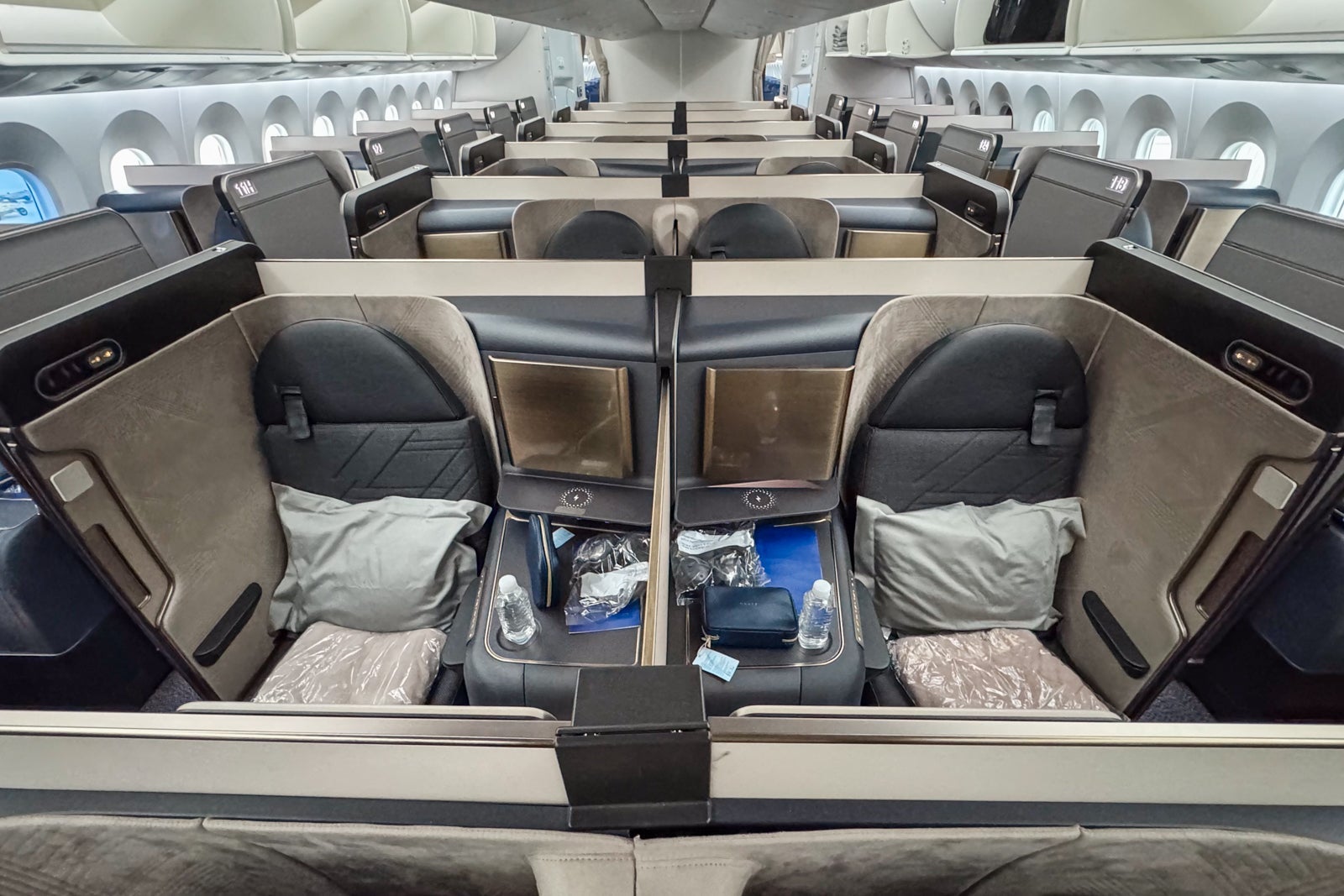
It has nine rows with four seats each in a 1-2-1 pattern for a total of 36 spots. Each of these seats is 21 inches wide at the hips and reclines to a lie-flat bed that's 78 inches long.
| Number of seats | 36 |
|---|---|
Cabin layout | 1-2-1 |
Seat recline | Lie-flat, 78 inches |
Seat width | 21 inches |
Screen size | 24 inches |
For the airline seat manufacturer aficionados out there, these are Collins Aerospace Horizon models. Rather than the angled, reverse-herringbone orientation that's currently so popular with airlines around the world, these all simply face forward.
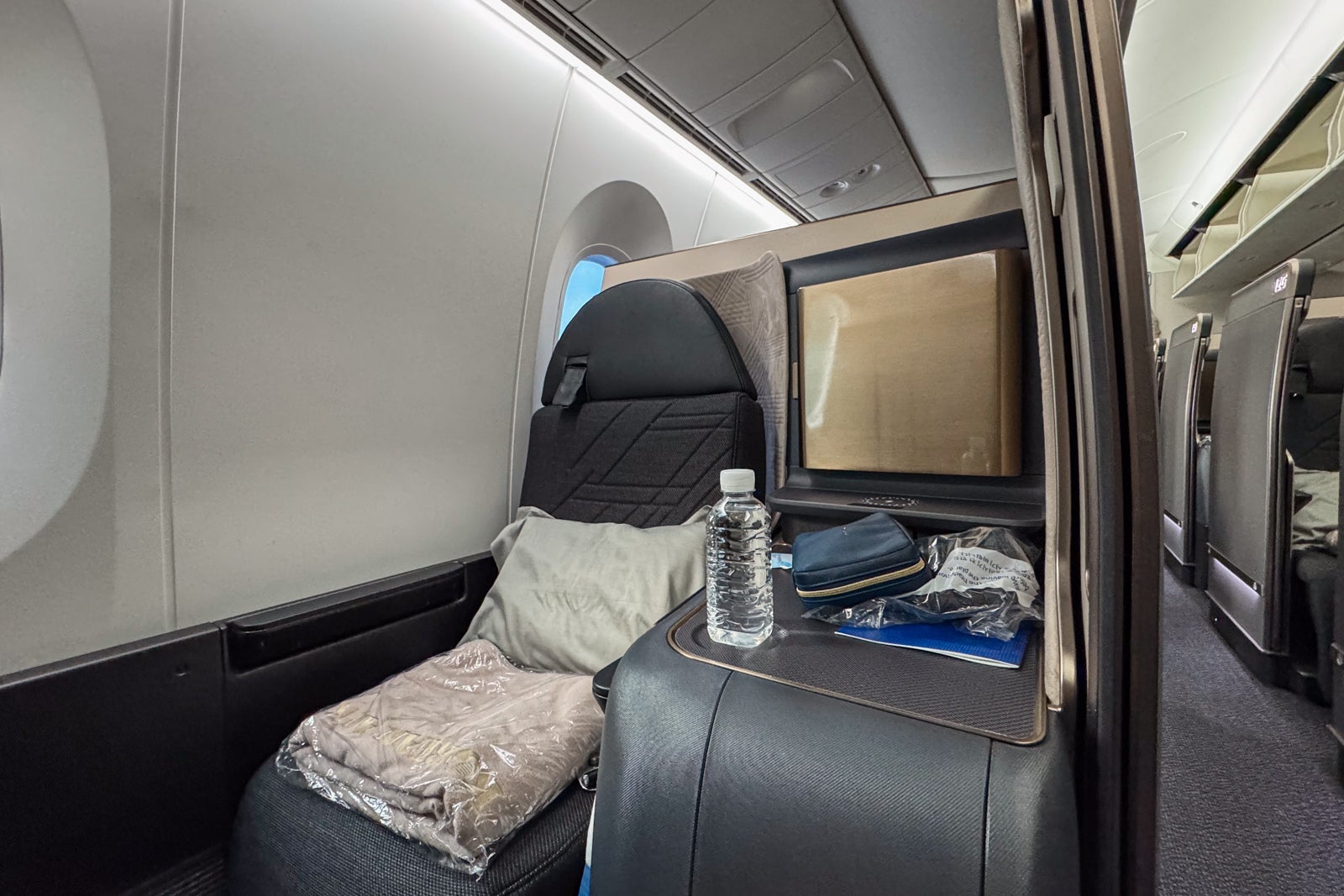
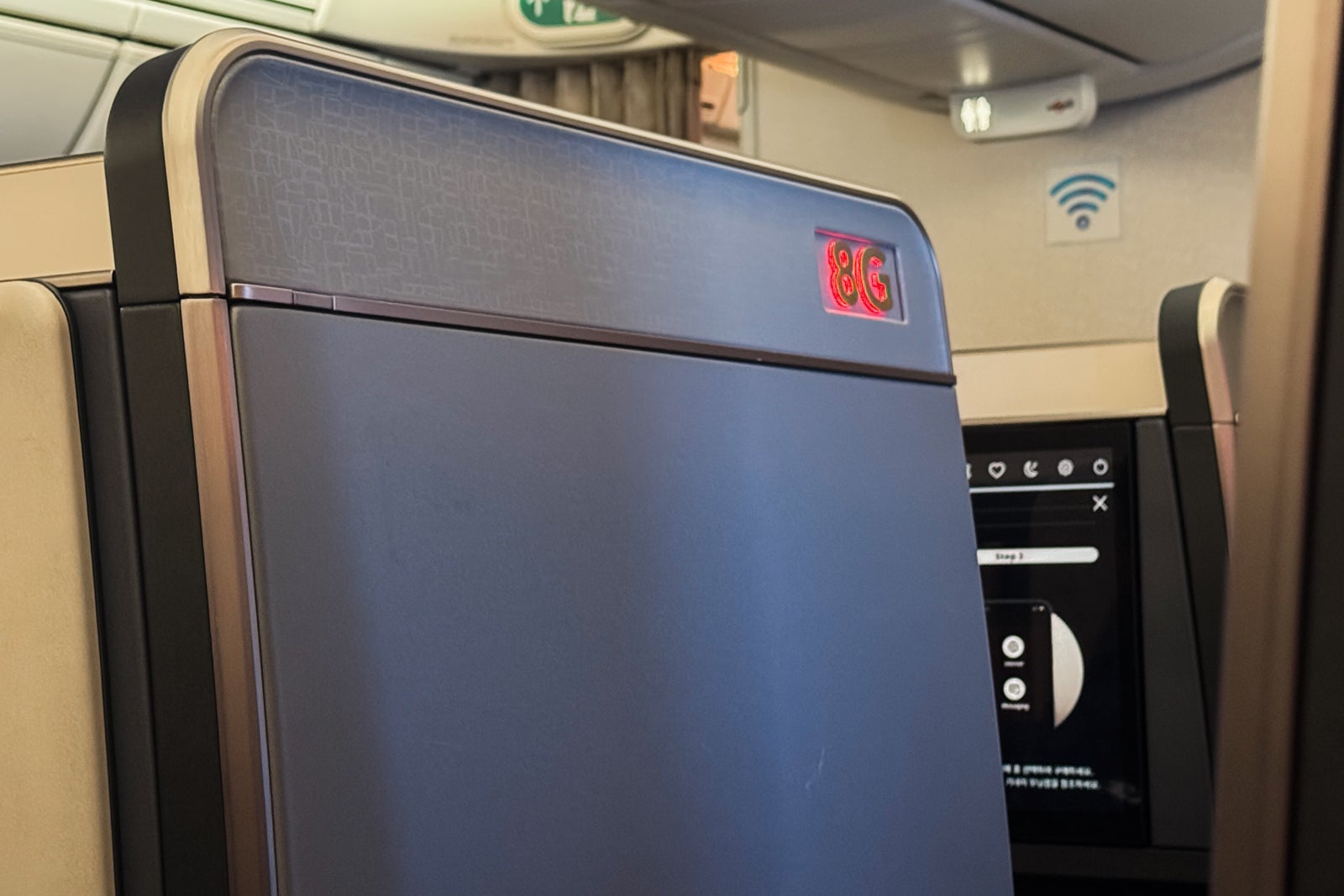
Those on the sides of the cabin alternate closer to the cabin wall or to the aisle, with a wide armrest to one side. A and J seats in even-numbered rows are the ones closer to the wall.
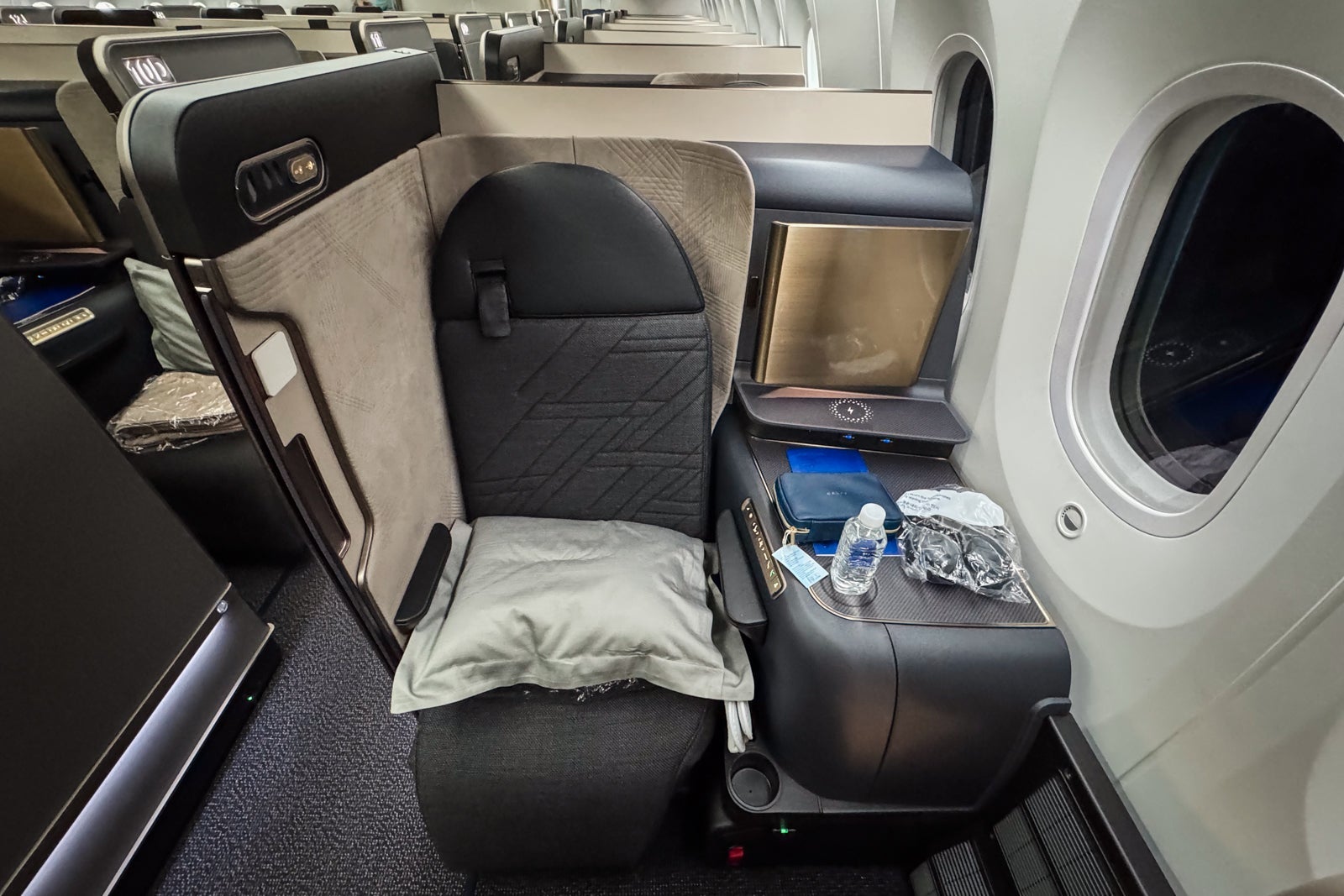
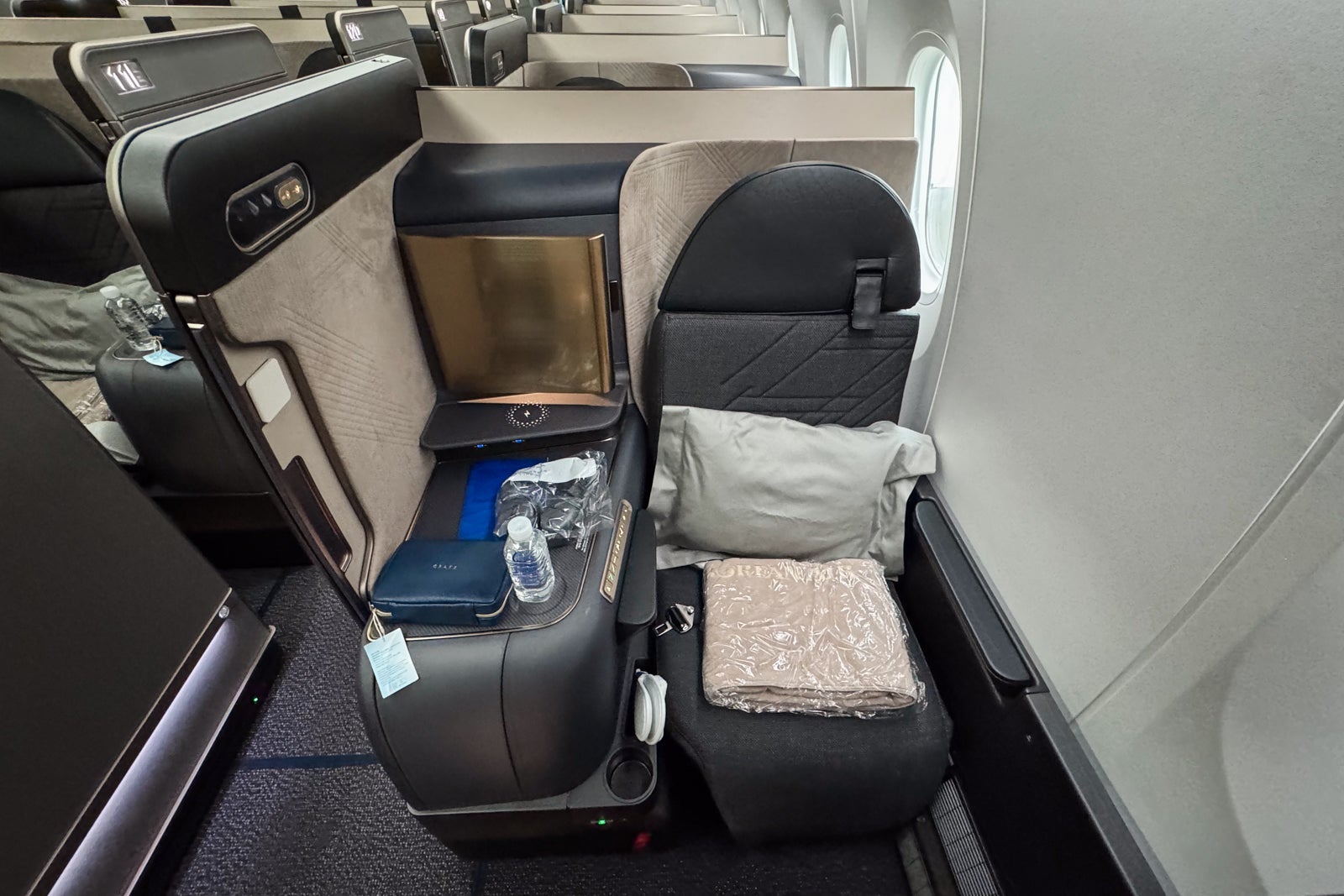
The seats running down the center of the cabin are alternately closer together, in a "honeymoon" style that's great for couples, or farther apart and separated from each other by their wider armrests. Those in odd-numbered rows designated E and F are the closest together.
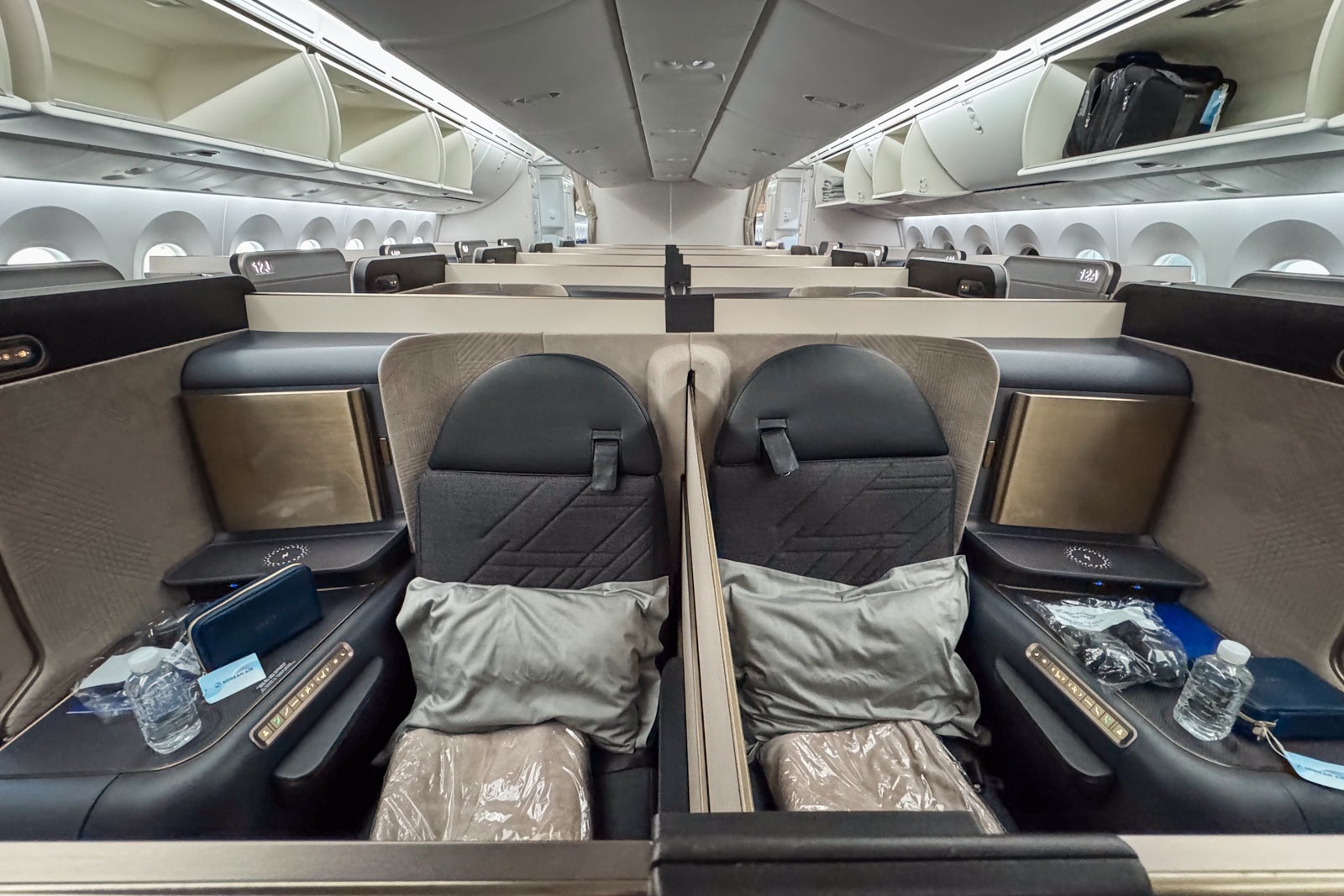
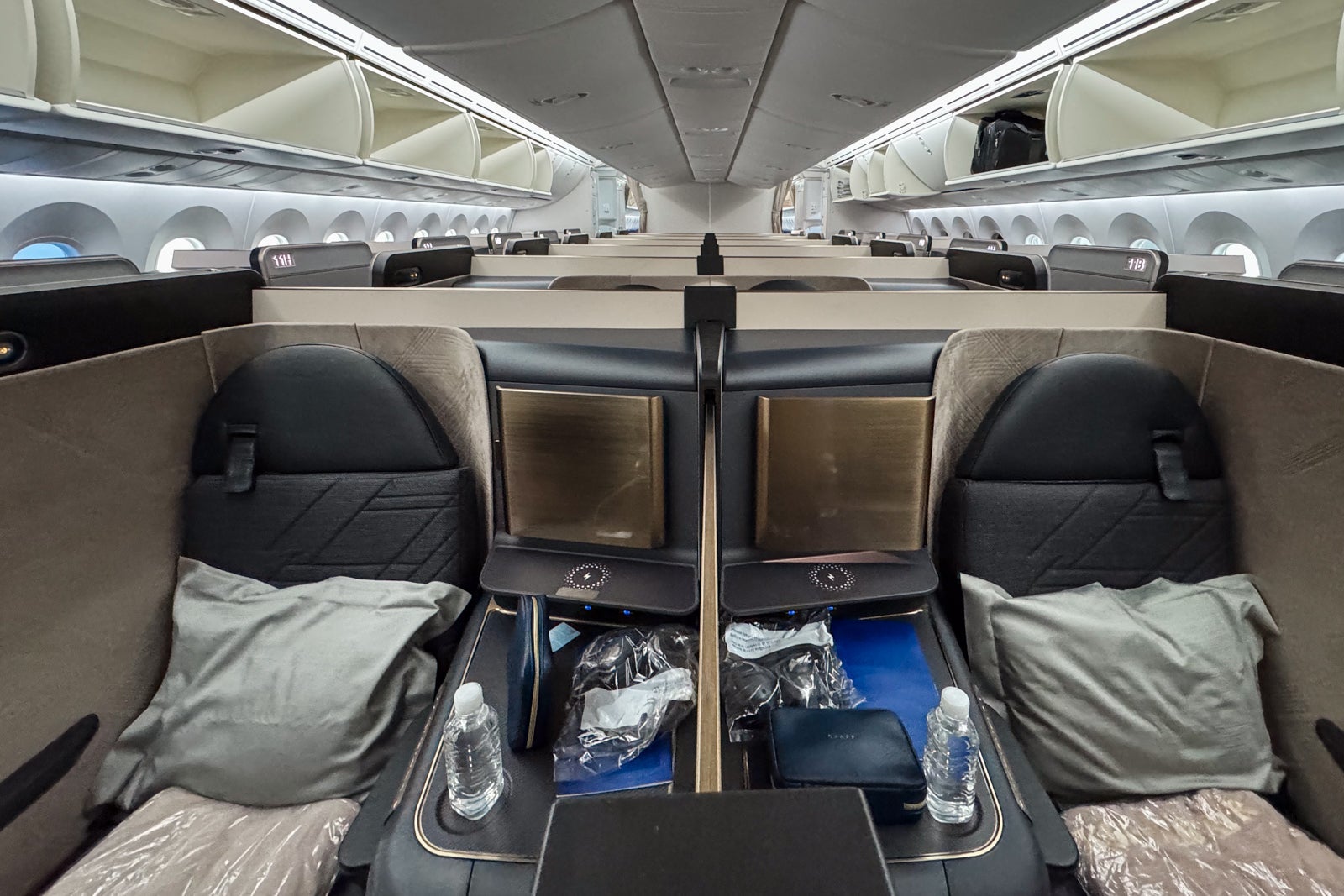
Regardless of which set of seats you're in, though, there is a substantial privacy partition in case you want to be left to your own devices.
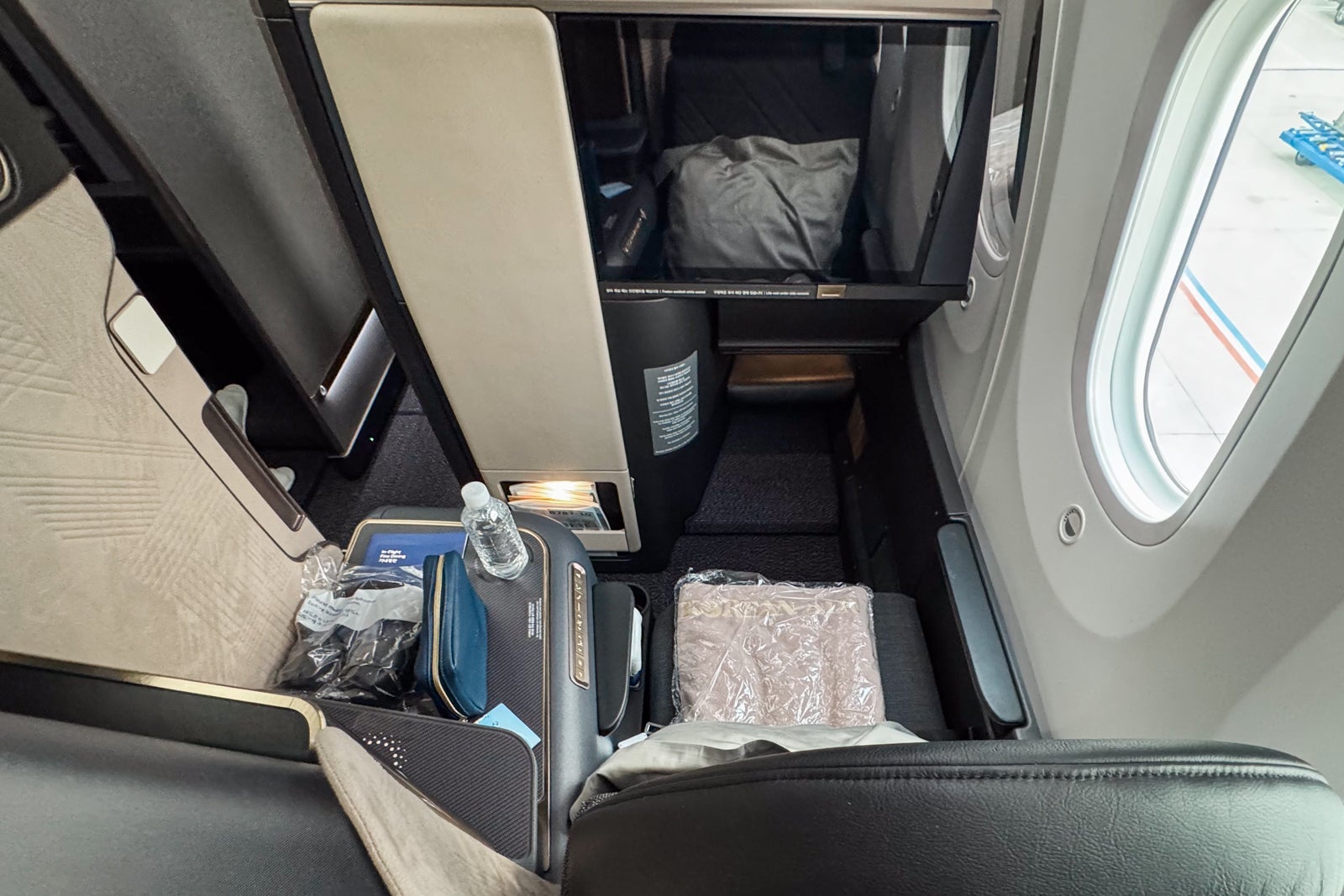
| Best seats for solo travelers | A and J seats |
|---|---|
Best seats for couples | E and F seats |
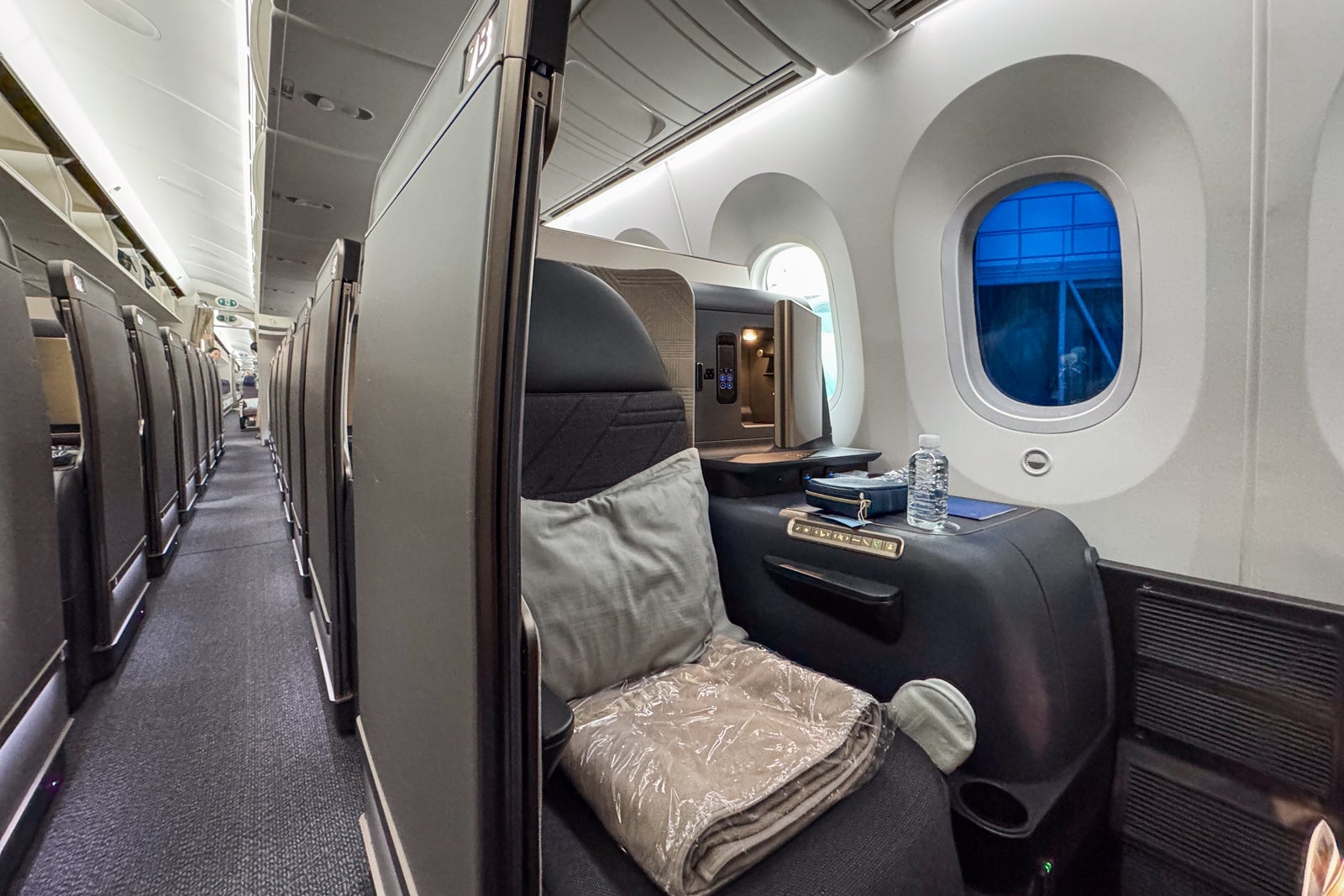
There are many things that set these seats apart from the airline's older fixtures aboard its other aircraft, but the most significant is that these seats have closing doors that rise to a height of 51 inches (nearly to the top of the seat shells). That's nowhere near full enclosure, but it's high enough to block out most activity in the aisle.
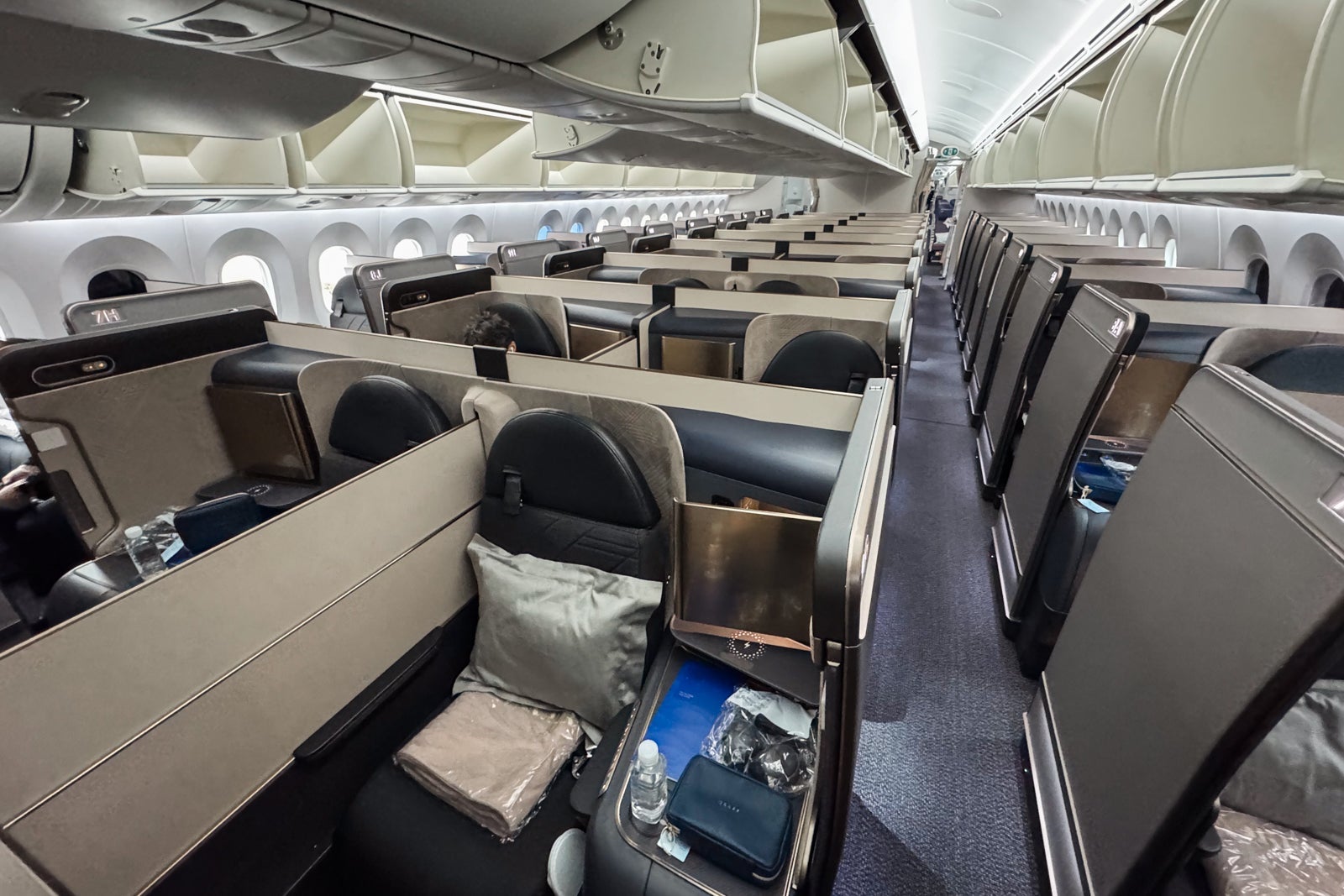
Unfortunately, the doors are not yet operable. The airline is waiting for regulatory approval of them, which is too bad, but hopefully that will be coming soon (an airline representative was unable to confirm a specific timeline). While this is still the case, I would definitely suggest a seat whose wider armrest is on its aisle side to give you more of a buffer from other passengers.
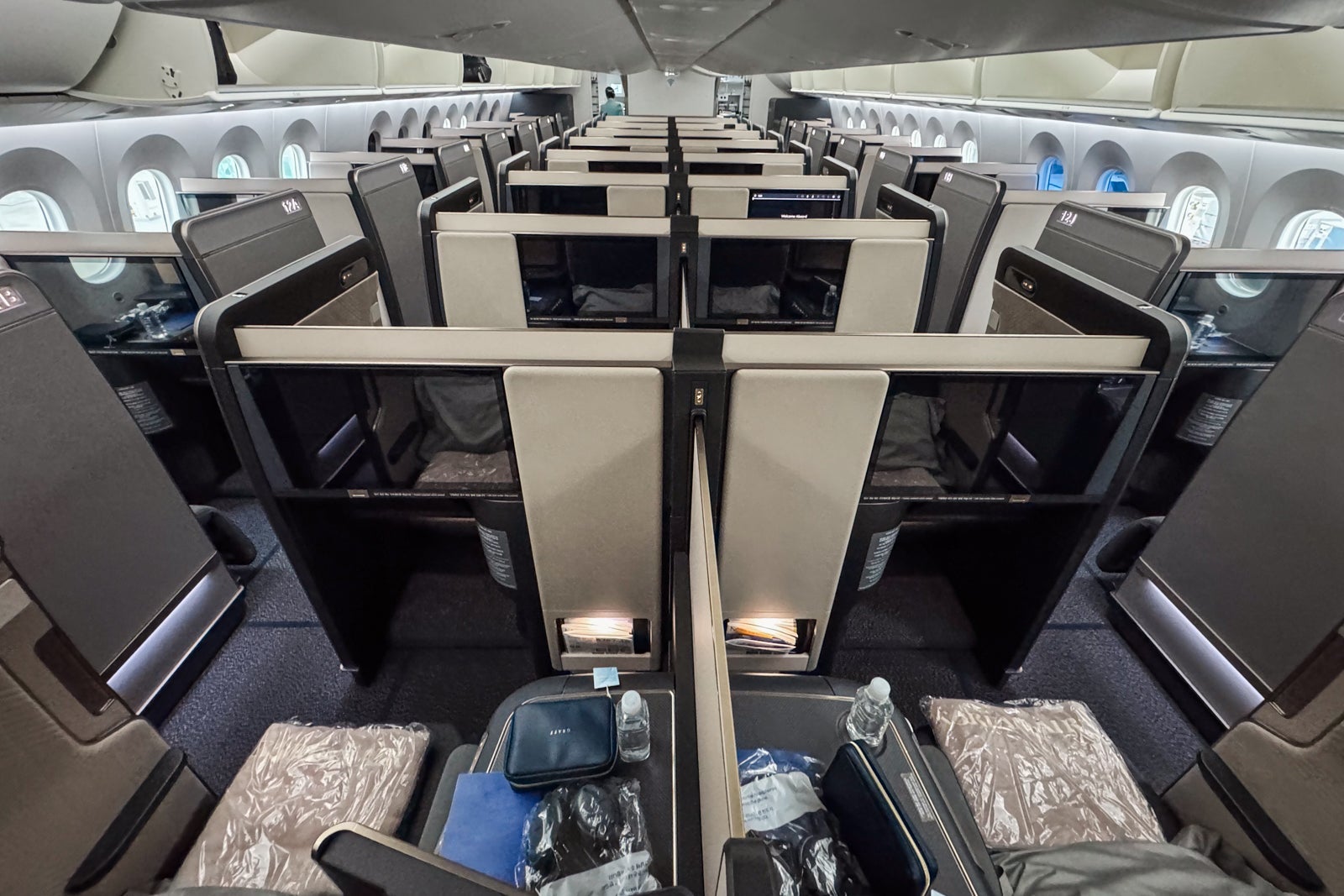
Perhaps the other noticeable difference between this new Prestige 2.0 cabin and Korean Air's older cabins and seats is the departure from the airline's longstanding palette of sky blue. With Prestige 2.0, the airline switched to a much sleeker, more muted color scheme. The seats' upholstery and leather headrests are in various shades of gray with patterning inspired by the traditional Korean patchwork art of jogakbo. There are also brushed metal accents of silver, and the seat-side storage cubby has a glossy bronze finish.
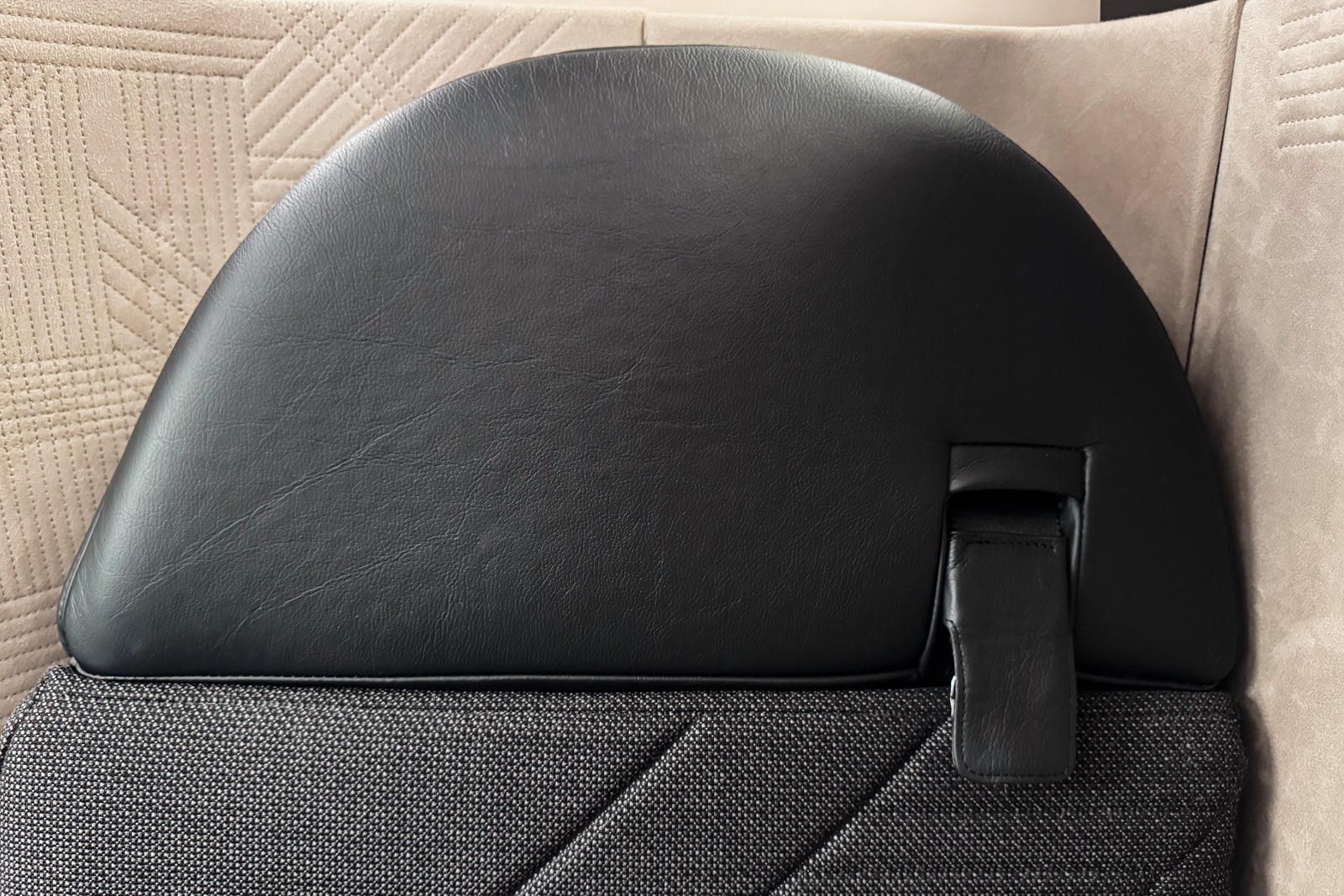
Though toned down, the overall effect feels sophisticated and elegant, though I do miss how bright those blue cabins were.
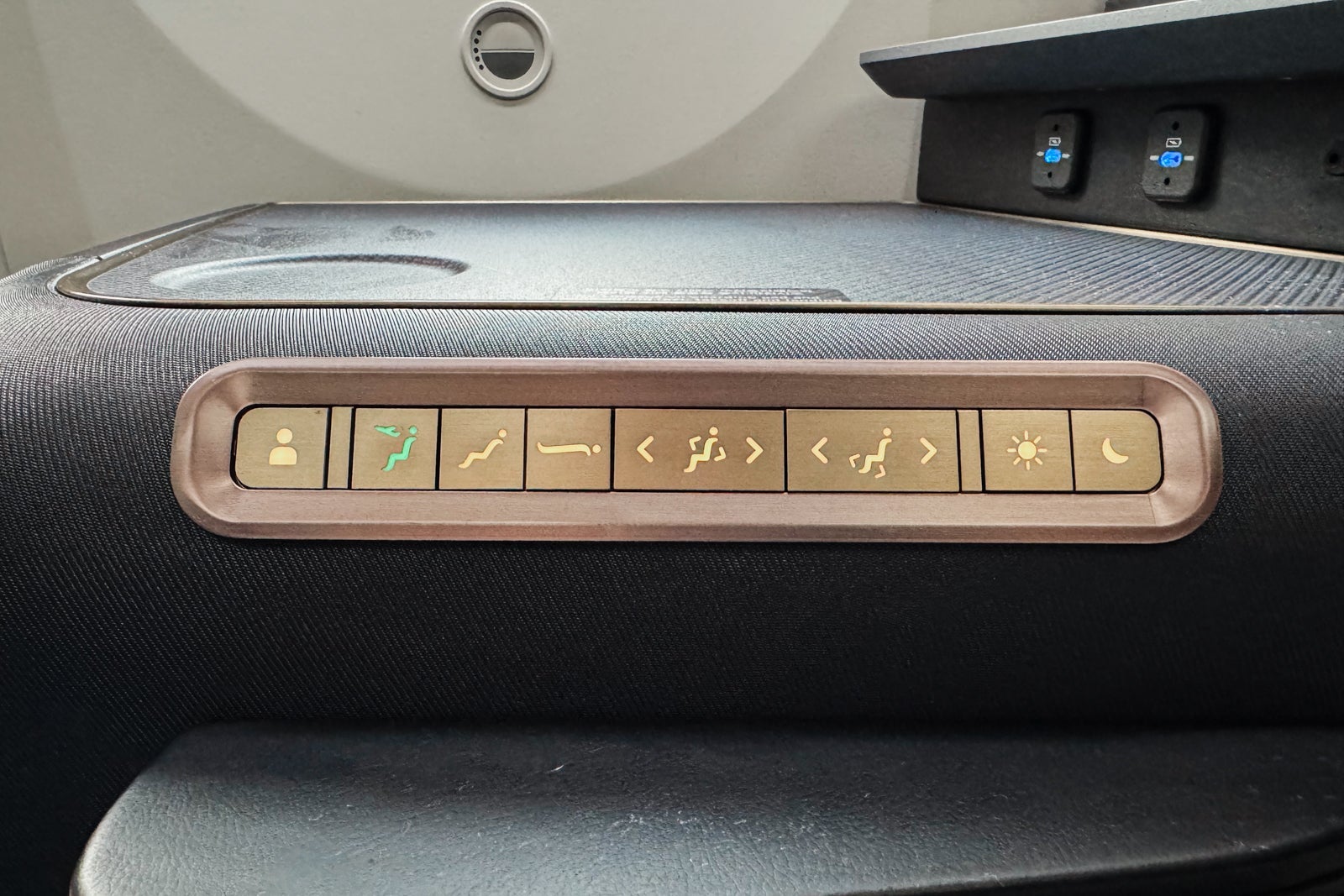
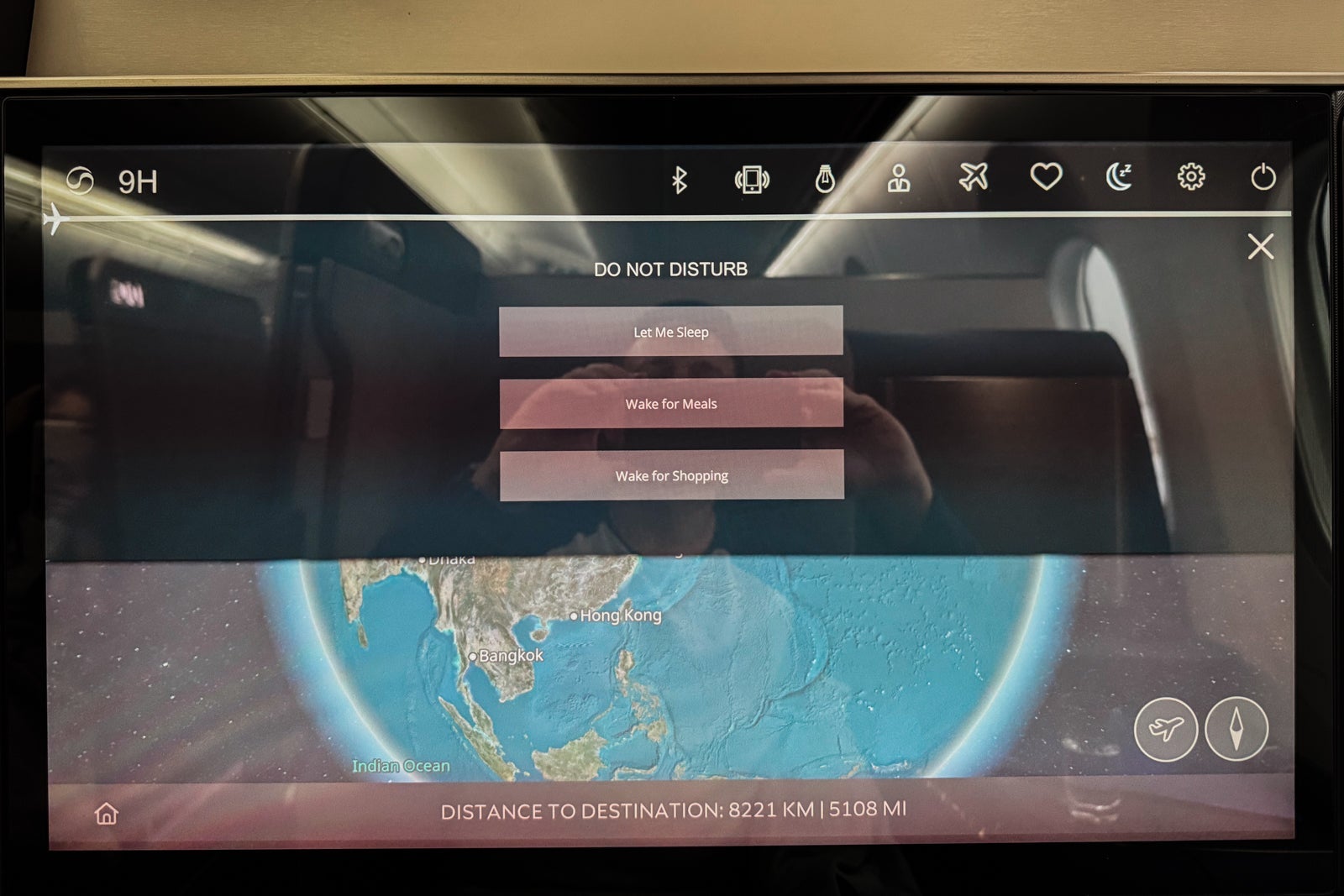
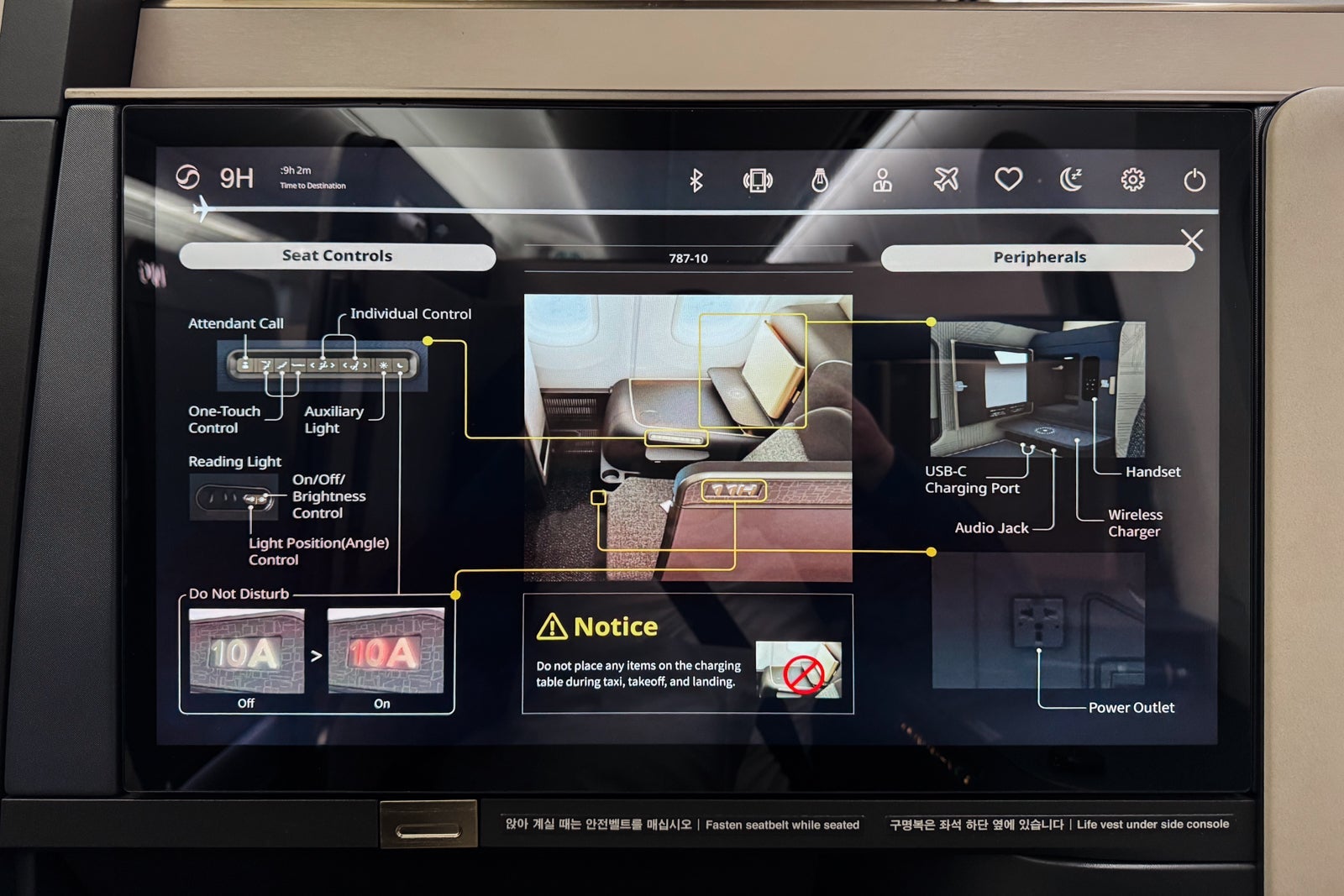
The seat controls could be found along the side of the wider armrest and had preset positions for takeoff and landing, relaxation, and lie-flat mode. You could also adjust the seatback and legrest individually. The other two buttons were to call the flight attendant, to operate the overhead light and for do-not-disturb mode.
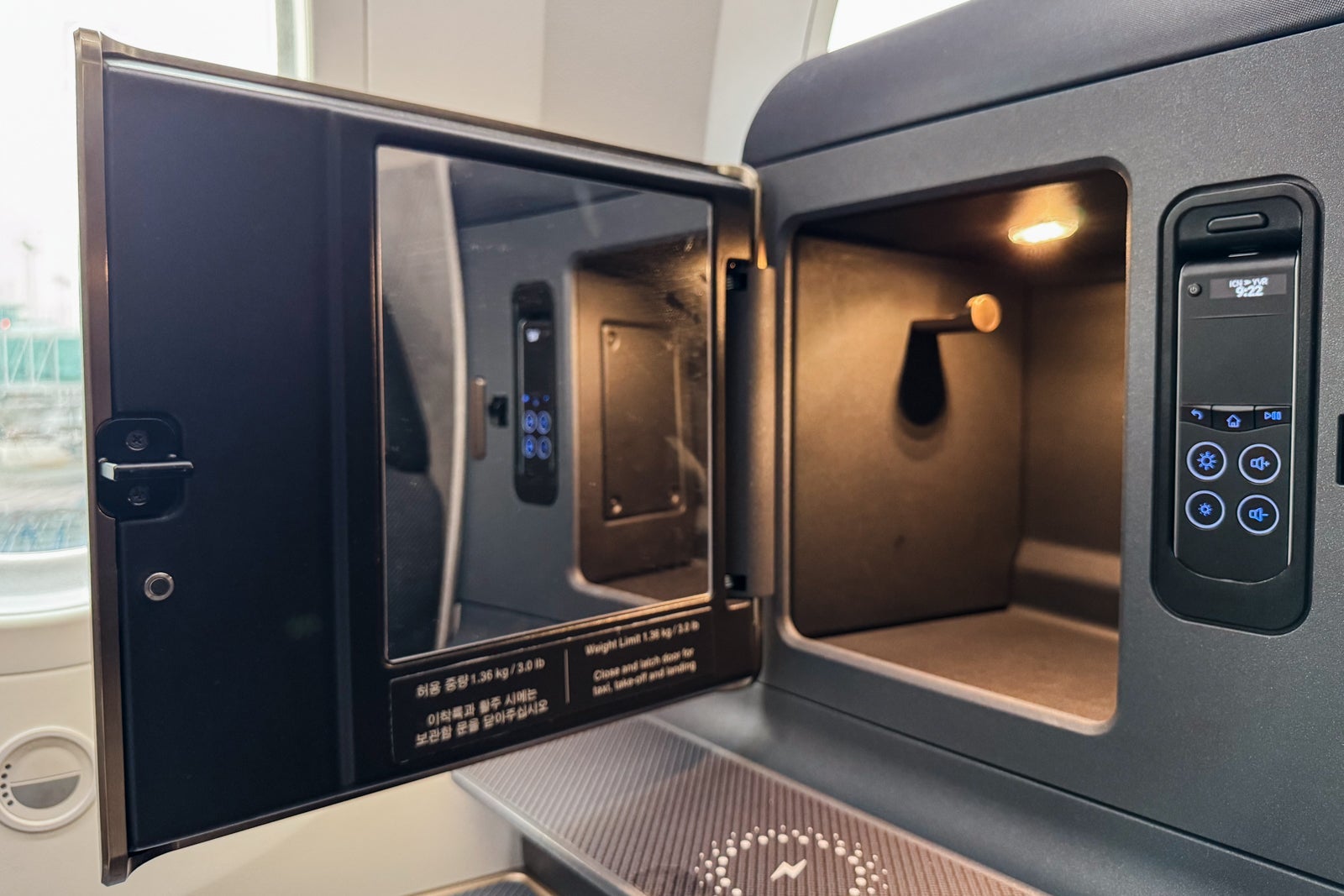
Next to the seatback, there was a handy storage compartment that contained a mirror, a peg to hang headphones and a handheld control for the entertainment system — though since it was a touchscreen, the remote was not really necessary.
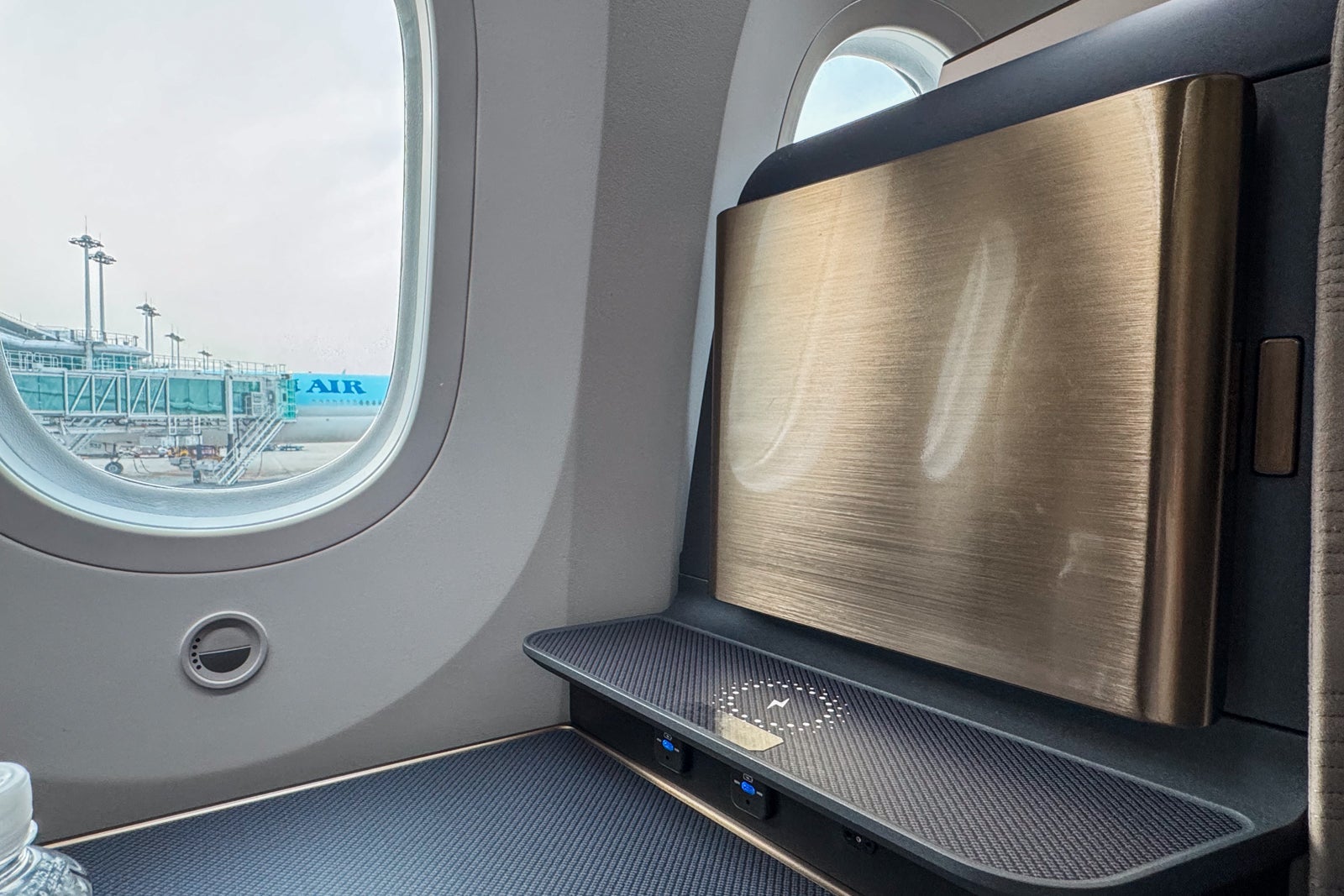
Just below this, on a small shelf, was a wireless charging surface. It worked decently; the charge rate on my iPhone 15 was only about 1% per three minutes.
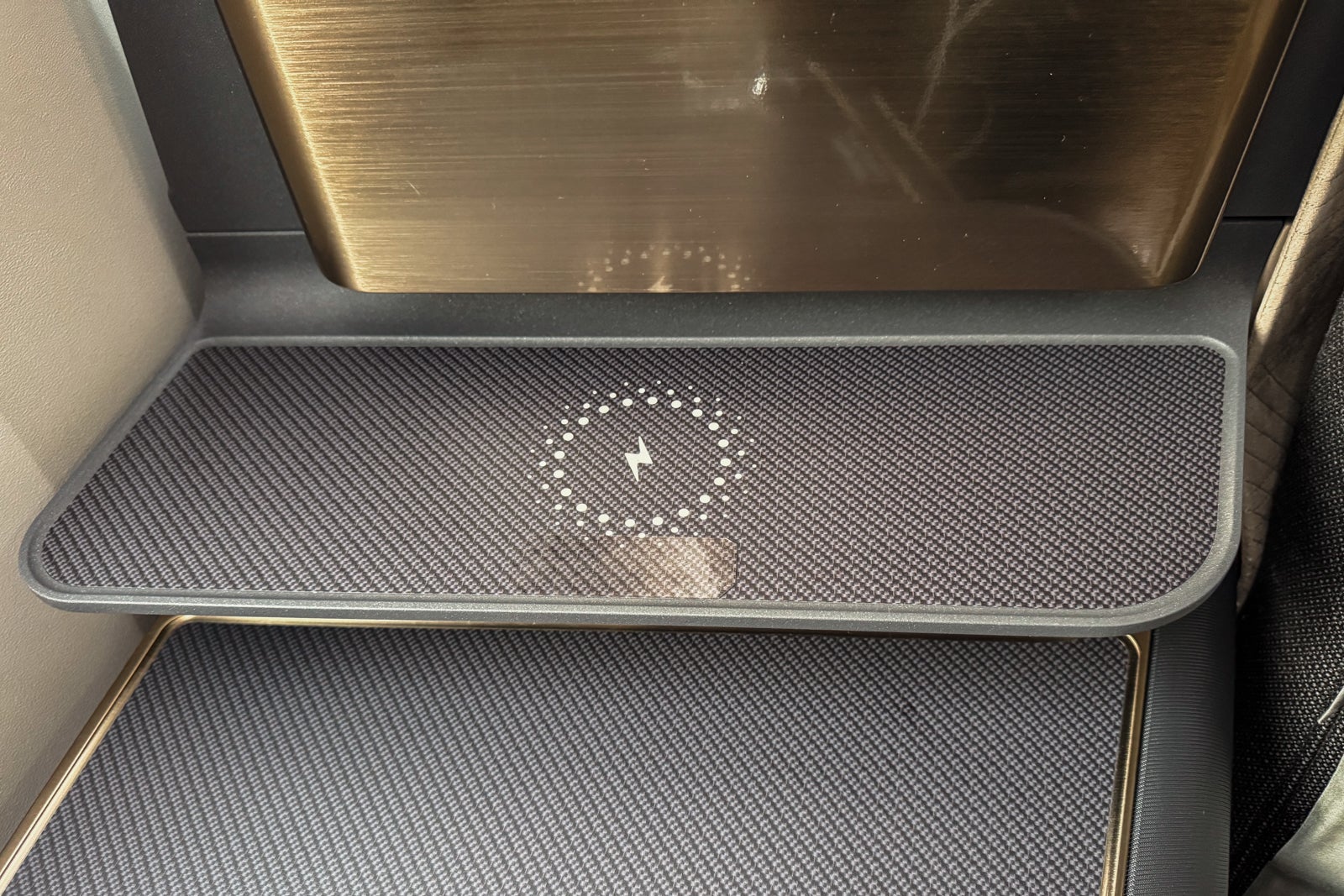
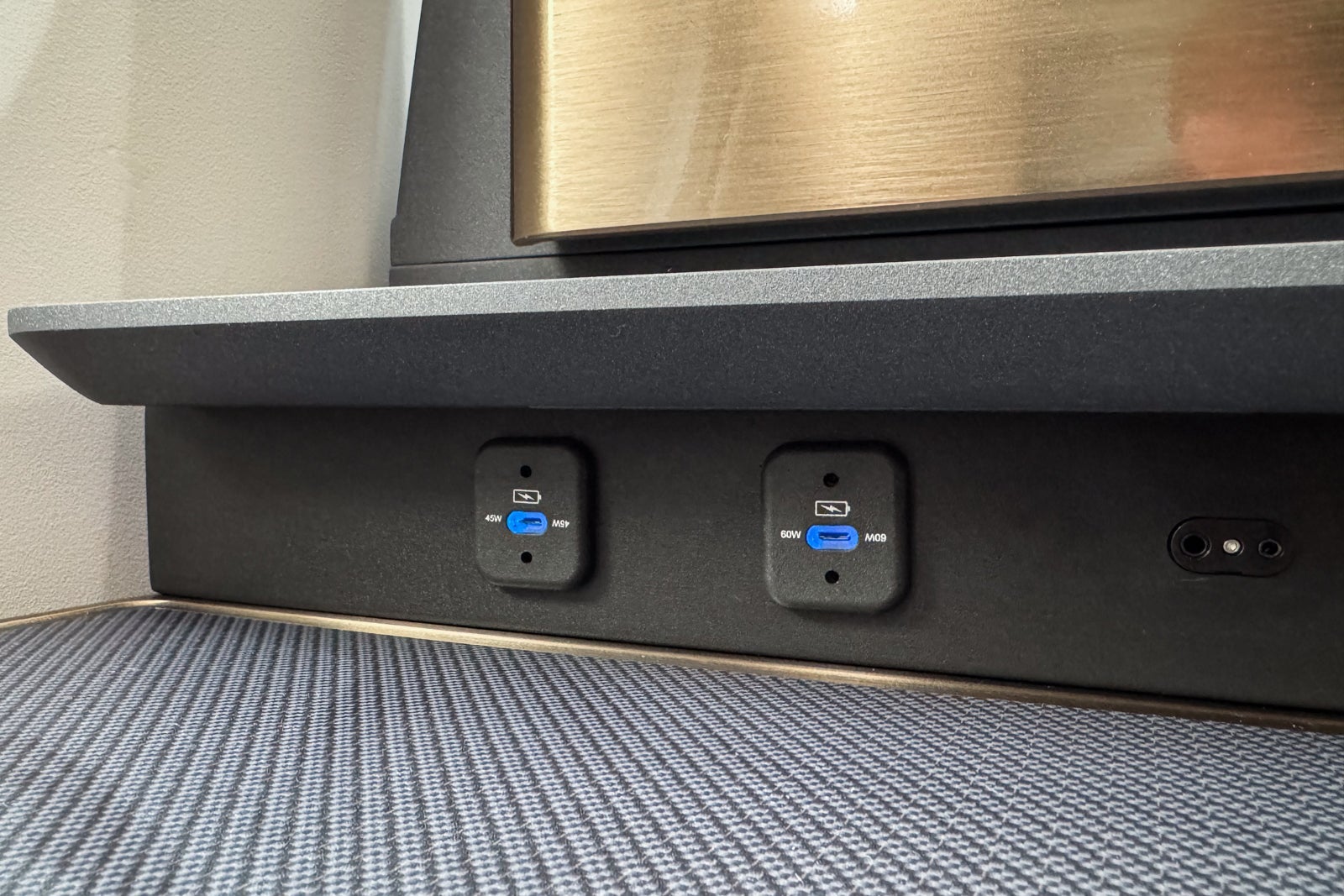
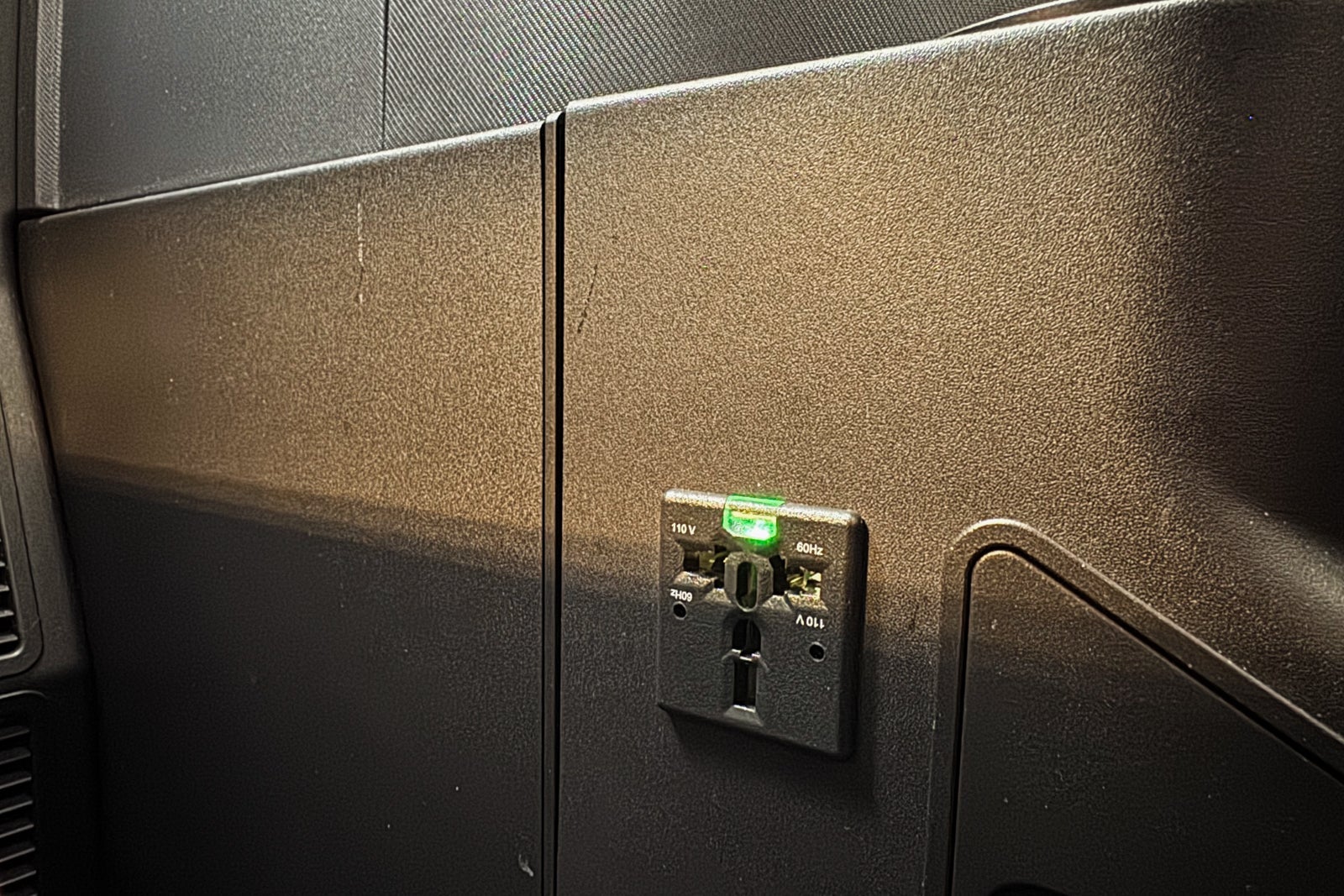
In terms of hardware, there was a universal power plug embedded halfway down the large armrest adjacent to the seat and two USB-C ports under the shelf with the wireless charging surface.
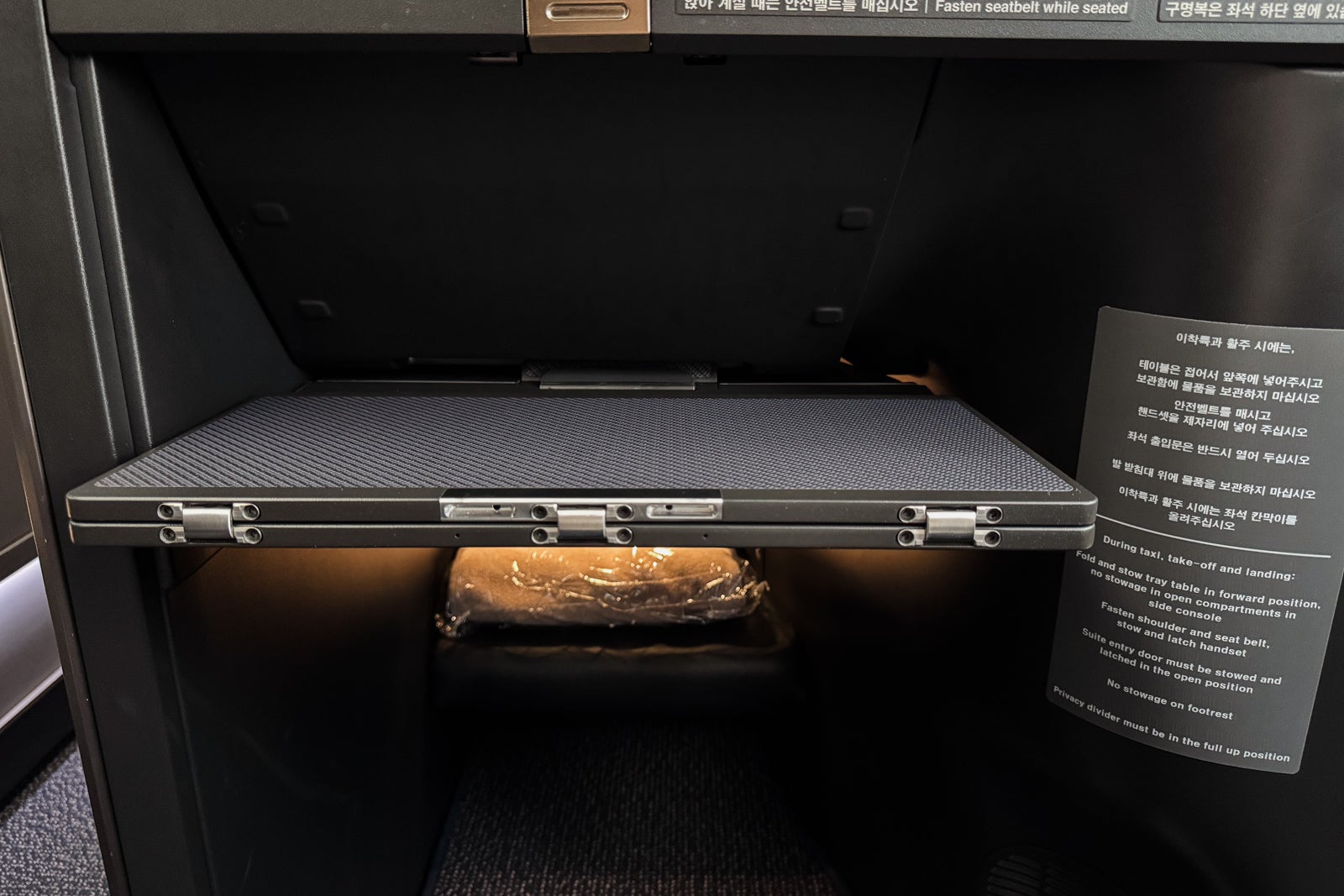
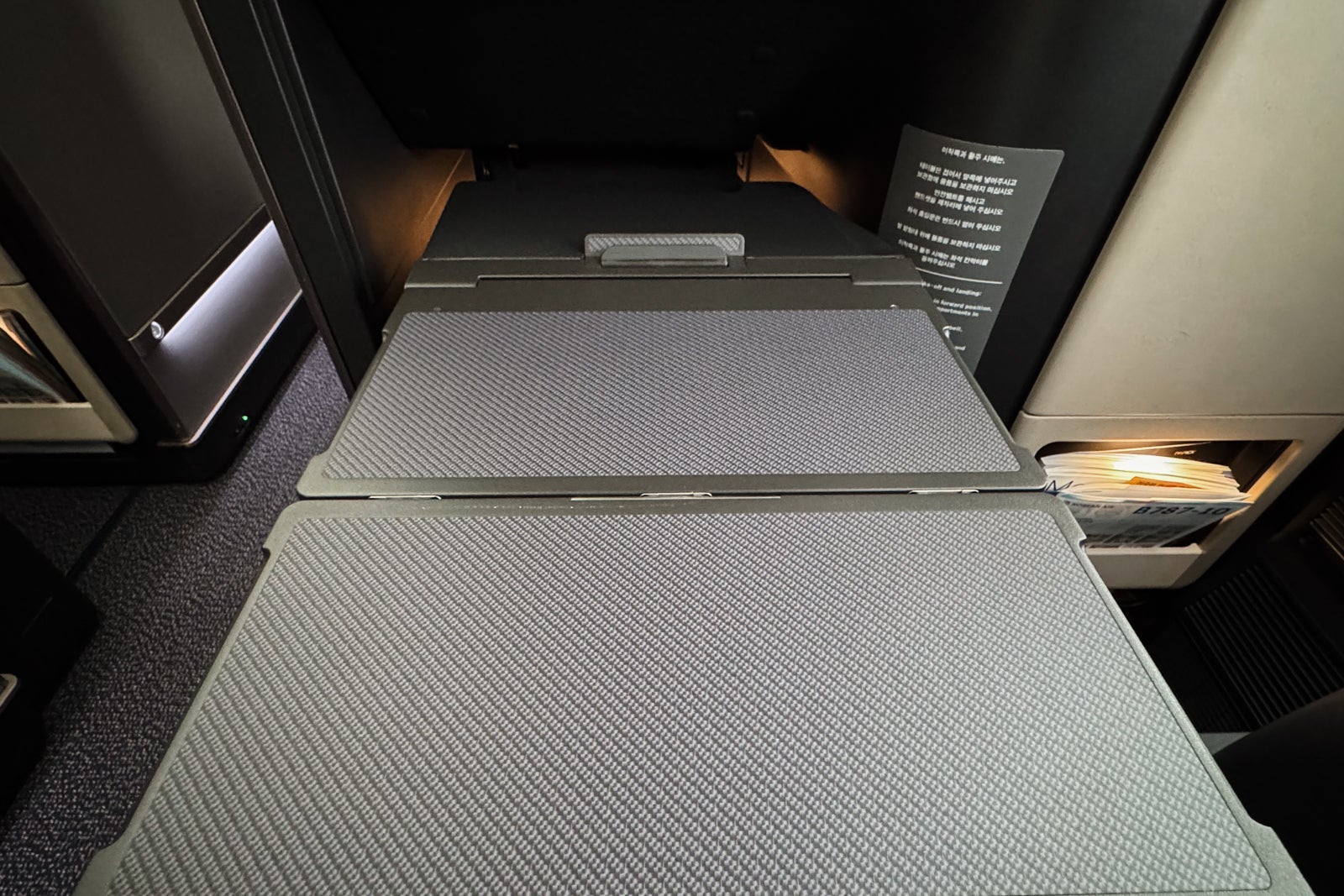
The seat's tray table unlatched from under the entertainment screen and then slid forward and folded open to a full size of 15 1/2 inches by 18 inches with a device holder at the back. The design made it easy to get in and out of the seat while still providing a lot of surface area. My one quibble was that, because it latched into the preceding seatback, when my posterior neighbor used her table (which she seemed to need to do frequently), it felt like something was being rammed into my seat. After that happened, I was careful to gently open and close my own table for the sake of my forward neighbor.
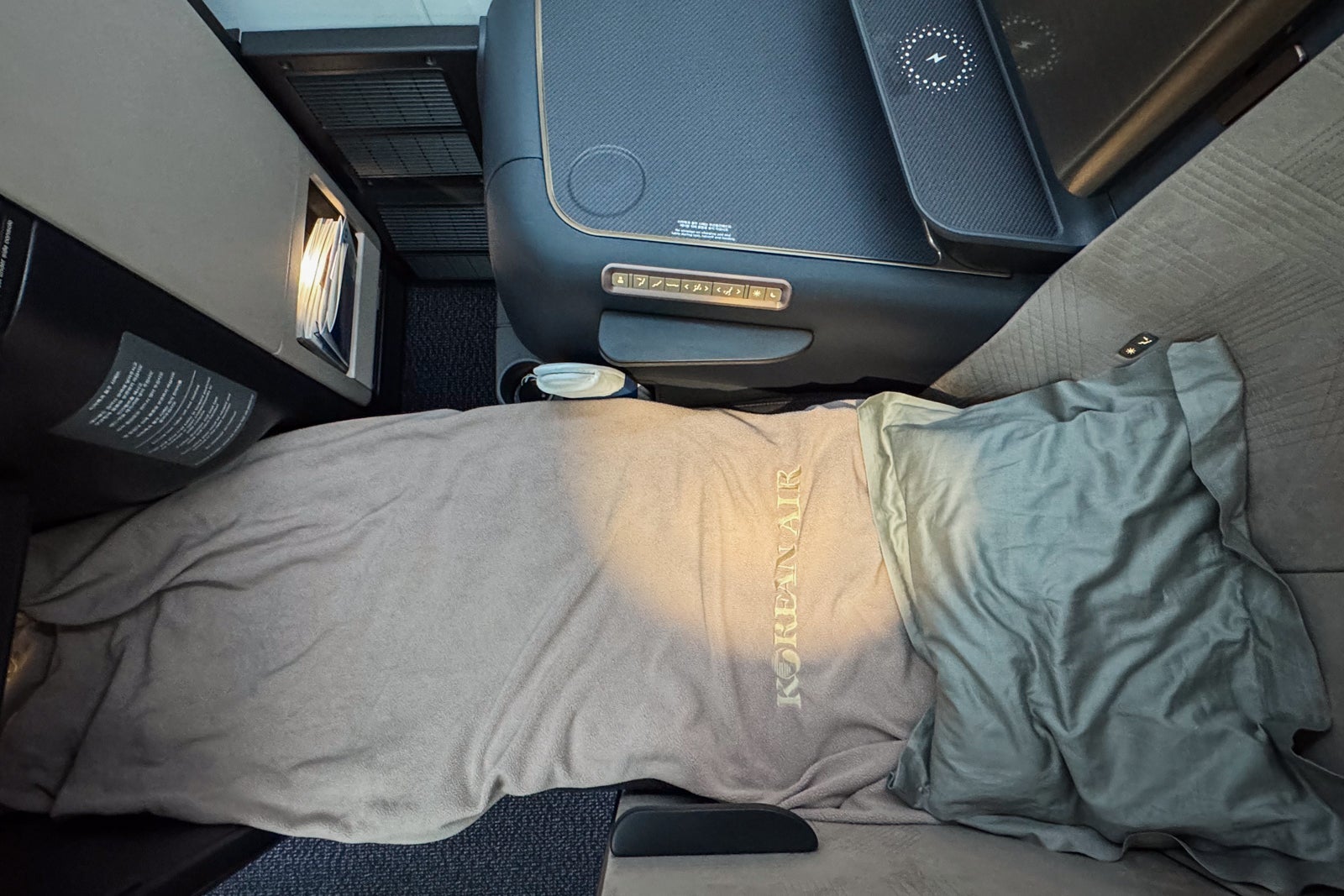
In lie-flat mode, the seat was comfortable and spacious enough for me to roll over without hitting my elbows, knees or feet.
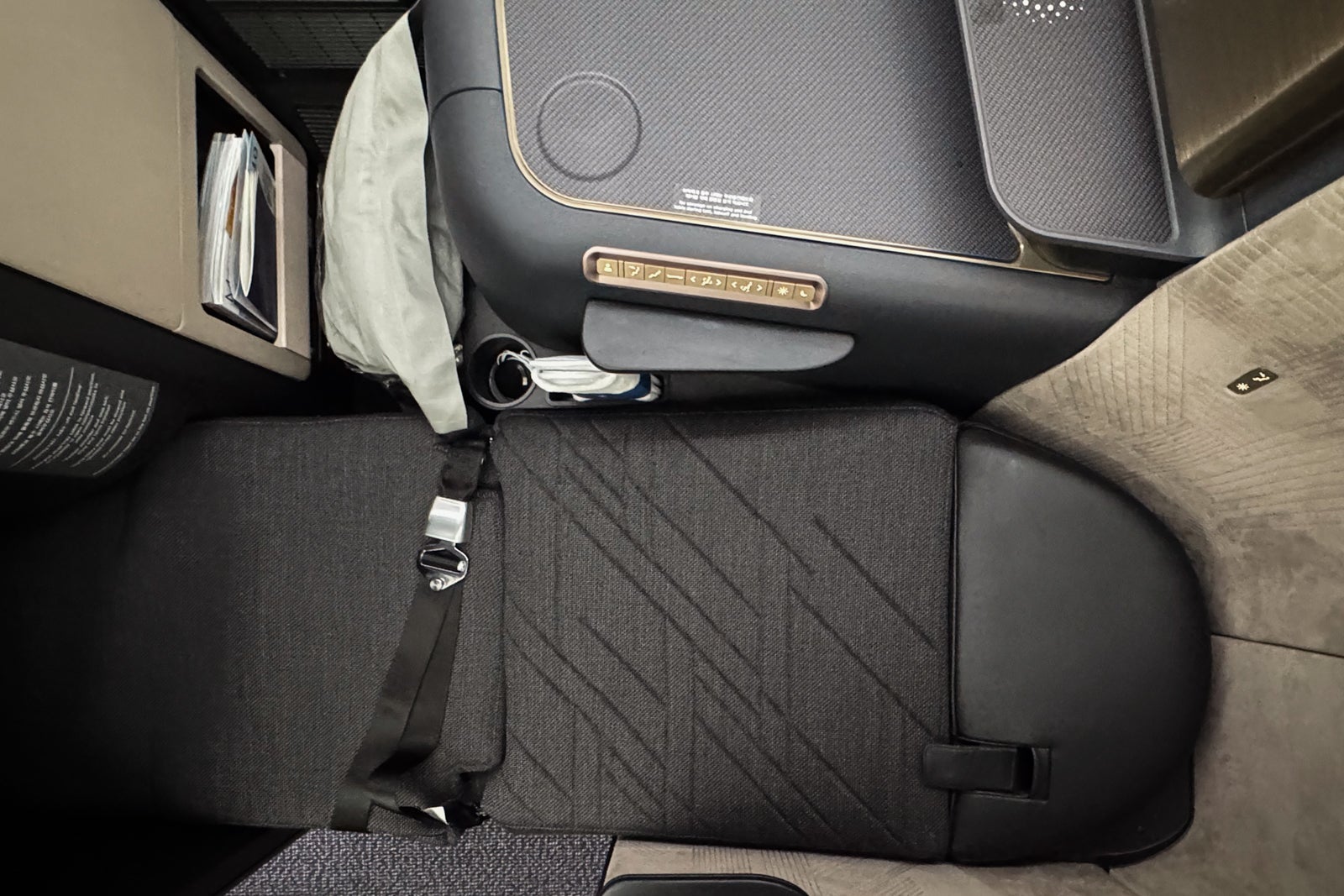
That said, perhaps in the next iteration of this seat, the airline will consider installing movable armrests that can be lowered to create more sleeping surface area since the fixed ones did feel a little constraining.
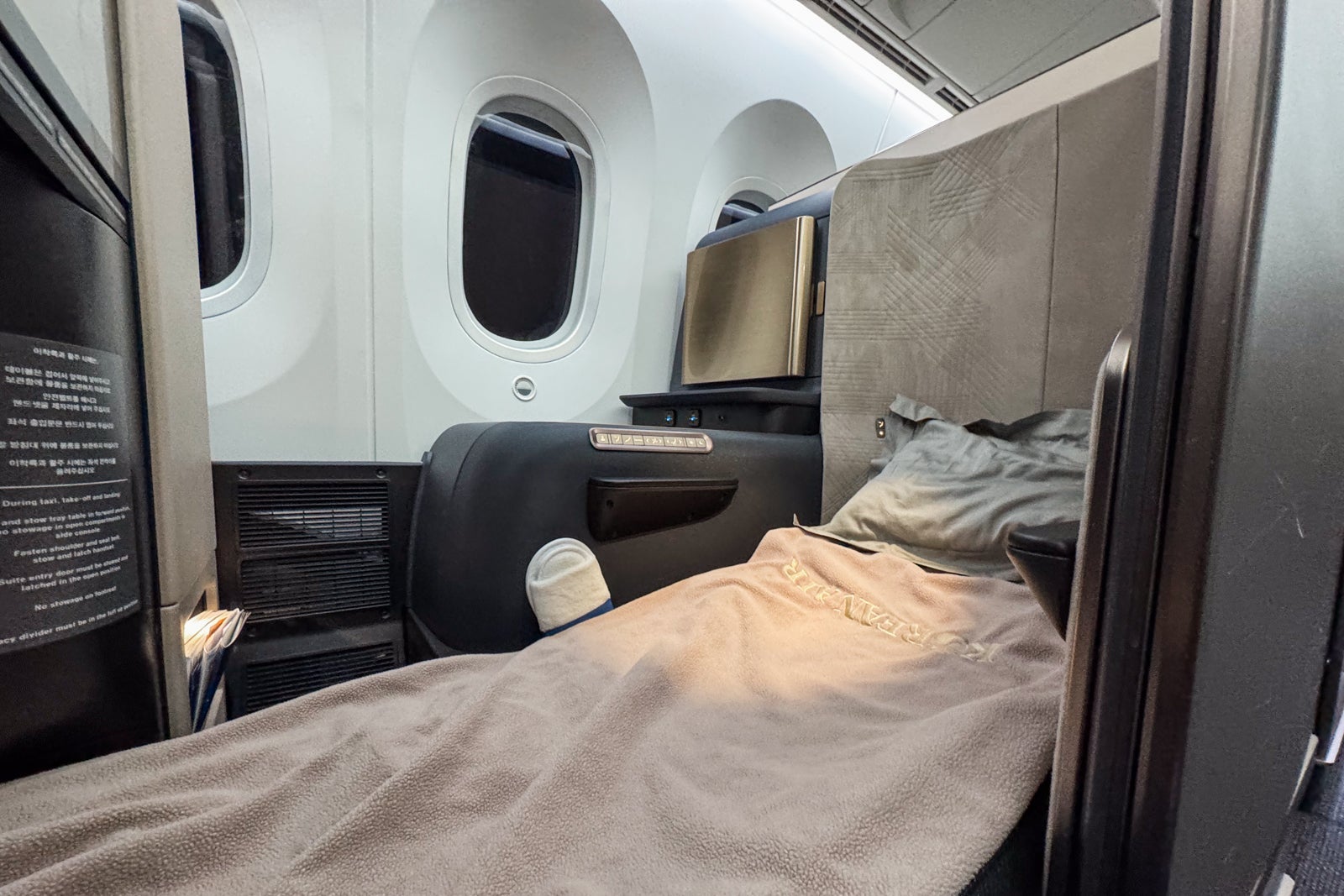
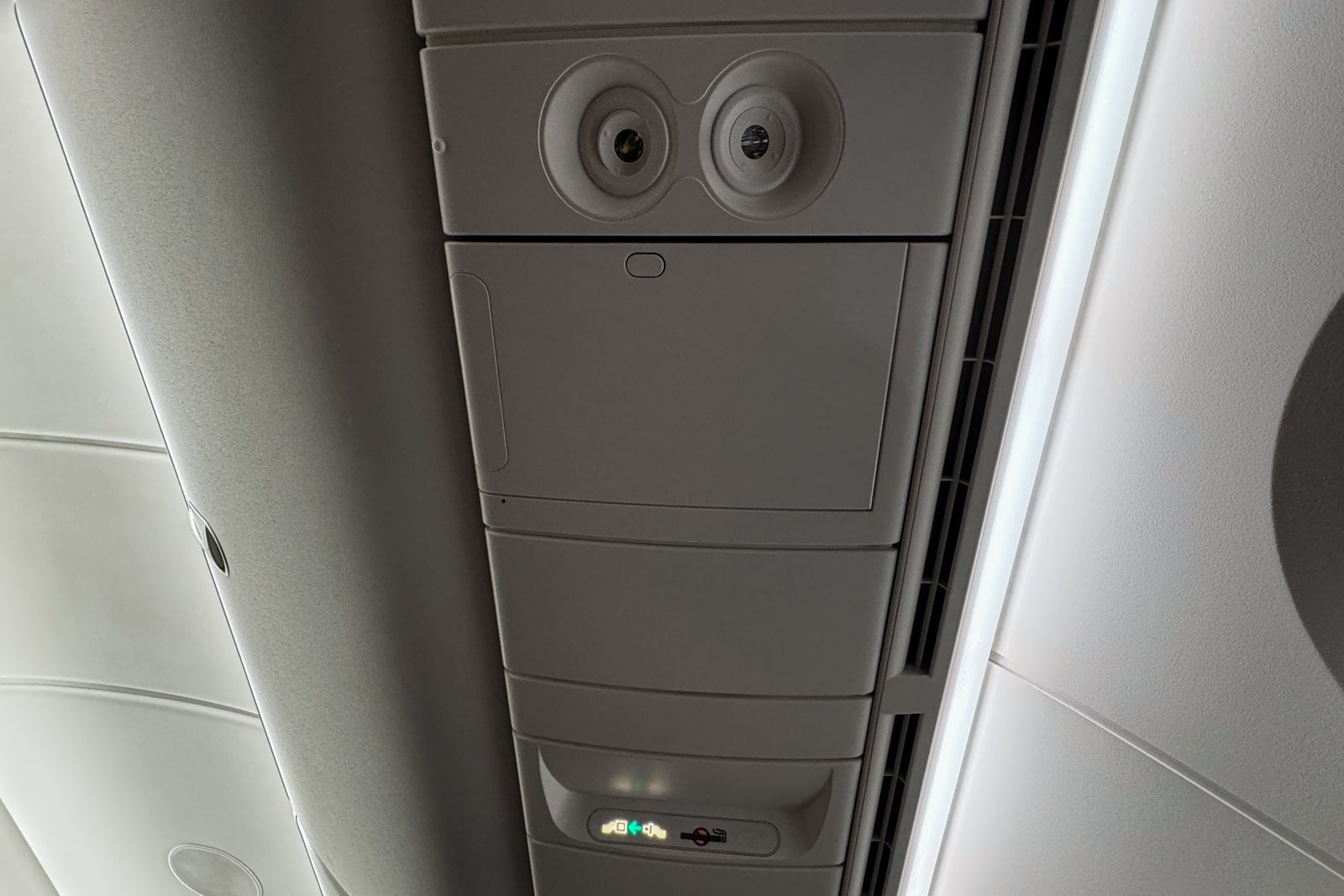
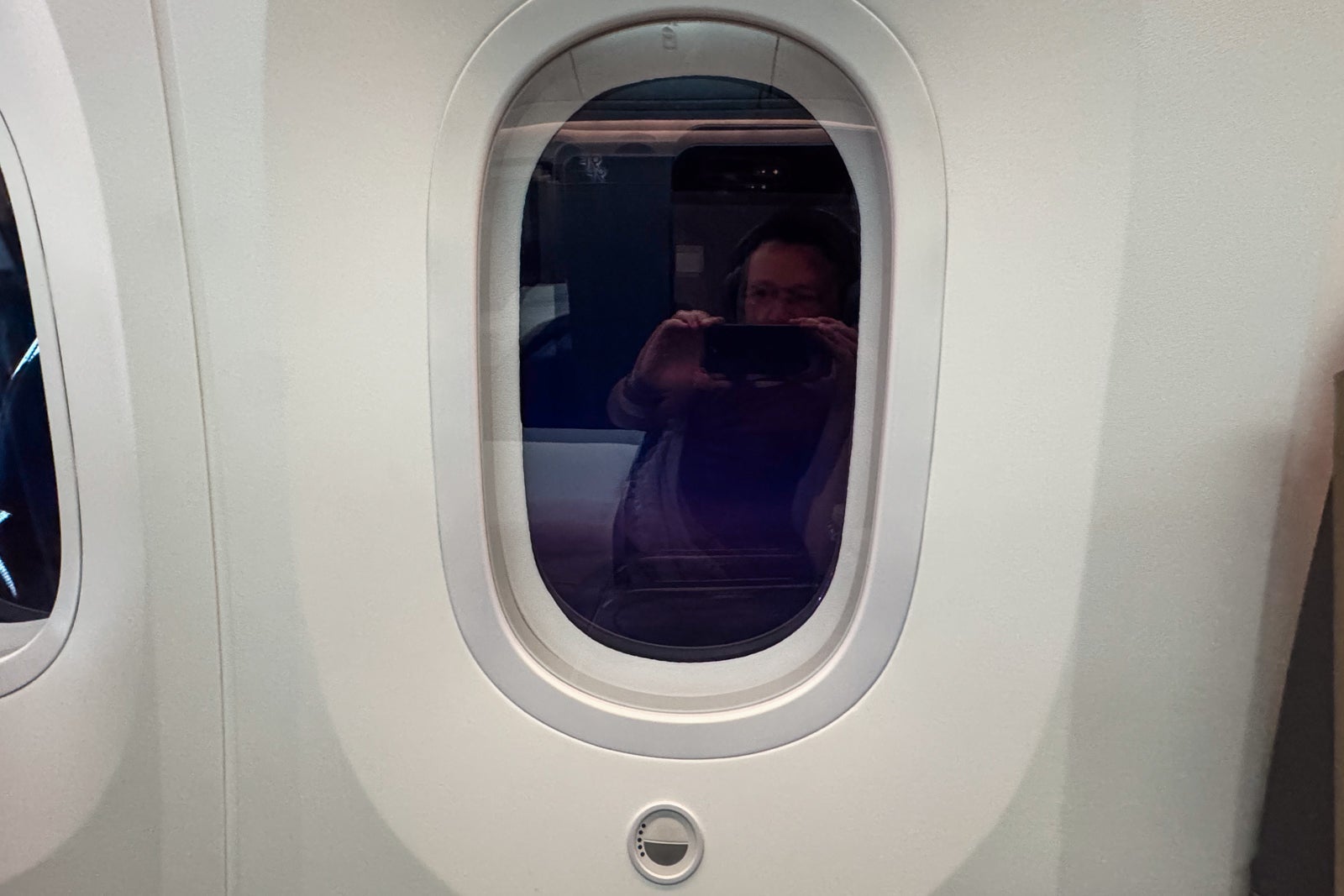
The crew kept the cabin relatively cool, which I was grateful for since there were no overhead air nozzles. As this was a Dreamliner, there were no physical window shades, but rather the aircraft's signature electronically dimmable windows. Though this sometimes means a plane's cabin is not as dark as it would be with manual shades, that was not the case on this flight, and the crew kept it dark until the beginning of the second meal service.
There were three business-class lavatories: one up front (the other front lavatory is for the crew) and two adjacent to the galley behind the cabin. That was a pretty good ratio of passengers to lavs, and there were only ever lines right after the meal services.
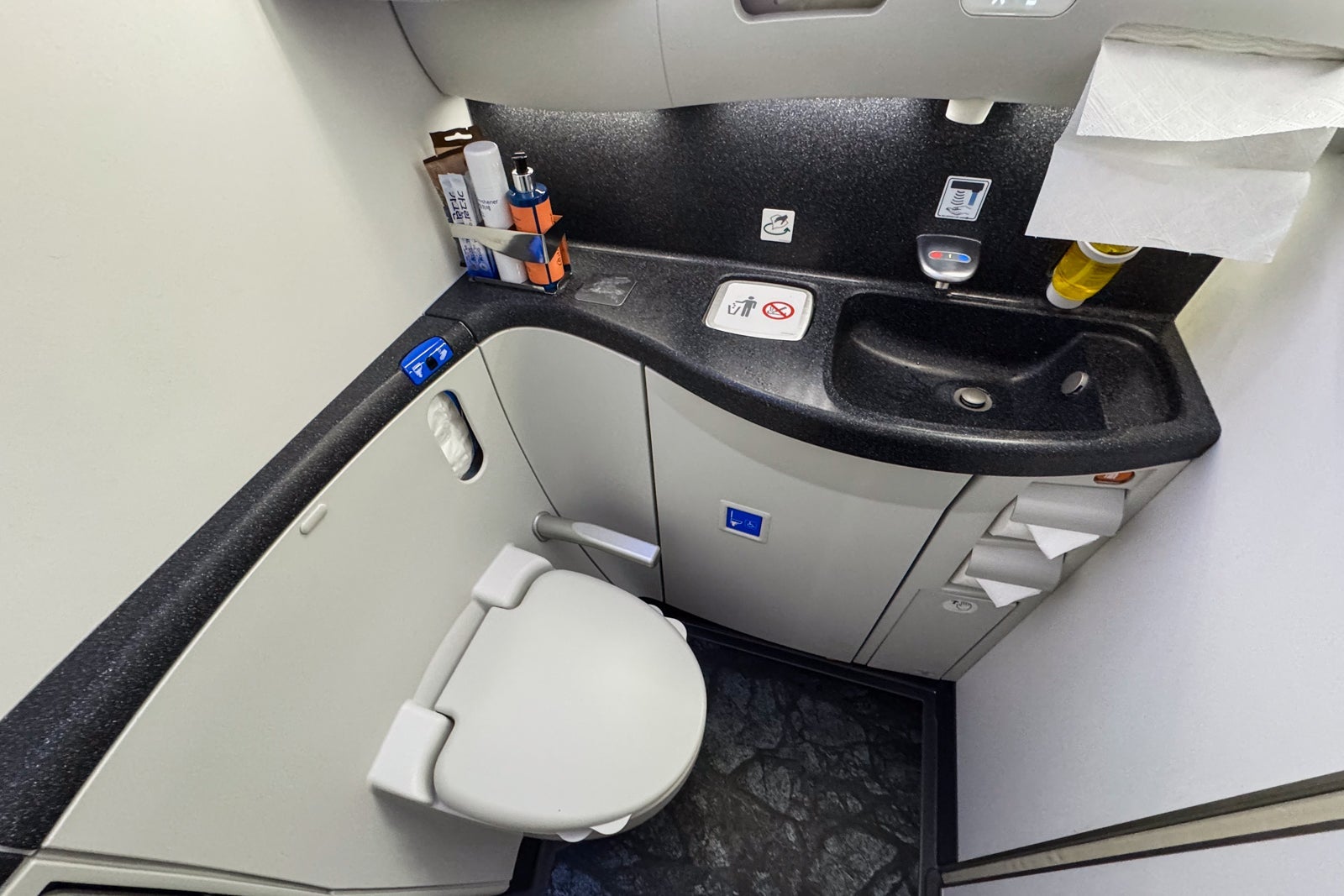
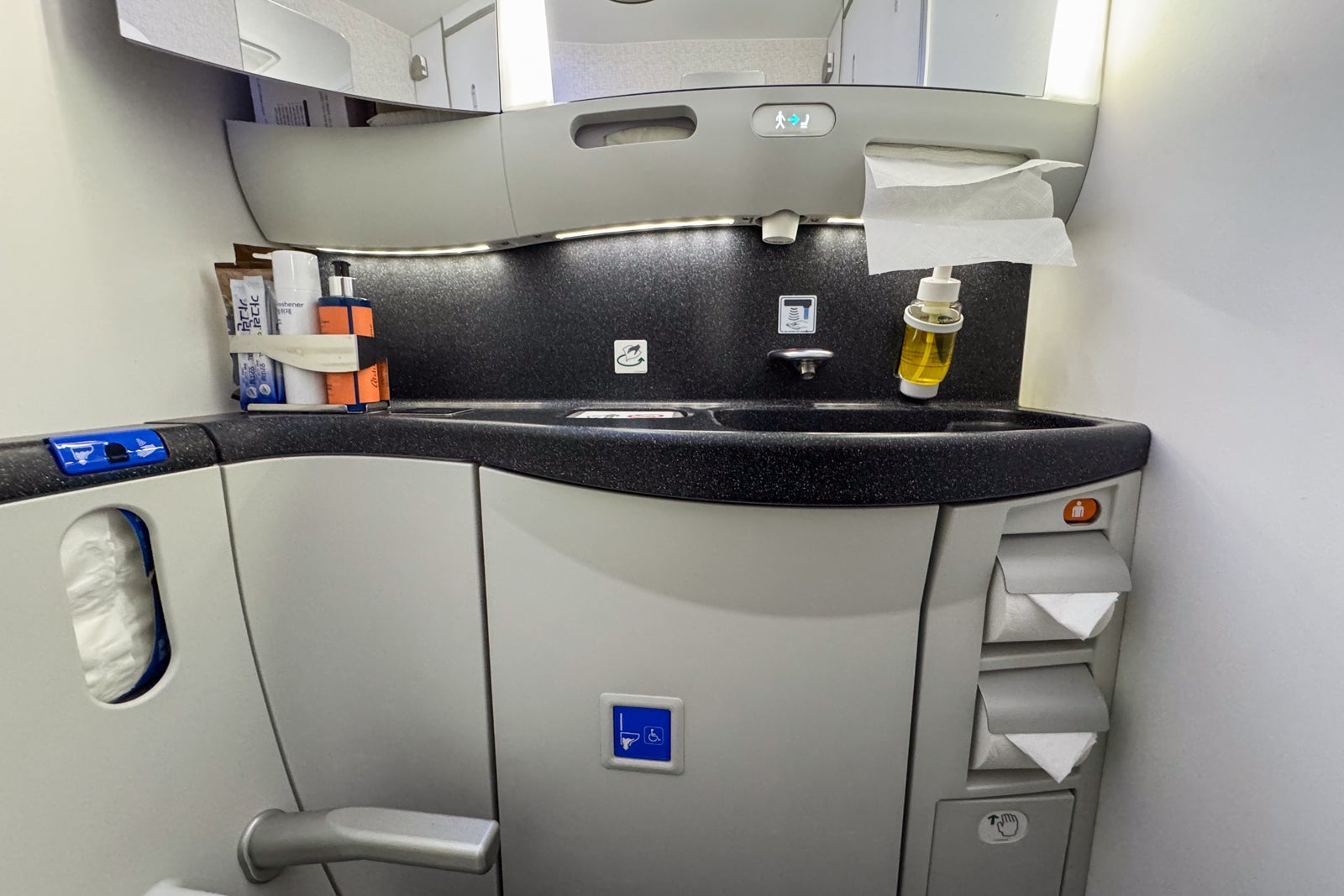
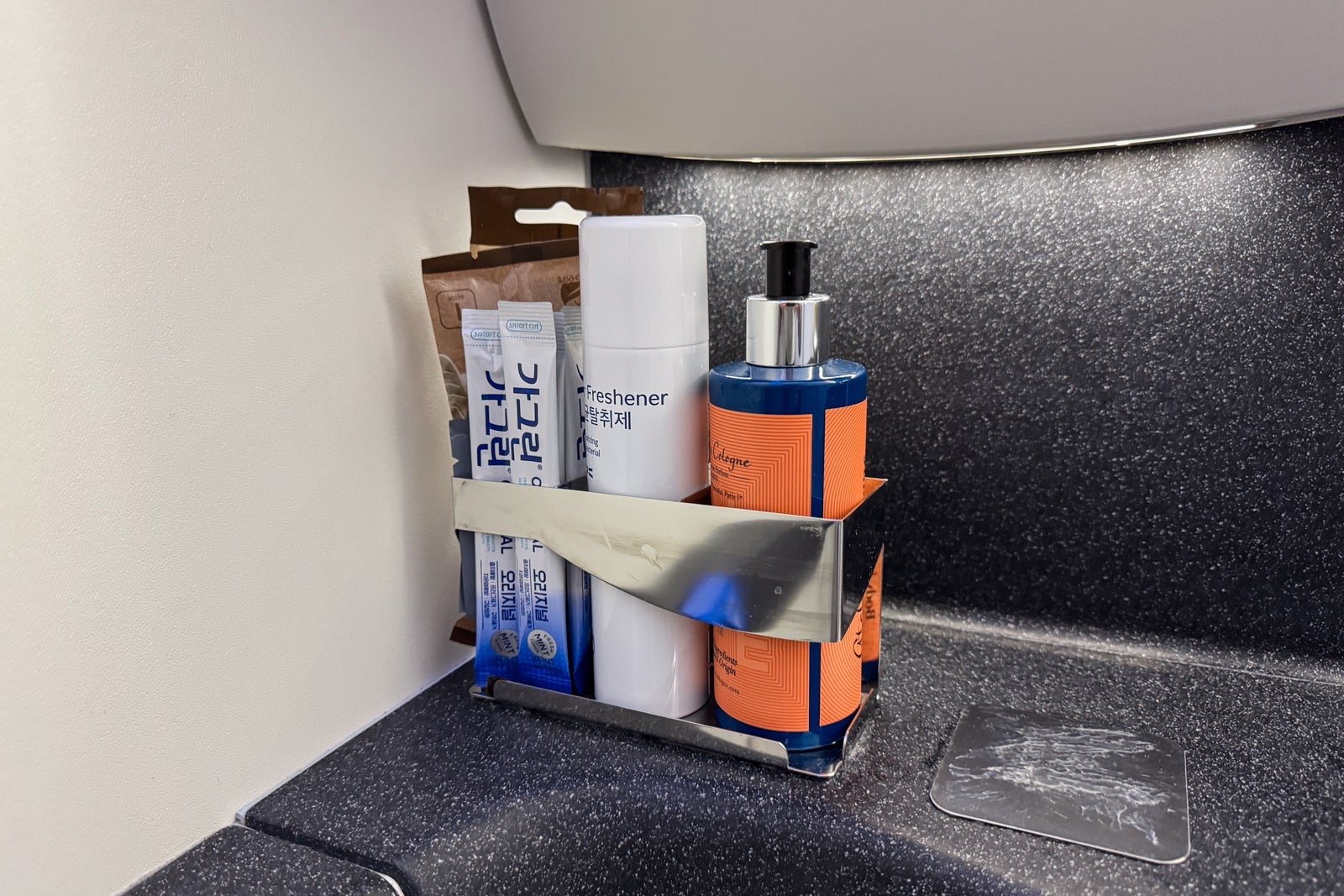
The facilities had touchless faucets and toilet flushes and were provisioned with mouthwash, shaving kits and Atelier Cologne products. The crew also cleaned them practically between every passenger, so they were spotless the whole flight.
Amenities in Korean Air business class
At boarding, the seat held a full-size fleecelike blanket embroidered with the airline's name and logo wrapped in plastic and a medium-size pillow.
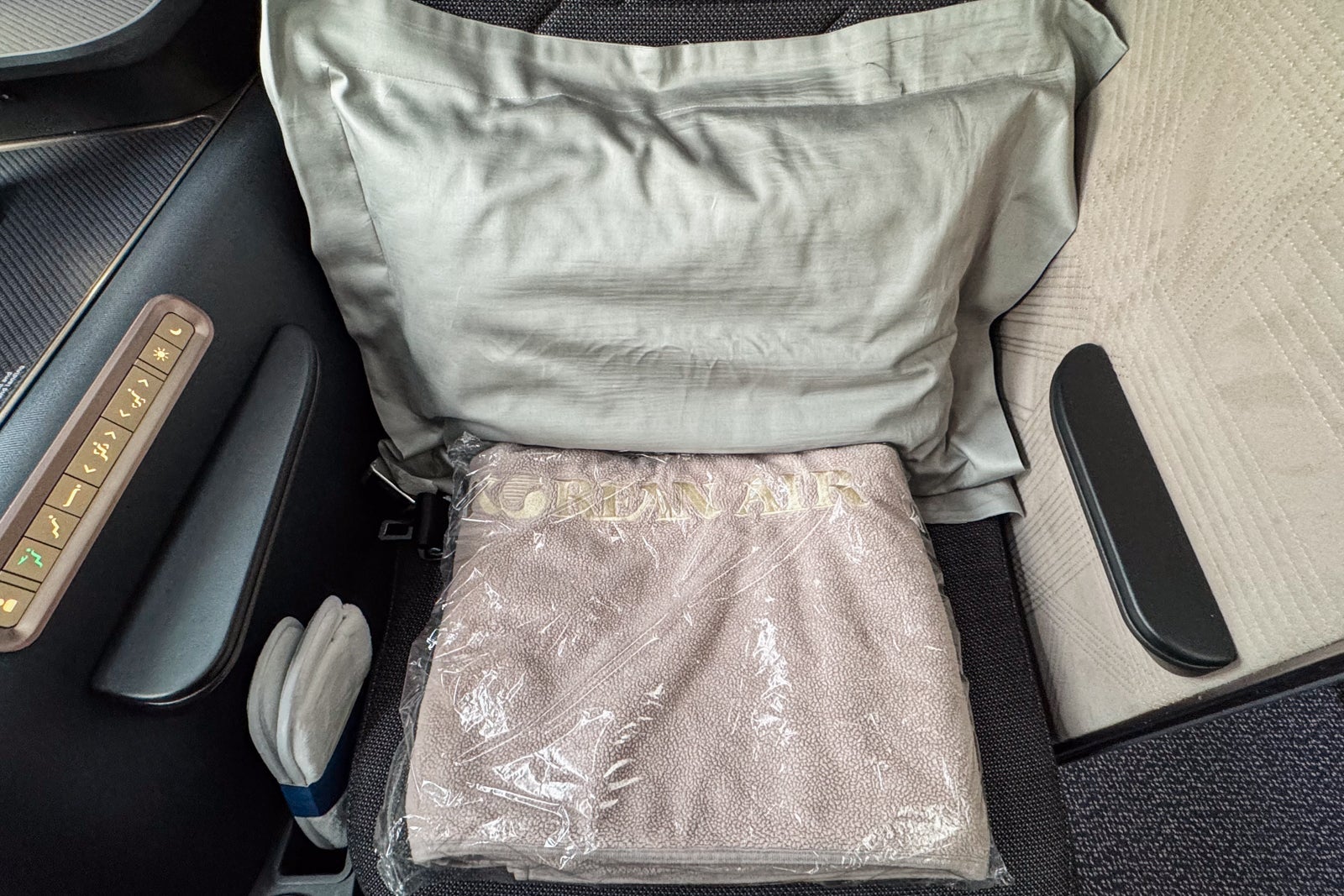
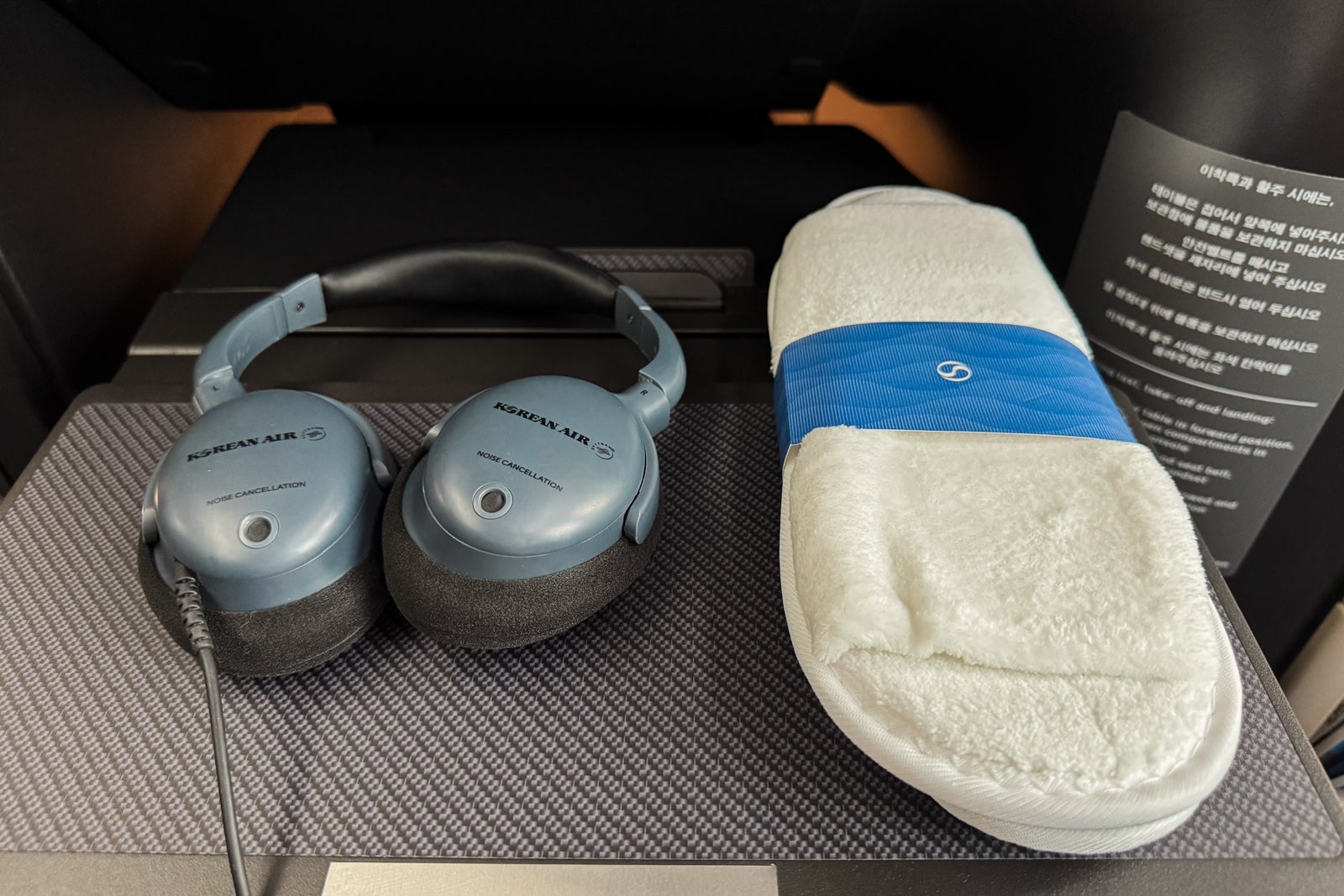
Unfortunately, there was no seat cover or mattress pad for bed mode. Korean Air does not offer business-class passengers pajamas, but there were fluffy slippers tucked into a cubby.
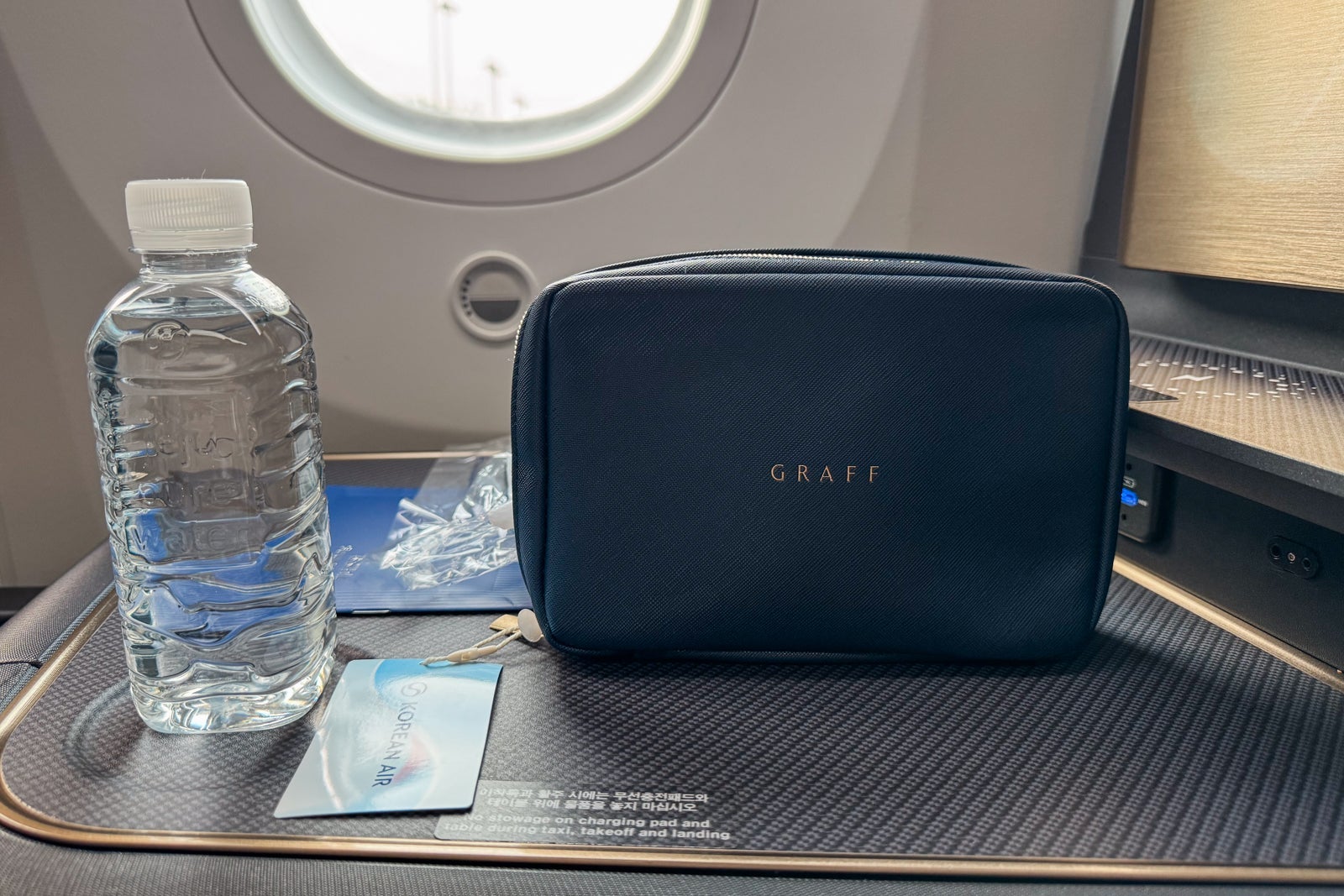
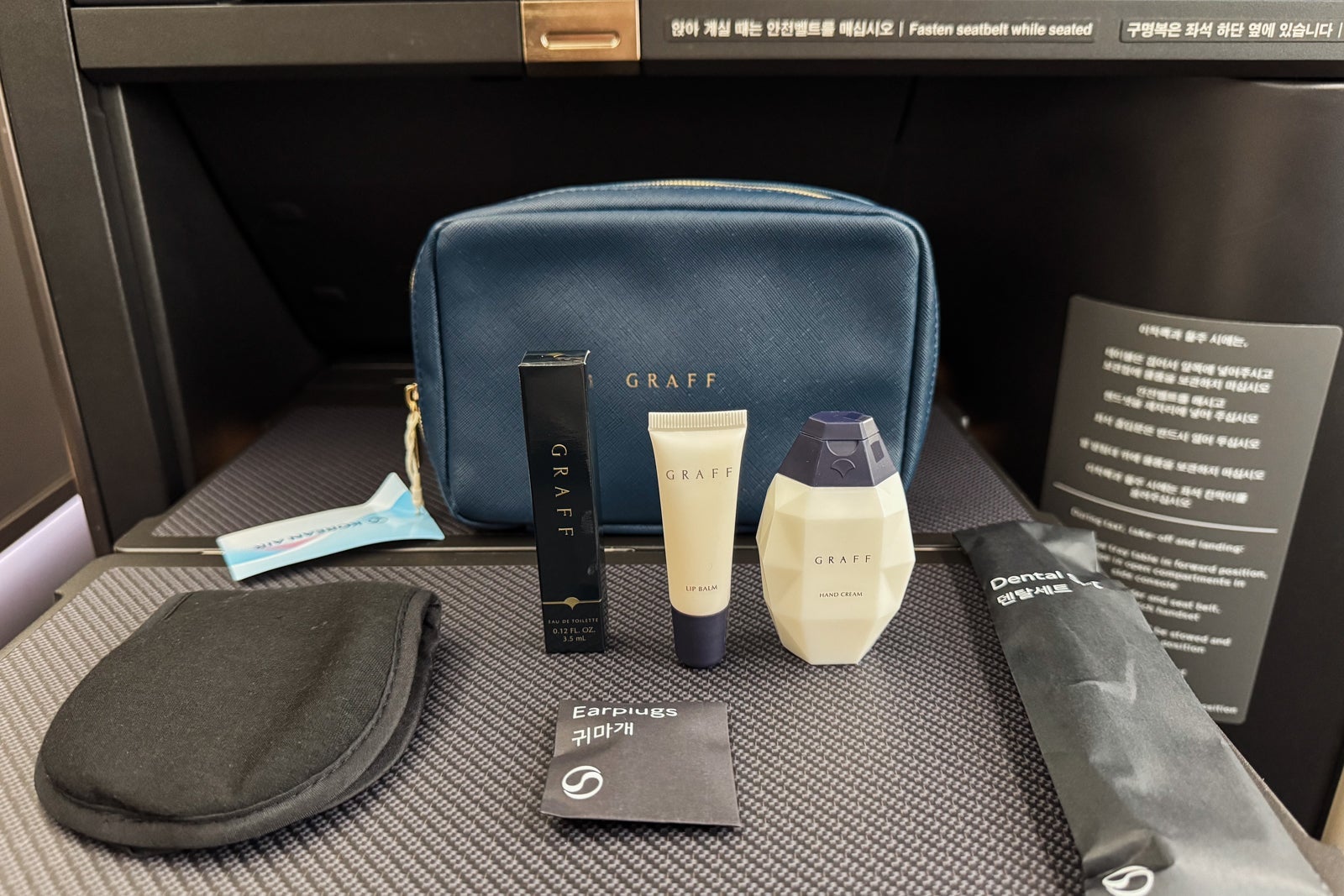
There was a handsome blue amenity kit from British brand Graff. Inside, I found a dental set, an eye mask, earplugs and Graff lip balm, hand cream and eau de toilette, all with a citrusy and faintly floral bouquet.
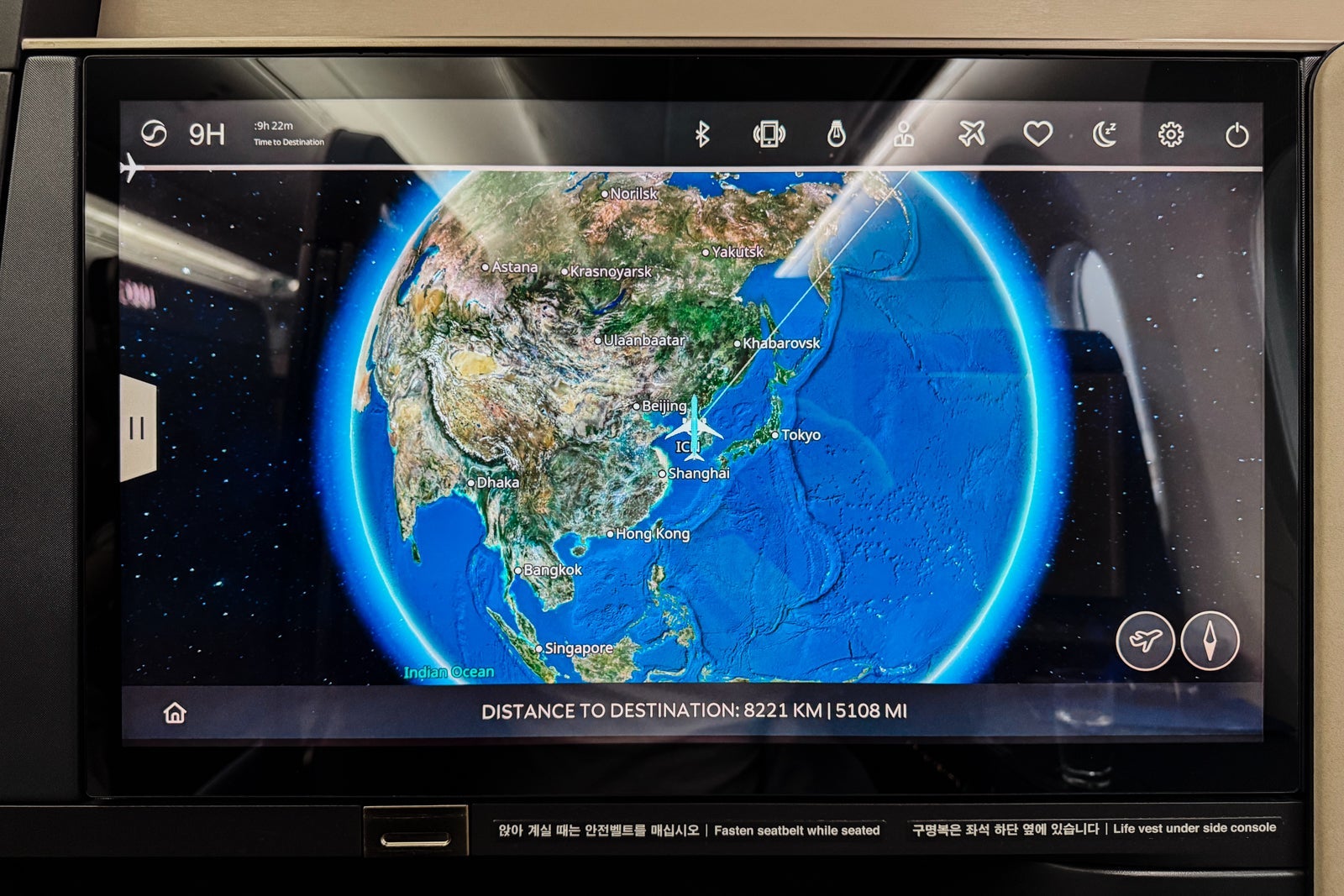
The entertainment system was a 24-inch 4K screen, which is pretty much at the top of what you'll find in business class these days.
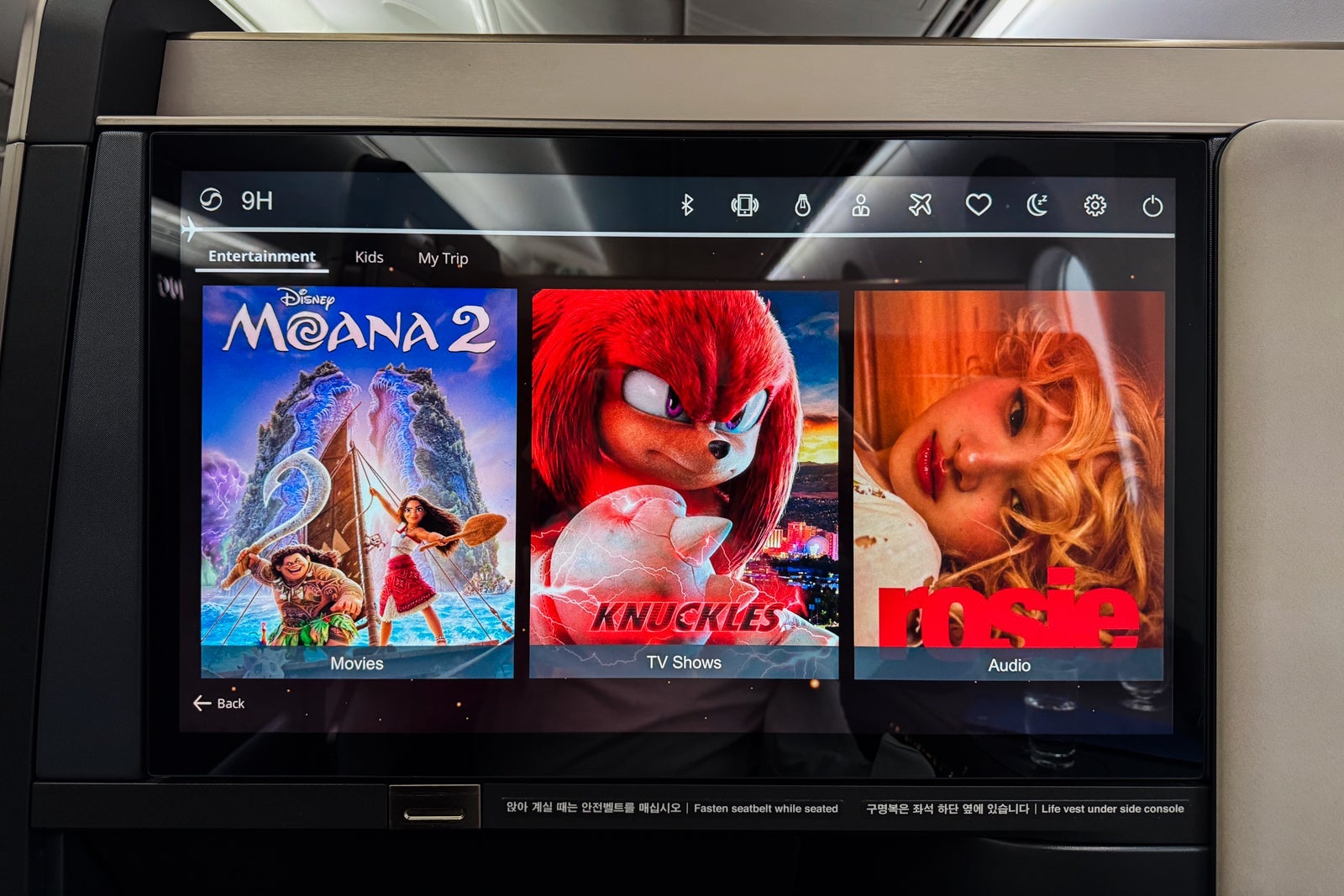
It was loaded with hundreds of movies and television shows, including a smattering of K-dramas. There were also music playlists and albums as well as games, plus informational functions such as the flight map and instructions on how to operate the seat.
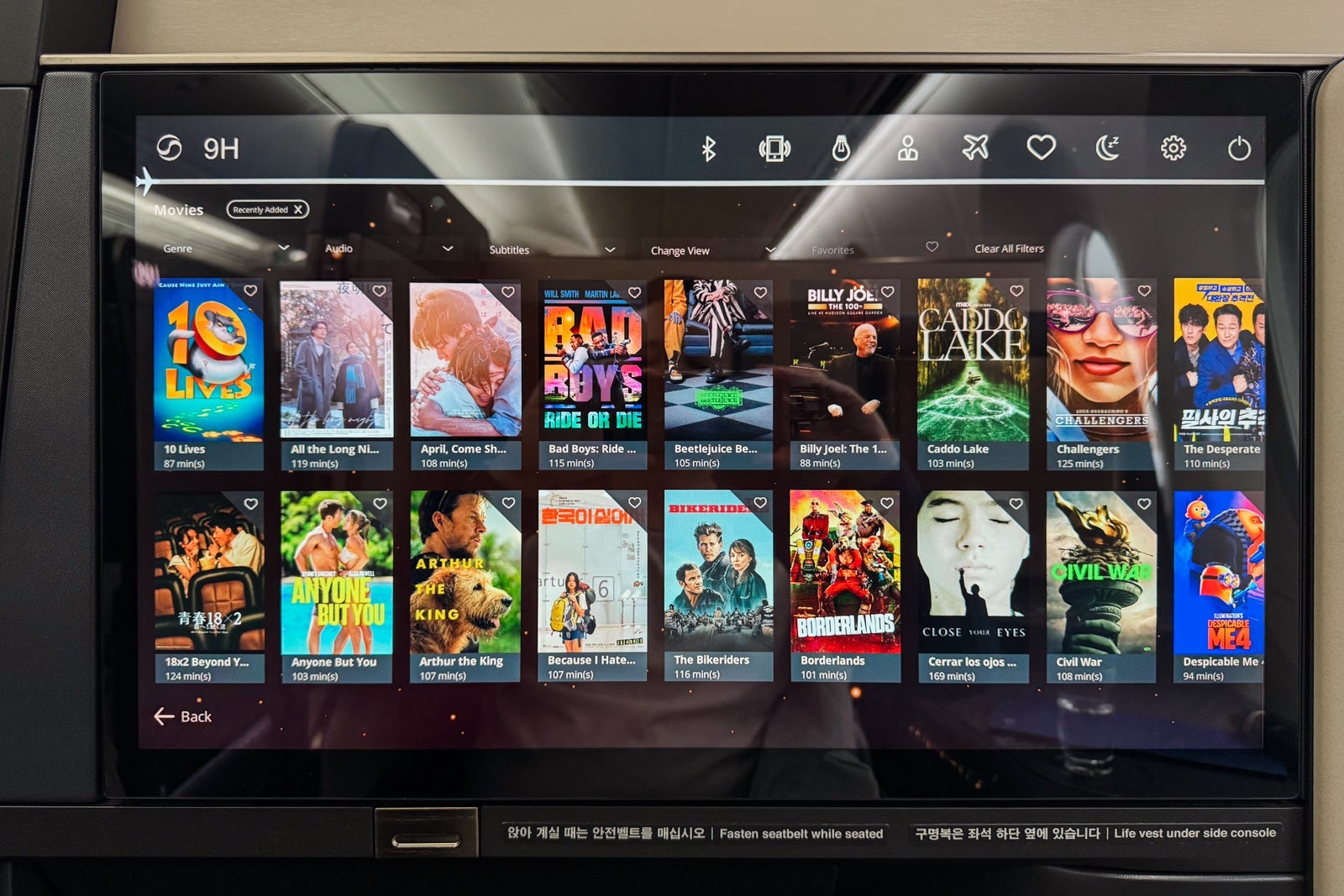
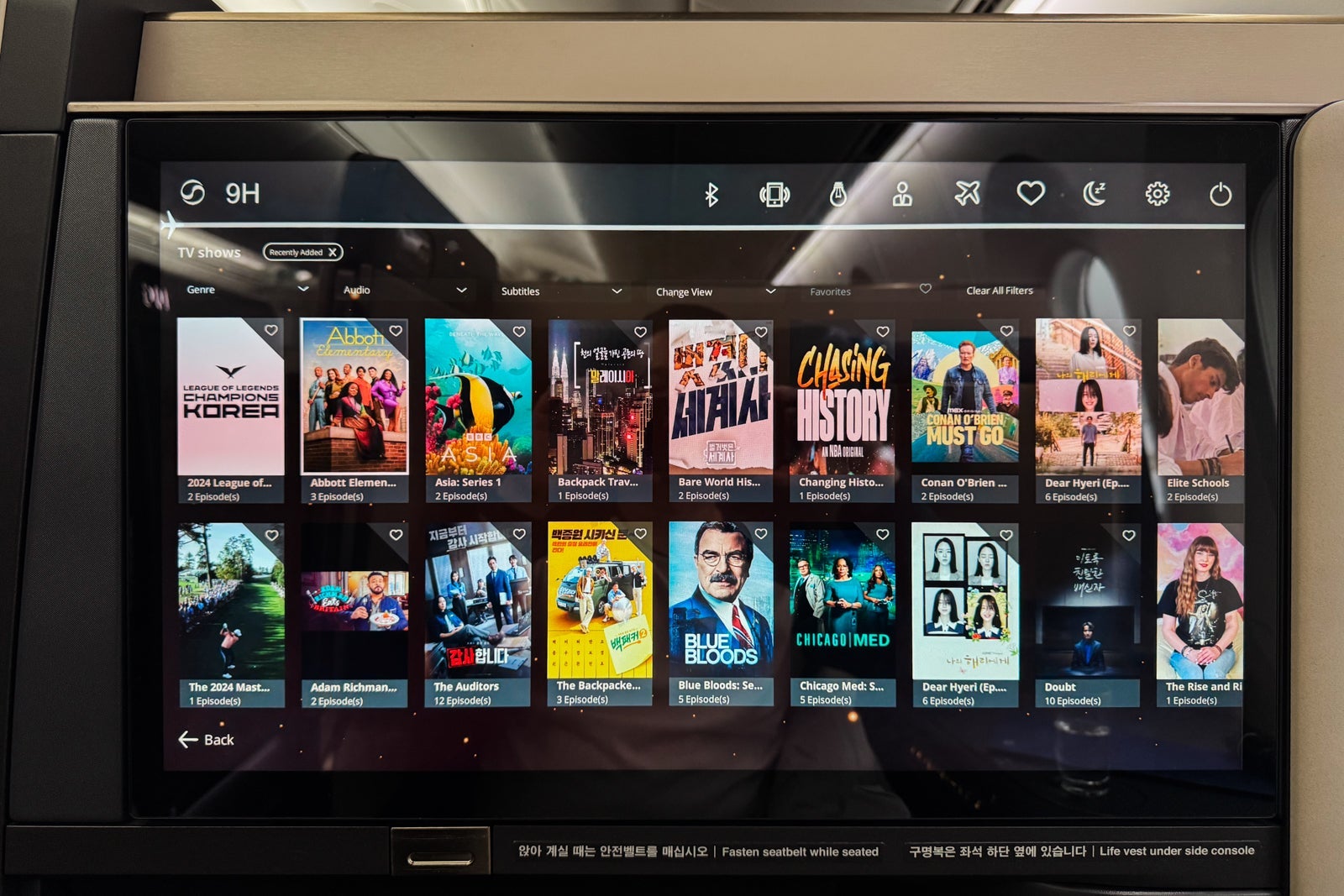
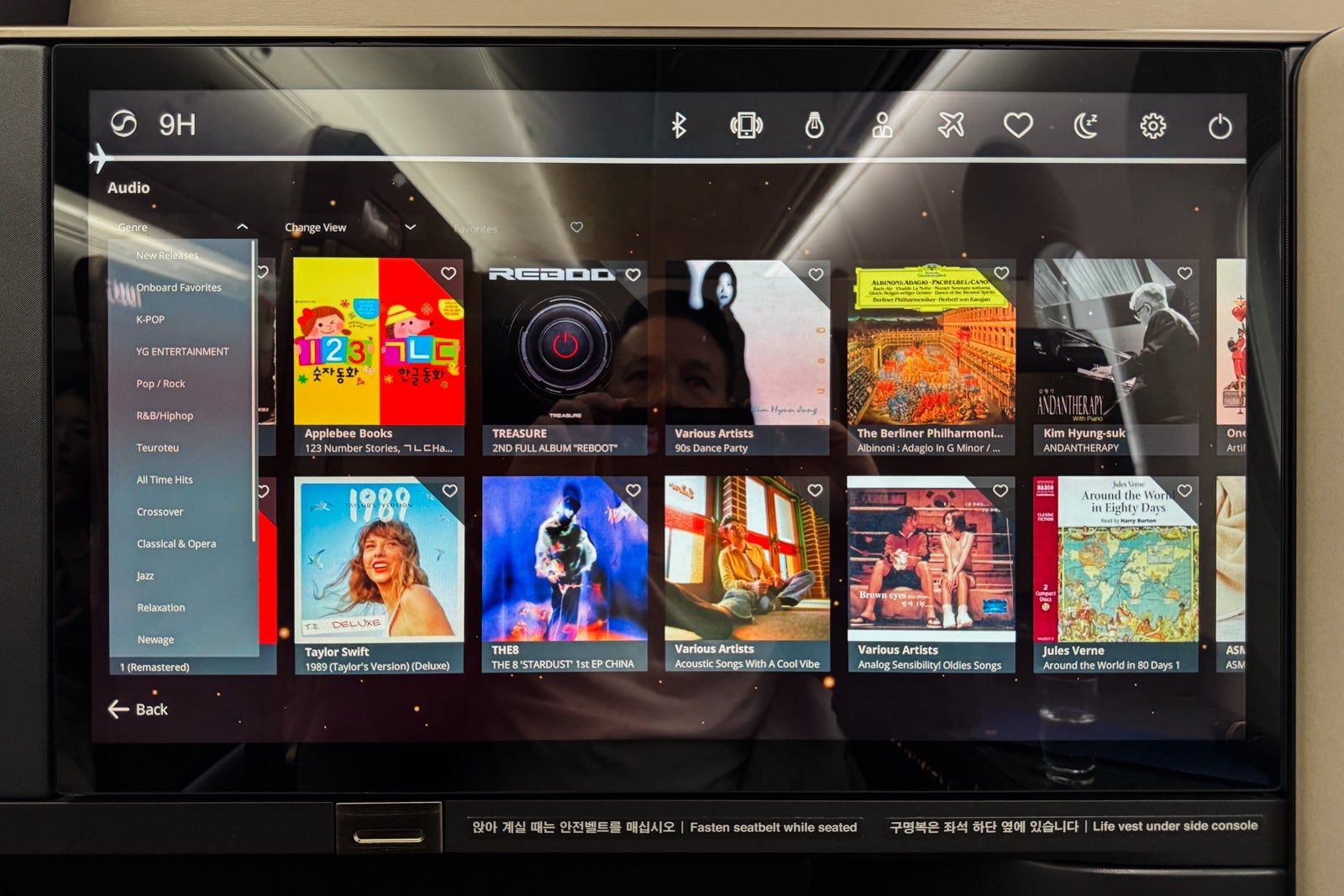
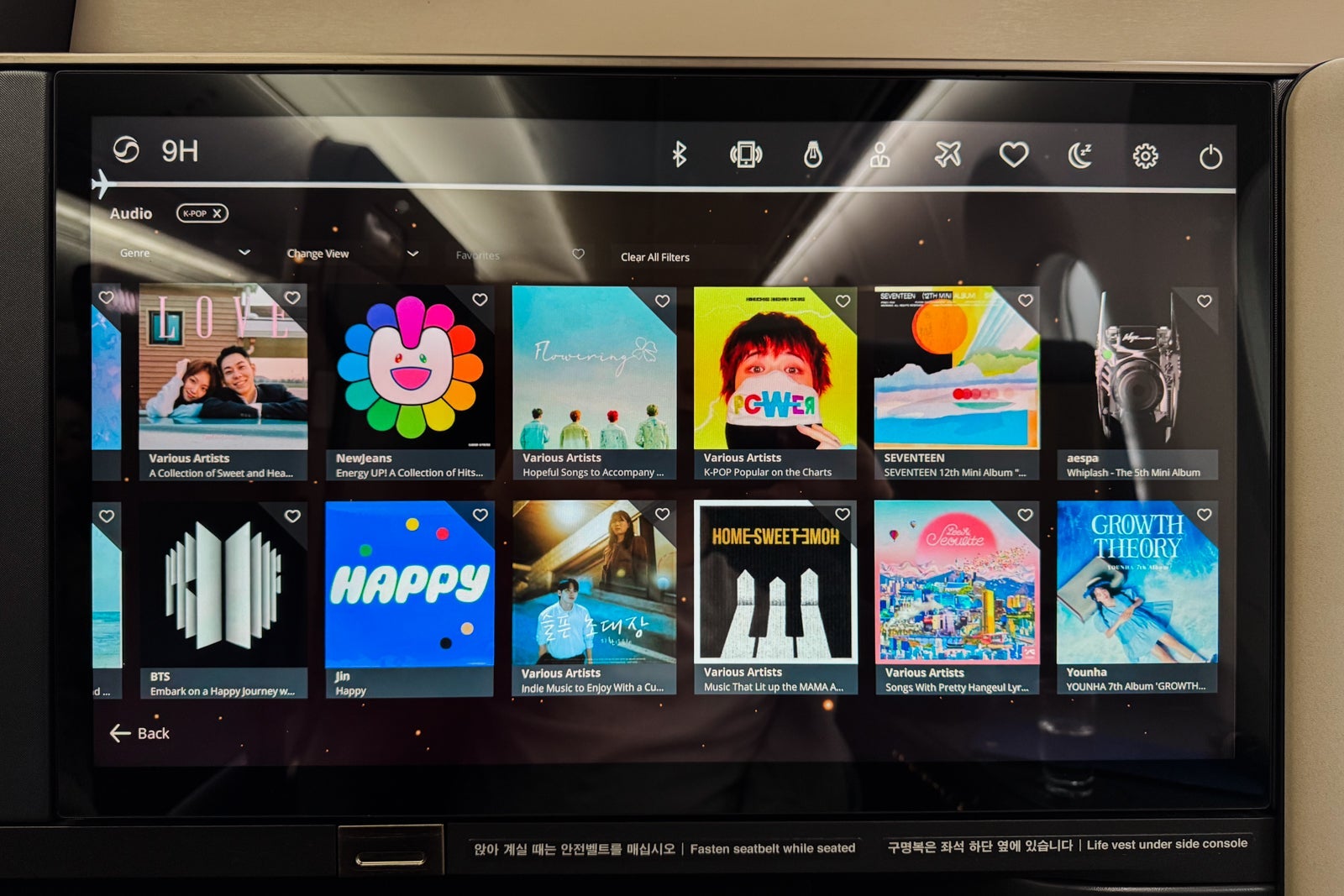
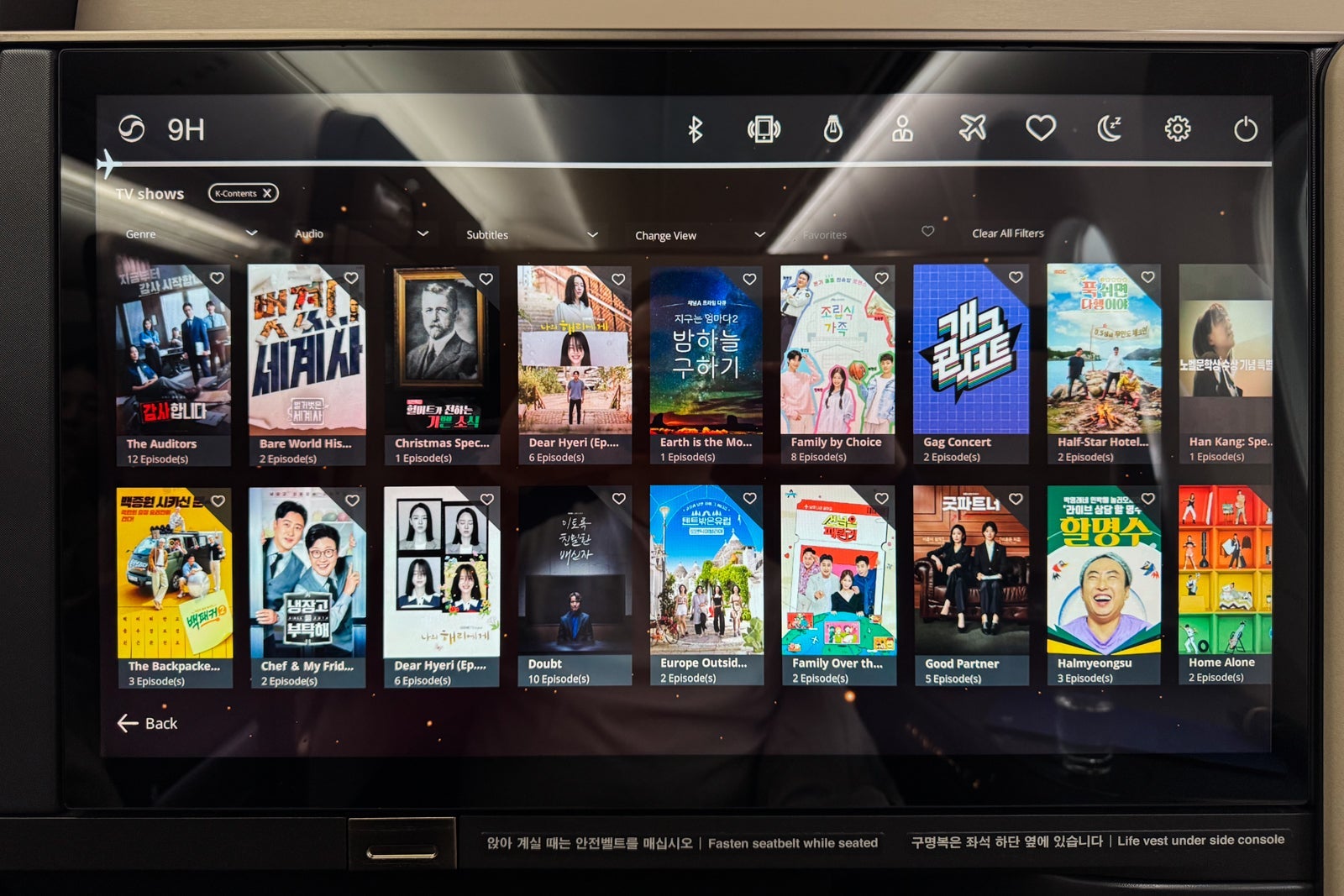
The airline provided passengers with basic noise-canceling headphones, which functioned well. If you have your own set with Bluetooth capability, though, you'll probably just want to pair it with the entertainment system, which was quick and easy to accomplish. You can also pair your phone to the system via Bluetooth and use it as a remote control.
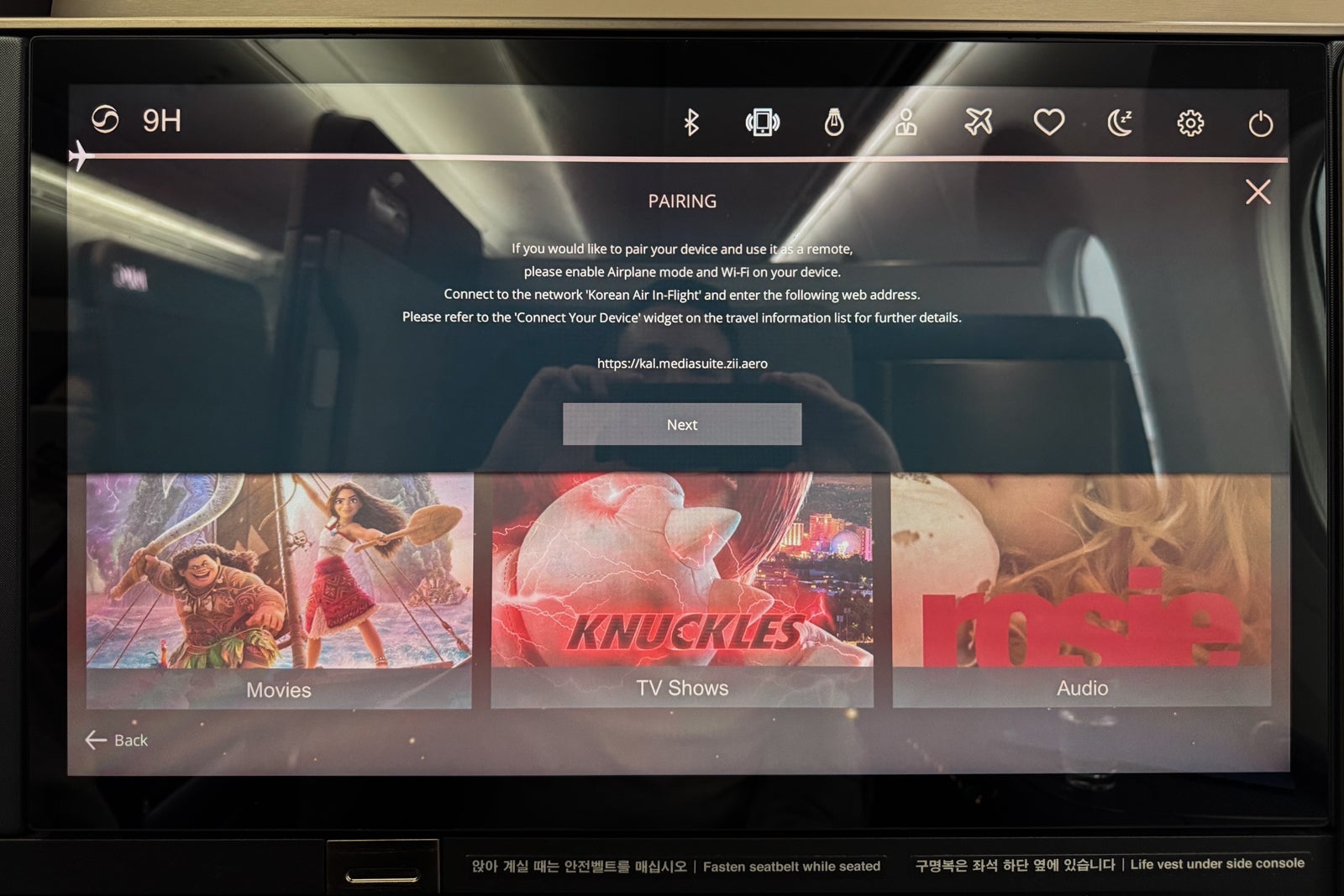
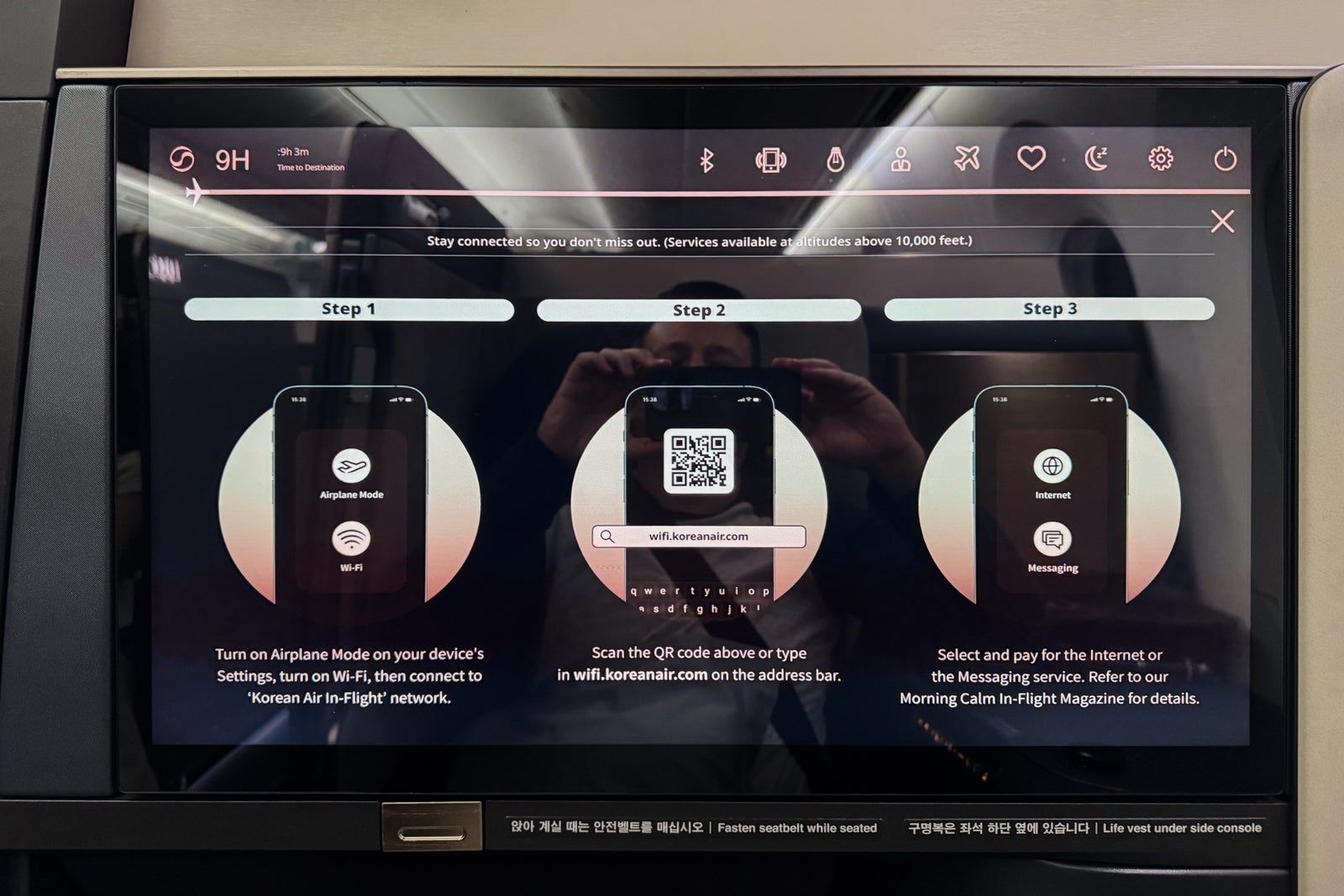
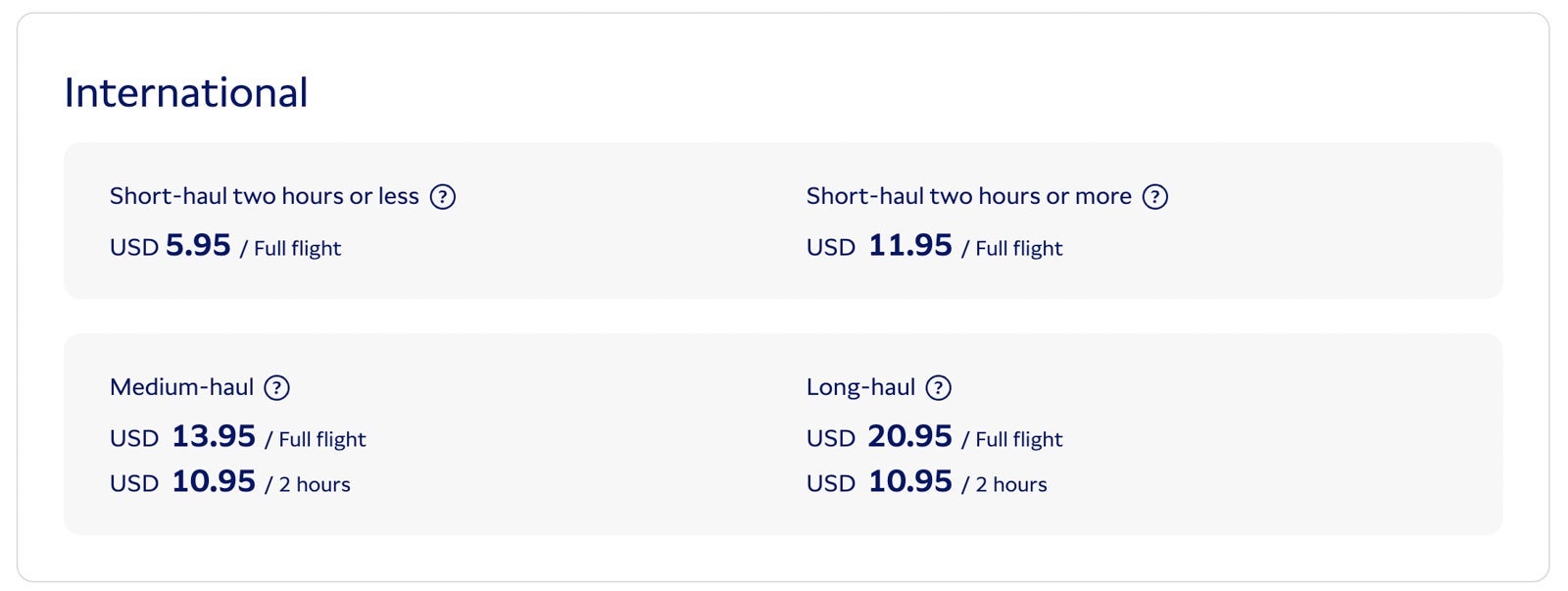
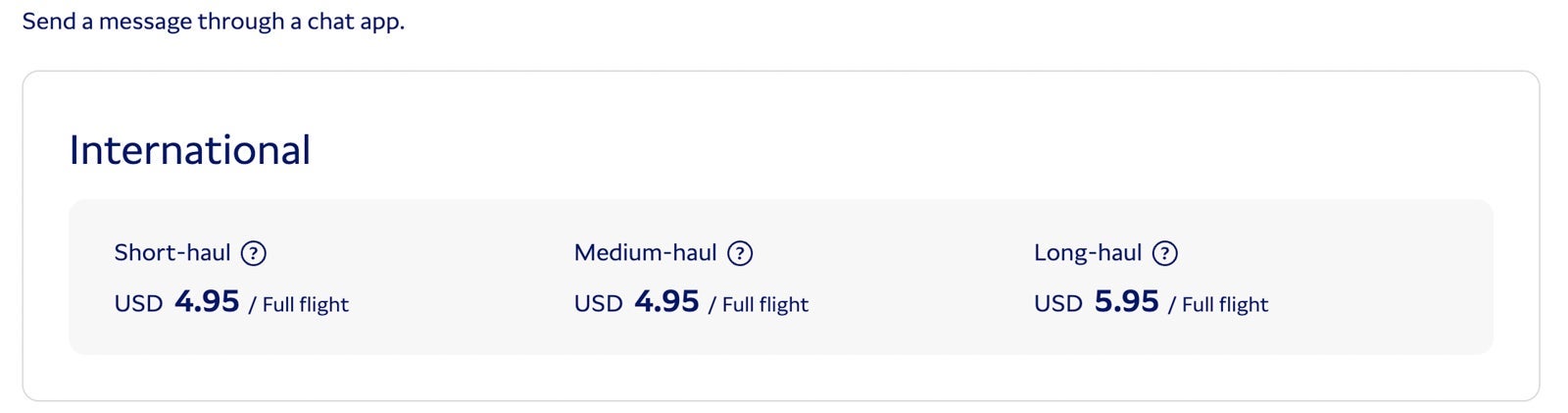
Wi-Fi was advertised on my flight, with three possible options:
- Full-flight texting for $5.95
- Two hours of surfing for $10.95
- Full-flight pass for $20.95
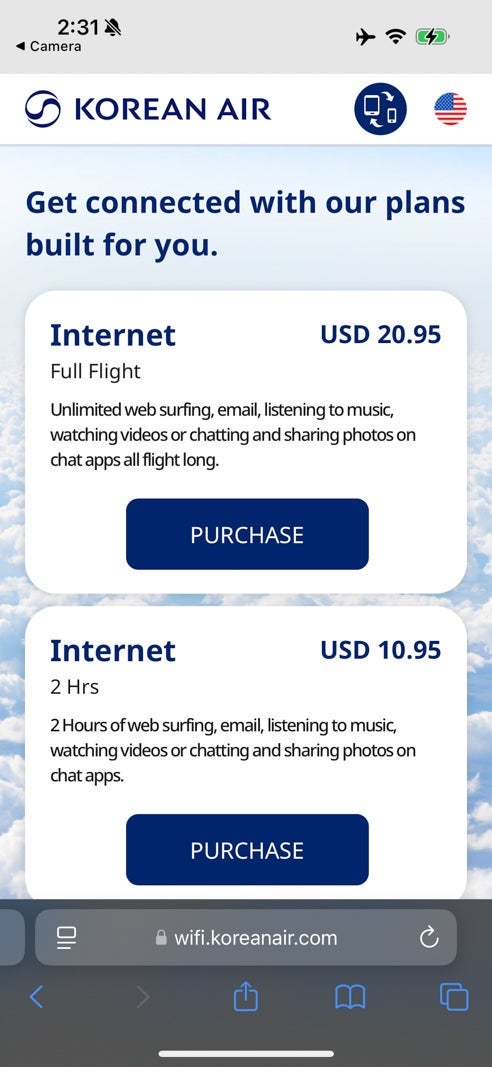
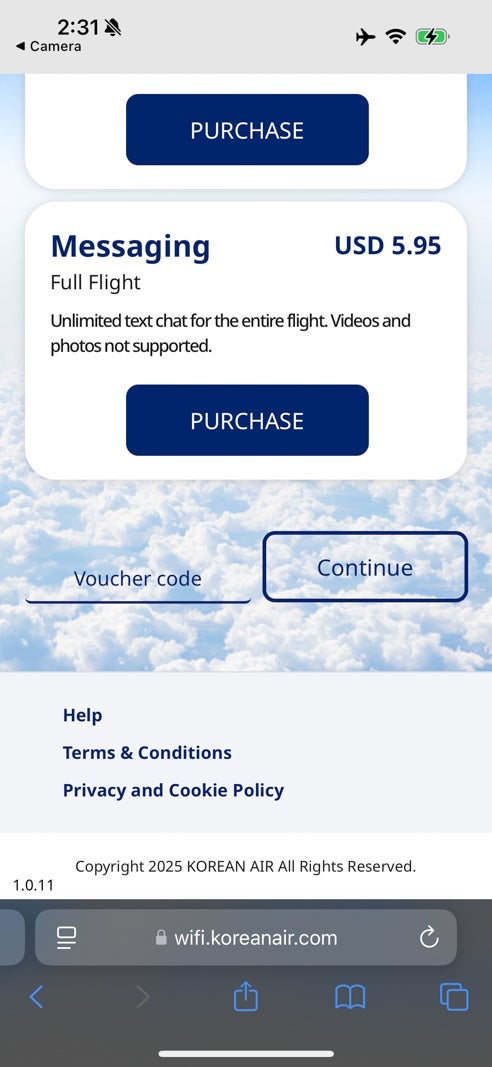
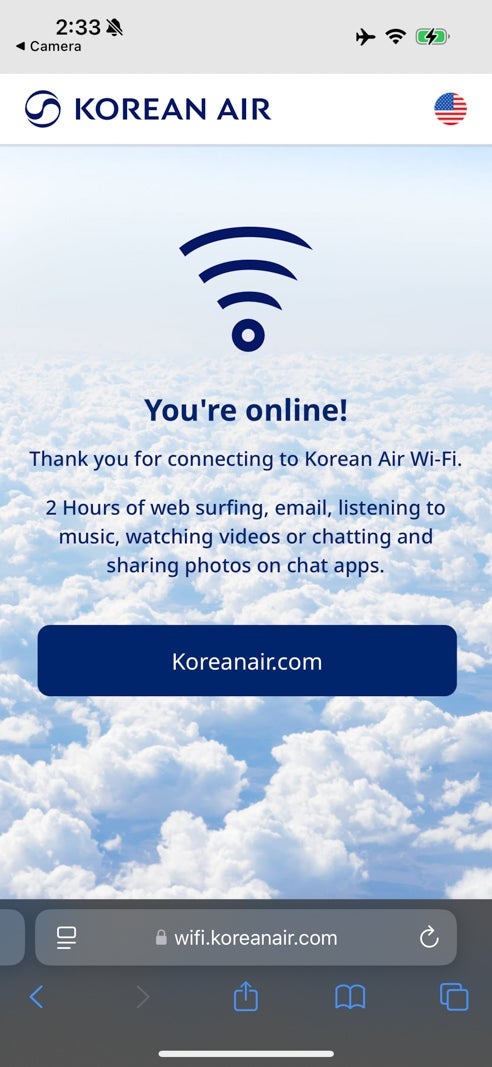

I was not able to get the Wi-Fi to work on my laptop, but I did get it up and running on my phone toward the end of the flight. Speeds were around 3.2Mbps, and most websites I checked loaded quickly. I was also able to check social media apps and send and receive emails with no issues.
How was the food in Korean Air business class?
As the boarding process wound down, flight attendants came through the cabin offering passengers a choice of orange juice, Duval-Leroy Blanc de Blancs Brut Grand Cru Champagne or water, along with a snack mix.
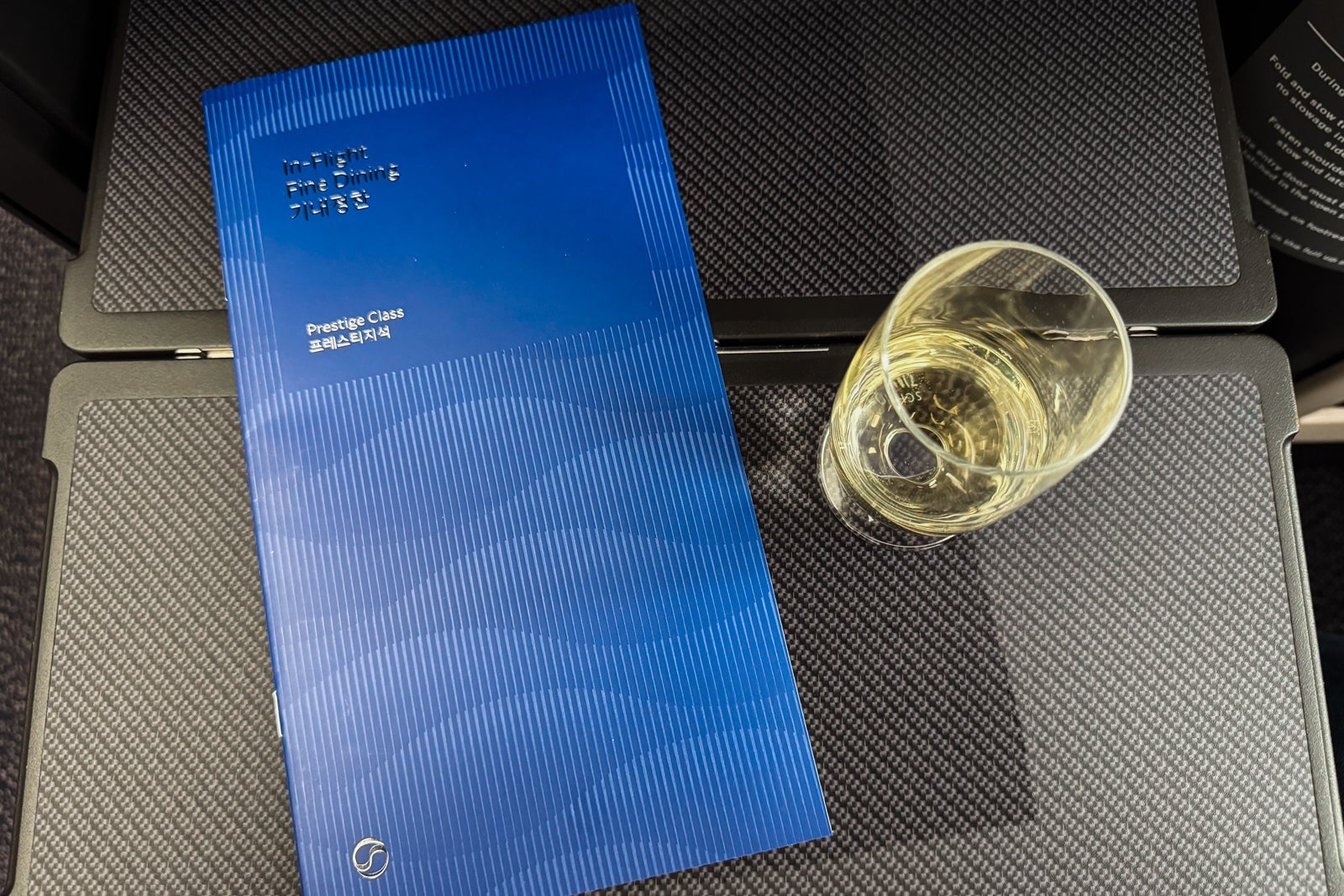
About a week before my flight I received an email asking if I would like to preorder my meals (there were also special meals for those with dietary restrictions). I decided just to do it at that point rather than taking my chances on board, but the crew did not seem to run out of anyone's first choice.
About 30 minutes into the flight, the attendants came by to set passengers' tables and pour them a drink along with an amuse-bouche of seared shrimp with bell pepper aioli. This was savory and tasty.
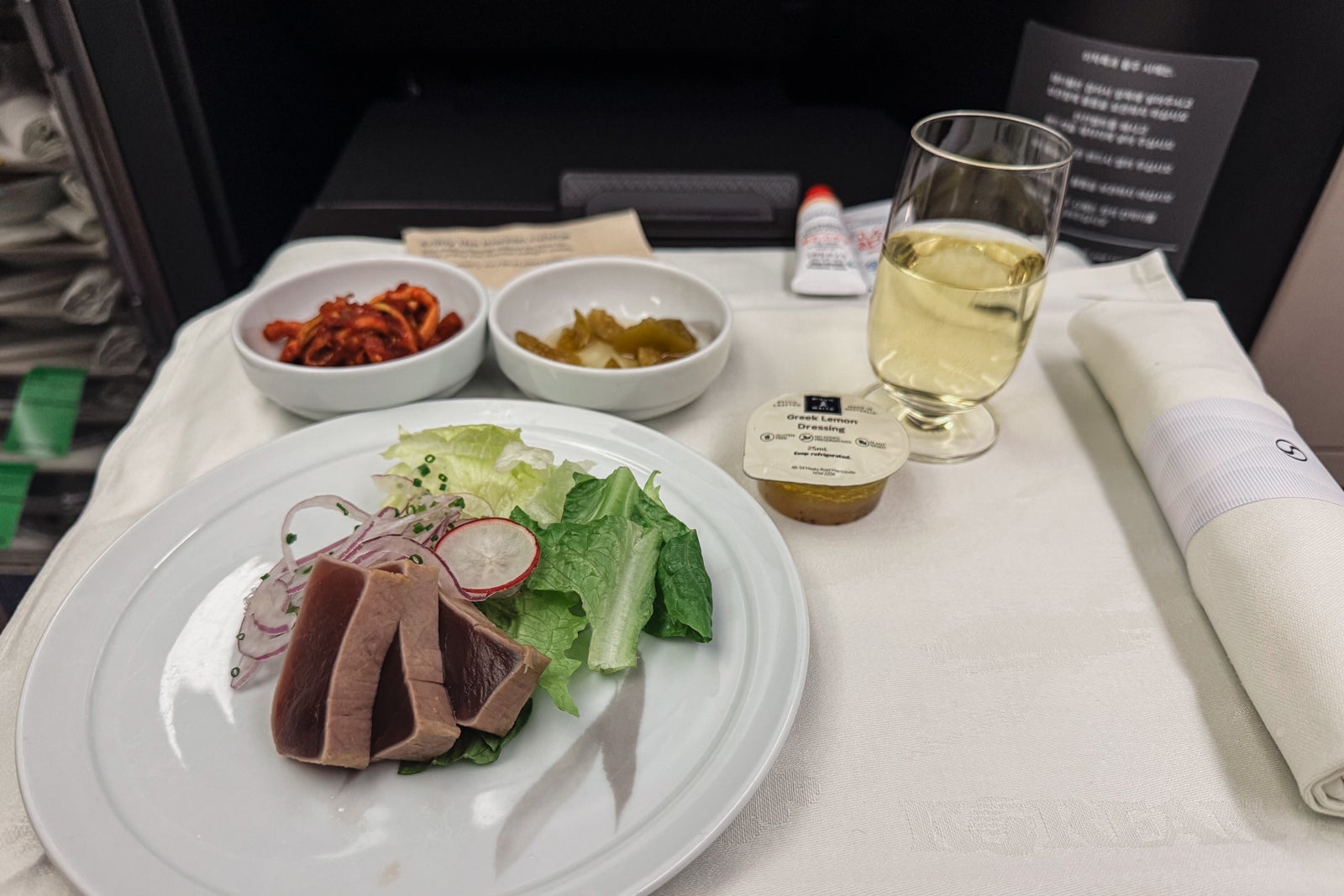
Then, about 20 minutes after that, they commenced meal service, with an appetizer of salad with grilled tuna slices and lemon vinaigrette, or cream of carrot and coconut soup, which was only available to folks who'd ordered a Western entree.
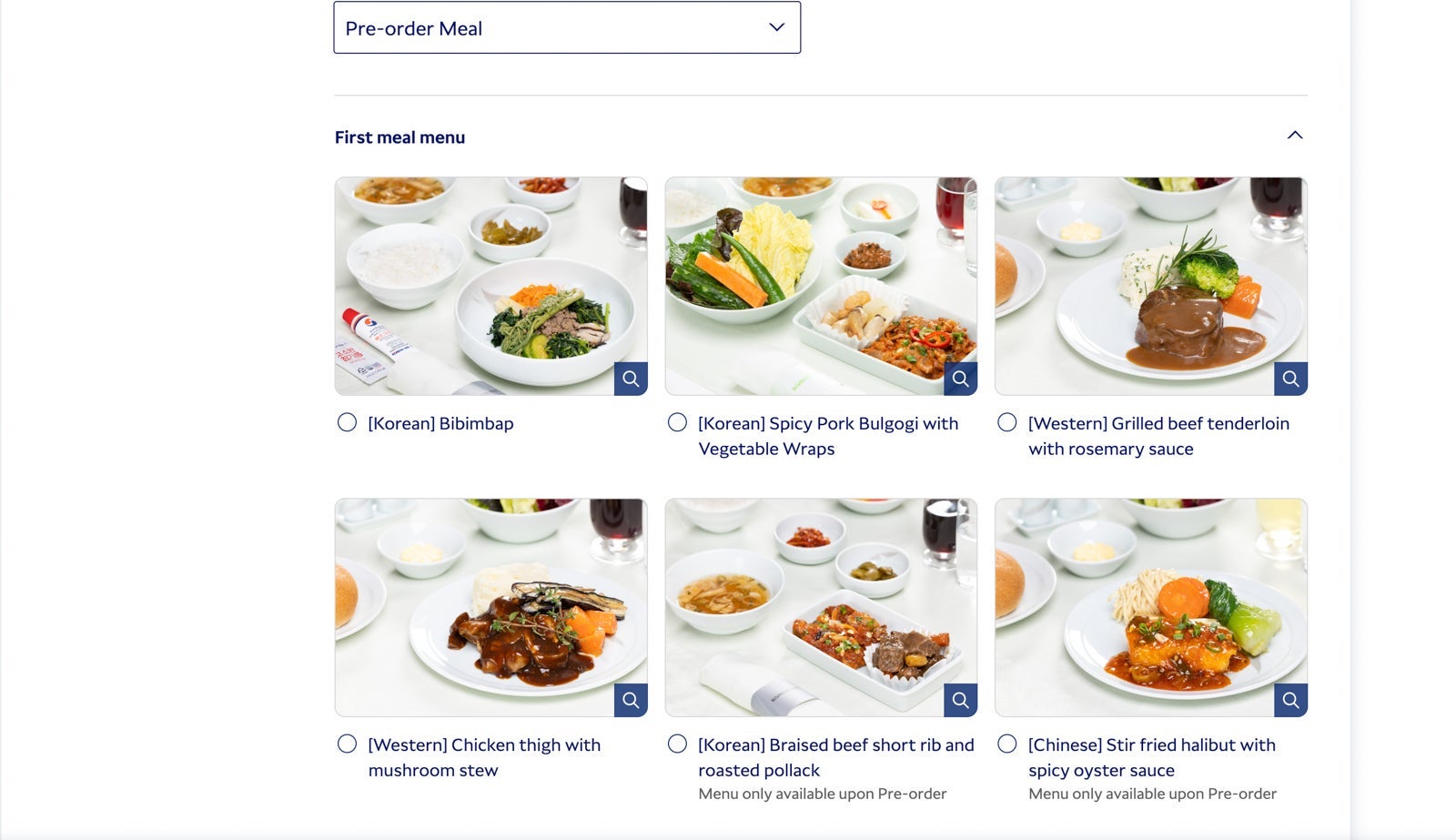
For the main course, the choices were:
- Bibimbap
- Spicy pork bulgogi with vegetables
- Grilled beef tenderloin with rosemary
- Chicken thighs with mushroom sauce
- Braised beef short rib and roasted pollack (fish)
- Stir-fried halibut with spicy oyster sauce
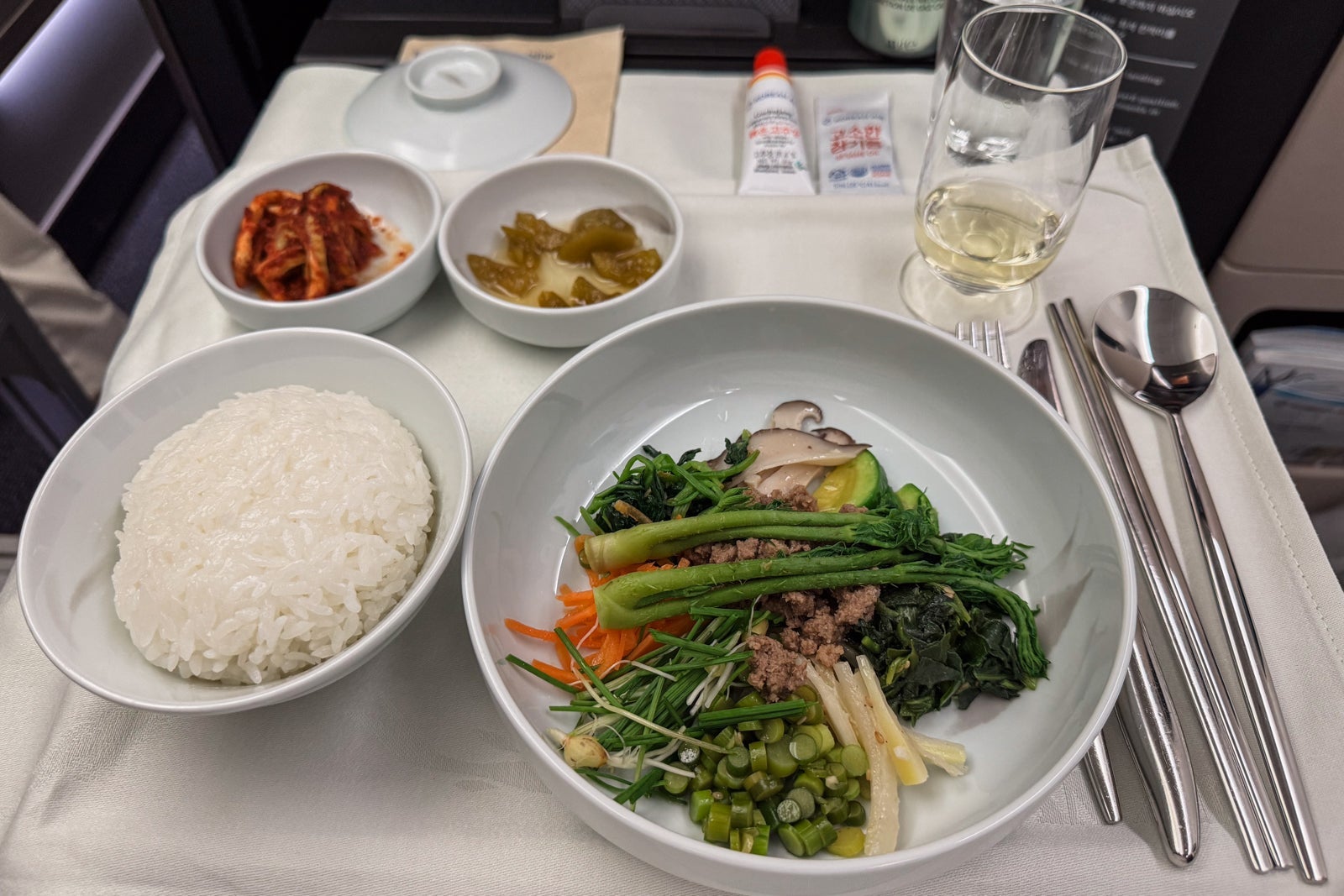
The last two were only available via preorder. Only the Western dishes came with a choice of bread. I had chosen the bibimbap, though, which is one of the airline's specialties and was simple but hearty.
About 20 minutes after the main course was cleared, flight attendants wheeled through another trolley with cheese plates and fresh fruit.
Fifteen minutes or so after that, they were back with a choice of Haagen-Dazs ice cream or strawberry cheesecake, which I skipped, though I did have a soothing peppermint tea.
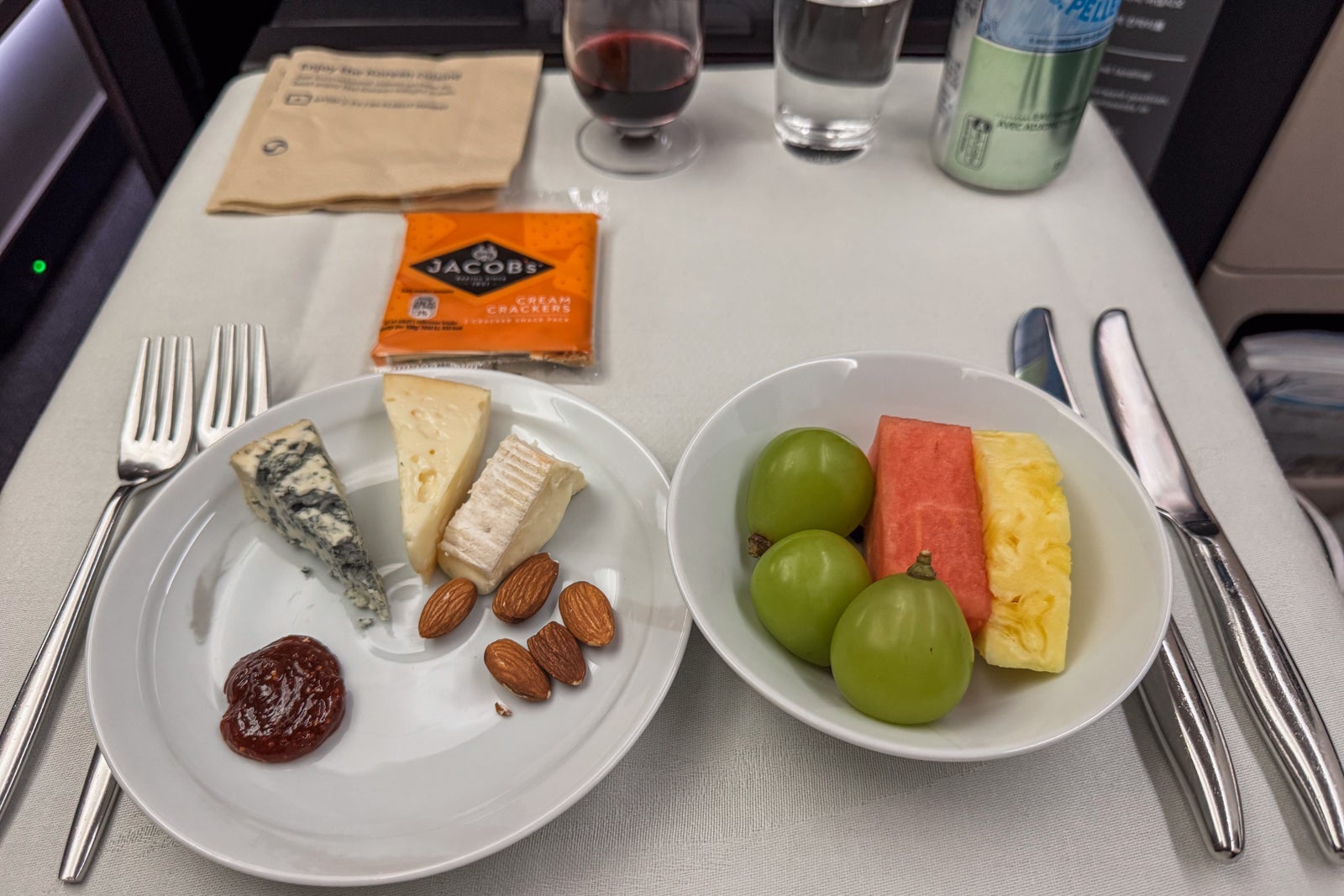
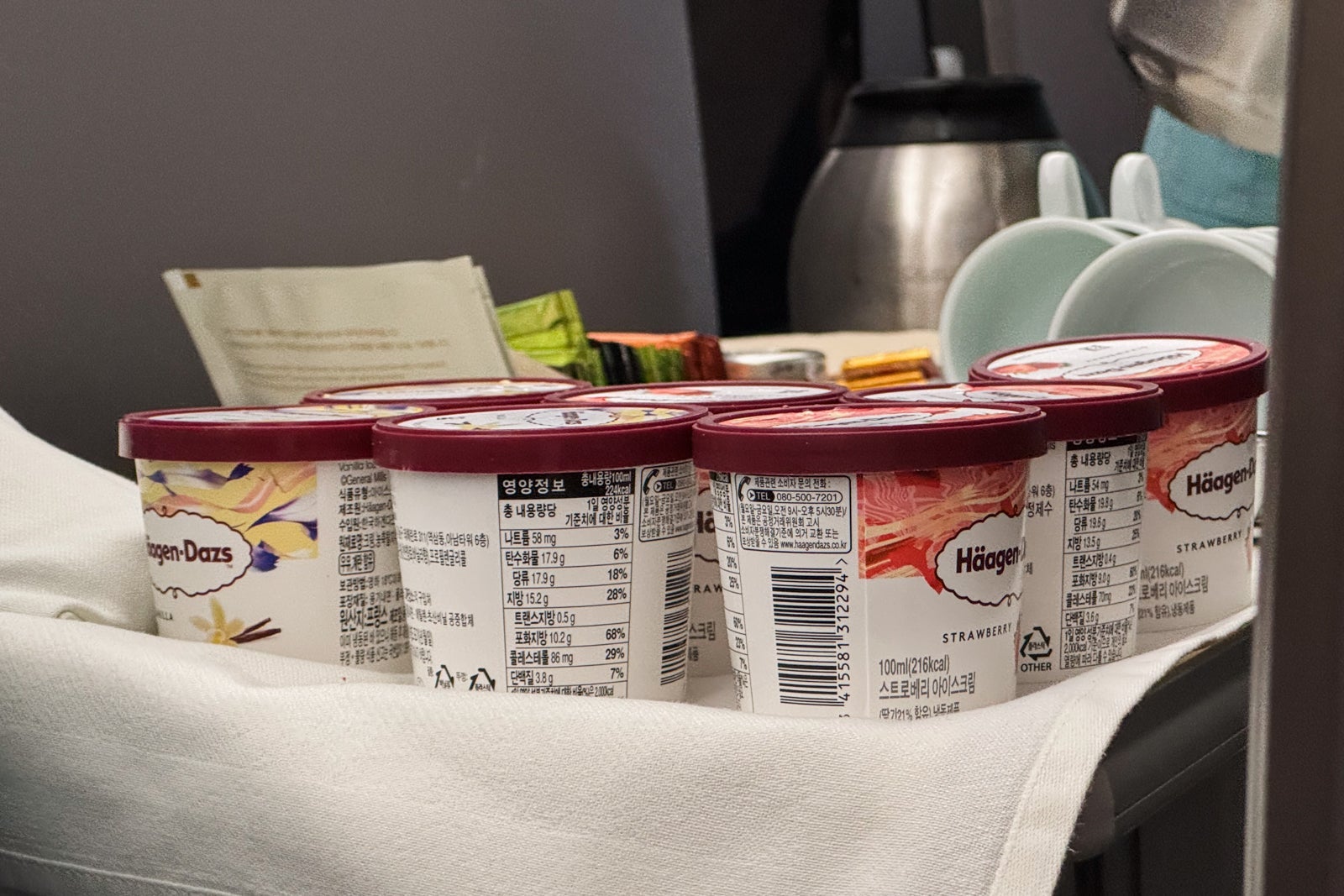
As for beverages, the wine list included the Duval-Leroy Champagne as well as:
- Jean-Marc Brocard Chablis Premier Cru Mont de Milieu from Burgundy, France
- Chateau de Chantegrive Caroline semillon-sauvignon blanc from Bordeaux, France
- Chateau Montus red wine from France
- M. Chapoutier Tournon Lady's Lane Vineyard shiraz from Australia
- Sandeman Founders Reserve Porto from Portugal
The Chablis was full-bodied and went well with the tuna starter while the shiraz was a good accompaniment for the bibimbap.
There were also various spirits and cocktails available, plus a selection of beers that included Blue Moon, Stella Artois and Jeju Pellong Ale.
For nonalcoholic beverages, there was Jeju spring water and S.Pellegrino along with various sodas, juices, teas, and regular and decaf coffee.
Meal service concluded just under two hours into the flight, with around seven left to go.
Between meals, there were snacks available including cookies, popcorn, mixed nuts and ramen, though I did not partake since I was trying to maximize my rest.
With an hour and 45 minutes left before landing, flight attendants brightened the cabin and came through to wake passengers (whose do-not-disturb signs were off) for the second meal.
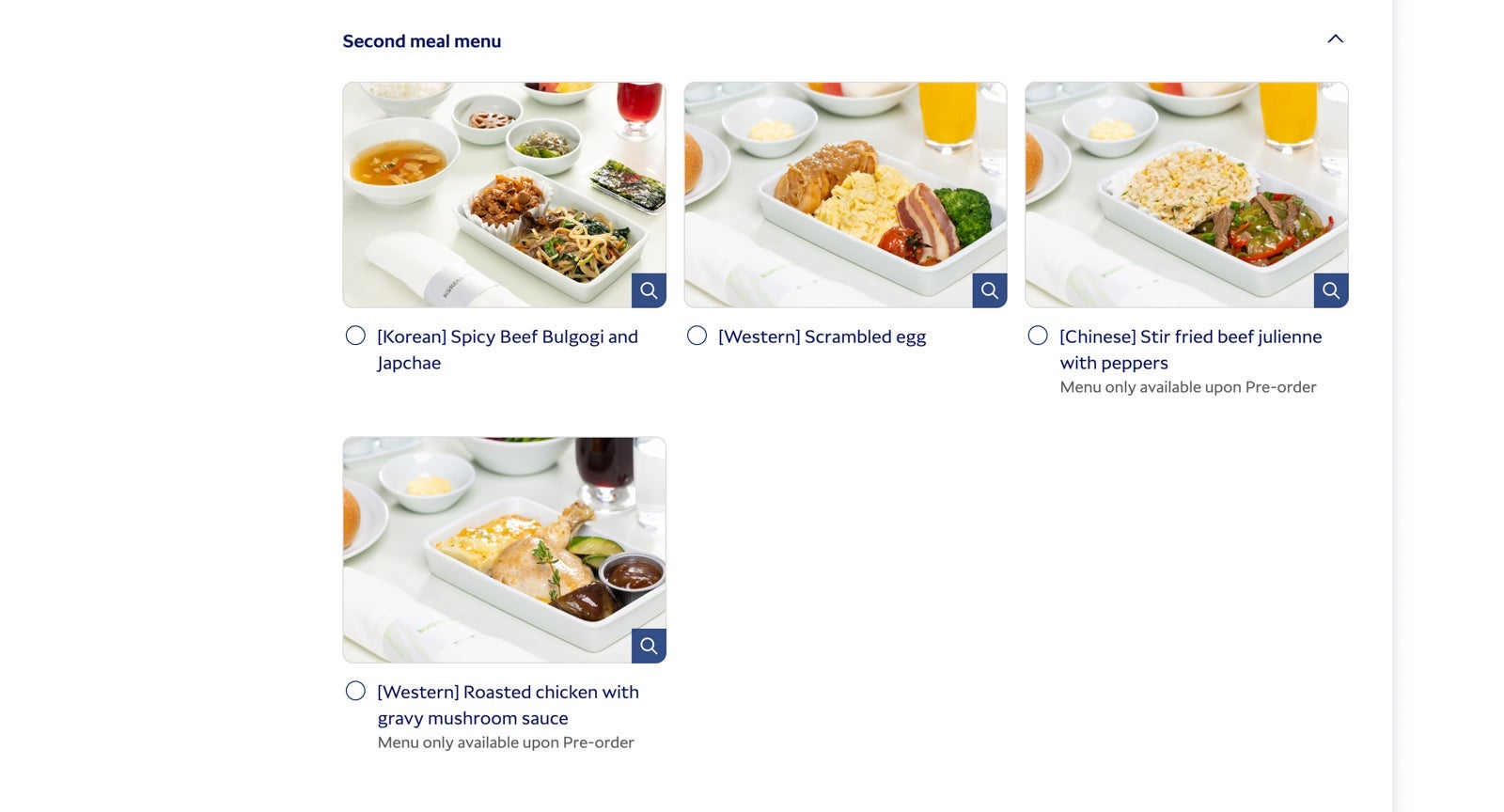
The entree choices included:
- Spicy beef bulgogi with japchae (glass noodle stir-fry)
- Scrambled eggs with bacon
- Continental breakfast with yogurt and pastries
- Stir-fried beef julienne with peppers
- Roasted chicken with mushroom sauce
The last two were only available for preorder. All were served with a selection of fresh fruit, though only the eggs came with yogurt and pastries. I had the bulgogi, which was a bit robust for breakfast, but since I wouldn't be eating for a while on the ground, I figured it was my best choice.
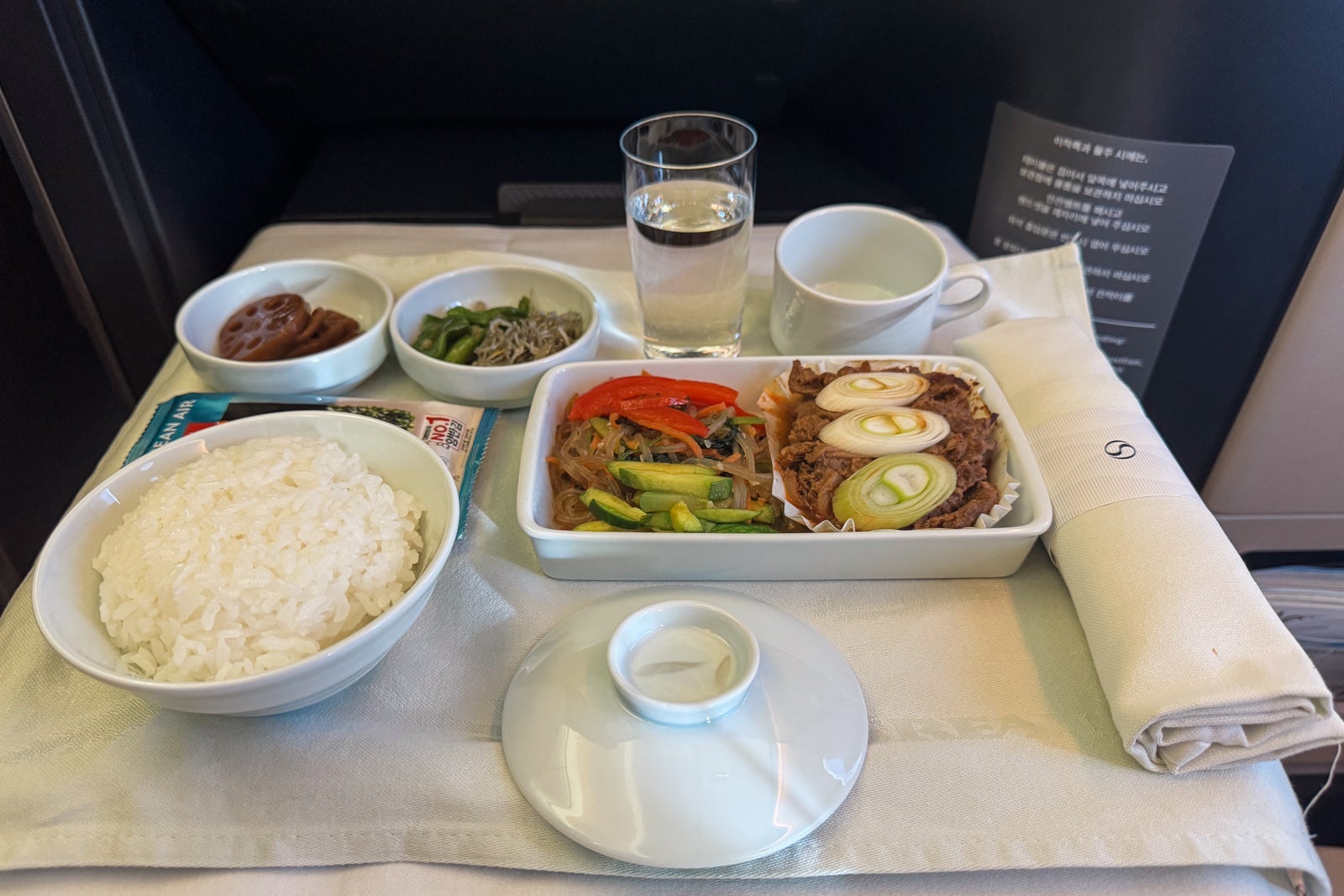
After trays were set out, flight attendants came back through offering coffee from a pot or hot water for tea and then brought out little plates with fresh fruit. The service concluded about an hour before landing.
Overall, the food tasted fresh and was filling, though it wasn't the most diverse assortment of dishes. If you have special dietary needs or are vegetarian or vegan, I would suggest preordering a special meal to ensure you have food that meets your requirements.
Would you recommend Korean Air business class?
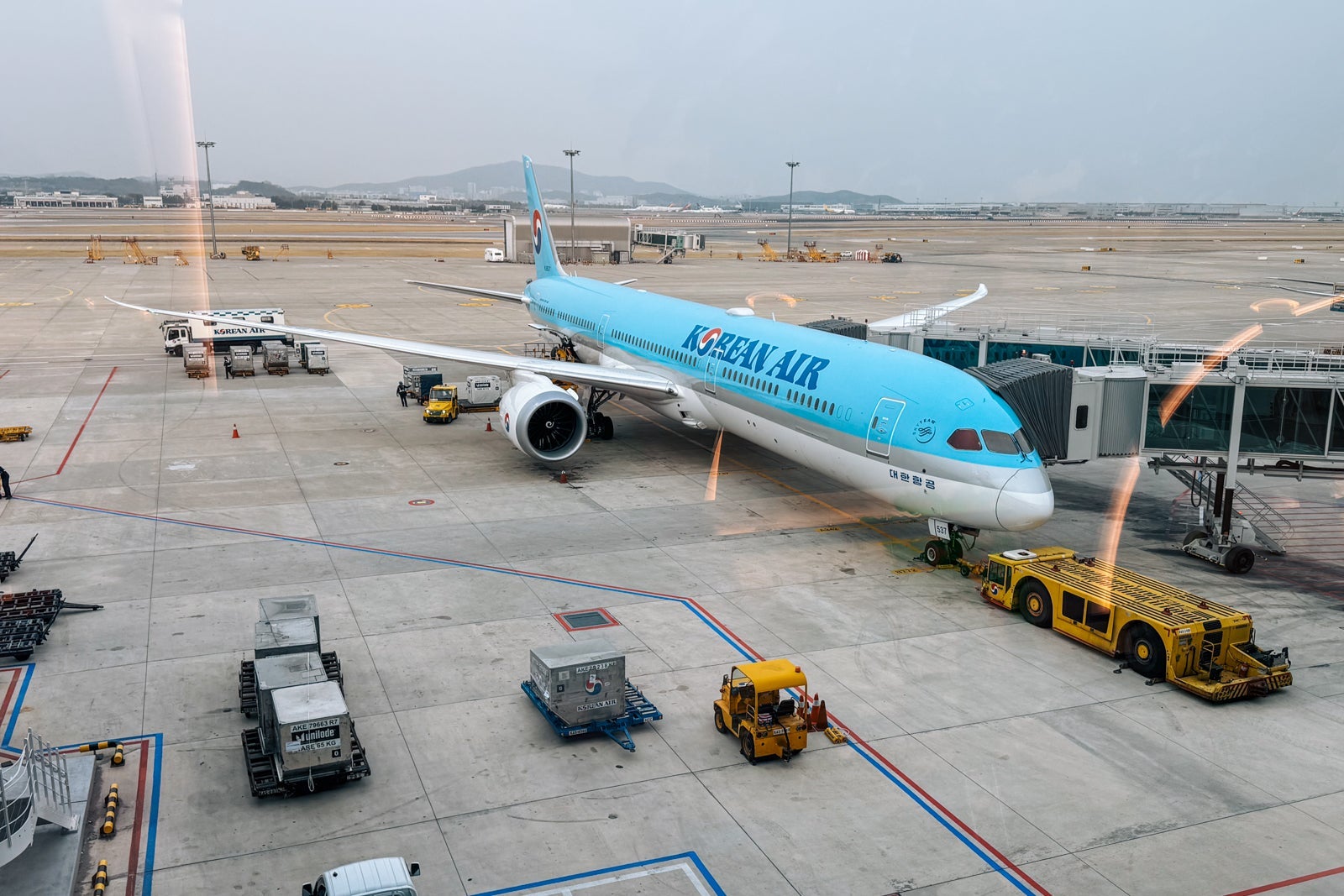
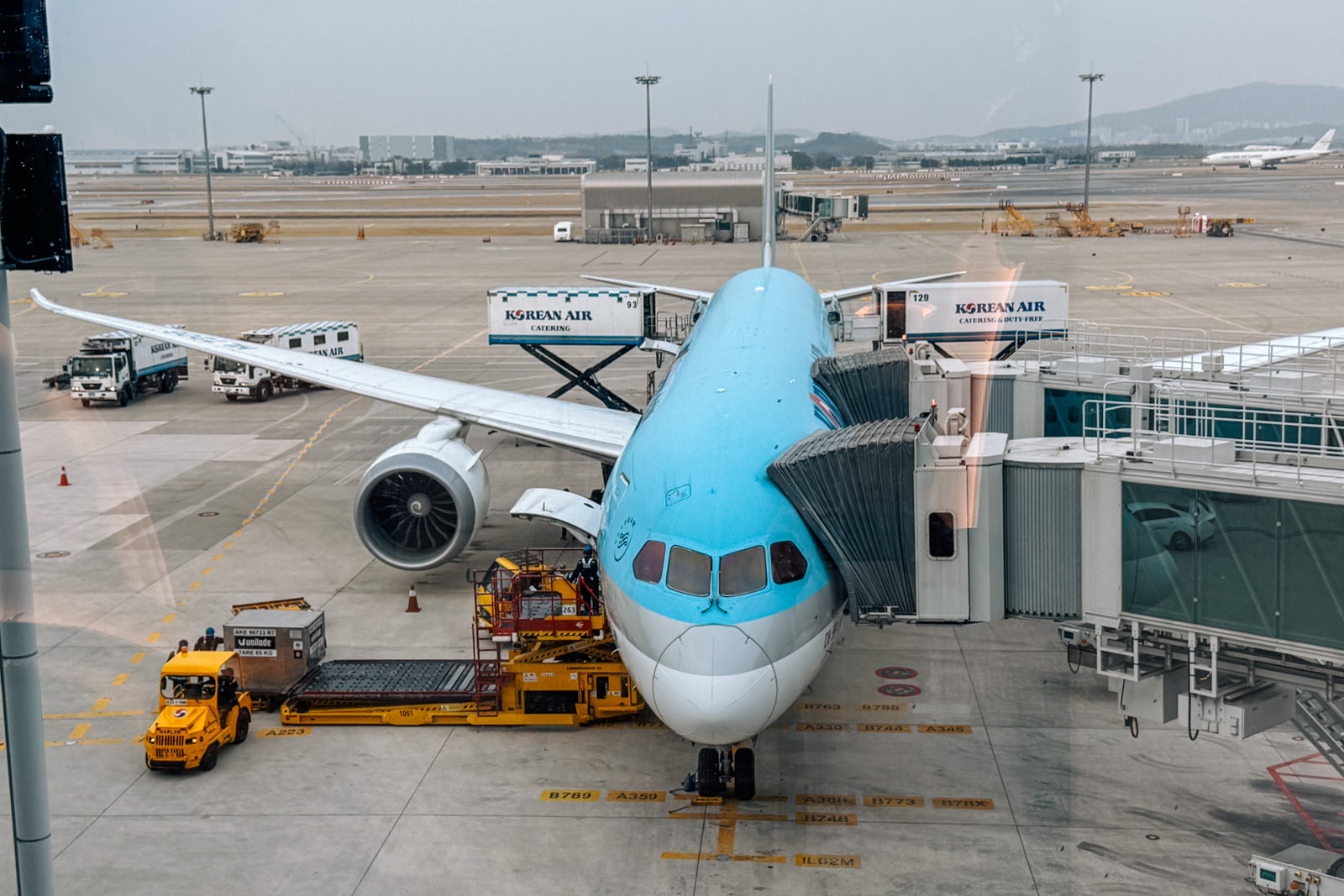
I would absolutely recommend Korean Air business class in the Prestige Suites 2.0 ... as soon as they get those doors working.
Even without functioning doors, the suites are impressive. They look swanky, they feel spacious and their technology is impressively current. While the soft amenities could use a little tweaking (namely with seat covers), the service was sterling — flight attendants constantly came through the cabin checking on passengers and proactively offering drink refills, to help turn down the bed and more.
If only SkyPass established some transfer partnerships, this would be one of the best ways to get to and from Asia using points.
Related reading:
- Korean Air debuts exciting new business-class product with doors
- The best airline credit cards
- Premium economy vs. business class: Are the differences worth an upgrade?
- Maximize your airfare: The best credit cards for booking flights
- What are airline alliances, and who's in them?
- The best ways to search for SkyTeam award availability
- Korean Air just made huge changes to its look, dining and inflight amenities
- Korean Air to add premium economy on 11 Boeing 777s, plans lounge revamps at JFK, LAX
TPG featured card
at American Express's secure site
Terms & restrictions apply. See rates & fees.
| 4X | Earn 4X Membership Rewards® points per dollar spent on purchases at restaurants worldwide, on up to $50,000 in purchases per calendar year, then 1X points for the rest of the year. |
| 4X | Earn 4X Membership Rewards® points per dollar spent at US supermarkets, on up to $25,000 in purchases per calendar year, then 1X points for the rest of the year. |
| 5X | Earn 5X Membership Rewards® points on prepaid hotel stays booked through AmexTravel.com or the Amex Travel App™. |
| 3X | Earn 3X Membership Rewards® points on flights booked through AmexTravel.com, the Amex Travel App™, or purchased directly from airlines. |
| 2X | Earn 2X Membership Rewards® points on prepaid car rentals booked through AmexTravel.com or the Amex Travel App™ and cruises booked and paid through AmexTravel.com. |
| 1X | Earn 1X Membership Rewards® point per dollar spent on all other eligible purchases. |
Pros
- Valuable dining and food-related credits
- Flexible rewards with airline and hotel transfer partners
- Multiple travel and purchase protections
- No foreign transaction fees
- Access to Amex Offers for additional savings (enrollment required)
Cons
- Not as useful for those living outside the U.S.
- Some may have trouble using Uber and other dining credits
- You may be eligible for as high as 100,000 Membership Rewards® Points after you spend $8,000 in eligible purchases on your new Card in your first 6 months of Card Membership. Welcome offers vary and you may not be eligible for an offer. Apply to know if you’re approved and find out your exact welcome offer amount – all with no credit score impact. If you’re approved and choose to accept the Card, your score may be impacted.
- Earn 4X Membership Rewards® points per dollar spent on purchases at restaurants worldwide, on up to $50,000 in purchases per calendar year, then 1X points for the rest of the year.
- Earn 4X Membership Rewards® points per dollar spent at US supermarkets, on up to $25,000 in purchases per calendar year, then 1X points for the rest of the year.
- Earn 5X Membership Rewards® points on prepaid hotel stays booked through AmexTravel.com or the Amex Travel App™.
- Earn 3X Membership Rewards® points on flights booked through AmexTravel.com, the Amex Travel App™, or purchased directly from airlines.
- Earn 2X Membership Rewards® points on prepaid car rentals booked through AmexTravel.com or the Amex Travel App™ and cruises booked and paid through AmexTravel.com.
- Earn 1X Membership Rewards® point per dollar spent on all other eligible purchases.
- Pay It® lets you tap in the American Express® App to quickly pay for small purchase amounts throughout the month and still earn rewards the way you usually do. Plan It® gives you the option to split up big purchases into equal monthly payments with a fixed fee. You’ll know upfront exactly how much you’ll pay.
- $120 Dining Credit: Earn up to a total of $10 in statement credits monthly when you pay with the Gold Card at Grubhub (including Seamless), Buffalo Wild Wings, Five Guys, The Cheesecake Factory, and Wonder. This can be an annual savings of up to $120. Enrollment required.
- $100 Resy Credit: Get up to $100 in statement credits each calendar year at over 10,000 qualifying U.S. Resy restaurants after you pay for eligible purchases with the American Express® Gold Card. That’s up to $50 in statement credits semi-annually. Enrollment required.
- $84 Dunkin' Credit: Earn up to $7 in monthly statement credits after you pay with the American Express® Gold Card at U.S. Dunkin’ locations. Enrollment required.
- $120 Uber Cash on Gold: Enjoy up to $120 in Uber Cash annually with your Gold Card. Just add your Card to your Uber account and you'll get $10 in Uber Cash each month to use on orders and rides in the U.S. when you select an Amex Card for your transaction.
- Enjoy complimentary Hertz Five Star® Status benefits like skipping the counter at select locations, adding an additional driver at no additional cost*, and vehicle upgrades**. Benefit enrollment and Hertz Gold+ registration are required. *Additional drivers must meet standard rental qualifications and must be a spouse or domestic partner to qualify as complimentary. Other additional drivers subject to fees. **Benefits are subject to availability and vary by location. Additional Hertz program Terms and Conditions including age restrictions apply.
- Book two nights or more with The Hotel Collection through AmexTravel.com or the Amex Travel App™ and receive a $100* credit towards eligible charges at over 1,400 upscale hotels worldwide. *Eligible charges vary by property.
- Book your travel through the Amex Travel App™ with added peace of mind – backed by American Express® service and support. Only for American Express® Card Members.
- Whenever you need us, we're here. Our Member Services team will ensure you are taken care of. From lost Card replacement to statement questions, we are available to help 24/7.
- No Foreign Transaction Fees.
- Annual Fee is $325.
- Terms Apply.