The Points Guy believes that credit cards can transform lives, helping you leverage everyday spending for cash back or travel experiences that might otherwise be out of reach. That's why we publish a variety of editorial content and card comparisons: to help you find a great card to turn your goals into reality.
Our site may earn compensation when a customer clicks on a link, when an application is approved, or when an account is opened with our partners, and this may impact how or where these products appear. While we don't cover all available credit cards, our editorial team creates and maintains all of the analysis of these cards, and our content is not influenced nor subject to review by any credit card company, bank or partner prior to (or after) publication. Please view our advertising policy and product review methodology for more information.
Advertiser disclosure
The Points Guy believes that credit cards can transform lives, helping you leverage everyday spending for cash back or travel experiences that might otherwise be out of reach. That's why we publish a variety of editorial content and card comparisons: to help you find a great card to turn your goals into reality.
Our site may earn compensation when a customer clicks on a link, when an application is approved, or when an account is opened with our partners, and this may impact how or where these products appear. While we don't cover all available credit cards, our editorial team creates and maintains all of the analysis of these cards, and our content is not influenced nor subject to review by any credit card company, bank or partner prior to (or after) publication. Please view our advertising policy and product review methodology for more information.
Guides
The hardest airline miles to earn — and why you want them anyway
Ethan's been a frequent flier for as long as he can remember, from studying abroad in Paris to moving to Shanghai after graduating college, where he served as TPG's eyes and ears for all things travel in the Asia-Pacific region. If you asked him where he wants to travel next he'd quote Anthony Bourdain and tell you "anytime I'm eating spicy noodles in a bowl, I'm happy."
May 19, 2022 • 15 min read
The cards we feature here are from partners who compensate us when you are approved through our site, and this may impact how or where these products appear. We don't cover all available credit cards, but our analysis, reviews, and opinions are entirely from our editorial team. Terms apply to the offers listed on this page. Please view our advertising policy and product review methodology for more information.Editorial disclaimer: Opinions expressed here are the author's alone, not those of any bank, credit card issuer, airline or hotel chain, and have not been reviewed, approved or otherwise endorsed by any of these entities.
Comments
By commenting, you agree to our Community Guidelines to help create a positive space for conversation. The responses below are not provided or commissioned by the bank advertiser, our partners, or The Points Guy (“TPG”). They have not been reviewed, approved, or otherwise endorsed by any of these parties. All responses are submitted by individual contributors, and neither the bank advertiser, our partners, nor TPG are responsible for ensuring that all posts and/or questions are answered.
Related stories
Quick summary
The article examines four airline loyalty programs—Alaska Airlines Mileage Plan, Japan Airlines Mileage Bank, Korean Air SKYPASS and Asiana Club—that offer high-value but harder-to-earn miles.
These programs provide unique redemption opportunities, such as premium cabin flights with stopovers, distance-based award charts and access to exclusive airline partners.
Most miles are primarily earned by crediting revenue flights or transferring points from hotel loyalty programs, with limited options for direct credit card transfers.
Scarcity of these miles helps maintain their value, making them especially attractive for travelers seeking luxury or complex itineraries.
What to consider
Some of the best redemptions require booking by phone or have limited award space, especially for first-class cabins.
Fuel surcharges and taxes can significantly impact the value of certain awards, particularly with Asiana Club.
Award charts and redemption rates are subject to change, and some programs are moving toward higher mileage requirements or new structures.
What you'll miss from the article
Detailed strategies for maximizing value with hard-to-earn airline miles, including specific redemption examples and stopover rules.
Generated by AI with support from our editorial team.
Update: Some offers mentioned below are no longer available. View the current offers here.
Scarcity is an important and often overlooked element of value, though. If everyone had access to an unlimited supply of Membership Rewards points, we would snap up all thebest first-class redemptions, forcing airlines to devalue their award charts. In many ways, scarcity helps your miles retain their value over time.
While plenty of hard-to-get miles aren't worth all that much (you don't see me crying over the fact thatSpirit Airlines doesn't have any transfer partners), a few of the most valuable airline miles happen to be some of the hardest to get. Today, we'll take a look at these programs, including how to earn miles and the high-value redemption options that make them worth your time.
In each of these cases, you can earn miles by crediting revenue flights to the specific loyalty program. So I'll skip over that option and focus instead on credit card bonuses and transfer options.
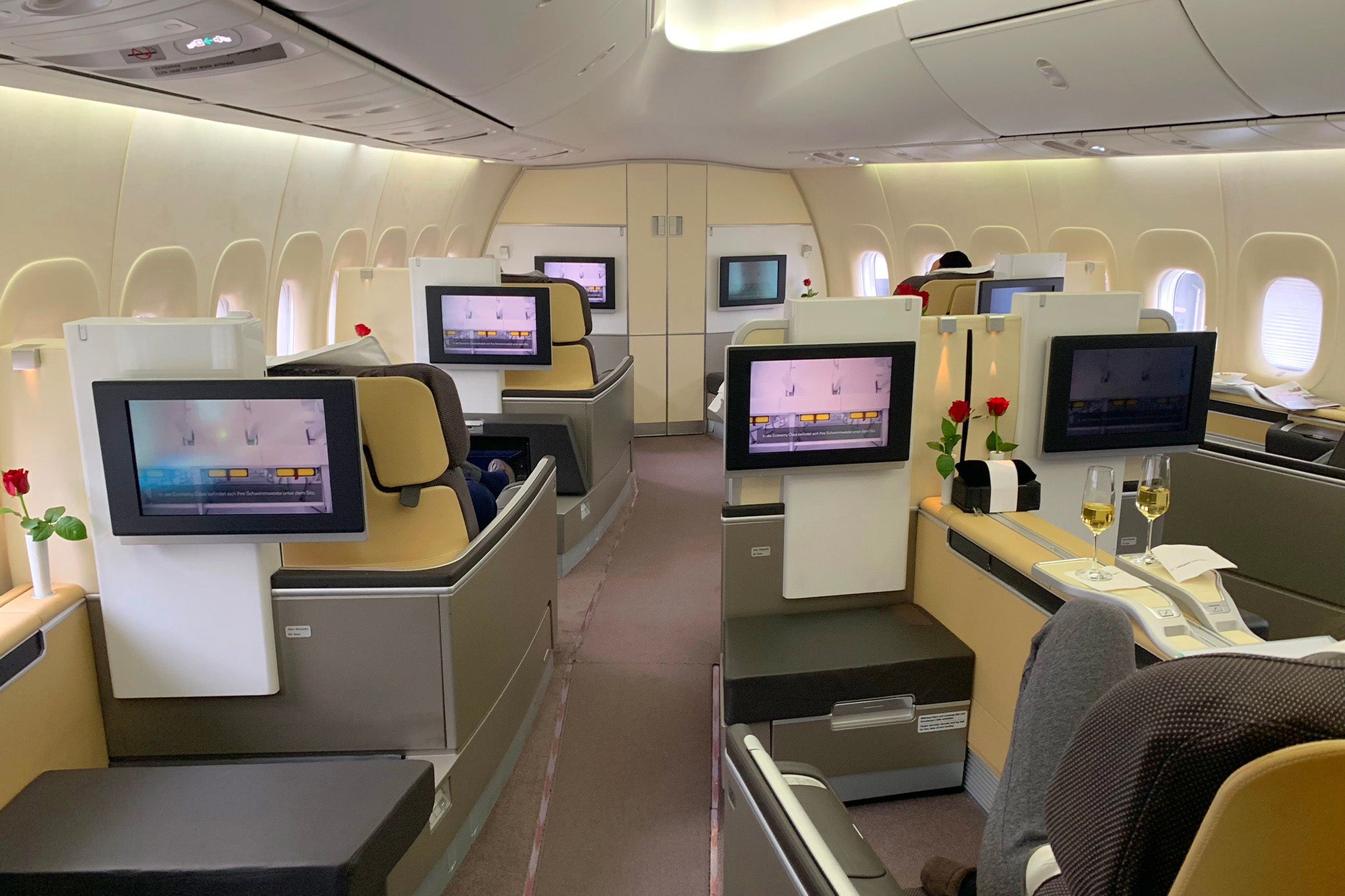
Japan Airlines first class. (Photo by Samantha Rosen / The Points Guy)
Earning
The Alaska Airlines Visa Signature® credit card is currently offering a bonus where you earn 60,000 bonus miles plus Alaska's Famous Companion Fare™ ($99 fare plus taxes and fees from $23) with this offer. To qualify, make $3,000 or more in purchases within the first 90 days of opening your account.
You can also transfer points from Marriott Bonvoy at a 3:1 ratio with a 5,000-mile bonus for every 60,000 points transferred.
Redeeming
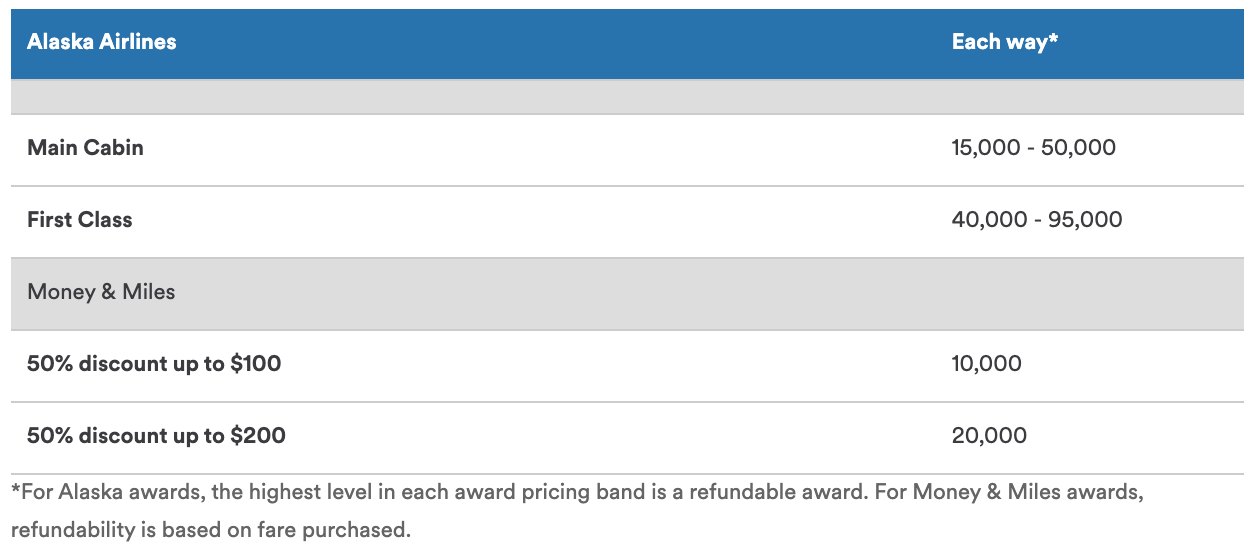
Alaska is a Oneworld member, but its Mileage Plan program maintains partnerships with a uniquely valuable collection of airlines outside of the alliance, such as Singapore Airlines and Korean Airlines. Each partner has its own award chart, and while you can't combine partners on an award ticket (you can mix Alaska-operated flights with partner flights), you are allowed a stopover on one-way tickets. This includes domestic flights within the U.S. or stopovers at a partner's hub airport on international tickets.
The program has seen its fair share of devaluations over the last few months, including gradually shying away from fixed award charts. However, there still are some great sweet spots in the program for the time being.
One of myfavorite Alaska redemptions is using 70,000 Alaska miles for a one-wayCathay Pacific first-class flight between the U.S. and Asia. These flights often cost as much as $12,000, giving you a value of nearly 20 cents per Alaska mile.
(Screenshot from google.com/flights)
You can also fly Japan Airlines first class to North Asia for the same cost, though if you're flying in business class, Cathay Pacific is cheaper (50,000 miles vs. 60,000 miles). Cathay Pacific flights to Southeast Asia require fewer miles than JAL. You can even stop in Hong Kong on your way to India, all for just 70,000 miles one-way in first class. Note that you have to call in to book Cathay Pacific awards, but JAL awards can be booked through the Alaska website.
If you're looking to stay closer to home, Alaska miles are great for flights to Hawaii – if you can find saver space. Alaska also has an extensive route network from the West Coast to several different Hawaiian destinations.
JAL miles are one of the cheapest ways to try out Emirates' A380 onboard shower
Earning
While JAL offers an unappealing credit card, your best bet for quickly racking up Mileage Bank miles is by transferring from Marriott Bonvoy. Points transfer at a 3:1 ratio with a 5,000-mile bonus for every 60,000 points transferred.
JAL allows up to two stopovers on Emirates tickets. So you could book an itinerary such as: New York – Dubai (stopover) – Bangkok (destination) – Dubai – Milan (stopover) – New York-JFK. This would cover almost 20,000 flight miles and cost 130,000 JAL miles in business class.
You would need to transfer 315,000 Marriott points (worth $2,646 based onTPG's latest valuations) to get this many JAL miles. In return, you'd get five long-haul flights in Emirates business class and get to explore three cities.
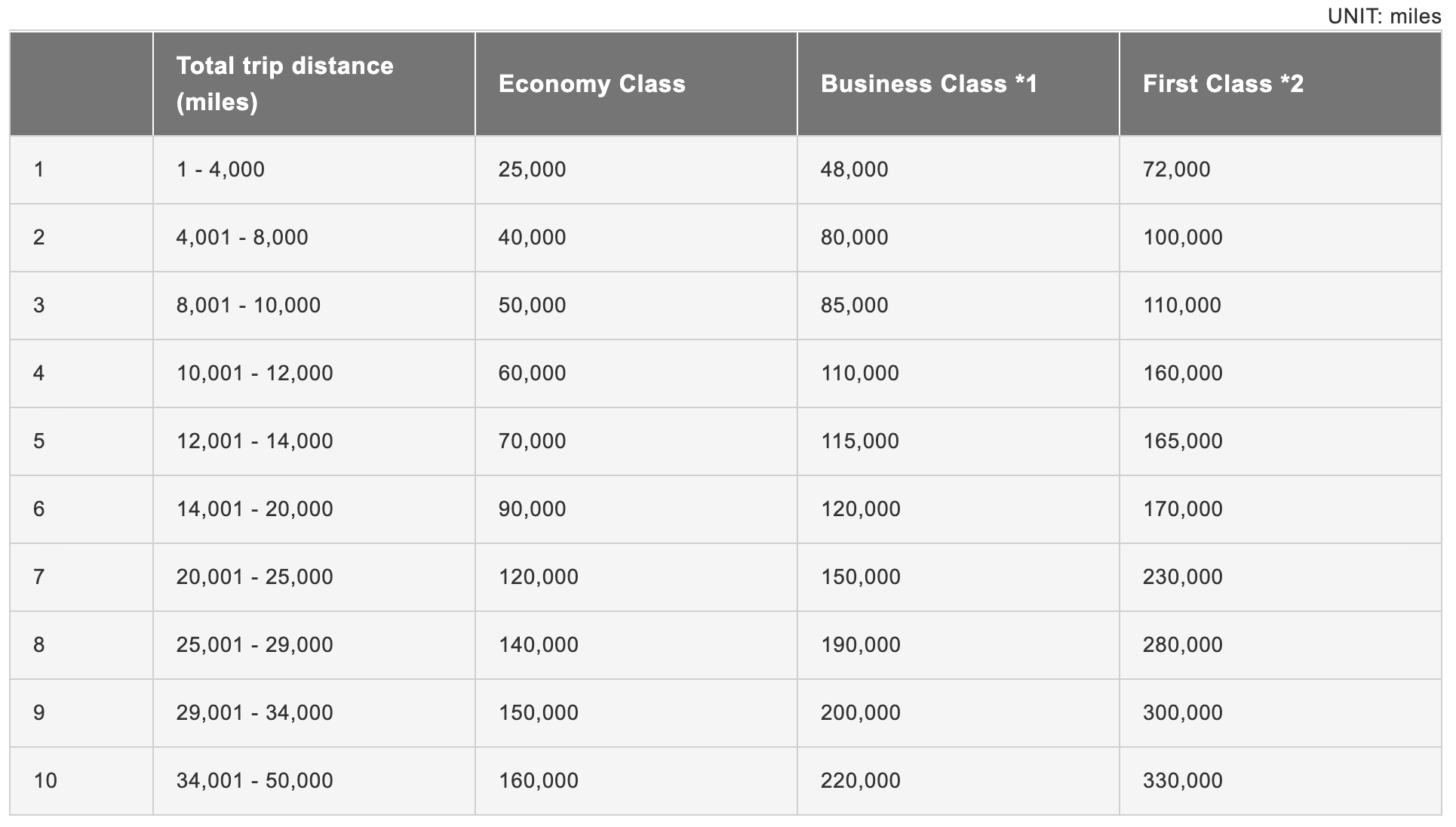
You can also use Mileage Bank miles to get a great rate on JAL premium cabin redemptions. You can access the full award charthere, but some of the highlights include:
U.S. to Japan for 50,000 miles each way in business, or 70,000 miles in first class
U.S. to China and South Korea for 55,000 miles each way in business, or 80,000 miles in first class
U.S. to Oceania for 70,000 miles in business class (or 85,000 miles in first class, but the Tokyo-Oceania leg would be in business)
JAL first class is an incredibly refined and luxurious flight experience. You'll find it aboard the carrier's flagship 777-300ER aircraft flying to only a small handful of destinations around the globe. Redeeming 70,000 miles for 10+ hours in first-class is an incredible deal and puts JAL on par with Alaska Airlines for award tickets to Asia.
On the shorter end, flights from much of the East Coast to Europe fall under 4,000 miles. One-way awards, say, from New York-JFK to Paris (CDG) on American Airlines would only cost 25,000 miles one-way in economy or 48,000 in business, which is significantly cheaper than what the competition charges. For example, American Airlines normally requires 30,000 miles in economy and 57,500 in business.
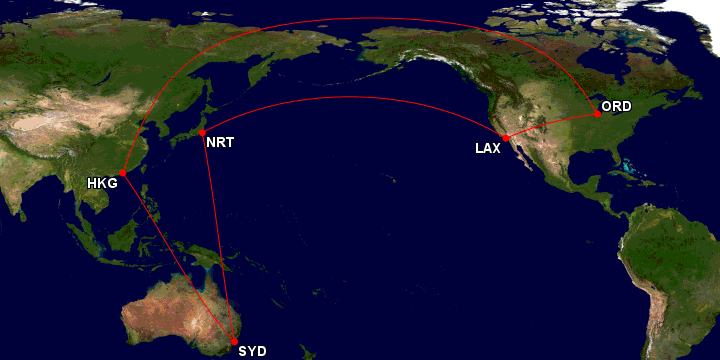
You can use this combination of multiple stopovers and a distance-based award chart to create your own mini round-the-world itinerary. For example, this trip from Chicago to Sydney, with stops in Los Angeles (LAX), Tokyo-Narita (NRT) and Hong Kong (HKG), only cover ~24,400 flight miles.
To fly this whole trip in business class would only cost 150,000 miles for all five flights. That's less than most airlines would charge for the simple round-trip ticket from Chicago to Sydney, and you get to enjoy three stopovers free of charge.
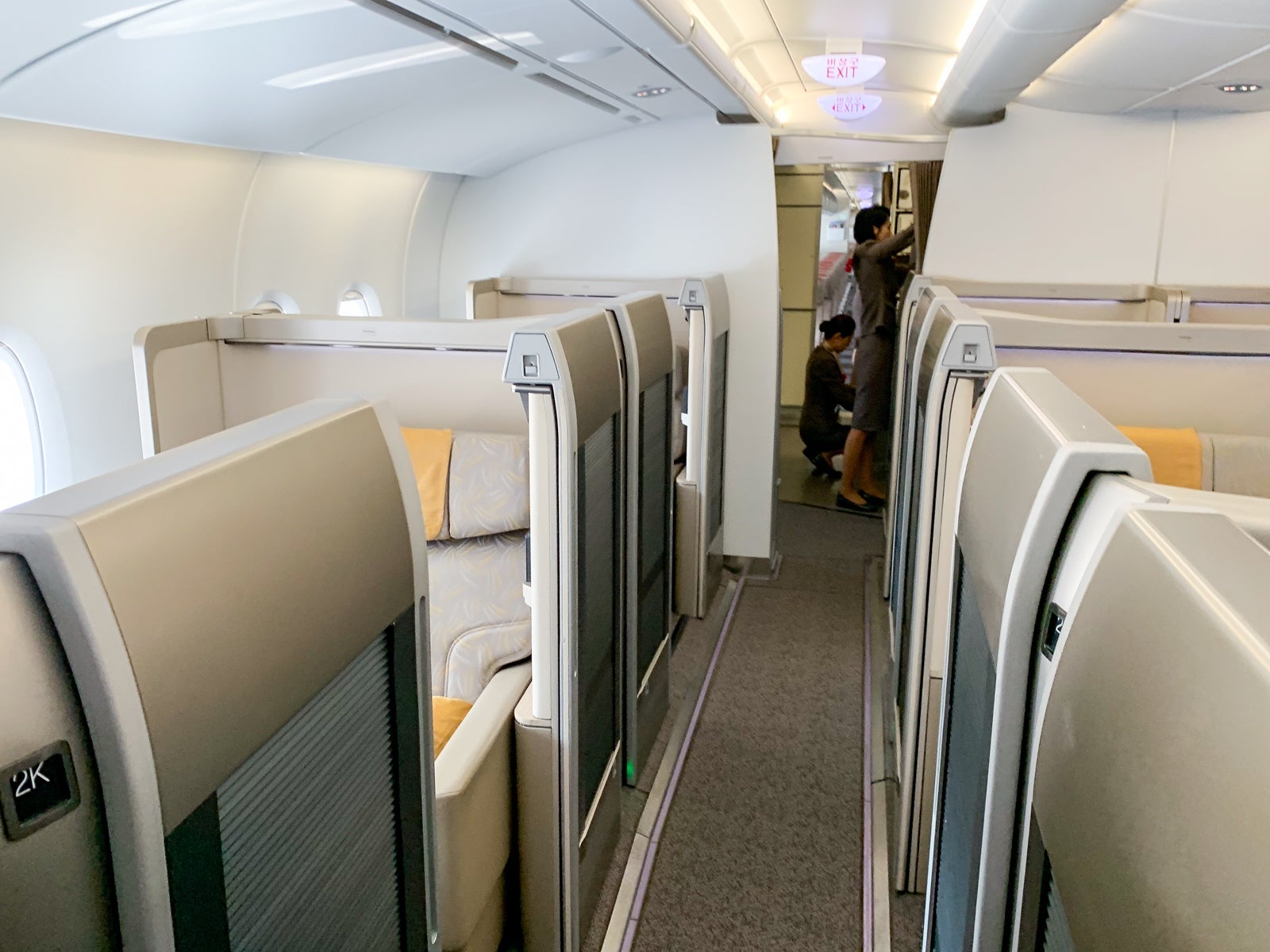
First class in the nose of Korean Air's 747-8 feels like flying in a private jet. Photo by Ethan Steinberg / The Points Guy
Earning
Korean Air has several personal and business co-branded cards issued by U.S. Bank, all offering 30,000-mile sign-up bonuses. While not the most compelling offers on the market, this could be a good way to earn some elusive miles. SinceChase dropped Korean Air as a transfer partner a few years back, your best option is again to transfer Marriott points at a 3:1 ratio with a 5,000-mile bonus for every 60,000 points transferred.
Redeeming
Cheap award rates, low taxes and a fairly extensive North American route network all mean that one of the best uses of Korean Air SKYPASS miles is for flights actually operated by Korean. Korean flies a mix of Boeing 777-300ERs, 787s, 747-8s and Airbus A380s (most of which feature first class) to about half a dozen U.S. cities.
One-way flights from the U.S. to Korea, Japan, China or North Asia only cost 80,000 miles each way in first class or 62,500 miles in Korean's Apex Suite business class. Prices are slightly higher during peak season, but this just applies to two months at the beginning of summer and two weeks around New Year's. You can also build in a free stopover in Seoul (ICN) before continuing to another destination.
While not as generous as it used to be, Korean Air is also known for releasing multiple premium cabin award seats on a single flight, making this an ideal way to fly in comfort with your family or friends. I had the chance to try outKorean's 747-8 first class, and the spacious cabin in the nose felt like a private jet, even though we were flying a double-decker jumbo.
It's worth noting that these great redemptions have an expiration date on them asSkyPass will be moving to a zone-based award chart and increasing award rates by as much as 110% as of April 2023.
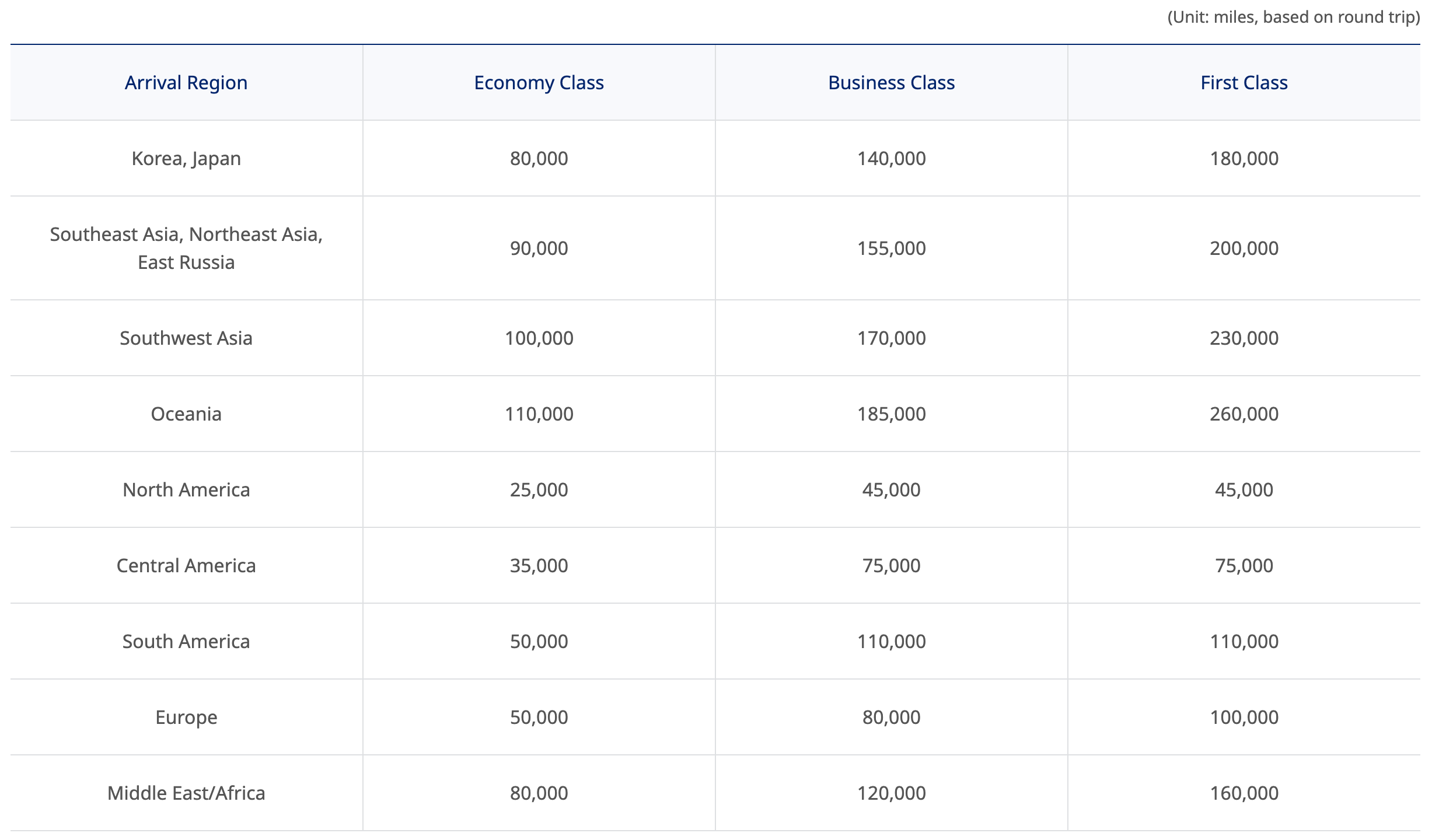
The SkyPass program also hasseveral great sweet spots for SkyTeam partner awards, but note that only round-trip tickets are allowed. For flights departing the U.S., the SkyTeam partner award chart is as follows:
(Screenshot from koreanair.com)
Before you get too excited about the prospects of flying round-tripfirst class to Europe for only 100,000 miles, I have to dash your hopes: There isn't actually a SkyTeam carrier that will let you book that ticket. Air France is the only SkyTeam carrier to operate a true first-class cabin between the U.S. and Europe, but itrestricts first-class award bookings to elite members of its own Flying Blue program. Still, 80,000 miles for a round-trip business class ticket to Europe is a great deal, whether you choose to fly on Air France, KLM or Delta.
SkyPass is also one of the best programs for booking awards to Israel, a popular destination that's surprisingly hard to get to on points and miles. You can fly round-trip in business class for only 120,000 miles, or 80,000 miles in economy. Between Delta's nonstop flight from New York-JFK to Tel Aviv (TLV) and one-stop routings through Paris (CDG) or Amsterdam (AMS) on Air France or KLM, you have plenty of options to choose from here.
Another great redemption option to consider is Delta economy from the U.S. to Hawaii for only 25,000 miles round trip. Saver level award space is tough to come by, but this ranks as one of the top ways to get toHawaii on points and miles.
Asiana Club miles
Asiana offers one of the cheapest ways to book Lufthansa first class, but they pass on massive fuel surcharges. (Photo by Zach Honig/The Points Guy)
Earning
Asiana used to have a co-branded card issued by Bank of America, but discontinued it earlier this year. Like JAL and Korean Air, you can transfer Marriott points to Asiana at a 3:1 ratio with a 5,000-mile bonus for every 60,000 points transferred.
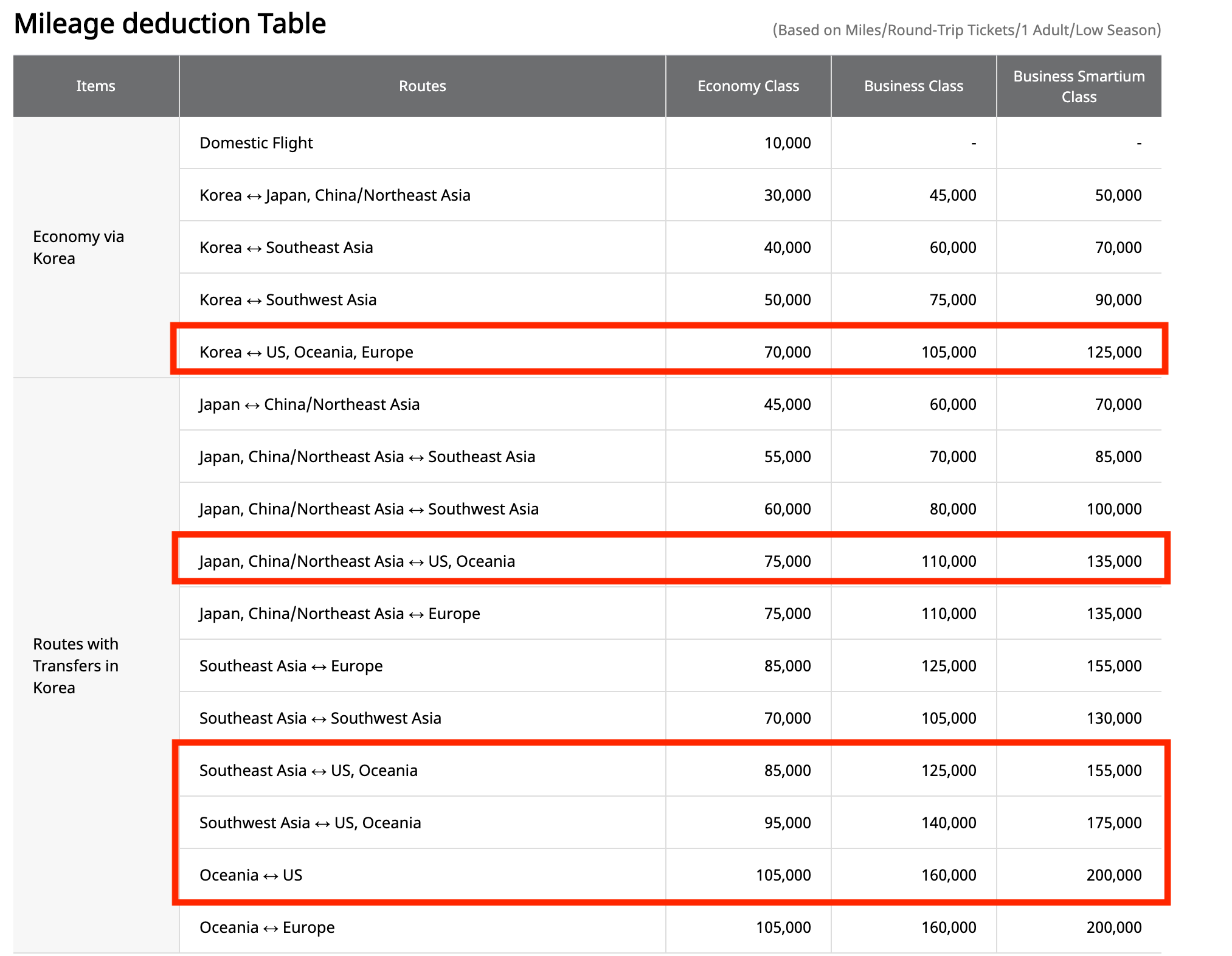
Asiana offers some of the lowestStar Alliance redemption rates. Unfortunately, it passes on massive fuel surcharges, which can really undermine the value of your "free" ticket. Let's start with the award chart for flights operated by Asiana itself. Prices shown are round-trip and I've highlighted the routes to and from the U.S. You can book a one-way ticket for half the miles, and Asiana Club even allows stopovers on one-way awards.
(Screenshot from flyasiana.com)
If you're confused about the difference between a business class ticket and a "Business Smartium" ticket, you're definitely not alone. Business Smartium refers to Asiana's flagship product available on its A380s, A350s and 777s, while all other business class seats the airline operates are just regular business class.
Unfortunately, Asiana discontinued its first-class product, which had only been available on the carrier's A380 fleet.
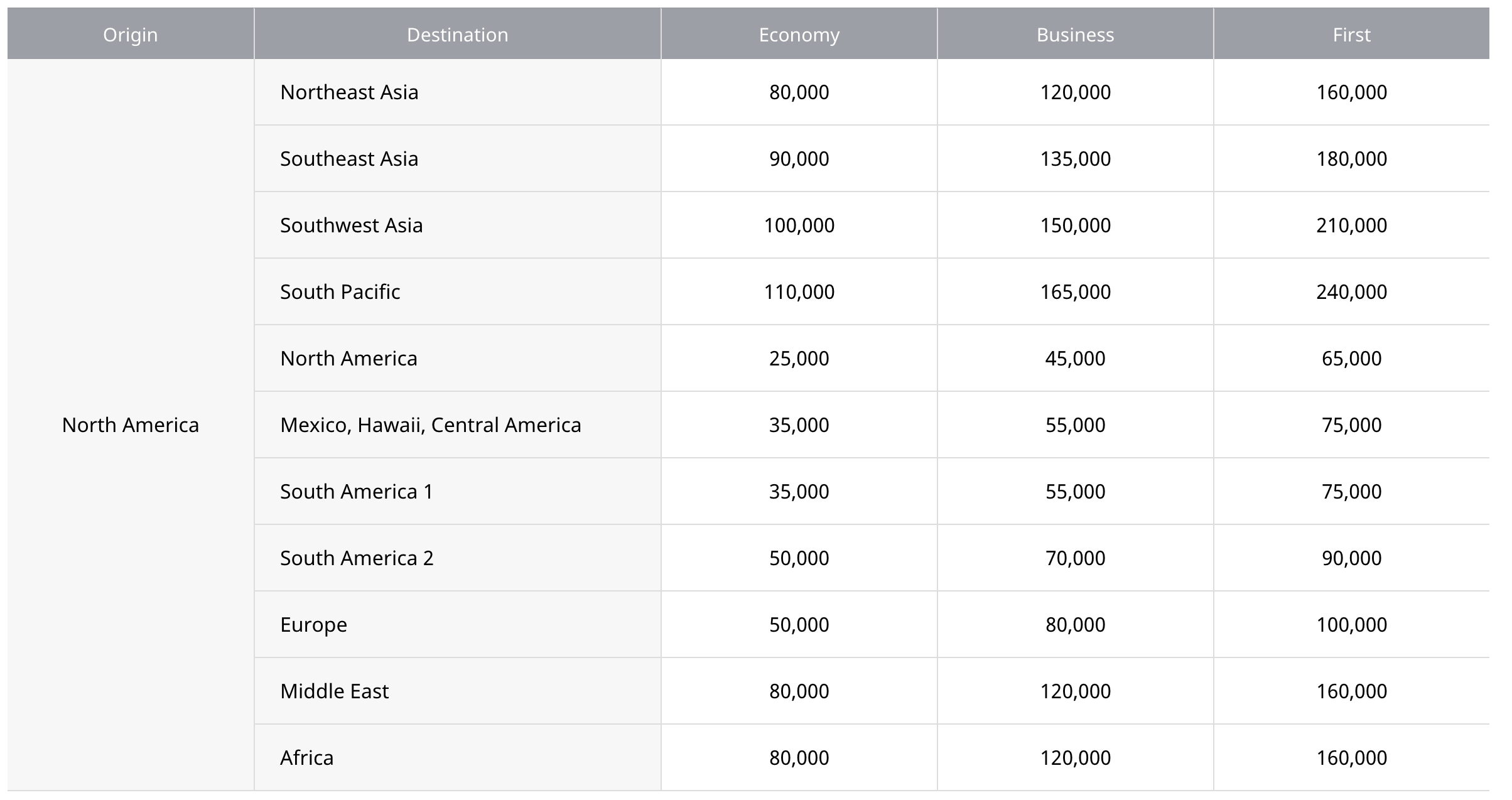
Now let's turn to Asiana's Star Alliance partner chart for flights departing the U.S. The mileage premium to fly from the U.S. to Asia on a partner airline likeEVA, ANA or even United is relatively small. You'd pay 160,000 miles for a round-trip business class award from the U.S. to China on those airlines, while you'd only pay 135,000 if you flew with Asiana directly.
(Screenshot from flyasiana.com)
The best value on this chart has to be the U.S. to Europe round-trip inLufthansa first class for only 100,000 miles (plus surcharges, likely around ~$1,000). This is one of the cheapest way to book Lufthansa first class awards. By comparison, Aeroplan usually charges around that much for a one-way ticket, but it doesn't pass on fuel surcharges.
One caveat is that Asiana faces the same restrictions onbooking Lufthansa first class awards as other programs: Generally speaking, Lufthansa will only release partner award space about 30 days before departure.
Bottom line
While these miles will take a little more effort to earn, they can help you unlock some of the most luxurious and coveted premium cabin redemptions available. And there's another benefit to scarcity as well: the fewer people who have these miles, the less competition there will be for award space. You can give yourself a real advantage by diversifying your earning strategy to include some of these trickier programs, especially if you have a specific first-class redemption at the top of your wish list.
Additional reporting by Benji Stawski.
Updated as of 4/18/2024.
Comments
By commenting, you agree to our Community Guidelines to help create a positive space for conversation. The responses below are not provided or commissioned by the bank advertiser, our partners, or The Points Guy (“TPG”). They have not been reviewed, approved, or otherwise endorsed by any of these parties. All responses are submitted by individual contributors, and neither the bank advertiser, our partners, nor TPG are responsible for ensuring that all posts and/or questions are answered.