How pilots prepare to land during severe storms


Last weekend saw the worst storm the U.K. has experienced in years. Storm Ciara brought 90 mph winds, heavy rain and flooding to almost all of the U.K. While most people had the benefit of being at home, for pilots, it was one of the most testing days of their careers.
Social media posts were full of praise for how pilots handled their aircraft in the most extreme of situations. Always keeping their passengers safe, always reassuring them, always keeping them informed. People quite often take their safety for granted when they board an aircraft but it's in conditions like this that they truly appreciate the skills of their crew.
And another storm — albeit not expected to be as severe — is supposed to affect air traffic on Saturday. Here's what the pilots on a typical Boeing 787 Dreamliner from New York (JFK) to London Heathrow (LHR) would have been doing behind the flight deck door.
Before the Flight
For long-haul flights arriving at the peak of the storm on Sunday, the pilots' preparation would have begun days earlier. Weather forecasts had already been predicting the storm several days out. Even before the flight going to New York on Friday, the pilots would already have been discussing the implications for the flight home.
"Who's taking it out?"
On a normal two-sector trip, the crew of two pilots will operate a sector each. The captain will do the takeoff and landing in one direction and the first officer will do the same on the other direction. However, most airlines have a crosswind limit for co-pilots, normally around two-thirds of the aircraft's limit. Anything beyond this, the captain must do the landing.
As a result, with the forecast for the arrival back into London on Sunday, most crew will have decided that the first officer flew the sector to New York. This left the captain with the responsibility of the landing in the forecast strong winds.
The fuel decision is key
Arriving at the check-in desk, the crew would have got their first chance to look at the briefing pack. This details the route they plan to fly, the minimum required fuel and all relevant weather and airfield information. The decisions made at this point will have a massive bearing on the outcome hours later on arrival into London.
There are a few things in aviation which are of no use to pilots. Runway behind us, altitude above us and fuel in the fuel truck. We only get one chance to load more fuel. Once airborne, we only have a finite amount of time available to us until we have to find a runway to land on. As a result, the decision on how much fuel to take it absolutely key.


When the airline's flight planning department prepares a flight plan for the crew, it will also indicate the minimum amount of fuel needed for the flight. On most days when the weather is fine, this amount will normally suffice. However, when bad weather is forecast pilots will take a much closer look at this figure.
Related reading: How do pilots know how much fuel to take on a flight?
Holding and Diverting
The planned fuel will not only account for the flight to the destination, it will also include two other important scenarios. First is for when there are delays on arrival. In this situation, the aircraft may have to enter a holding pattern and wait its turn to land.
Secondly, should the pilots be unable to land at the destination, fuel is provided to divert to another airport. When flying into London Heathrow, this alternate airfield will normally be somewhere like London Gatwick or London Stansted. For the purpose of this 'flight', we'll have LGW as the planned alternate.
However, on days like Sunday, the whole of the U.K. was affected by bad weather. The last thing you want when needing to divert is to find that the weather at your diversion airfield is even worse than your destination. Before you know it, you only have enough fuel to reach airports where the weather is no good to land.
As a result, the crew will look for an alternate airfield that is wide-open, meaning it has a weather forecast that would cause no issues for landing. If this airfield has to be hundreds of miles away in mainland Europe, then so be it. The crew always want to have a surefire option up their sleeve should they need it. Increasing an already high workload due to a lack of fuel is not a corner they want to be backed into.
Landing in Frankfurt when you're meant to be landing in London isn't ideal for the passengers, but safety is always your pilots' number one priority. If landing in Frankfurt is the safest option, then that's what they'll do.
Cruise
Once up in the air, the work doesn't stop. The pilots will constantly be monitoring the latest actual and forecast weather conditions at Heathrow and at Gatwick. Long-haul flights can often be longer than 15 hours, and sometimes the forecasts can change significantly to what was available to the crew before departure.
This could result in an improving situation but also a worsening situation. If the latter is the case, they may have to start coming up with alternative plans. If the weather at Gatwick or Frankfurt had changed, they may have to come up with another option.
Brief
As the flight nears London, it's time for the most important part of the approach, the brief.
Before every takeoff and landing, pilots will discuss among themselves the major threats that could affect the safety of the flight. A major part of this brief on Sunday would have been about the wind and what effect it will have.
Firstly, the latest weather will have been sourced for not only Heathrow but also for Gatwick and Frankfurt. With this information, the crew will be able to predict the likelihood of being able to land at each of these.
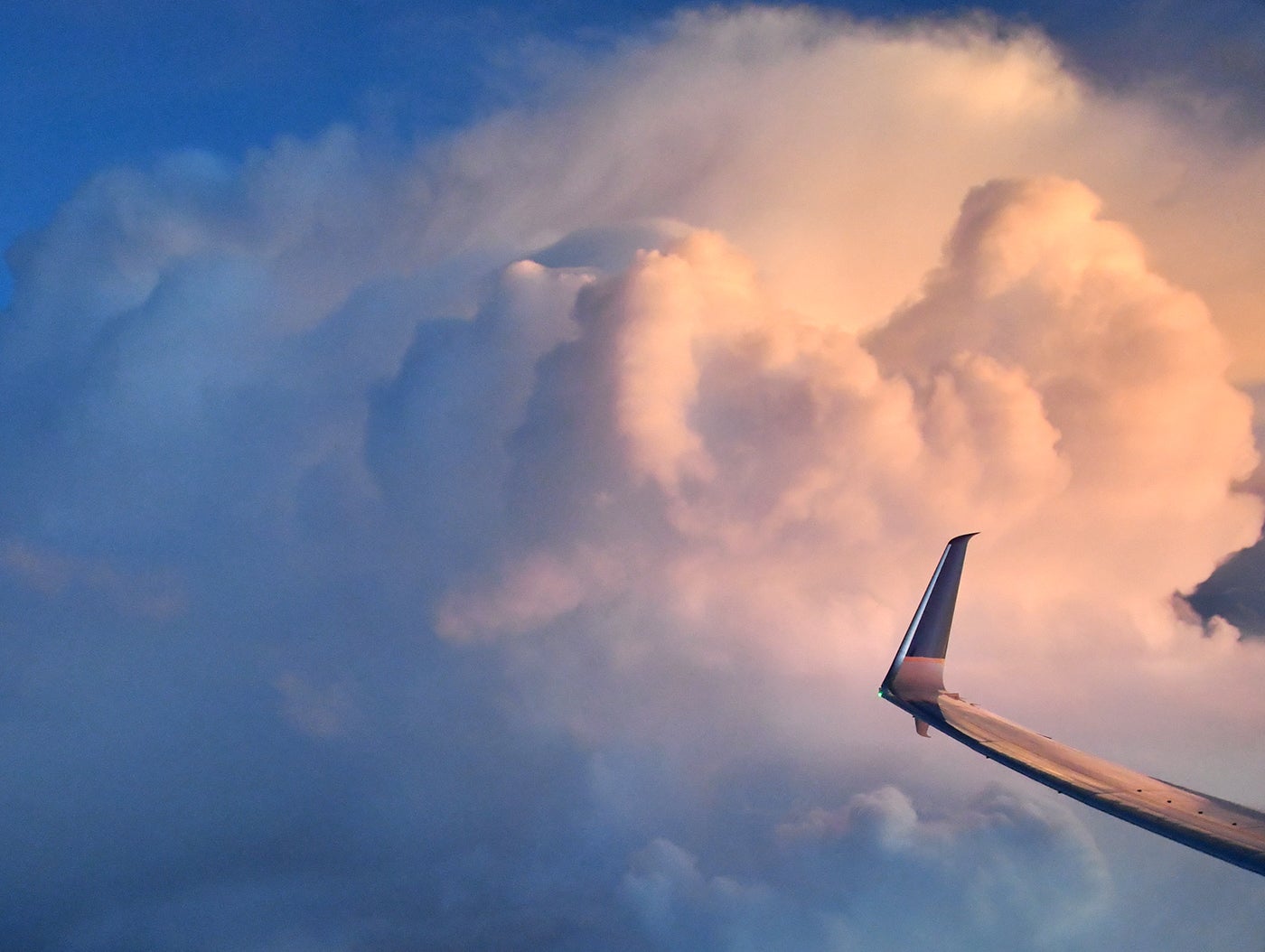
If Heathrow and Gatwick are not looking too great, hopefully the weather at Frankfurt will still be as forecast. If not, a new airfield will need to be found. The crew will then be able to discuss the fuel situation.
"How much time do we have?"
Knowing that the weather at Frankfurt is fine, they'll calculate how much fuel they will need to divert from Heathrow to each of their alternates. Let's call this 3 tonnes for Gatwick and 6 tonnes for Frankfurt. They can then calculate how much fuel they will have when they arrive at the holding pattern. Let's say this was 10 tonnes.
The crew will then know that they have 4 tonnes of fuel to use up before needing to divert to Frankfurt and 7 tonnes before needing to divert to Gatwick. This can then be converted to how much time they have to hold — a much more useful metric to use in a dynamic ATC environment.
Finally, knowing what time they will arrive at the holding pattern, they can calculate the time at which they will have to start a diversion to each of the alternate airports.
Go-rounds
A go-round is when the pilots decide that it is safer to climb back up into the air rather than continue to land. They are far more likely on windy days for this exact reason.
During a go-round, both pilots have different, but equally important jobs to do. It's a carefully executed ballet of moving the flaps and landing gear while safely flying the aircraft away from the ground. Like with real ballet, practice makes perfect and this is what the approach brief is all about.

Together, they will both talk through exactly what they will do in the case of a go-round. What will the Pilot Flying (PF) say? What will the Pilot Monitoring (PM) do in response? What is the missed approach altitude? Each stage of the go-round is discussed in detail to ensure that they are both absolutely clear how the procedure will run. This ensures that there are no surprises in the heat of the moment.
After a go-round, it'll be time to make a decision. Do they try to land at Heathrow again or do they divert to an alternate airport? This will depend on a number of factors, primarily how much fuel they have remaining.
By discussing this at the briefing stage, making a decision when the blood is pumping just after a missed approach is made much easier.
The brief is also a great time to discuss a few factors about the alternate — the routing to get there, the approach in use and the current weather. With these items discussed in the calm of the cruise, not when the pressure is on after a go-round, the workload is greatly reduced.
Approach
With the brief finalized, the crew can begin the descent and approach. As turbulence normally comes hand-in-hand with strong winds, the pilots may suggest that the cabin crew secure the cabin for landing earlier than normal and get strapped into their own seats.
Entering the holding pattern, ATC will be passing the crew as much information as possible. What the latest winds are, how many aircraft have had to go-round and most importantly, what time they can expect to start an approach — the Estimated Approach Time (EAT).
Having checked the latest weather at Gatwick, Frankfurt is now the only viable alternative. They will compare the EAT to the time at which they will have to start a diversion to Frankfurt. They will then be able to tell ATC at this early stage at what time they will need to start a diversion if the EAT is extended.
Landing
As the aircraft approaches the airport, it enters what's known as the boundary layer, an area where the turbulence tends to increase. When the wind passes over objects such as buildings, trees and bridges, the flow is interrupted and it becomes more turbulent. The boundary layer normally extends just a few thousand feet above the ground.
The pilots will make maximum use of the Autopilot in conditions like this, leaving them greater capacity to monitor the other aircraft systems. That said, the Autopilot has its limitations and is unable to land the aircraft in strong winds. The pilots must take control and land the aircraft themselves.
This will normally be done around 1,000 feet above the ground. This gives the landing pilot, most likely the captain, enough time to get a feel for the weather conditions and how the aircraft is responding.
At any point on the approach, if either of the crew is unhappy about the path of the aircraft, they can call for a go-round. As this will have been discussed at the briefing stage, the application of the maneuver is as straight forward as can be.
Crosswind landing
If you've ever seen an aircraft coming into land in a crosswind, you'll have noticed that it doesn't point at the runway, it's angled off to one side. This is called crabbing. In order to keep the aircraft flying in a straight track over the ground, pilots deliberately angle the nose into the wind.
This is fine when in the air, but what happens when the aircraft touches down?

On the 787 (and 777), the most commonly used technique is known as the de-crab during flare. The objective of this technique is to keep the wings level throughout the approach whilst maintaining a crab into the wind. As the aircraft approaches the runway, the pilot flares (pulls back on the stick) as normal. This raises the nose and reduces the rate of descent. Just before the main wheels touch down, the pilot squeezes in some rudder to straighten the nose and align it with the runway centerline.
If this sounds complicated enough, the crosswind causes uneven lift. As the nose straightens, the upwind wing travels through the air faster than the other wing, creating more lift. To counter this, the pilot must also apply some into-wind aileron by turning the control wheel.
This means that the pilot is simultaneously pulling back on the control stick, turning it into the wind and squeezing the rudder pedals with their feet — all whilst traveling at 160 mph. Multitasking at its finest. The video below shows two 777s demonstrating this technique perfectly.
Bottom line
Flying in strong winds is no easy task. It's not just getting the aircraft onto the runway that provides the challenge, it's the dynamic situation that goes on around it. Pilots must comply with ATC instructions and ATC will do their very best to do what pilots request from them. Aircraft may end up going round in holding patterns whilst waiting for their turn to land. All with a finite amount of fuel before they have to land somewhere. However, like with all things aviation, by planning ahead, pilots are able to make time for themselves later on in the flight, increasing the options that are available to them. The Autopilot is great at dealing with strong winds in the air, but not so great when landing. As a result, it's the pilots' own skills that must fly the aircraft the final few feet to the safety of the runway.
TPG featured card

at Capital One's secure site
Terms & restrictions apply. See rates & fees.
| 5X miles | Earn 5X miles on hotels, vacation rentals and rental cars booked through Capital One Travel |
| 2X miles | Earn unlimited 2X miles on every purchase, every day |
Pros
- Stellar welcome offer of 75,000 miles after spending $4,000 on purchases in the first three months from account opening. Plus, a $250 Capital One Travel credit to use in your first cardholder year upon account opening.
- You'll earn 2 miles per dollar on every purchase, which means you won't have to worry about memorizing bonus categories
- Rewards are versatile and can be redeemed for a statement credit or transferred to Capital One’s transfer partners
Cons
- Highest bonus-earning categories only on travel booked via Capital One Travel
- LIMITED-TIME OFFER: Enjoy $250 to use on Capital One Travel in your first cardholder year, plus earn 75,000 bonus miles once you spend $4,000 on purchases within the first 3 months from account opening - that’s equal to $1,000 in travel
- Earn unlimited 2X miles on every purchase, every day
- Earn 5X miles on hotels, vacation rentals and rental cars booked through Capital One Travel
- Miles won't expire for the life of the account and there's no limit to how many you can earn
- Receive up to a $120 credit for Global Entry or TSA PreCheck®
- Use your miles to get reimbursed for any travel purchase—or redeem by booking a trip through Capital One Travel
- Enjoy a $50 experience credit and other premium benefits with every hotel and vacation rental booked from the Lifestyle Collection
- Transfer your miles to your choice of 15+ travel loyalty programs
- Top rated mobile app