How pilots stay alert on ultra-long-range flights


Last week, Qantas operated the world's first commercial flight between New York and Sydney, a 19-hour and 16-minute epic journey. It was part of the airline's "Project Sunrise," a study into the feasibility of super-long-haul flights for both machine and human.
While the 787 Dreamliner is a great aircraft to operate such ultra-long-range (ULR) flights, humans aren't designed particularly well to be cooped up in a pressurized tube for such sustained periods. It's made a bit better if you have a flatbed to spend the entirety of the flight in. Even in the back of the aircraft, having films to watch and being able to doze off whenever you chose helps eat up the time.
However, what about the crew who call that pressurized tube their office? Those people are working a 20-plus-hour day and have to perform at their peak, right until the end of that long slog. ULR flights pose their own challenges to those who keep you safe on board, so this is how we do it.
How are ULRs possible?
Your pilots are the final arbitrators of safety. It's our job to catch any errors made further up the chain and deal with any problems that may occur out of the blue. When we're six miles above the Pacific Ocean with 200 people on board, there's no allowance for only bringing our B game. There are no second chances.
For this reason, how our bodies and minds function at all stages of flight, particularly takeoff and landing, is of utmost importance. No passenger wants a tired pilot. Yet, ask anyone to work a 20-plus hour shift and you can be sure they won't be breaking the doors down to get to work.
Pilots normally report for duty around 1.5 hours before the flight departs. It also takes some time to taxi from the gate to the runway and then from the runway to the gate at the destination. As a result, a 19-hour, 16-minute flight time could very easily have a block time of around 20 hours, particularly out of a busy airport such as New York-JFK. Altogether, you're looking at a 21-hour, 30-minute working day — and that's without any delays.
In order to keep passengers safe, there are limits to the number of hours a crew can be on duty. These are called flight duty periods, or FDPs, and each country or governing area has their own rules on FDPs. In Europe, with an augmented crew, the maximum FDP is 17 hours. With a close eye being kept on crew fatigue, the Australian authorities have allowed a maximum FDP of 20 hours.
Read more: How the 787 Dreamliner protects itself from the threat of fire
The 787 requires two pilots to operate the aircraft, but to increase the FDP for ULR flights like those planned for Project Sunrise, four pilots are carried. The experience of these pilots depends on the airline. For Qantas' 17-hour Perth to London flight, there is one captain, one first officer and two second officers. The second officers are only qualified to sit in the operating seats during the cruise, leaving the captain and first officer to do the takeoff and landing.

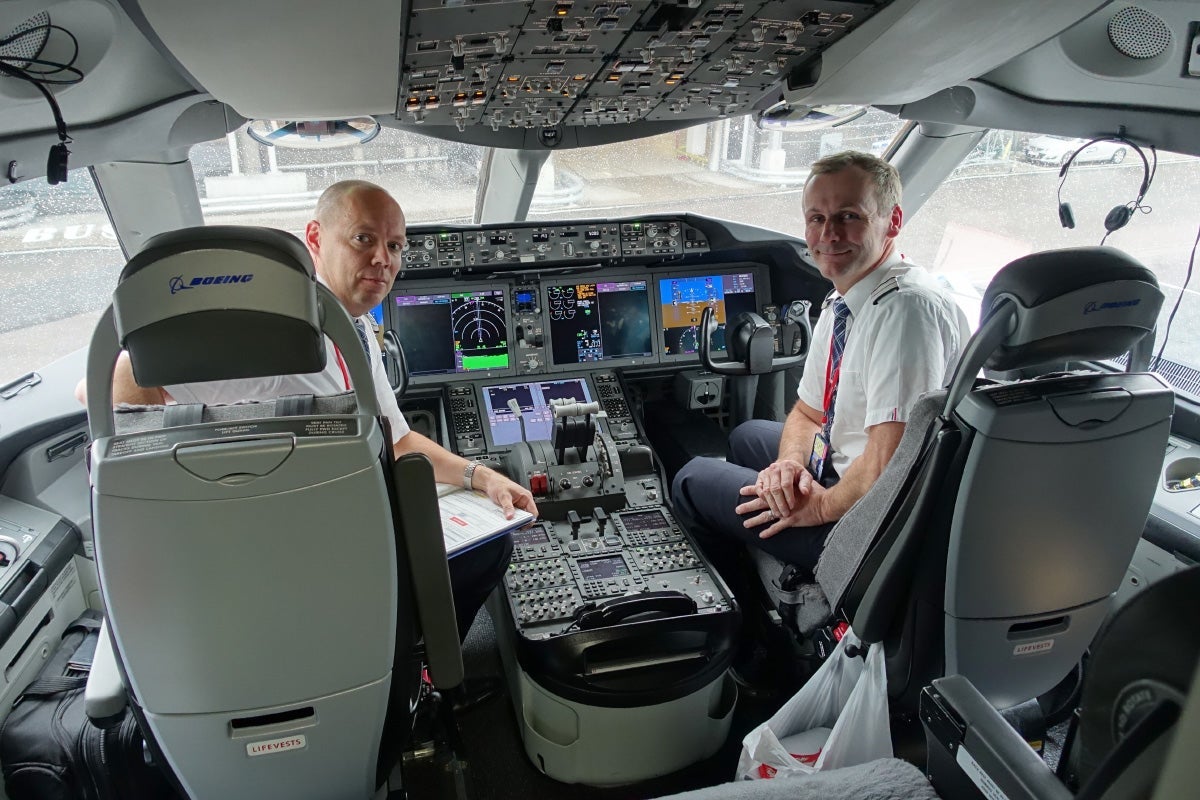
Other airlines have two identical crews, each with one captain and one first officer. One crew will be designated the operating crew and the other, the relief crew. This will be determined when the rosters are published, weeks before the flight. This enables the pilots to report for duty and rest in accordance with their planned working pattern.
Being a long-haul pilot isn't just a job, it's a lifestyle. It affects every moment of not only your working day, but very often your days off, too. There have been a number of occasions, even a few days after a flight, where I've found myself nodding off on the sofa at home or at a friend's dinner party.
Before the flight
The pilot's preparation for a ULR flight will quite often begin the day before, depending on the departure time and whether they are the operating crew or the relief crew. It's all about being alert when you need to be alert and tired when you need to be tired.
As a result, managing sleep is key and each pilot has their own way of making this work for them. If I have an evening departure, say 9 p.m. as the operating crew, I know that I'll have to be at my peak from when I report at 7.30 p.m. until around 2 a.m. when I will go on my break. Thinking ahead, I'll go to bed late the night before the flight and wake up early the next day. I'll have a busy morning around the house, pack my suitcase, iron my uniform and then go to the gym. Come early afternoon, due to the short sleep the night before and early rise, I'll be ready for a nap.
Sleeping at home during the afternoon is never easy. Depending on where you live, it may be quite noisy outside, the curtains may not block out the light and if you have children, it may not be particularly peaceful. This is why having a decent-quality hotel whilst away on trips is important to enhance flight safety. Waking around 5 p.m., I'm ready to start my "working day."
Read more: How pilots keep you safe while flying through strong winds
Onboard rest
Normally, at least three pilots will be on the flight deck for the departure, and once safely into the climb, the relief crew will go on their rest. Planning to return from the final rest period around an hour before landing, the remaining flight time is divided in two. So, for a 14.5-hour flight time, the rest periods would be around six hours and 40 minutes each. This may sound like a pretty sweet deal: Go to work and sleep for six hours, but this is no normal sleeping environment. It's here where your sleep management before the flight comes into its own.
Overhead flight crew rest (OFCR)
On the 787, the rest area for the pilots is hidden away above first class, accessed by a hidden door. Once upstairs, there is a seat for watching the in-flight entertainment and two beds. I use the word "bed" lightly because it is effectively just a thin mattress on the floor. Depending on the airline, these are furnished with anything from a thin blanket and pillow to bedding from the first-class cabin.
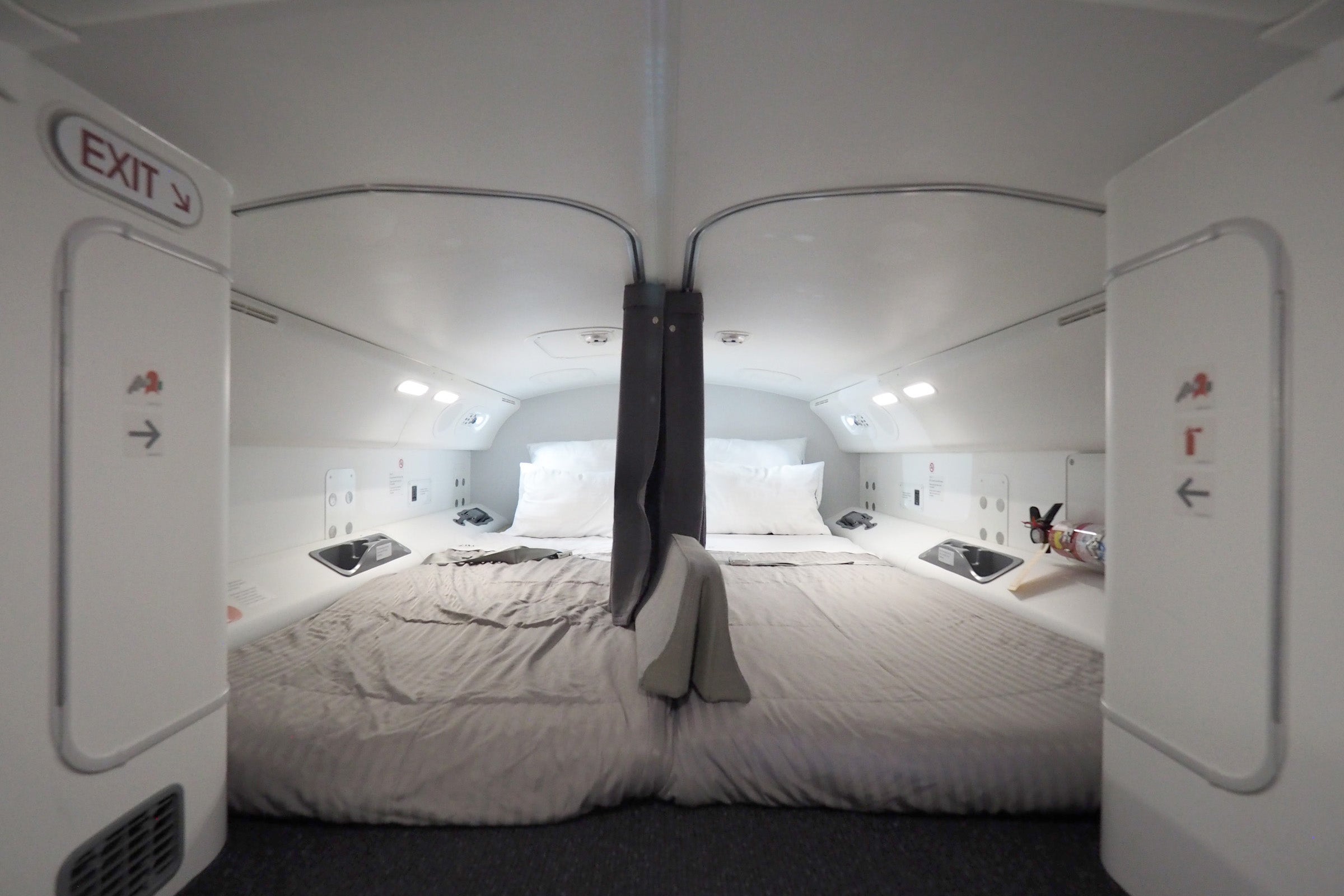
There is a control panel to control the temperature of the OFCR and a curtain to close off the foot end of each bed. The major benefit of the rest area is that once the lights are off, it really is quite dark and surprisingly quiet.
That said, there is no bed like your own, and there are very few beds that will throw you around because of turbulence as you try to sleep. If you've managed your sleep well before the flight, hopefully you'll drop off to sleep pretty quickly. If you weren't able to manage your sleep, it's going to be a long flight.
Rest structure
The ultimate aim is to ensure that the crew who are flying the approach and landing are as fresh as they can possibly be. To achieve this, there are a couple of options. The easiest option is to do a straight 6/6 schedule where, in this example, each crew gets a solid six hours and 40 minutes rest, with the operating crew returning to the flight deck an hour before landing. The downside to this is that if the weather conditions have changed at the destination during the time the operating crew were on their break, there could be a lot of work to do with very little time remaining.
The preferred option of most crews is a 4/6/2 schedule. In effect, the sleep quality of the relief crew is sacrificed to ensure that the operating crew get a solid rest in the middle of the flight. They then return to the flight deck for the final three hours before landing. This affords them enough time to wake up properly and then adapt to any changes that may have occurred during their rest period.

However, on flights such as the one between New York and Sydney, the 19-hour, 16-minute flight time would have resulted in shifts of nine hours each. With a 4/6/2 style schedule of rest, this would have resulted in a nine-hour middle shift. Even during the cruise, this is a long time to be staring at computer screens, especially when your body just wants to be asleep.
The problem with this is that the human body isn't great at switching on and off. With the operating crew having their rest broken up into 4.5-hour shifts, it may result in poorer sleep quality and them potentially not being as alert for the approach and landing as they could be. This would completely destroy the whole point of having the rest periods in the first place. As part of Project Sunrise, I'd hope that some of the studies are looking at the structure of the crew rest.
With such a long time spent on the aircraft, it's of utmost importance that the crew are able to perform at their best at the most critical stage of flight, the approach and landing. Qantas CEO Alan Joyce did touch on the subject of crew rest during ULR flights. "Pilots are data driven," Joyce said. "So if you can show them the benefits — how to improve their rest, how to make sure fatigue is managed — they love that, and they want to see the scientific information." Whilst this sounds positive from the pilot's perspective, I hope that this is a genuine effort to make the crews' lives better and not just a tasty sound bite.
Post-flight recovery
No matter how much sleep you managed during your rest period, when you arrive at the hotel, you're shattered. You've spent the last 20 hours in a sealed tube, may not have seen nighttime for more than 30 hours and you may have arrived in a place where the seasons have flipped. It might even be tomorrow. Or yesterday. Disorientation is not uncommon. Yet, you're already thinking about the flight home. How am I going to be rested in time? How long do I have to do this?

One of the hot topics is whether to stay on your own time zone or convert to local time. Both have their benefits but I find that going local works best for me. I sleep when it's dark and I'm active when it's light. When it comes to the night before the flight home, the same principles apply as per the outbound flight at home. This is why having a decent-quality hotel while away is really important.
It's one thing trying to sleep before a flight in your own bed in your own time zone. It's a completely different matter when you're trying to do this in a hotel on the other side of the world before your flight home.
Bottom line
Ultra-long-haul flying is hard on the body, especially if you're the one doing the flying. With airlines planning ever longer flights, it's important that they also consider the health and well-being of their crews.
In January 2019, the Australian Transport Safety Bureau published a report that stated that 60% of long-haul pilots had experienced moderate to severe fatigue on their most recent flight. Any changes to the current maximum FDPs must consider not only the short-term effects of being on duty for more than 20 hours at a time, but also the long-term effects it will have on crews health. Fatigue reporting systems are in place, but often a pilot who reports as fatigued is treated as "sick" and is then at risk of losing pay and being managed under the airline's sickness policy. It's therefore understandable why some pilots decide not to go down the fatigued path.
As pilots, our only aim is to get you safely from A to B. We are of course excited about the progression of the industry, but it must never be at the detriment to flight safety.
TPG featured card

at Capital One's secure site
Terms & restrictions apply. See rates & fees.
| 5X miles | Earn 5X miles on hotels, vacation rentals and rental cars booked through Capital One Travel |
| 2X miles | Earn unlimited 2X miles on every purchase, every day |
Pros
- Stellar welcome offer of 75,000 miles after spending $4,000 on purchases in the first three months from account opening. Plus, a $250 Capital One Travel credit to use in your first cardholder year upon account opening.
- You'll earn 2 miles per dollar on every purchase, which means you won't have to worry about memorizing bonus categories
- Rewards are versatile and can be redeemed for a statement credit or transferred to Capital One’s transfer partners
Cons
- Highest bonus-earning categories only on travel booked via Capital One Travel
- LIMITED-TIME OFFER: Enjoy $250 to use on Capital One Travel in your first cardholder year, plus earn 75,000 bonus miles once you spend $4,000 on purchases within the first 3 months from account opening - that’s equal to $1,000 in travel
- Earn unlimited 2X miles on every purchase, every day
- Earn 5X miles on hotels, vacation rentals and rental cars booked through Capital One Travel
- Miles won't expire for the life of the account and there's no limit to how many you can earn
- Receive up to a $120 credit for Global Entry or TSA PreCheck®
- Use your miles to get reimbursed for any travel purchase—or redeem by booking a trip through Capital One Travel
- Enjoy a $50 experience credit and other premium benefits with every hotel and vacation rental booked from the Lifestyle Collection
- Transfer your miles to your choice of 15+ travel loyalty programs
- Top rated mobile app