Skip to content

How Do Planes Stop?

June 25, 2019
7 min read
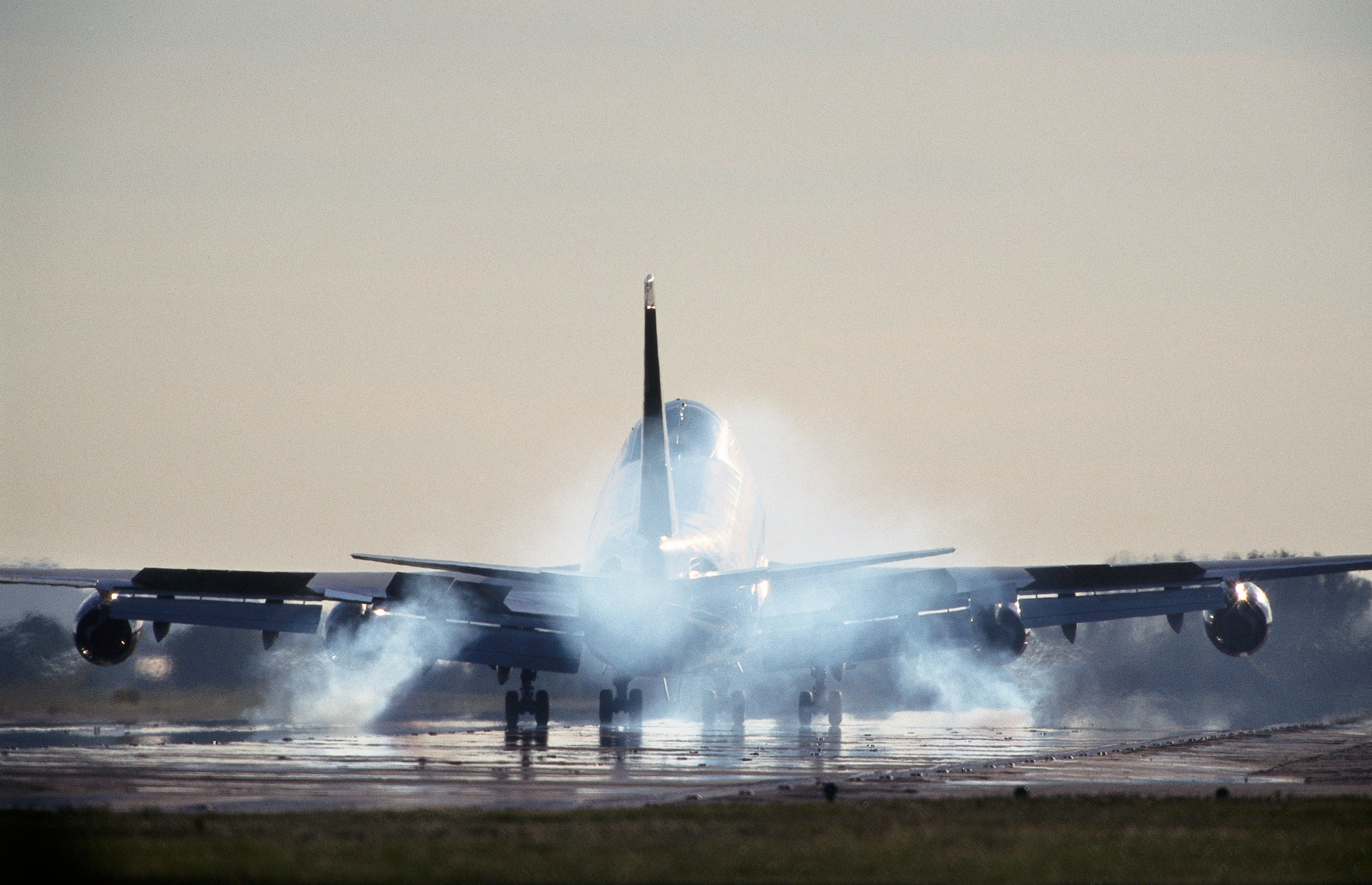
Boeing 747-400 with smoking tyres at touchdown landing on the runway
The cards we feature here are from partners who compensate us when you are approved through our site, and this may impact how or where these products appear. We don’t cover all available credit cards, but our analysis, reviews, and opinions are entirely from our editorial team. Terms apply to the offers listed on this page. Please view our advertising policy and product review methodology for more information.

A commercial aircraft is on approach for landing. It's flying at around 145 miles per hour. The pilot flying pulls back gently on the control column to slow the sink rate and flare for landing. The wheels touch down in a cloud of burnt rubber. The landing gear and wheels absorb the impact of the massive aircraft.

And then, how exactly does it come to a stop? And how much of that braking action is performed by the pilots, versus an automated system built into the plane?

I checked in with Chris Brady, a longtime Boeing 737 and Airbus A320 pilot in Europe, who runs the Boeing 737 Technical Site and Facebook Page.

He explained that braking comes from three sources: ground spoilers, wheel disc brakes, and reverse thrusters.

Ground Spoilers

In general, when the wheels touch the ground, a set of spoilers raise up quickly, which kills the lift provided by the wings. (There are two sets seen in the image below: ground spoilers that only deploy on landing, and spoilers that are used in flight as speed brakes as well as on landing.) While the spoilers provide some drag, their primary purpose is to stop the plane from actually flying, putting all of the weight on the landing gear and in turn making the brakes that much more effective.
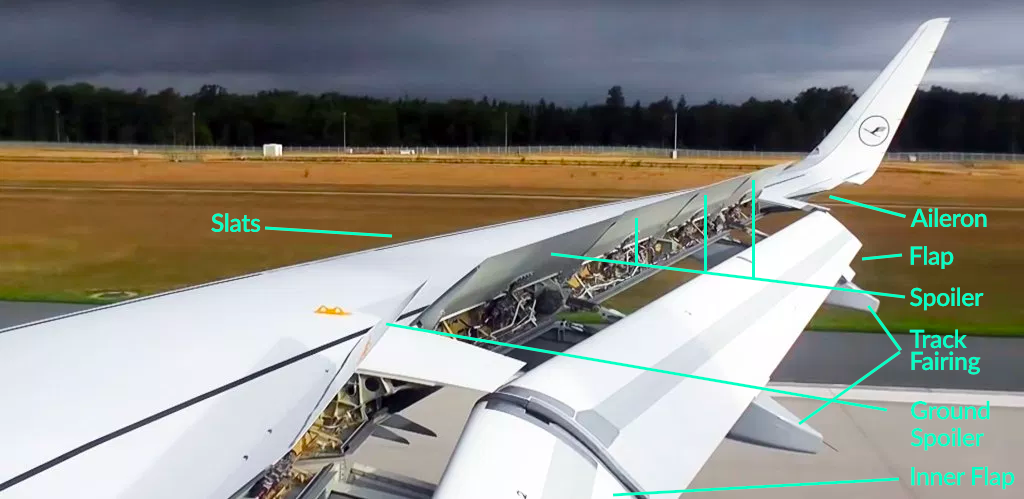
The parts of a jetliner's wing. (Screencap from YouTube / Elaboration by Mike Arnot)

Before landing, when the landing gear is lowered, the pilots arm the ground spoilers to deploy automatically on touchdown.

This lever controls the speed brakes, or ground spoilers. Here, it is shown in the armed position, prior to landing (Image via Boeing 737 Technical Site / Chris Brady).

"We could do it manually but it would involve moving the hands quickly during the landing roll which is never a good idea as you might accidentally move the wrong lever," Brady said. "Going back a long way there were incidents were pilots accidentally retracted the landing gear after landing, so the ground spoilers were made to auto-deploy to avoid this embarrassing scenario. Plus if the spoilers are armed to deploy automatically they will deploy faster and won't be forgotten."

Hit the Brakes

Aircraft have highly-engineered, multi-disc brakes made of a carbon-steel material. Manufacturers include Honeywell and Goodrich, part of Collins Aerospace. In general, the brakes are composed of discs that rotate with the wheel and separate discs that are fixed. When pressure is applied—and below you see pressure applied from the right fixed disc on all of the discs—the entire assembly compresses to create the braking action. Carbon brakes are standard today; they cool faster than steel brakes (their predecessor) and can weigh up to 700 pounds less. That represents a significant weight saving for airlines.

Autobrakes

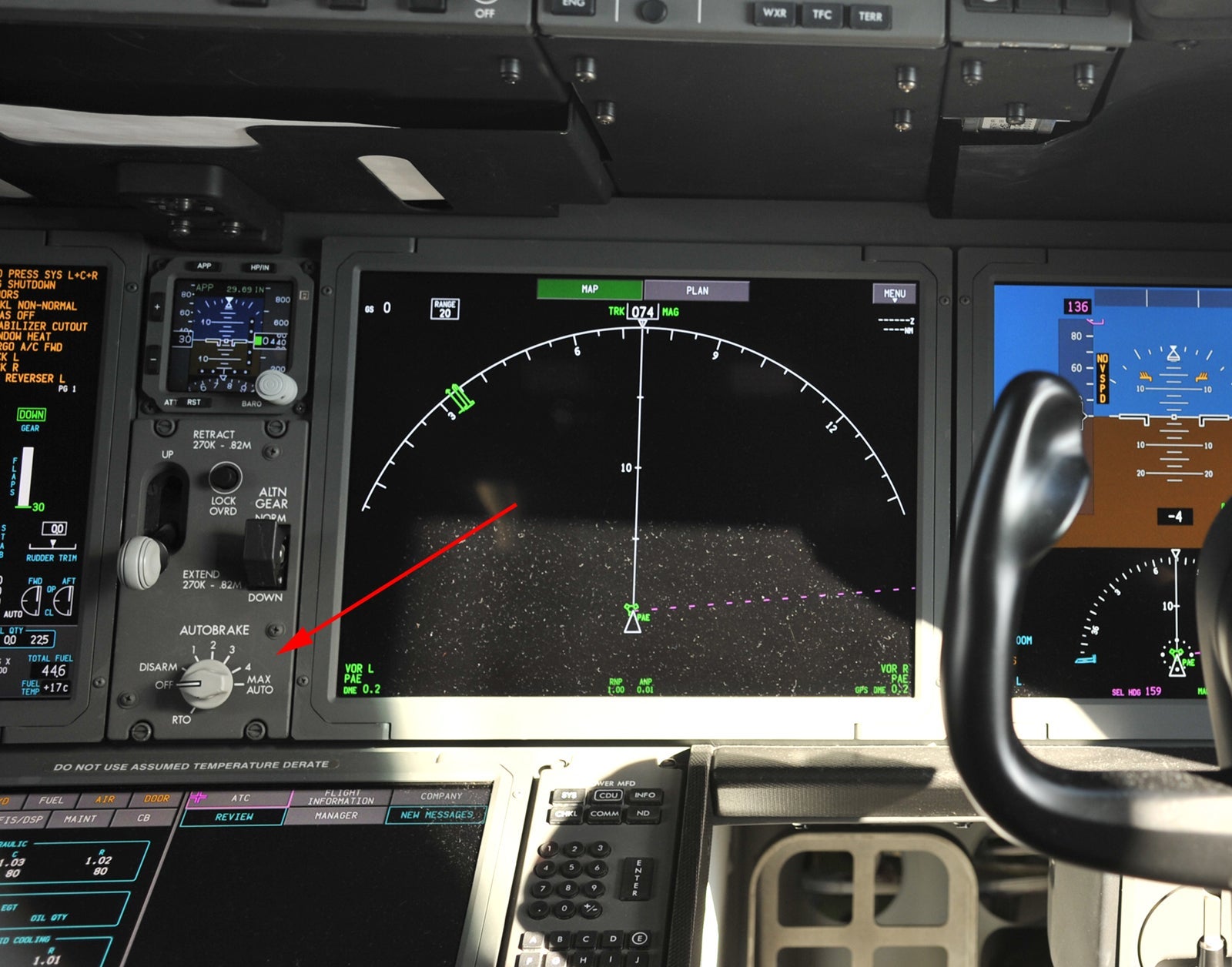
Wheel brakes are usually selected to engage automatically after landing, Brady explained. These are called "autobrakes". Brady says that all airliners have several levels of autobrake “severity”. The crew will decide which is the most appropriate to use for every landing depending upon factors like the length of runway, if it is wet or dry, or if the pilots want to exit the runway at a particular point. "For a short wet runway you might select autobrake 3, or MED on the Airbus. For a long dry runway you might select autobrake 1 or LOW on the Airbus," Brady says.

Daily Newsletter
Reward your inbox with the TPG Daily newsletter
Join over 700,000 readers for breaking news, in-depth guides and exclusive deals from TPG’s experts
The autobrake switch (indicated by the arrow) in a Boeing 787 instrument panel, sitting between the two pilots (Photo by Alberto Riva/TPG)

"For the initial part of the braking, say down to around 70 knots, we let the autobrakes do the job, but after that we have to come onto the toe brakes to disengage the autobrake," Brady says. Accordingly, at the outset, the pilot flying doesn't step on the top of the rudder pedals — which are used to operate the aircraft's rudder or, when pressed with the toes, the wheel brakes.

"This transition from autobrake to manual brakes can be quite difficult to do smoothly especially in a crosswind, as you will be steering the aircraft with the rudder pedals and then have to press down on the tops of the rudder pedals evenly to deactivate the autobrakes and start manual braking," Brady said.

As a passenger, you can sometimes feel a jolt as this happens, if the pilot has not been able to do it smoothly.

Reverse Thrust In Action

The final element of braking action is the thrust reversers. In a modern high-bypass turbofan engine, a full 90 percent of the air passing through the engine is simply sucked in, sped up and pushed out the engine without mixing with fuel. In these engines, ducts on the side of the engine open up and direct that air out and nearly forward, opposite the direction of travel. This is called a cold-stream reverse thrust, and is part of the engine design of most modern engines. (You may have also seen clam-shell style reverse thrusters on older aircraft, which cup the back of the engine.)
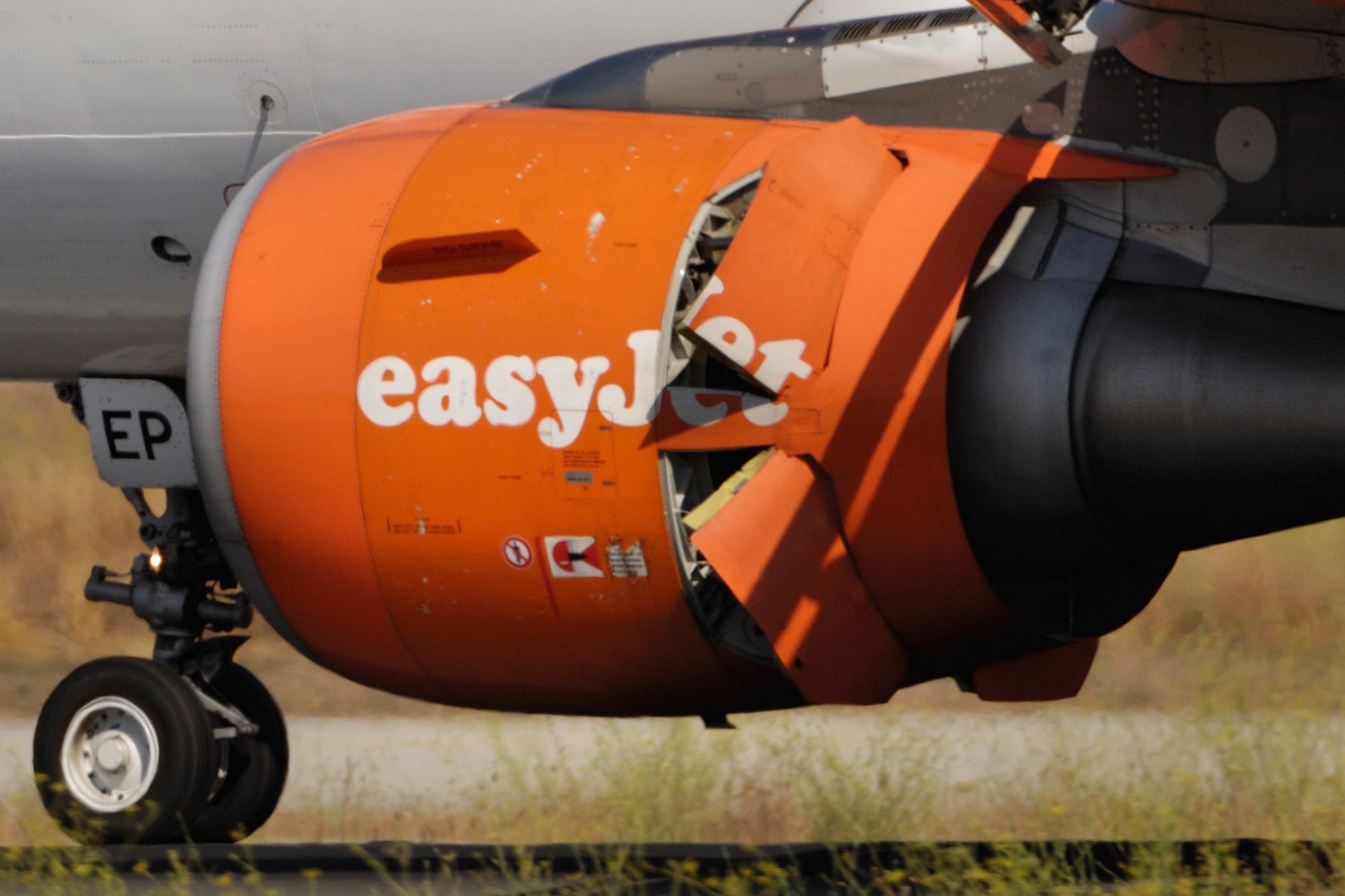
Cold-stream thrust reversers deploying on this easyJet Airbus A319, directing the bypass air forward. (Aviation-images.com/Universal Images Group via Getty Images)

"Reverse thrust is always selected manually," Brady says. "We pull the thrust levers back and then lift the reverse thrust selector. We can then control the amount of reverse thrust that we apply appropriate to the landing conditions."

He explained that nowadays, where possible, pilots try to bring the reverse thrust to idle, which is less noisy, quieter in the cabin — which helps avoiding nervousness in some passengers — and uses less fuel and is thus environmentally friendly. However, if necessary, the pilot can spool up the engine anew to offer full reverse thrust—that is to say, have the engine generate more power and the fan to spin faster, but with the effect of directing that force forward to arrest the roll. (Quite counter-intuitive, stepping on the gas to slow down.)

The Orange Glow of an Aborted Takeoff Roll

Aircraft manufacturers test the braking action as part of the certification process. For example, here is footage from Boeing testing the brakes on a fully-fueled Boeing 747-8 at its maximum takeoff weight. The pilots throttled up to full power and proceeded to roll down the runway, but then aborted the takeoff. The carbon brakes alone stop the roll, with no reverse thrusters deployed. The braking action heats the brake pads up to 1,400 degrees Celsius, or 2,550 Fahrenheit, which is quite toasty. You can see the brakes heated to bright orange in the gif below. The tires were melted, the brakes were destroyed, but the plane came to a complete stop, just as intended.

Mike Arnot is the founder of Boarding Pass NYC, a New York-based travel brand, and a private pilot.

Featured image by Universal Images Group via Getty

TPG featured card

Best for dining at restaurants
TPG Editor‘s Rating
4 / 5
Go to review
Apply for American Express® Gold Card
at American Express's secure site

Rewards

1 - 4X points

Intro offer

As High As 100,000 points. Find Out Your Offer.

Annual Fee

$325

Recommended Credit

Excellent to Good

Why We Chose It

There’s a lot to love about the Amex Gold. It’s a fan favorite thanks to its fantastic bonus-earning rates at restaurants worldwide and at U.S. supermarkets. If you’re hitting the skies soon, you’ll also earn bonus Membership Rewards points on travel. Paired with up to $120 in Uber Cash annually (for U.S. Uber rides or Uber Eats orders, card must be added to Uber app and you can redeem with any Amex card), up to $120 in annual dining statement credits to be used with eligible partners, an up to $84 Dunkin’ credit each year at U.S. Dunkin Donuts and an up to $100 Resy credit annually, there’s no reason that foodies shouldn’t add the Amex Gold to their wallet. These benefits alone are worth more than $400, which offsets the $325 annual fee on the Amex Gold card. Enrollment is required for select benefits. (Partner offer)

Pros

  • 4 points per dollar spent on dining at restaurants worldwide and U.S. supermarkets (on the first $50,000 in purchases per calendar year; then 1 point per dollar spent thereafter and $25,000 in purchases per calendar year; then 1 point per dollar spent thereafter, respectively)
  • 3 points per dollar spent on flights booked directly with the airline or with amextravel.com
  • Packed with credits foodies will enjoy
  • Solid welcome bonus

Cons

  • Not as useful for those living outside the U.S.
  • Some may have trouble using Uber and other dining credits
  • You may be eligible for as high as 100,000 Membership Rewards® Points after you spend $6,000 in eligible purchases on your new Card in your first 6 months of Card Membership. Welcome offers vary and you may not be eligible for an offer. Apply to know if you’re approved and find out your exact welcome offer amount – all with no credit score impact. If you’re approved and choose to accept the Card, your score may be impacted.
  • Earn 4X Membership Rewards® points per dollar spent on purchases at restaurants worldwide, on up to $50,000 in purchases per calendar year, then 1X points for the rest of the year.
  • Earn 4X Membership Rewards® points per dollar spent at US supermarkets, on up to $25,000 in purchases per calendar year, then 1X points for the rest of the year.
  • Earn 3X Membership Rewards® points per dollar spent on flights booked directly with airlines or on AmexTravel.com.
  • Earn 2X Membership Rewards® points per dollar spent on prepaid hotels and other eligible purchases booked on AmexTravel.com.
  • Earn 1X Membership Rewards® point per dollar spent on all other eligible purchases.
  • $120 Uber Cash on Gold: Add your Gold Card to your Uber account and get $10 in Uber Cash each month to use on orders and rides in the U.S. when you select an American Express Card for your transaction. That’s up to $120 Uber Cash annually. Plus, after using your Uber Cash, use your Card to earn 4X Membership Rewards® points for Uber Eats purchases made with restaurants or U.S. supermarkets. Point caps and terms apply.
  • $84 Dunkin' Credit: With the $84 Dunkin' Credit, you can earn up to $7 in monthly statement credits after you enroll and pay with the American Express® Gold Card at U.S. Dunkin' locations. Enrollment is required to receive this benefit.
  • $100 Resy Credit: Get up to $100 in statement credits each calendar year after you pay with the American Express® Gold Card to dine at U.S. Resy restaurants or make other eligible Resy purchases. That's up to $50 in statement credits semi-annually. Enrollment required.
  • $120 Dining Credit: Satisfy your cravings, sweet or savory, with the $120 Dining Credit. Earn up to $10 in statement credits monthly when you pay with the American Express® Gold Card at Grubhub, The Cheesecake Factory, Goldbelly, Wine.com, and Five Guys. Enrollment required.
  • Explore over 1,000 upscale hotels worldwide with The Hotel Collection and receive a $100 credit towards eligible charges* with every booking of two nights or more through AmexTravel.com. *Eligible charges vary by property.
  • No Foreign Transaction Fees.
  • Annual Fee is $325.
  • Terms Apply.
Apply for American Express® Gold Card
at American Express's secure site
Terms & restrictions apply. See rates & fees
Best for dining at restaurants
TPG Editor‘s Rating
4 / 5
Go to review

Rewards Rate

4XEarn 4X Membership Rewards® points per dollar spent on purchases at restaurants worldwide, on up to $50,000 in purchases per calendar year, then 1X points for the rest of the year.
4XEarn 4X Membership Rewards® points per dollar spent at US supermarkets, on up to $25,000 in purchases per calendar year, then 1X points for the rest of the year.
3XEarn 3X Membership Rewards® points per dollar spent on flights booked directly with airlines or on AmexTravel.com.
2XEarn 2X Membership Rewards® points per dollar spent on prepaid hotels and other eligible purchases booked on AmexTravel.com.
1XEarn 1X Membership Rewards® point per dollar spent on all other eligible purchases.
  • Intro Offer

    As High As 100,000 points. Find Out Your Offer.
  • Annual Fee

    $325
  • Recommended Credit

    Excellent to Good

Why We Chose It

There’s a lot to love about the Amex Gold. It’s a fan favorite thanks to its fantastic bonus-earning rates at restaurants worldwide and at U.S. supermarkets. If you’re hitting the skies soon, you’ll also earn bonus Membership Rewards points on travel. Paired with up to $120 in Uber Cash annually (for U.S. Uber rides or Uber Eats orders, card must be added to Uber app and you can redeem with any Amex card), up to $120 in annual dining statement credits to be used with eligible partners, an up to $84 Dunkin’ credit each year at U.S. Dunkin Donuts and an up to $100 Resy credit annually, there’s no reason that foodies shouldn’t add the Amex Gold to their wallet. These benefits alone are worth more than $400, which offsets the $325 annual fee on the Amex Gold card. Enrollment is required for select benefits. (Partner offer)

Pros

  • 4 points per dollar spent on dining at restaurants worldwide and U.S. supermarkets (on the first $50,000 in purchases per calendar year; then 1 point per dollar spent thereafter and $25,000 in purchases per calendar year; then 1 point per dollar spent thereafter, respectively)
  • 3 points per dollar spent on flights booked directly with the airline or with amextravel.com
  • Packed with credits foodies will enjoy
  • Solid welcome bonus

Cons

  • Not as useful for those living outside the U.S.
  • Some may have trouble using Uber and other dining credits
  • You may be eligible for as high as 100,000 Membership Rewards® Points after you spend $6,000 in eligible purchases on your new Card in your first 6 months of Card Membership. Welcome offers vary and you may not be eligible for an offer. Apply to know if you’re approved and find out your exact welcome offer amount – all with no credit score impact. If you’re approved and choose to accept the Card, your score may be impacted.
  • Earn 4X Membership Rewards® points per dollar spent on purchases at restaurants worldwide, on up to $50,000 in purchases per calendar year, then 1X points for the rest of the year.
  • Earn 4X Membership Rewards® points per dollar spent at US supermarkets, on up to $25,000 in purchases per calendar year, then 1X points for the rest of the year.
  • Earn 3X Membership Rewards® points per dollar spent on flights booked directly with airlines or on AmexTravel.com.
  • Earn 2X Membership Rewards® points per dollar spent on prepaid hotels and other eligible purchases booked on AmexTravel.com.
  • Earn 1X Membership Rewards® point per dollar spent on all other eligible purchases.
  • $120 Uber Cash on Gold: Add your Gold Card to your Uber account and get $10 in Uber Cash each month to use on orders and rides in the U.S. when you select an American Express Card for your transaction. That’s up to $120 Uber Cash annually. Plus, after using your Uber Cash, use your Card to earn 4X Membership Rewards® points for Uber Eats purchases made with restaurants or U.S. supermarkets. Point caps and terms apply.
  • $84 Dunkin' Credit: With the $84 Dunkin' Credit, you can earn up to $7 in monthly statement credits after you enroll and pay with the American Express® Gold Card at U.S. Dunkin' locations. Enrollment is required to receive this benefit.
  • $100 Resy Credit: Get up to $100 in statement credits each calendar year after you pay with the American Express® Gold Card to dine at U.S. Resy restaurants or make other eligible Resy purchases. That's up to $50 in statement credits semi-annually. Enrollment required.
  • $120 Dining Credit: Satisfy your cravings, sweet or savory, with the $120 Dining Credit. Earn up to $10 in statement credits monthly when you pay with the American Express® Gold Card at Grubhub, The Cheesecake Factory, Goldbelly, Wine.com, and Five Guys. Enrollment required.
  • Explore over 1,000 upscale hotels worldwide with The Hotel Collection and receive a $100 credit towards eligible charges* with every booking of two nights or more through AmexTravel.com. *Eligible charges vary by property.
  • No Foreign Transaction Fees.
  • Annual Fee is $325.
  • Terms Apply.
