The Best and Worst Airports in the US in 2016
The US may lead the world in military might, diplomatic influence and economic power, but you'd never know it by looking at the state of our airports. And even though many Americans have a sense of oversized pride, when you ask people to name their favorite airports, most sheepishly point to Asia (have you been to Singapore?). That said, not all airports in America are terrible. So we stacked the 30 busiest ones up against one another to find out which are truly the best and worst — ranked using data and not public opinion.
We pored over stats, crunched the numbers, and soon realized that there are three overarching categories in the airport arena: timeliness, accessibility and amenities (see methodology at the bottom of article for more on how we measured the airports).
Some of the findings surprised us — and we like to think of ourselves as unflappable, well-seasoned travelers who have come to treat these terminals like second homes — while other results, well, let's just say that we could see them coming from a hundred frequent flyer miles away. (We're looking at you, LaGuardia.)
The Top 10
Though Phoenix didn't take the top spot in any single category (except how quickly you can drive to and from downtown), it was consistently among the best scorers in almost all categories, with excellent flight delay and flight cancellation scores, a convenient light rail, a high number of restaurants and bars for its level of passenger traffic and free Wi-Fi. About the worst thing that could be said about Sky Harbor, apparently, is it could stand to add more lounges.
The 10 Best Airports in the US
1. Phoenix Sky Harbor International (Arizona; PHX)
2. Portland International (Oregon; PDX)
3. San Diego International (California; SAN)
4. Salt Lake City International (Utah; SLC)
5. Honolulu International (Hawaii; HNL)
6. Seattle-Tacoma International (Washington; SEA)
7. Philadelphia International (Pennsylvania; PHL)
8. Charlotte Douglas International (North Carolina; CLT)
9. Las Vegas McCarran International (Nevada; LAS)
10. Minneapolis-St. Paul International (Minnesota; MSP)
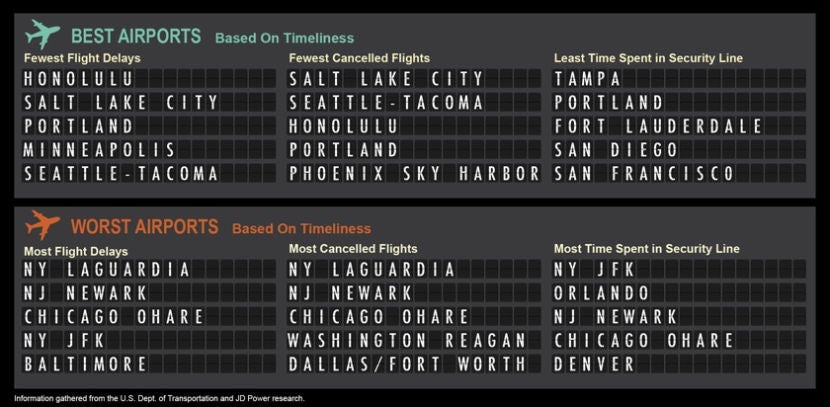
The two airports tied for the best on-time records (fewest delays) were Salt Lake City and Honolulu, and Salt Lake also took top honors for the lowest percentage of flight cancellations. But SLC fell to No. 4 in the rankings because of its relatively sluggish public transportation options and a lack of lounges. Honolulu, meanwhile, was hurt by the fact that its public transportation crawls when it comes to getting to the airport. (Hawaiians can still rejoice in coming in at a respectable No. 5.) Portland, Oregon, at No. 2, had high marks in nearly every category, but it had to settle for the silver medal because it takes notably longer to get to and from the airport compared to Phoenix.
At No. 3, San Diego is a serious contender that could compete for the top spot in the future — but it will have to do something about its middling flight cancellation rate. Its overall timeliness score was surprisingly low, despite the fact that it has near-perfect weather all year long. But keep in mind: Other factors besides weather are actually more likely to cause cancellations and delays. There's been plenty of ink spilt on this topic.
If you really, really hate waiting for security screening, you'll be happiest flying out of No. 11 Tampa, which will have you re-lacing your shoes in just under 12 minutes on average (fastest TSA security wait time). According to our calculations, Philadelphia has more restaurants per passenger than any other major airport in the US, which helped it achieve a No. 7 ranking. The downside: Philly scored below-average in flight delays and cancellations. Charlotte Douglas, on the other hand, has the lowest number of per capita restaurants, but excellent marks when it comes to flights leaving on time and not being cancelled, and solid accessibility — helping it reach No. 8 on our list.
If relaxing is a priority, you'll want to book your flights through D.C.'s Dulles, where departing diplomats can enjoy a staggering number of airline lounges for an airport of its size (nine of them for just over 10 million passengers per year). Or maybe all those lounges exist because Washingtonians trying to get to Dulles have to contend with a relatively high probability of flight cancellations (this brings it down to No. 24 out of 30).

Who are the real losers? Two words: New Yorkers.
The 10 Worst Airports in the US
1. LaGuardia (New York; LGA)
2. John F. Kennedy International (New York; JFK)
3. Newark Liberty International (New Jersey; EWR)
4. Chicago O'Hare International (Illinois; ORD)
5. Detroit Metro (Michigan; DTW)
6. Orlando International (Florida; MCO)
7. Washington Dulles International (Virginia; IAD)
8. Denver International (Colorado; DEN)
9. Los Angeles International (California; LAX)
10. Houston George Bush Intercontinental (Texas; IAH)
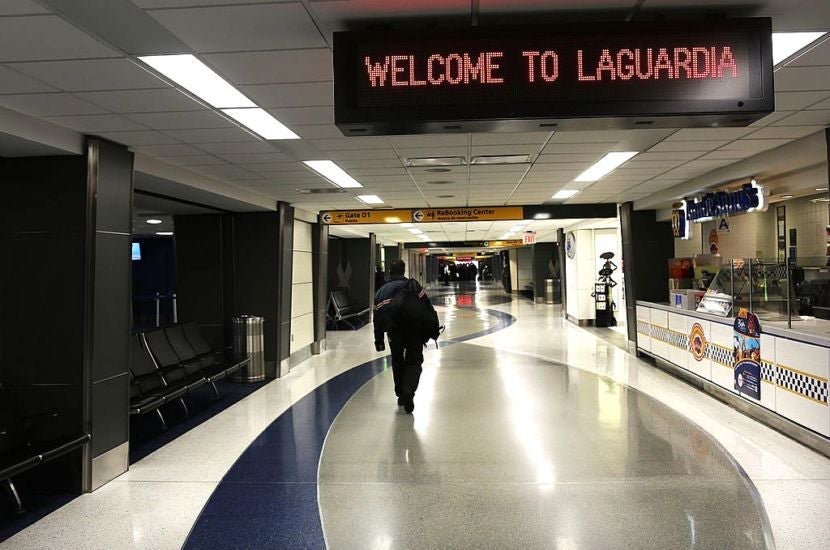
Yes, all three of the major NYC-area airports landed at the bottom of the barrel in our rankings. LaGuardia earned the dubious distinction of having the highest rate of flight delays and cancellations, the second-longest drive time (tied with Newark and Denver) and extortionate parking rates to top it all off ($29 per day or higher). At JFK, you can expect both the longest drive times (over an hour) and the longest waits to get through security (nearly 17 minutes), and while Newark Liberty isn't the lowest-ranked in any one area, it suffers from lackluster ratings across the board — except when it comes to where to eat. Newark, at least, has a decent number of restaurants per passenger, coming in fourth behind Philly, Phoenix and JFK.
The worst non-New York-area airport, Chicago O'Hare, is a slog: It shows high rates of delayed or cancelled flights, and a long wait in security, to boot. The fifth-worst airport makes its home near the Motor City. Detroit's public transit rating is simply shameful — in this era of eco-consciousness, there's no reason it should take someone in a modern major American city two transfers and over 100 minutes to go from the city center to the airport via rail or bus. (It's a half-hour drive.) Denver, meanwhile, takes a long time to get to by any means, and passengers there have to deal with the fact that there's more than a one in five chance that a flight will be delayed (sadly, this is not far from the average).
We know that it's not possible for ailing airports to simply turn themselves around and install dozens of new lounges or overhaul their air-traffic systems overnight any more than it's practical to expect Tampa to know precisely why its security lines are 5.07 minutes faster on average than Orlando's. Airport improvements are major investments that require time, money and the will of the local community. But by letting the higher-scoring airports know what they're getting right and pointing out where the poorer-faring need to do better, maybe we can get the ball rolling on making US airports the jewels of the global flying network. We can do better than this.
The Top 30 Busiest US Airports. Ranked From Best to Worst
1. Phoenix Sky Harbor International (Arizona; PHX)
2. Portland International (Oregon; PDX)
3. San Diego International (California; SAN)
4. Salt Lake City International (Utah; SLC)
5. Honolulu International (Hawaii; HNL)
6. Seattle-Tacoma International (Washington; SEA)
7. Philadelphia International (Pennsylvania; PHL)
8. Charlotte Douglas International (North Carolina; CLT)
9. Las Vegas McCarran International (Nevada; LAS)
10. Minneapolis-St. Paul International (Minnesota; MSP)
11. Tampa International (Florida; TPA)
12. San Francisco International (California; SFO)
13. Washington Reagan National (Virginia; DCA)
14. Baltimore-Washington International (Maryland; BWI)
15. Fort Lauderdale-Hollywood International (Florida; FLL)
16. Hartsfield-Jackson Atlanta International (Georgia; ATL)
17. Chicago Midway International (Illinois; MDW)
18. Boston Logan International (Massachusetts; BOS)
19. Dallas/Fort Worth International (Texas; DFW)
20. Miami International (Florida; MIA)
21. Houston George Bush Intercontinental (Texas; IAH)
22. Los Angeles International (California; LAX)
23. Denver International (Colorado; DEN)
24. Washington Dulles International (Virginia; IAD)
25. Orlando International (Florida; MCO)
26. Detroit Metro (Michigan; DTW)
27. Chicago O'Hare International (Illinois; ORD)
28. Newark Liberty International (New Jersey; EWR)
29. John F. Kennedy International (New York; JFK)
30. LaGuardia (New York; LGA)
Methodology: How We Did It
It's important to note that our results do not come from polling or suveys. Our research team identified the criteria we believe to be most important in determining "good" and "bad" airports, sticking with reliable data from trusted sources that could consistently be found for all 30 airports.
In many cases, the federal government proved an invaluable resource; the FAA and the Bureau of Transportation Statistics offer reams of priceless information. Other sources include the airport websites themselves, the airport's own self-published maps and good old-fashioned detective work (like counting).
The three main categories of criteria are TIMELINESS (flight delays, cancellations, security wait), ACCESSIBILITY (drive time to and from the city center or other popular destination, number of public transportation transfer required, public transit time to and from airport), and AMENITIES (number of restaurants, number of lounges, Wi-Fi fees, parking fees).
We gathered the percentage of delayed and cancelled flights (which the federal government tracks for domestic flights of major U.S. carriers) from the Bureau of Transportation Statistics; determined how accessible the airports are by car and public transit with the help of Google Maps; and found the number of restaurants, bars, lounges and how much you can expect to pay for Wi-Fi and parking from various sources (including the airports' websites and maps).
We also wanted to include an assessment of what is usually the worst part of any airport experience — the wait in the security checkpoint line. But our government sources either don't track that data or don't make that kind of data public. So in this case we went to the numbers guys at the market-research company J.D. Power, who in 2015 started a running survey of the wait time at security-checkpoint lines. Because J.D. Power didn't have data for the full year in 2015, we combined the data from the last half of 2015 and the first half of 2016 of J.D. Power's passenger survey to get a full year's worth of data for security-checkpoint wait times. Otherwise, we largely used data only from 2015 for other categories.
Some criteria are clearly more important than others. So we grouped certain factors together and weighted some more heavily than others; your terminal might brag about offering dozens of food options, but if the planes rarely make it off the tarmac, all you've got is a themed food court, not a functioning airport. We place top importance on how well each venue serves its primary purpose -- getting you where you're going on time (TIMELINESS). The next most significant factor is how easy it is to reach the airport by car or public transportation (ACCESSIBILITY). The third category spotlights the number of restaurants and lounges, and the fees for parking and 24-hour Wi-Fi (AMENITIES).
If you're wondering why we didn't include lost-luggage rates, it's because baggage throwers are employed by airlines, not airports, and are tracked accordingly. Therefore, while losing your luggage sucks, it doesn't factor into our airport rankings.
*Additional reporting by Brendan Dorsey and Alex Allegro
TPG featured card

at Capital One's secure site
Terms & restrictions apply. See rates & fees.
| 5X miles | Earn 5X miles on hotels, vacation rentals and rental cars booked through Capital One Travel |
| 2X miles | Earn unlimited 2X miles on every purchase, every day |
Pros
- Stellar welcome offer of 75,000 miles after spending $4,000 on purchases in the first three months from account opening. Plus, a $250 Capital One Travel credit to use in your first cardholder year upon account opening.
- You'll earn 2 miles per dollar on every purchase, which means you won't have to worry about memorizing bonus categories
- Rewards are versatile and can be redeemed for a statement credit or transferred to Capital One’s transfer partners
Cons
- Highest bonus-earning categories only on travel booked via Capital One Travel
- LIMITED-TIME OFFER: Enjoy $250 to use on Capital One Travel in your first cardholder year, plus earn 75,000 bonus miles once you spend $4,000 on purchases within the first 3 months from account opening - that’s equal to $1,000 in travel
- Earn unlimited 2X miles on every purchase, every day
- Earn 5X miles on hotels, vacation rentals and rental cars booked through Capital One Travel
- Miles won't expire for the life of the account and there's no limit to how many you can earn
- Receive up to a $120 credit for Global Entry or TSA PreCheck®
- Use your miles to get reimbursed for any travel purchase—or redeem by booking a trip through Capital One Travel
- Enjoy a $50 experience credit and other premium benefits with every hotel and vacation rental booked from the Lifestyle Collection
- Transfer your miles to your choice of 15+ travel loyalty programs
- Top rated mobile app