
You can use your dwell time to shop, eat, catch up on email, hang out in a lounge or settle in for some entertaining people watching while nursing a fancy cocktail.
Or, you can sidle up to an ATM-sized machine and in about 5 minutes learn how to save a life.
Sign up for the free daily TPG newsletter for more travel tips!
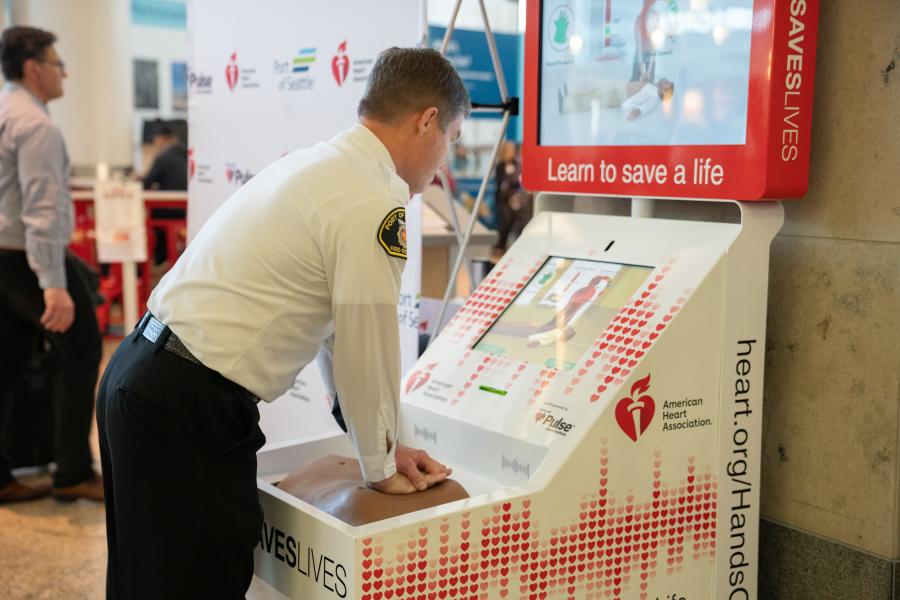
In partnership with the American Heart Association, a growing number of airports are now home to Hands-Only CPR training kiosks, which provide short classes in a form of CPR that doesn’t use rescue breaths but is as effective as conventional CPR.
The kiosks include a touch-screen display with a video introduction and a tutorial followed by an interactive practice session and a 30-second evaluation test. The short courses are offered in English or Spanish and are close captioned for accessibility.
Users learn on a rubber practice manikin and get feedback from the kiosk on the elements of Hands-Only CPR that make it effective: hand placement and the depth and rate of compressions.
You’ll need to push on the chest at a rate of 100 to 120 compressions per minute. And while that sounds tricky, the American Heart Association says it helps if you push in time to the beat of a song such as “Stayin’ Alive” by the Bee Gees, “Walk the Line” by Johnny Cash, “Crazy in Love” by Beyoncé, or “Hips Don’t Lie” by Shakira.
So, while you’re learning Hands-Only CPR, you may as well brush up on your music.
“The kiosks offer a very nonthreatening and inviting way to learn CPR,” said Randy Krause, fire chief for Seattle-Tacoma International Airport (SEA), which recently installed its first Hands-Only CPR kiosk. “If you learn this skill and are there when someone faints or passes out and doesn’t have a pulse, Hands-Only CPR gives them a 30% to 40% higher chance of survival than if someone had not engaged,” says Krause.
How to tell if you’re getting a blood clot while flying
According to the American Heart Association, more than 350,000 cardiac arrests occur outside the hospital each year in the United States. About 20 percent of those cardiac arrests occur in public places such as airports and there can be a spike in incidents during holidays.
“If you have a plane ticket and you’re going to see your grandkids or your family, it’s an important time and a lot of people end up traveling when they’re not feeling the greatest,” said Krause. That risk, combined with the anxiety associated with the crowds, “can create the perfect cocktail,” he said. “It can happen in a mall, it can happen in a grocery store, and it definitely happens quite frequently in the airport.”
So, what should you do if you if you’re in an airport and you somebody clutches their chest, falls to the floor and passes out?
“If you have the training and are confident to engage, have someone call 9-1-1 to make sure emergency responders are on the way; have someone find an AED [an automated external defibrillator] but immediately start performing hands only CPR,” said Krause, “All that activity creates a chain of greater success for that patient.”
And if you need some extra “nice” points this holiday season, keep in mind that Santa Claus will visit the Hands-Only CPR kiosks at airports in Indianapolis, Orlando, Baltimore and, perhaps, Atlanta to encourage travelers to learn lifesaving skills and to hand out CPR-themed gifts.
Here’s a list of the 16 airports around the country that currently have one or more Hands-Only CPR kiosks on site:
- Hartsfield-Jackson Atlanta International Airport (ATL)
- Baltimore-Washington International Airport (BWI)
- Chicago O’Hare International Airport (ORD)
- Cincinnati-Northern Kentucky International Airport (CVG)
- Cleveland Hopkins International Airport (CLE)
- Columbus Airport (CMH)
- Dayton International Airport (DAY)
- Dallas Fort Worth International Airport (DFW)
- Indianapolis International Airport (IND)
- John Wayne Airport (SNA)
- Los Angeles International Airport (LAX)
- Lubbock Preston Smith International Airport (LBB)
- Oakland Internal Airport (OAK)
- Orlando International Airport (MCO)
- Seattle-Tacoma International Airport (SEA)
- George Bush Intercontinental Airport (IAH)