Travel Science: Improving Airplane Boarding Procedures

TPG contributor Katharine Gammon is a science writer for publications including WIRED, Popular Science and Los Angeles Magazine. When she's not jetting to international conferences to interview some of the world's leading scientific minds, she's globetrotting herself, exploring unique destinations including recent trips to New Zealand and Southeast Asia. Today she explores the science behind plane boarding procedures and what could be done to improve efficiency.
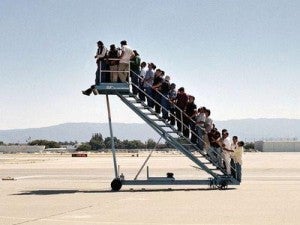
Like many travelers, Jason Steffen was fed up with the long slog down the jetway and the hustle to get into his seat while other people blocked the aisle.
"I just thought, there has to be a better way than what's going on. So I brooded over it for a couple years, and figured that I need to sit down and solve this or drop it," says Steffen. Unlike the majority of travelers, Steffen could do something about it - he is a postdoctoral fellow at Fermilab Center for Particle Astrophysics in Batavia, Illinois, where he hunts for exoplanets and researchers weak and strong gravitational lensing. You know, your typical seatmate.
Steffen finally decided to take the challenge that had been plaguing him and in a week he wrote a piece of software that modeled airplane boarding. He determined the optimal method that makes a boarding process work in a parallel way rather than in serial way (as most carriers do today). Steffen explains that in traditional methods, people standing in the aisle of the airplane are just standing in line. Loading back to front just moves the line inside the plane, but is not significantly faster than loading from the front to the back.
Breaking The Boarding Code
In Steffen's method, the first seat to board would be the back window, followed by the third-to-back window on the same side, and so on up the aisle. People need about two rows to stow their stuff, the model showed. Then the other side of the plane would board, outside-first, back-to-front. When all the window seats were seated, the middle seat passengers would file in, back to front – allowing for multiple people to sit at the same time.
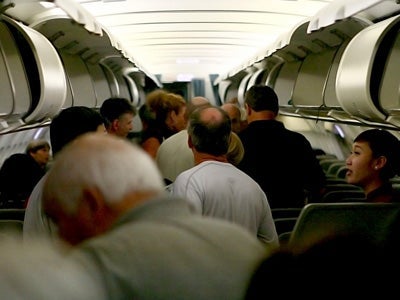
On a plane with 40 rows, that means having no more than 20 people boarding simultaneously, filling every other row down one side of the plane - 1A, 3A, 5A and so on - then the other. Try to get any more than that aboard at a time and things start slowing down quickly. His method has as many people as possible using the aisleway to store their luggage, allowing many more people to simultaneously prepare to sit. "If you're in the aisle, you're either putting luggage up or getting out of the way," he explains. The model showed that for 240 people, his method was eight times faster than boarding front to back, and four times faster than boarding back to front.
But travelers don't always come in single-servings - what about for families or people who are traveling together? Steffen simplified his method: fill the even-numbered rows first, starting on one side of the plane and moving to the other. Then repeat with the odd-numbered rows. This method also beat out the competition, boarding twice as fast as starting in the back.
Steffen was able to put his model to the test in 2011 during the taping of a show called This Vs. That, and it fared quite well. His method was faster by a factor of two than boarding by zones, says Steffen - and it also beat out the second-place finisher, the random first-come-first-served method that Southwest Airlines uses.

Saving Time is Saving Money
An airplane typically spends 30 - 60 minutes or more on the ground, and airline executives spend a lot of time thinking about boarding efficiency because it's the best way to reduce that wasted time. In 1998 Boeing did a study and found that the boarding rate has fallen more than 50 percent since 1970 to as little as nine people per minute. Another Boeing study showed that saving as little 10 minutes on turn time – the time an airplane needs between trips - on 2,000 trips per year could mean over 300 more hours that could be available for additional flights. That would add up to quite a bit of savings for any airline.
Although Steffen's work has been around for years, he says that airlines aren't really interested in what he has to say. He has had a new startup airline contact him, but that's about it. "Change is hard to implement. I don't know enough about the psyche of airlines to say what it is, but I don't have the impression that people have looked at other options."
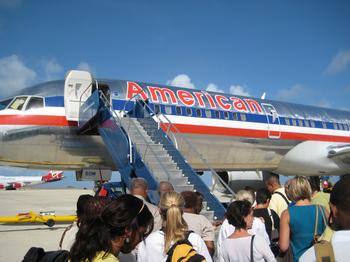
Steffen says his seat-by-seat model could be put to use with a boarding system like Southwest, where people line up in rows before entering the jetway - except that they'd have a seat assignment as well as a boarding number in hand.
It could be that airlines are more interested in pleasing their elite-status passengers who get to board first than getting their flights in the air quicker. After all, if the first person to board is the window in the last row of seats, who is going to jockey for position?
As for Southwest, they put a lot of thought into their boarding procedure method when they overhauled the system in 2007, said Southwest representative Ashley Dillon. They used to do a line-only system, but people would stress out about holding their place in line – people would leave their shoes in line while they went to grab something to eat, says Dillon. The company tested out different ways of boarding and settled on the modified first-come system, where everyone has a boarding number and can choose their seats onboard. For a little extra cash, passengers can buy the first choice of seats. Dillon says that Southwest's average time now to turn an aircraft is between 25-45 minutes - pretty short for a major carrier trying to get 137 people off one flight and 137 on to the next.
As more people take to the skies and airlines are squeezed for profits, they just might look to Steffen's work to improve their bottom line. But he's not holding his breath. "I don't have any plans to do any more work on this in the near future, mostly because I think there is no serious challenge to the method I developed being surpassed."
Well, at least he's right based on the way plane boarding is currently carried out!
[card card-name='Alaska Airlines Visa Signature Credit Card' card-id='220611156' type='javascript' bullet-id='1']
TPG featured card
at American Express's secure site
Terms & restrictions apply. See rates & fees.
| 4X | Earn 4X Membership Rewards® points per dollar spent on purchases at restaurants worldwide, on up to $50,000 in purchases per calendar year, then 1X points for the rest of the year. |
| 4X | Earn 4X Membership Rewards® points per dollar spent at US supermarkets, on up to $25,000 in purchases per calendar year, then 1X points for the rest of the year. |
| 5X | Earn 5X Membership Rewards® points on prepaid hotel stays booked through AmexTravel.com or the Amex Travel App™. |
| 3X | Earn 3X Membership Rewards® points on flights booked through AmexTravel.com, the Amex Travel App™, or purchased directly from airlines. |
| 2X | Earn 2X Membership Rewards® points on prepaid car rentals booked through AmexTravel.com or the Amex Travel App™ and cruises booked and paid through AmexTravel.com. |
| 1X | Earn 1X Membership Rewards® point per dollar spent on all other eligible purchases. |
Pros
- Valuable dining and food-related credits
- Flexible rewards with airline and hotel transfer partners
- Multiple travel and purchase protections
- No foreign transaction fees
- Access to Amex Offers for additional savings (enrollment required)
Cons
- Not as useful for those living outside the U.S.
- Some may have trouble using Uber and other dining credits
- You may be eligible for as high as 100,000 Membership Rewards® Points after you spend $8,000 in eligible purchases on your new Card in your first 6 months of Card Membership. Welcome offers vary and you may not be eligible for an offer. Apply to know if you’re approved and find out your exact welcome offer amount – all with no credit score impact. If you’re approved and choose to accept the Card, your score may be impacted.
- Earn 4X Membership Rewards® points per dollar spent on purchases at restaurants worldwide, on up to $50,000 in purchases per calendar year, then 1X points for the rest of the year.
- Earn 4X Membership Rewards® points per dollar spent at US supermarkets, on up to $25,000 in purchases per calendar year, then 1X points for the rest of the year.
- Earn 5X Membership Rewards® points on prepaid hotel stays booked through AmexTravel.com or the Amex Travel App™.
- Earn 3X Membership Rewards® points on flights booked through AmexTravel.com, the Amex Travel App™, or purchased directly from airlines.
- Earn 2X Membership Rewards® points on prepaid car rentals booked through AmexTravel.com or the Amex Travel App™ and cruises booked and paid through AmexTravel.com.
- Earn 1X Membership Rewards® point per dollar spent on all other eligible purchases.
- Pay It® lets you tap in the American Express® App to quickly pay for small purchase amounts throughout the month and still earn rewards the way you usually do. Plan It® gives you the option to split up big purchases into equal monthly payments with a fixed fee. You’ll know upfront exactly how much you’ll pay.
- $120 Dining Credit: Earn up to a total of $10 in statement credits monthly when you pay with the Gold Card at Grubhub (including Seamless), Buffalo Wild Wings, Five Guys, The Cheesecake Factory, and Wonder. This can be an annual savings of up to $120. Enrollment required.
- $100 Resy Credit: Get up to $100 in statement credits each calendar year at over 10,000 qualifying U.S. Resy restaurants after you pay for eligible purchases with the American Express® Gold Card. That’s up to $50 in statement credits semi-annually. Enrollment required.
- $84 Dunkin' Credit: Earn up to $7 in monthly statement credits after you pay with the American Express® Gold Card at U.S. Dunkin’ locations. Enrollment required.
- $120 Uber Cash on Gold: Enjoy up to $120 in Uber Cash annually with your Gold Card. Just add your Card to your Uber account and you'll get $10 in Uber Cash each month to use on orders and rides in the U.S. when you select an Amex Card for your transaction.
- Enjoy complimentary Hertz Five Star® Status benefits like skipping the counter at select locations, adding an additional driver at no additional cost*, and vehicle upgrades**. Benefit enrollment and Hertz Gold+ registration are required. *Additional drivers must meet standard rental qualifications and must be a spouse or domestic partner to qualify as complimentary. Other additional drivers subject to fees. **Benefits are subject to availability and vary by location. Additional Hertz program Terms and Conditions including age restrictions apply.
- Book two nights or more with The Hotel Collection through AmexTravel.com or the Amex Travel App™ and receive a $100* credit towards eligible charges at over 1,400 upscale hotels worldwide. *Eligible charges vary by property.
- Book your travel through the Amex Travel App™ with added peace of mind – backed by American Express® service and support. Only for American Express® Card Members.
- Whenever you need us, we're here. Our Member Services team will ensure you are taken care of. From lost Card replacement to statement questions, we are available to help 24/7.
- No Foreign Transaction Fees.
- Annual Fee is $325.
- Terms Apply.