JT is a location-independent digital nomad traveling 250,000+ miles each year with his wife Katie.
August 13, 2018 • 13 min read
The cards we feature here are from partners who compensate us when you are approved through our site, and this may impact how or where these products appear. We don't cover all available credit cards, but our analysis, reviews, and opinions are entirely from our editorial team. Terms apply to the offers listed on this page. Please view our advertising policy and product review methodology for more information.
Comments
By commenting, you agree to our Community Guidelines to help create a positive space for conversation. The responses below are not provided or commissioned by the bank advertiser, our partners, or The Points Guy (“TPG”). They have not been reviewed, approved, or otherwise endorsed by any of these parties. All responses are submitted by individual contributors, and neither the bank advertiser, our partners, nor TPG are responsible for ensuring that all posts and/or questions are answered.
Related stories
Quick summary
Iberia's Airbus A350-900 offers a transatlantic economy experience with modern amenities, including a bright entertainment screen, USB and universal power outlets and adjustable headrests.
The economy cabin is arranged in a 3-3-3 configuration with 30 inches of measured seat pitch and 18-inch seat width, providing slightly more space than some comparable aircraft.
Meal service includes a hot lunch with real metal cutlery and a pre-landing snack, though service is described as efficient but not particularly warm.
Award flights can be booked using Avios or other airline miles, with taxes and fees required; availability may differ between loyalty programs.
What to consider
Award availability may not always appear on partner airline websites, and taxes and fees apply to redemptions.
Some seats offer extra legroom or unique configurations, but overhead bin space and headroom can be limited in certain rows.
The article notes that some offers mentioned are no longer available.
What you'll miss from the article
A detailed review of seat comfort, in-flight entertainment, meal quality and specific tips for selecting the best seats on Iberia's A350.
Generated by AI with support from our editorial team.
Update: Some offers mentioned below are no longer available. View the current offers here.
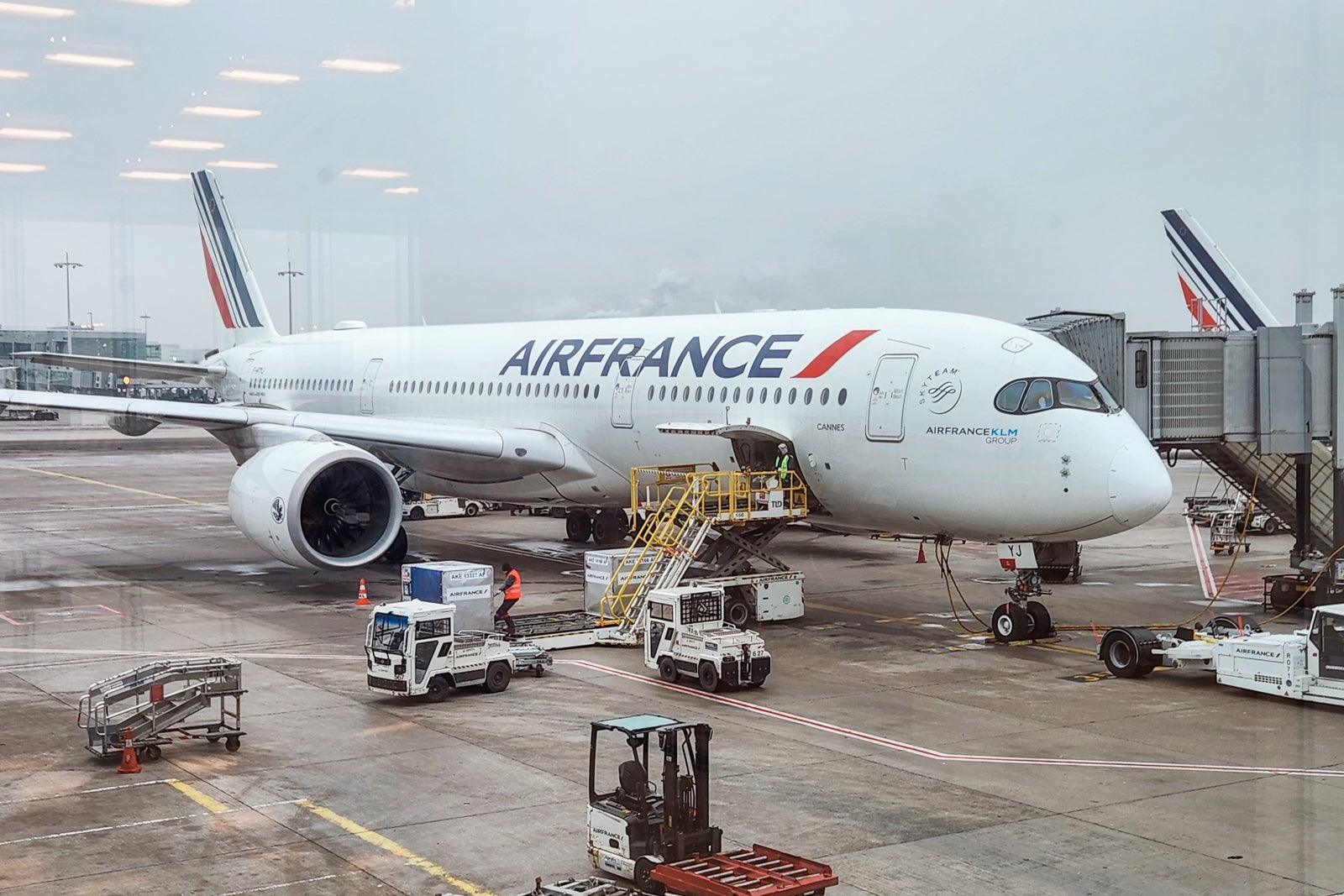
On June 26, 2018, Iberia took delivery of its first of 16 Airbus A350-900 aircraft. After running the aircraft and its crew on training runs between Madrid (MAD) and London's Heathrow (LHR), Iberia launched its inaugural A350 transatlantic service between Madrid and New York-JFK on Aug. 4.
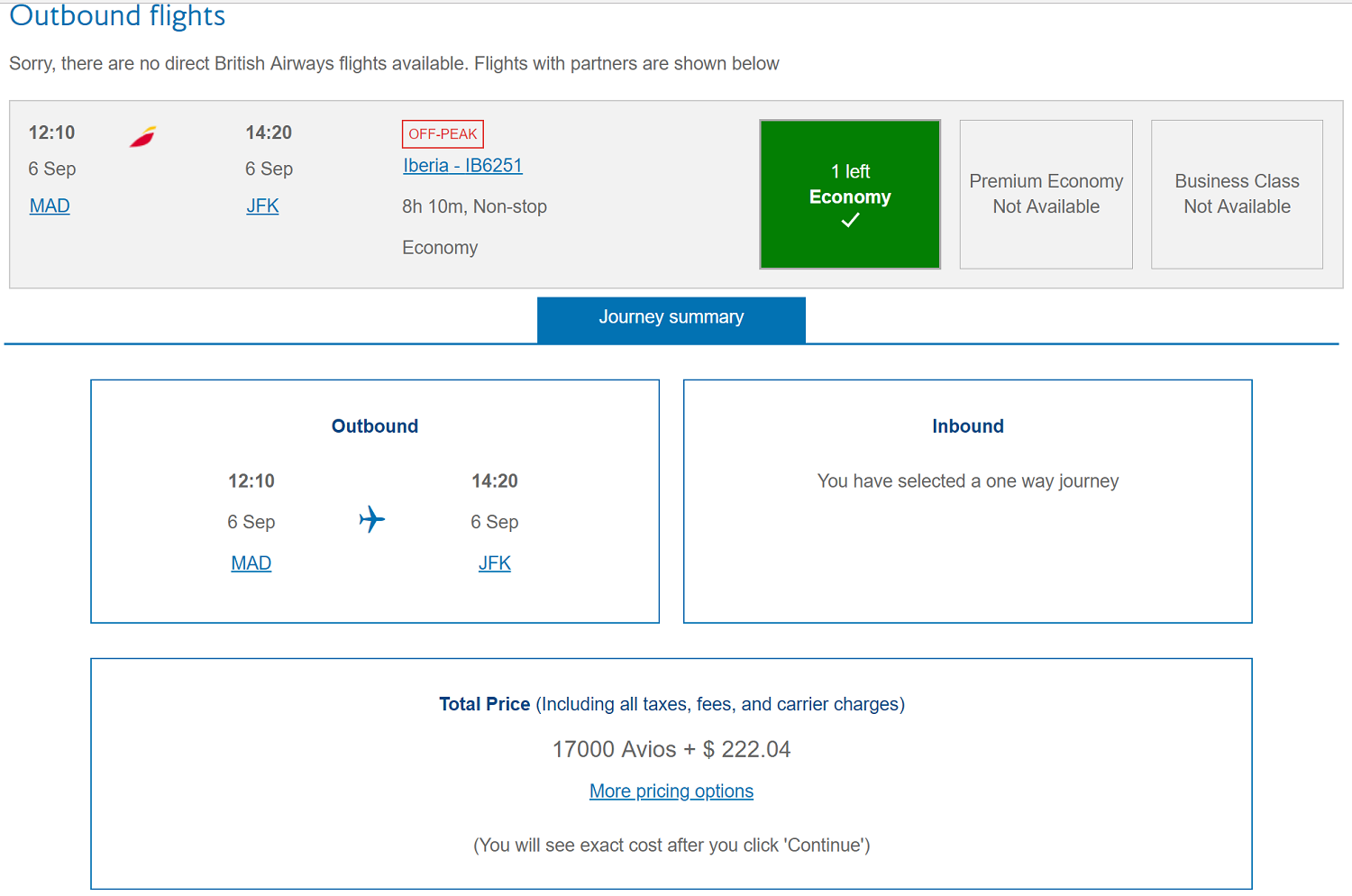
I just happened to need a flight across the pond just days after this inaugural service and was lucky enough to snag last-minute award availability in economy to check out the new aircraft.
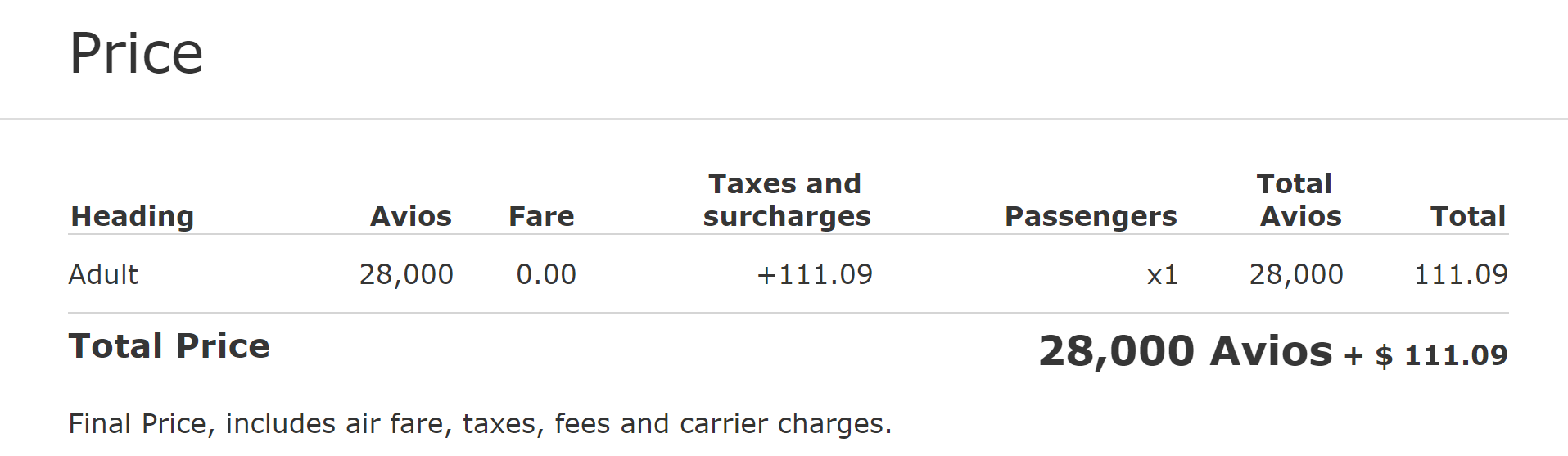
To price out my options, I checked award availability for the same date using British Airways Avios and American Airlines AAdvantage miles. While Iberia award availability is supposed to be bookable on AA's website, this economy award availability didn't appear on either partner. However, if you can find availability, this one-way flight would cost 30,000 AAdvantage miles. On off-peak dates, it'll cost as little as 17,000 British Airways Avios, but there are much higher fuel surcharges.
TPG pays for review flights for staff, so we put the $111 of award taxes and fees on TPG's Platinum Card® from American Express. Had I booked this ticket myself, though, I'd have put the taxes and fees on my Chase Sapphire Reserve, as I value the 3x points, trip delay and baggage-delay protection over the potential 5x points I'd have gotten by charging the fees to the Platinum Card.
Boarding
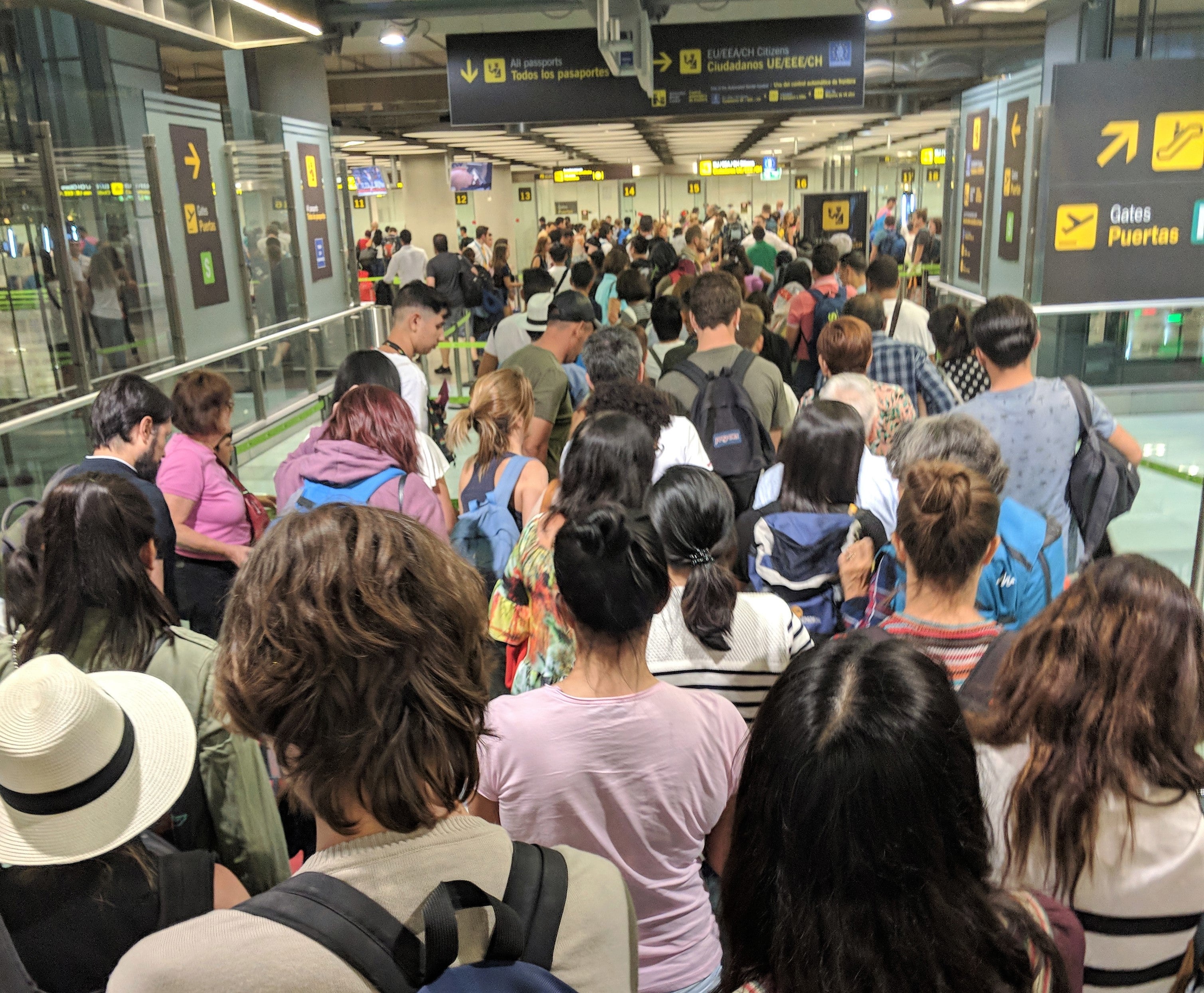
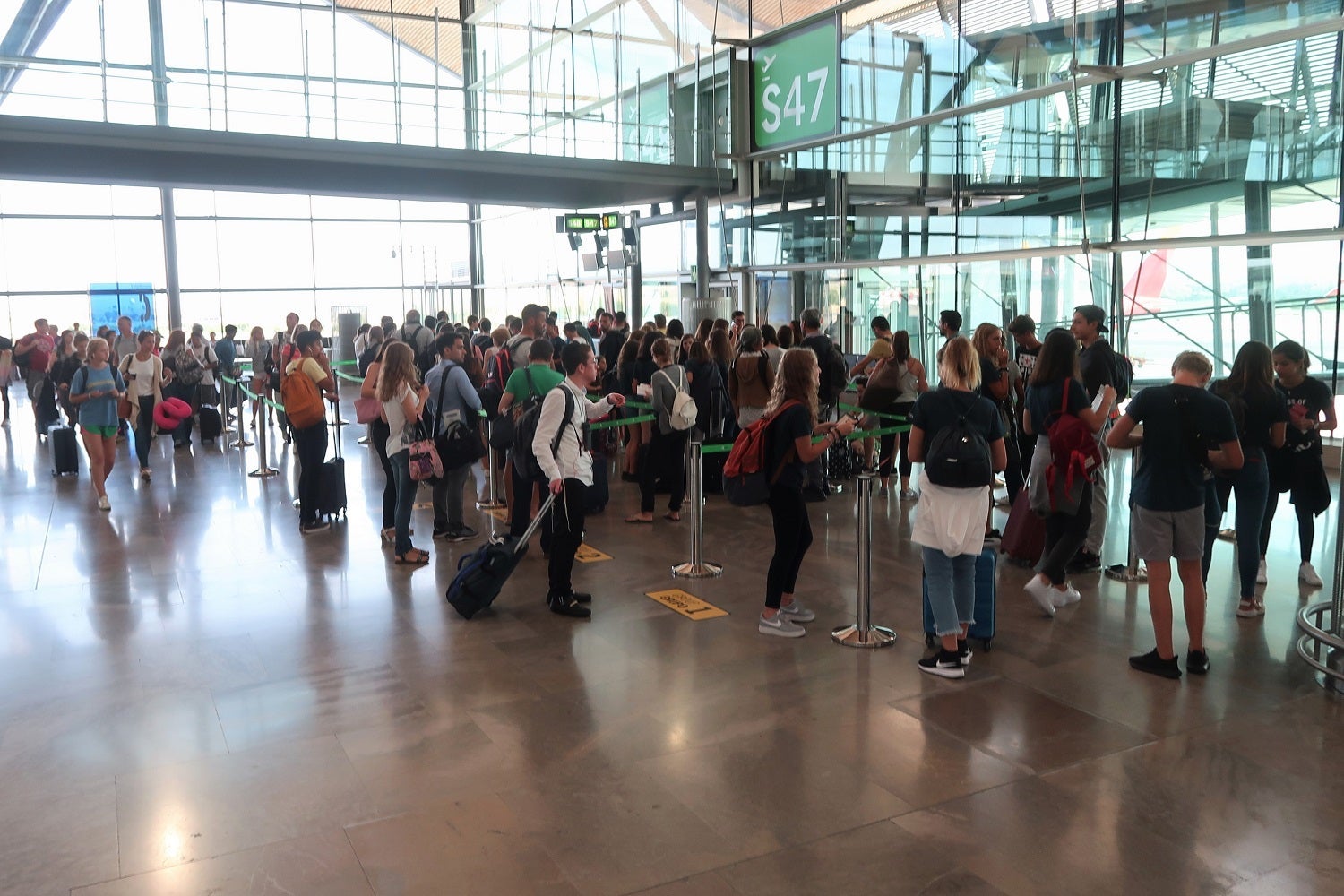
International flights departed from the satellite building of Madrid's Terminal 4, and US flights departed from the far ends of this terminal. With check-in, security, the underground train to the satellite building, immigration, walking to the end of the terminal and US security interviews, there were a lot of steps between arriving at the airport and boarding the plane. In order to have enough time to make it through the airport maze, I knew I needed to arrive at least two hours before departure.
There was a long line at the immigration counters when I flew out.
Oneworld elite status shortened my wait at multiple points along the way, with priority check-in, a dedicated security area, priority line for the US security interview and, finally, priority boarding — which let me skip these lines:
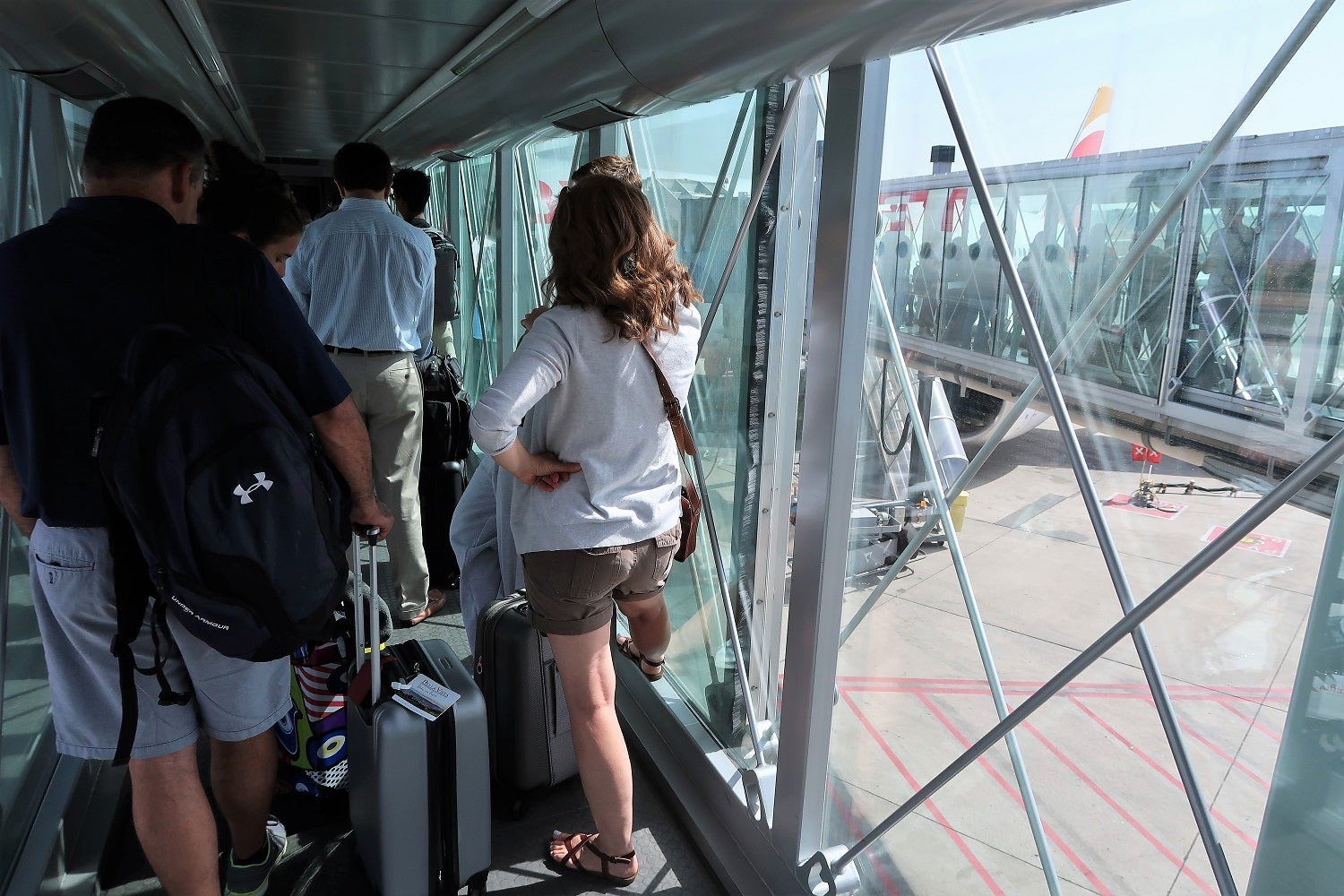
Priority boarding went down a different jetway than economy boarding, and there was no way of crossing over after my boarding pass was scanned. Passengers were held at the boarding door, so the lines backed up down both jetways. By the time passengers were able to board the aircraft, it turned it out it would've been better for me to have boarded with the first group of economy than to have stuck to priority boarding.
I wasn't able to figure out the boarding groups during my short time at the gate. Despite this sizable backup in the jetway, I still had plenty of time to photograph the rear economy cabin and stow my backpack in the overhead bin. So it seems possible that Iberia boarded economy from front to back.
Cabin and Seat
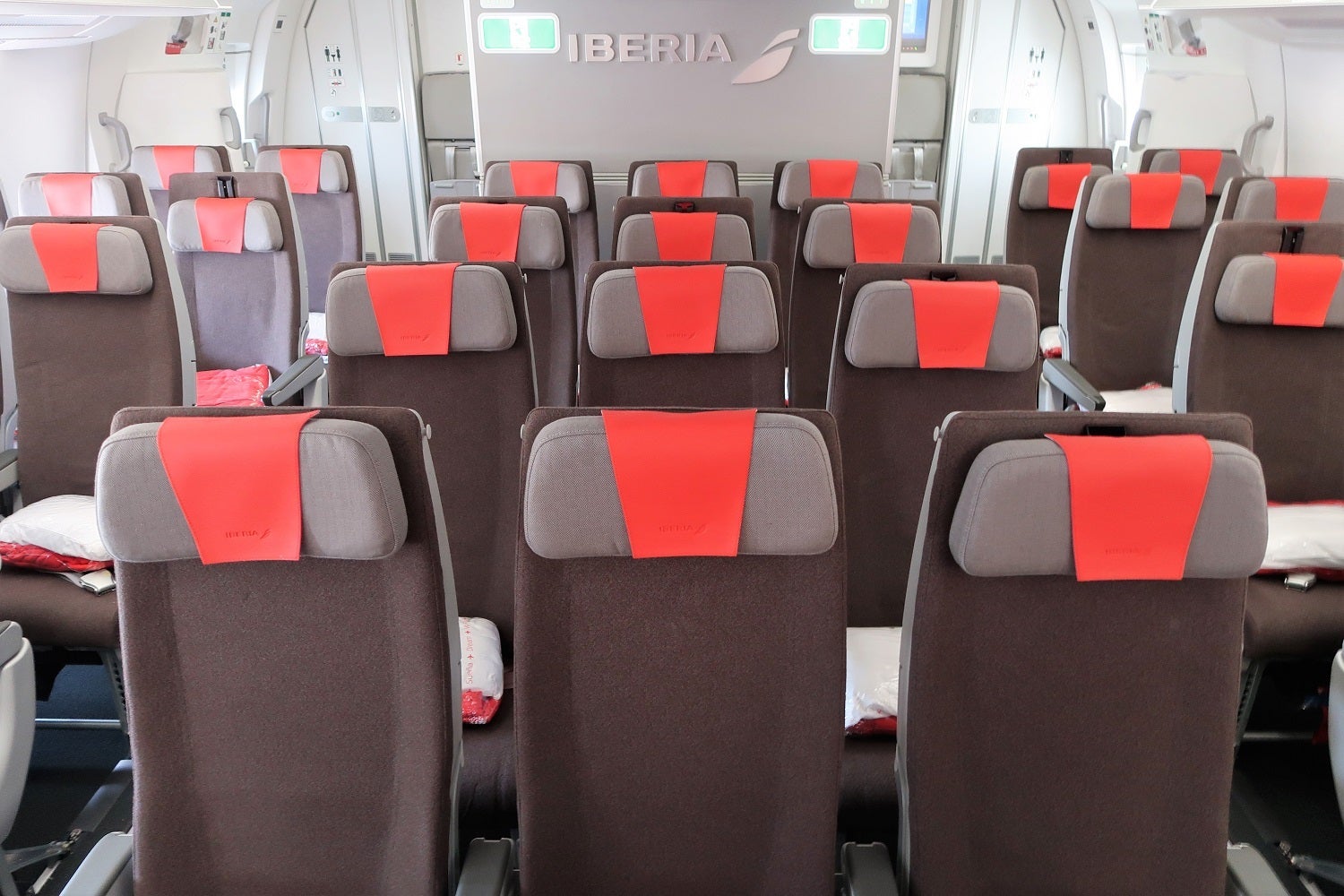
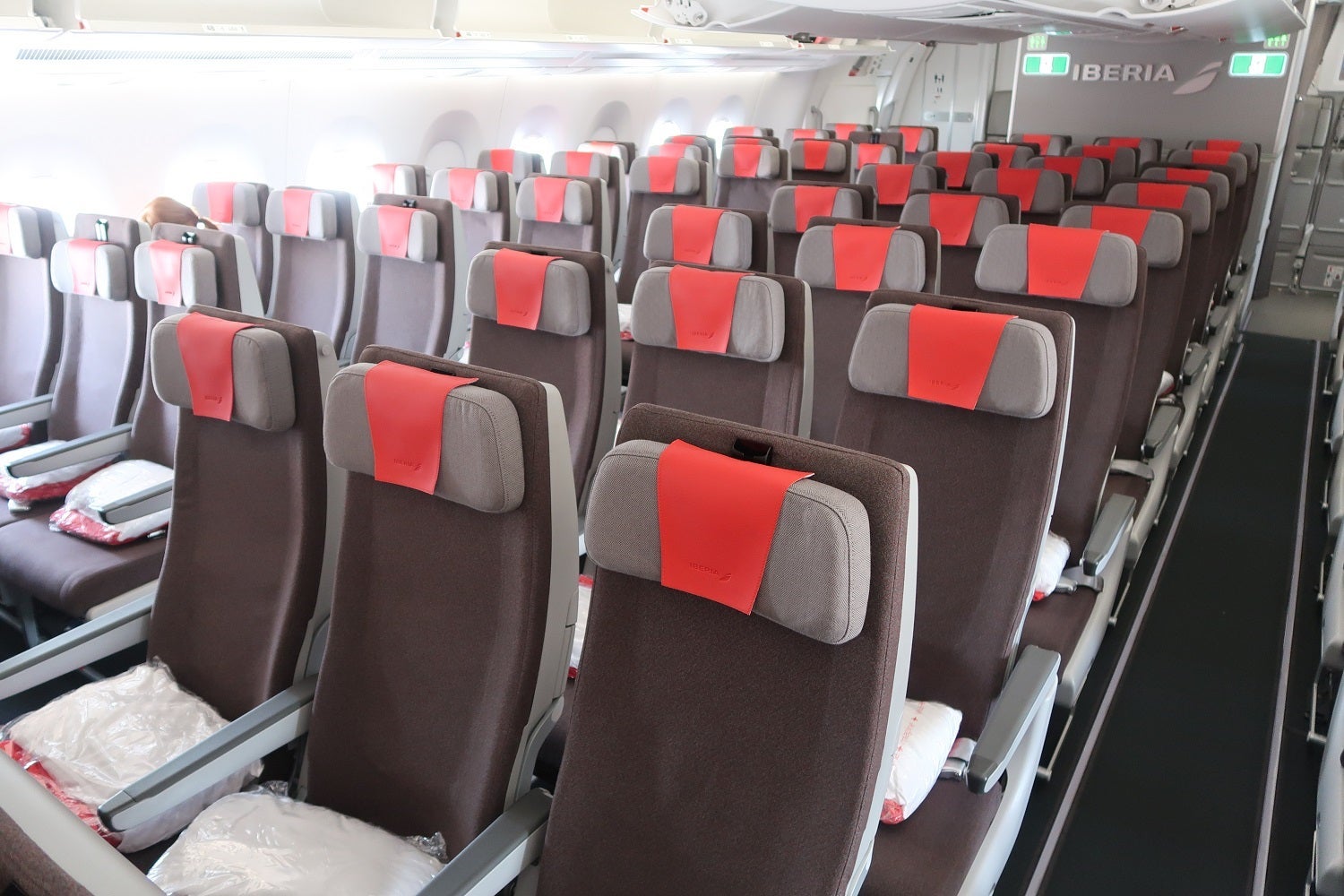
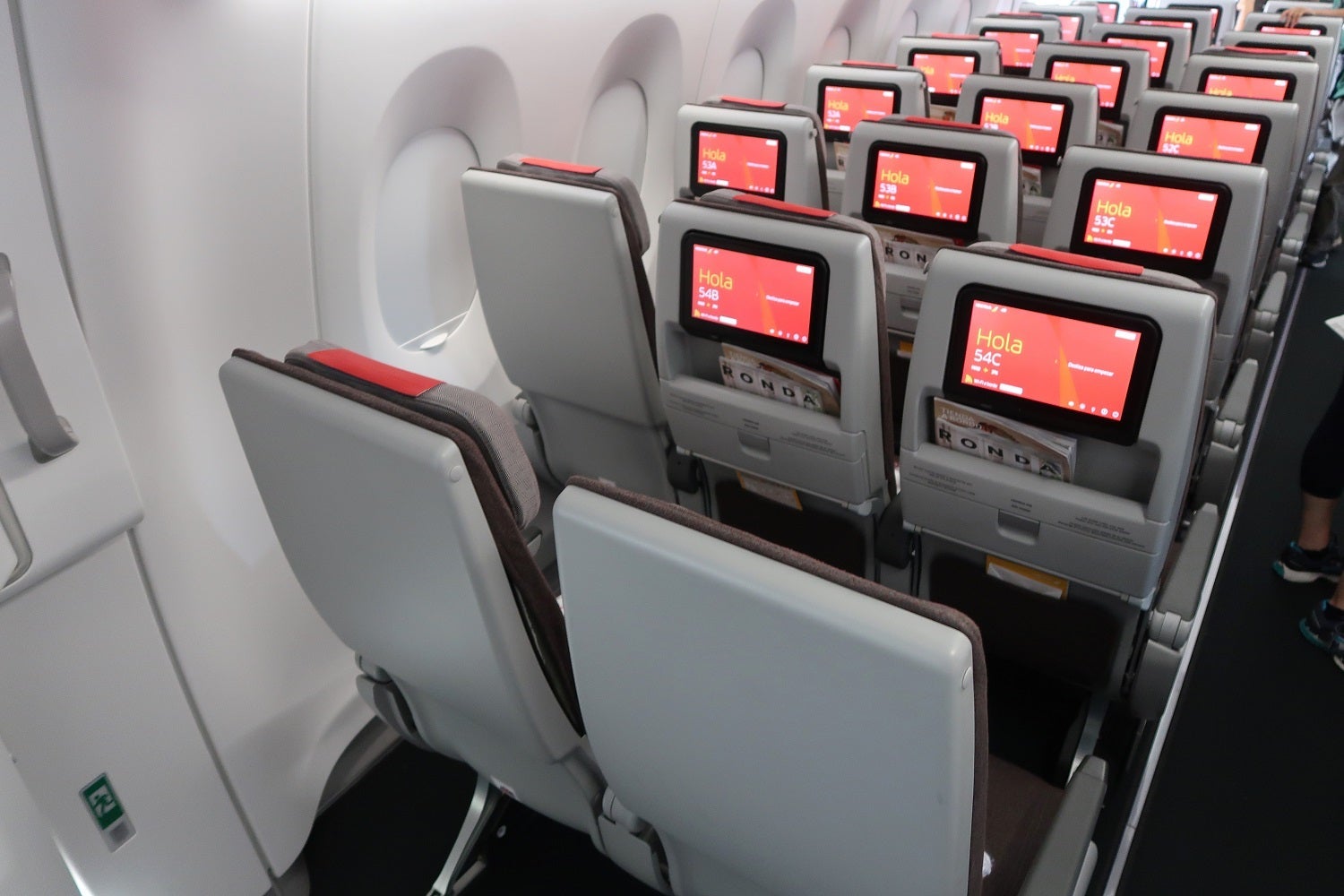
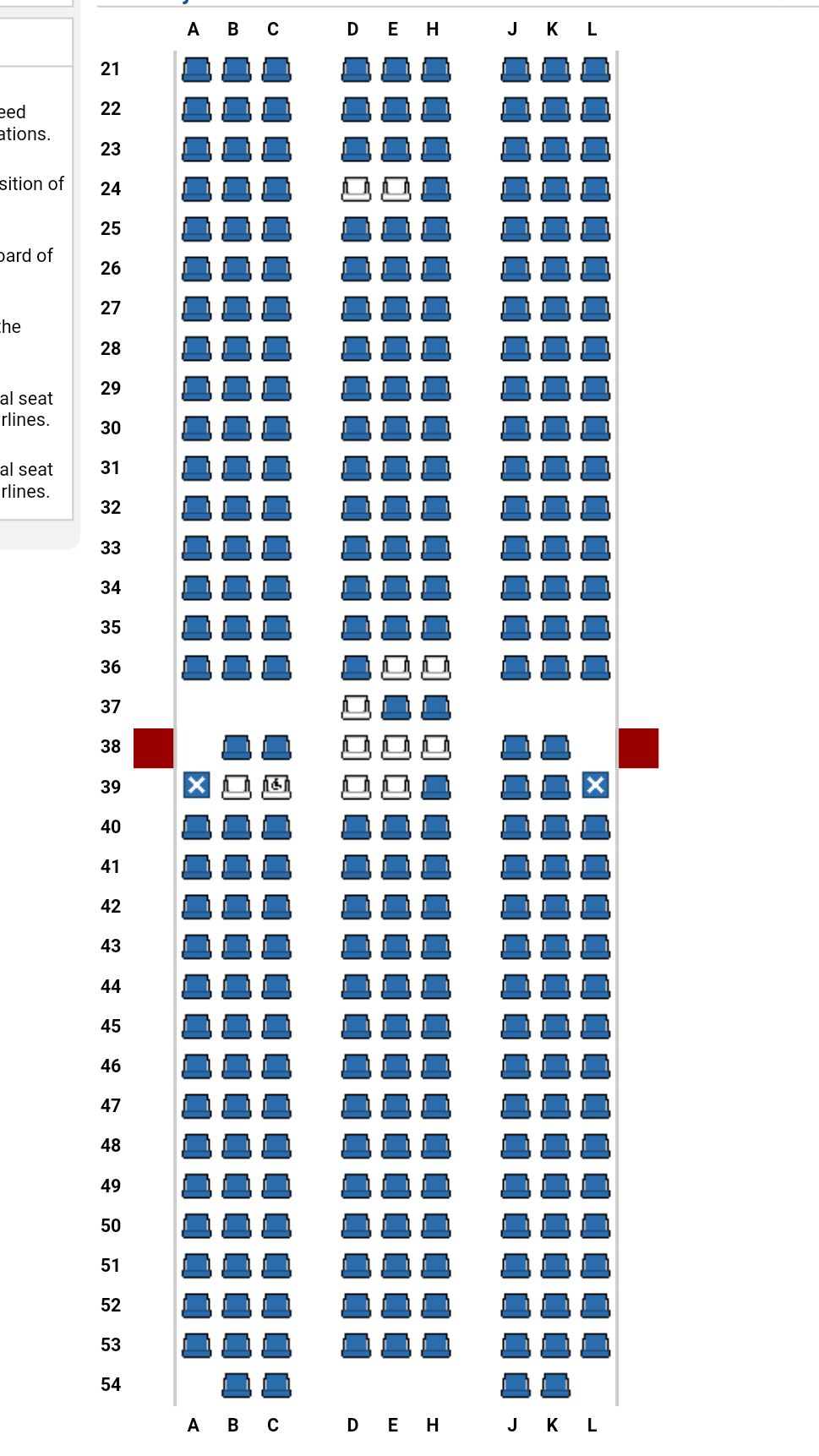
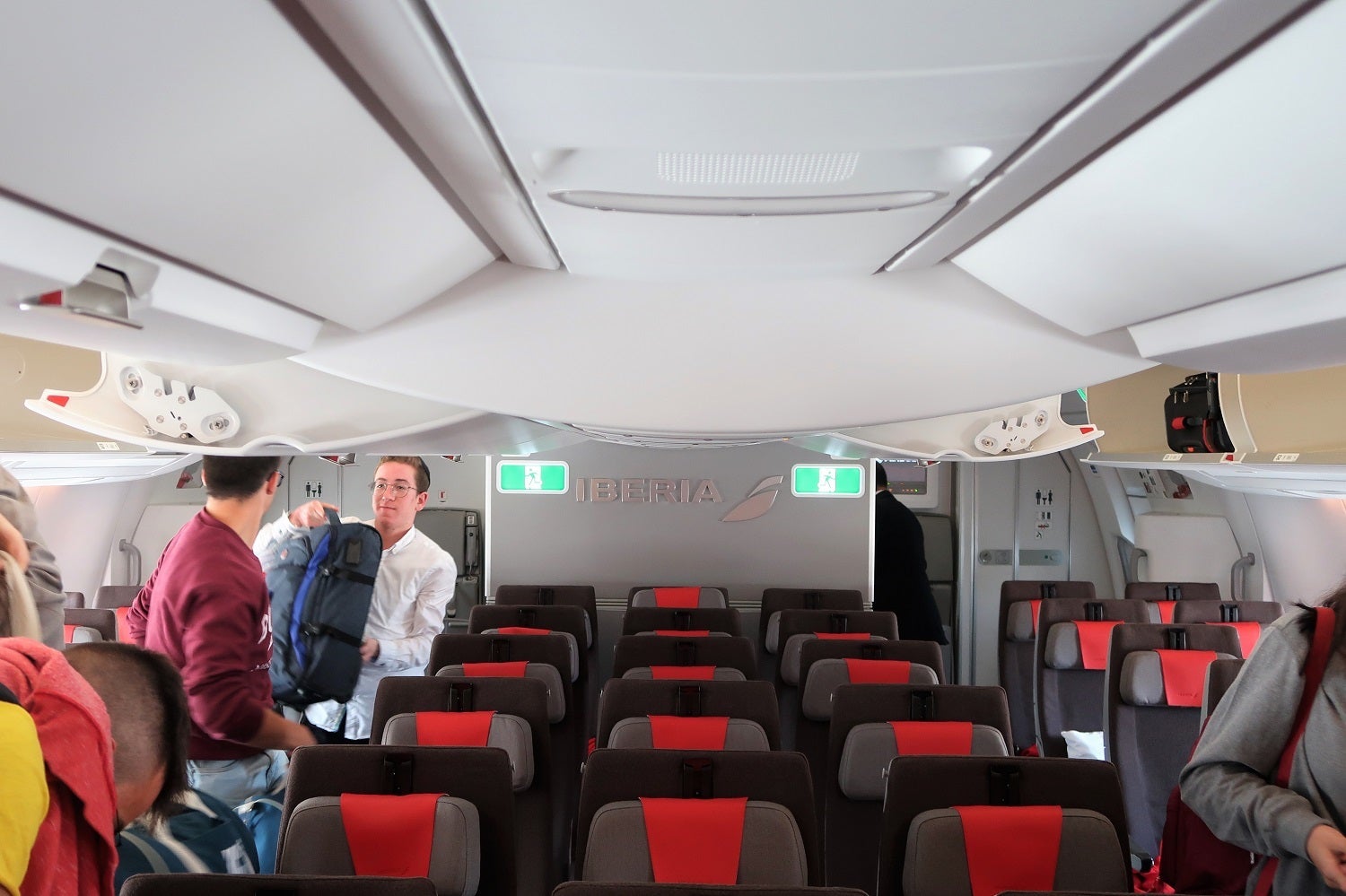
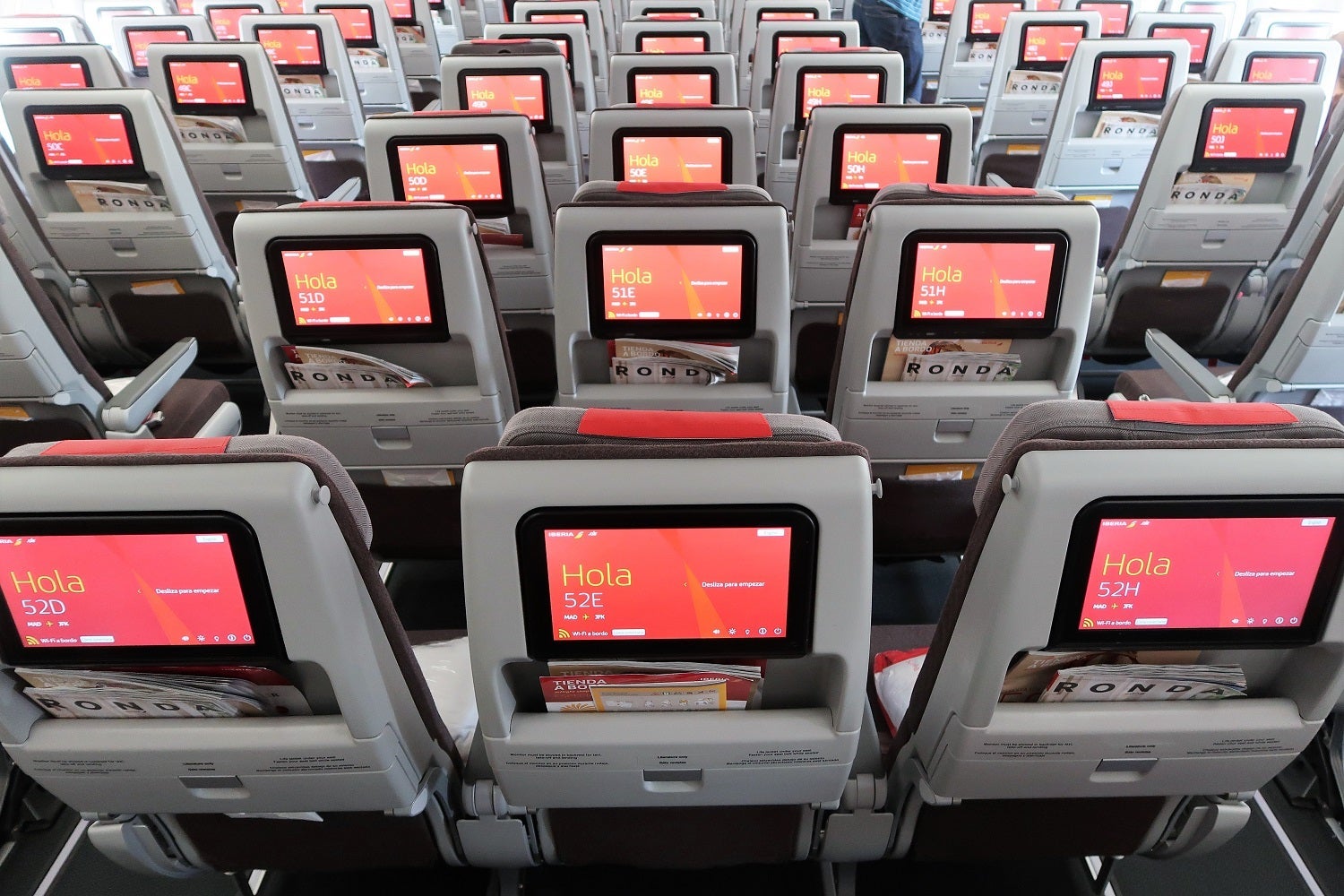
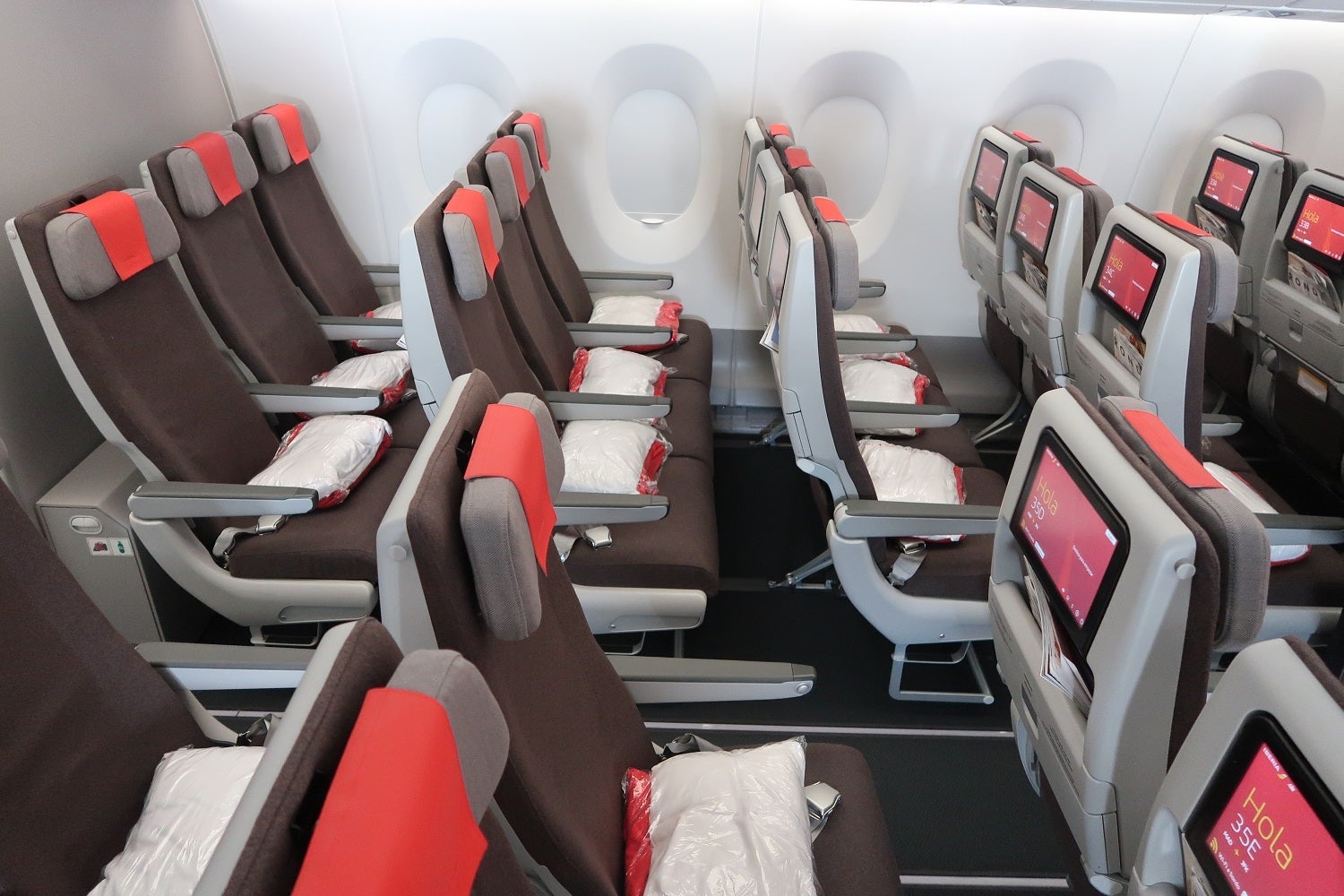
The economy cabin is configured with 34 rows of (mostly) 3-3-3 seating, divided across two cabins. The forward economy cabin contains rows 21 through 37, and the rear economy cabin continues from row 38 through 54.
Rows are spaced with 30 inches of pitch. After measuring this — and finding it different from the 31 inches advertised by Iberia – I started preparing myself for a long flight with my knees against the seat in front of me. Surprisingly, there was enough legroom for my 5 foot, 11 inch frame, possibly thanks to a lumbar curve built into the seats.
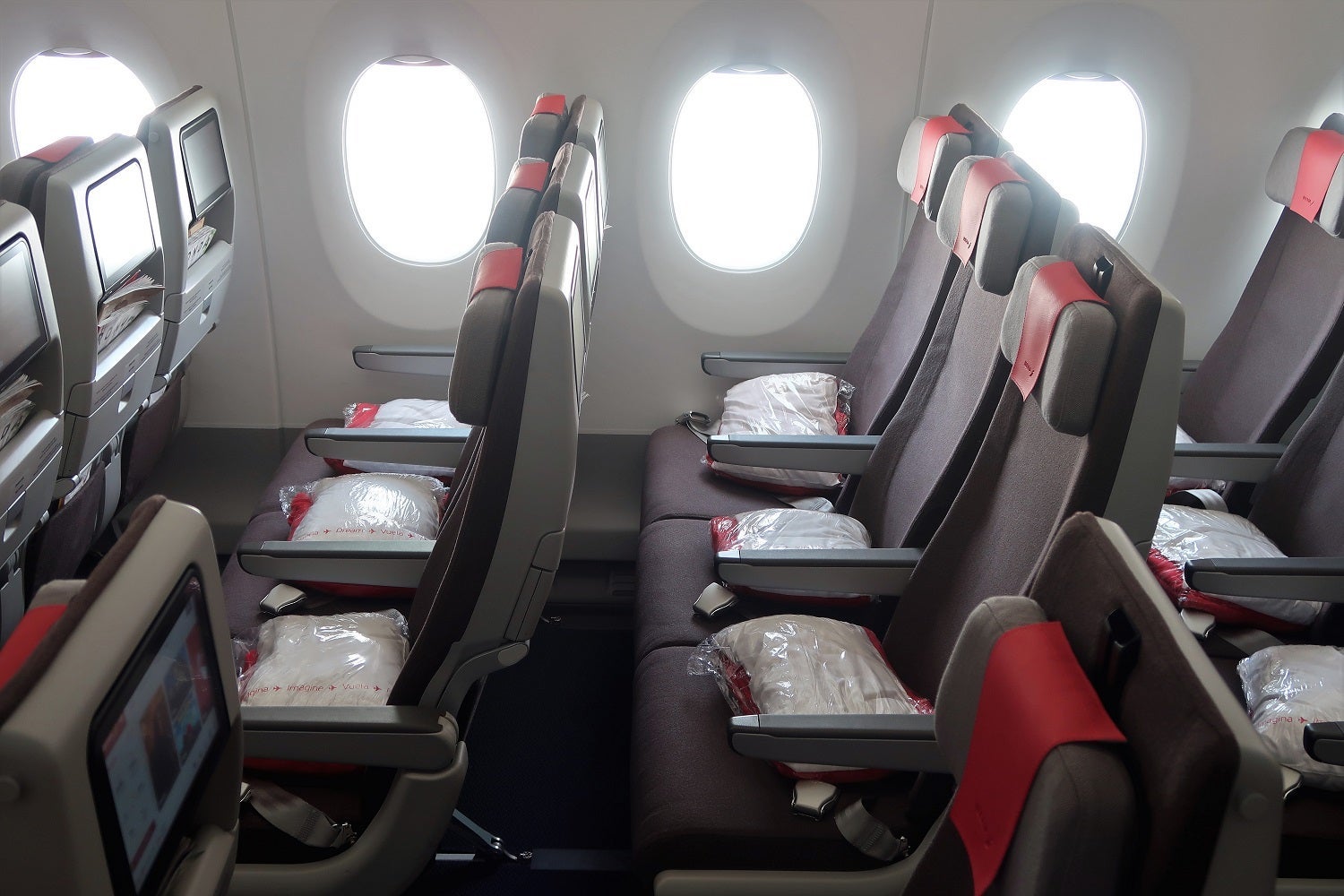
Seats measured 18 inches between armrests with 19-inch-wide seat cushions. While this certainly wasn't spacious, it was a critical inch more than what's found on Boeing 787 Dreamliners when configured in the common 3-3-3 arrangement or Boeing 777s when configured in the increasingly standard 3-4-3 arrangement.
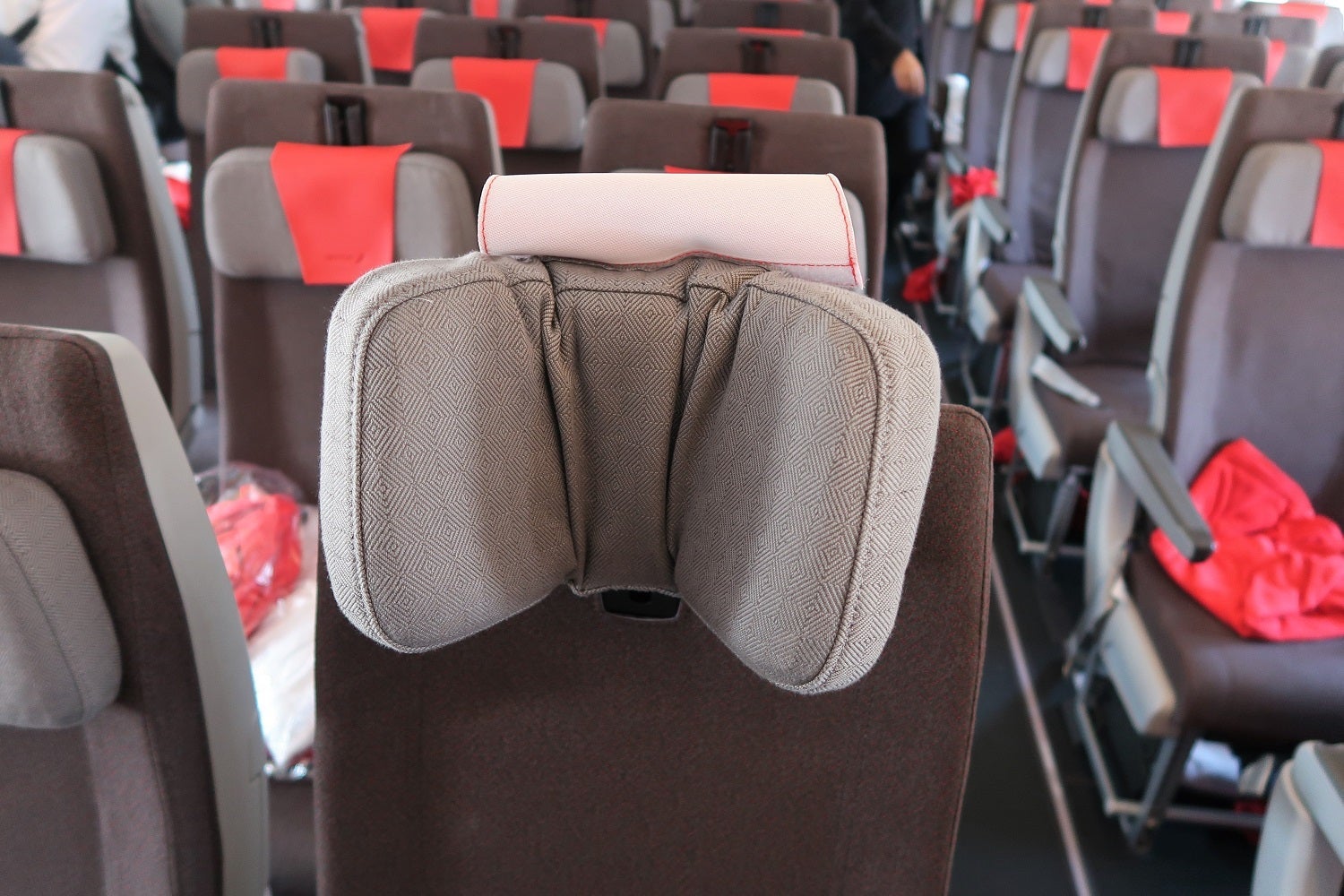
Seat headrests could be adjusted vertically by up to 6 inches, and the sides could be folded inward to create a cradle for your head for more comfortable sleeping.
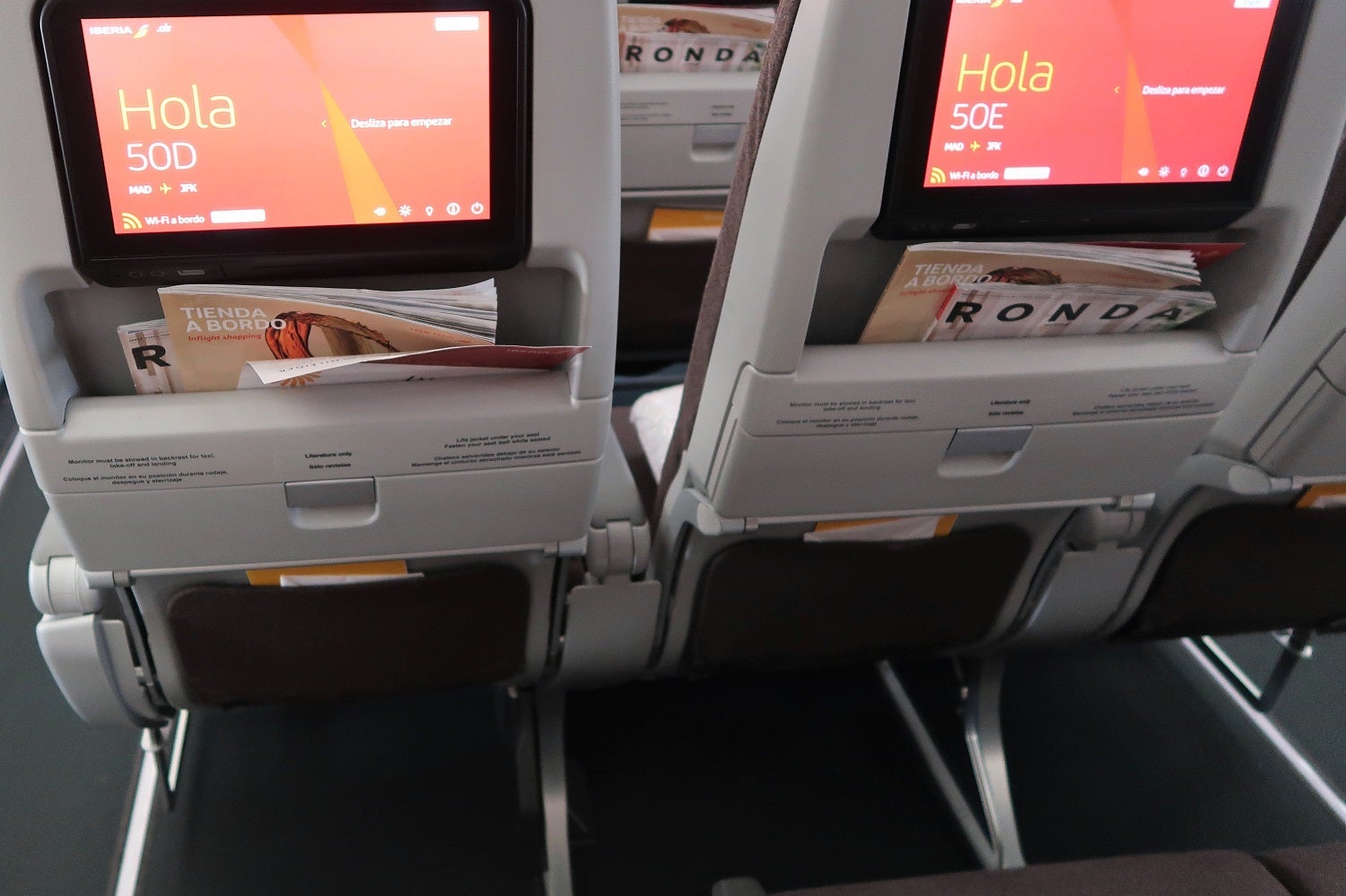
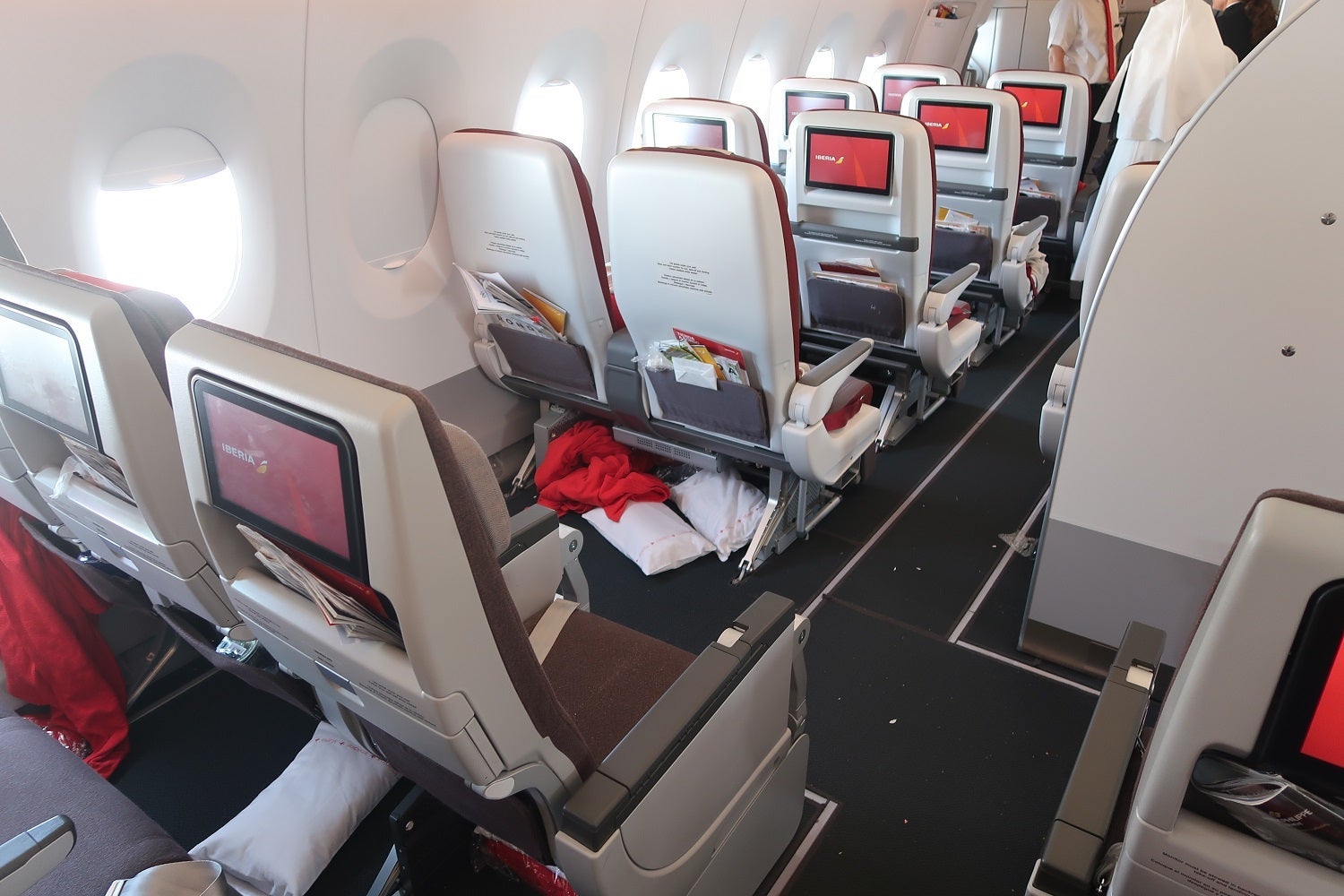
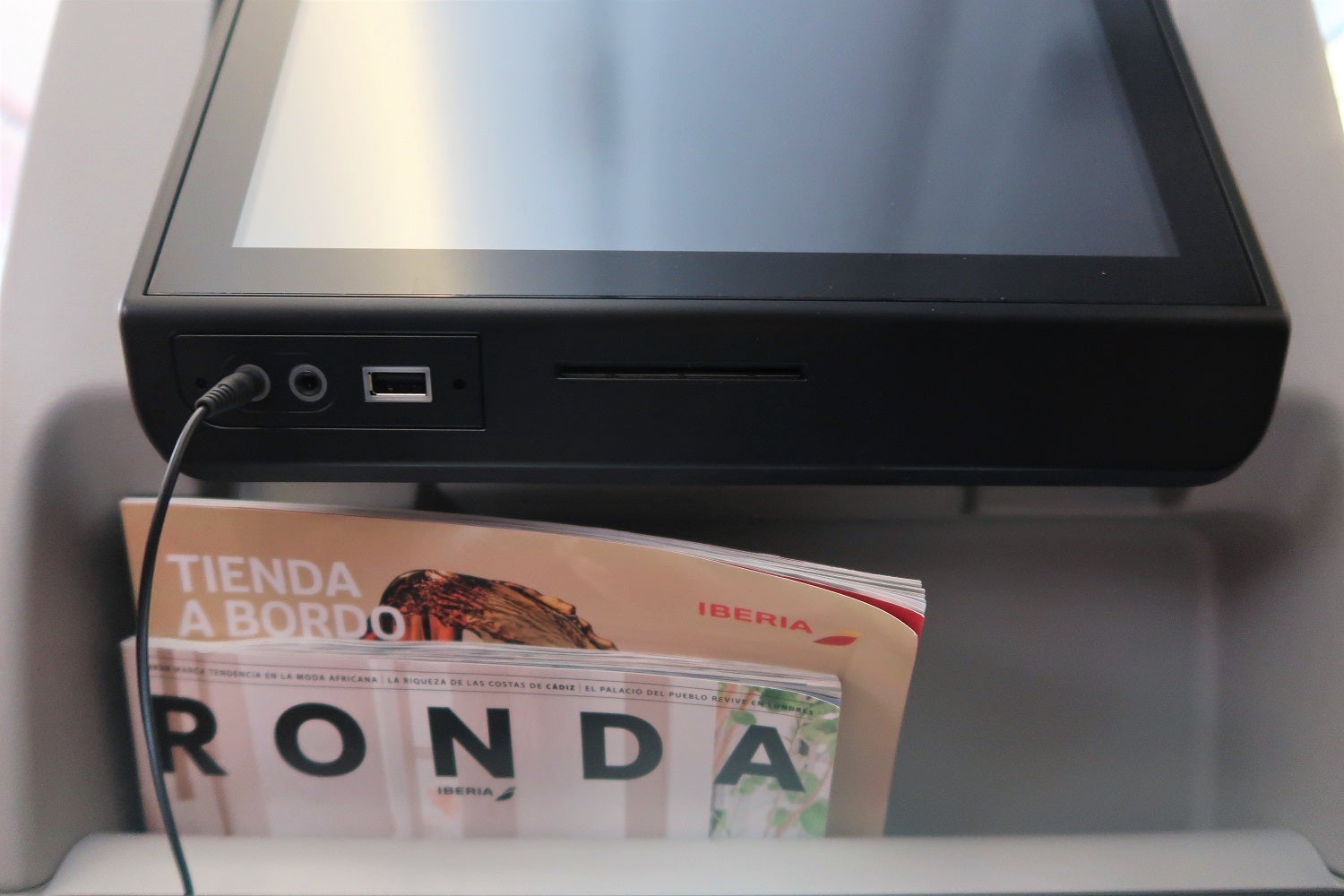
The seatbacks have two storage areas. There's a literature-only pouch measuring 13 inches wide and a couple inches deep just beneath the IFE screen. While partly filled with Iberia magazines, there was enough room for passengers to store passports, boarding passes, phones and other small items. Below this pouch is a 12-inch-wide standard seatback pocket. Thanks to the literature pouch, this pocket only contained the safety card and an air-sickness bag but was otherwise free for passenger storage.
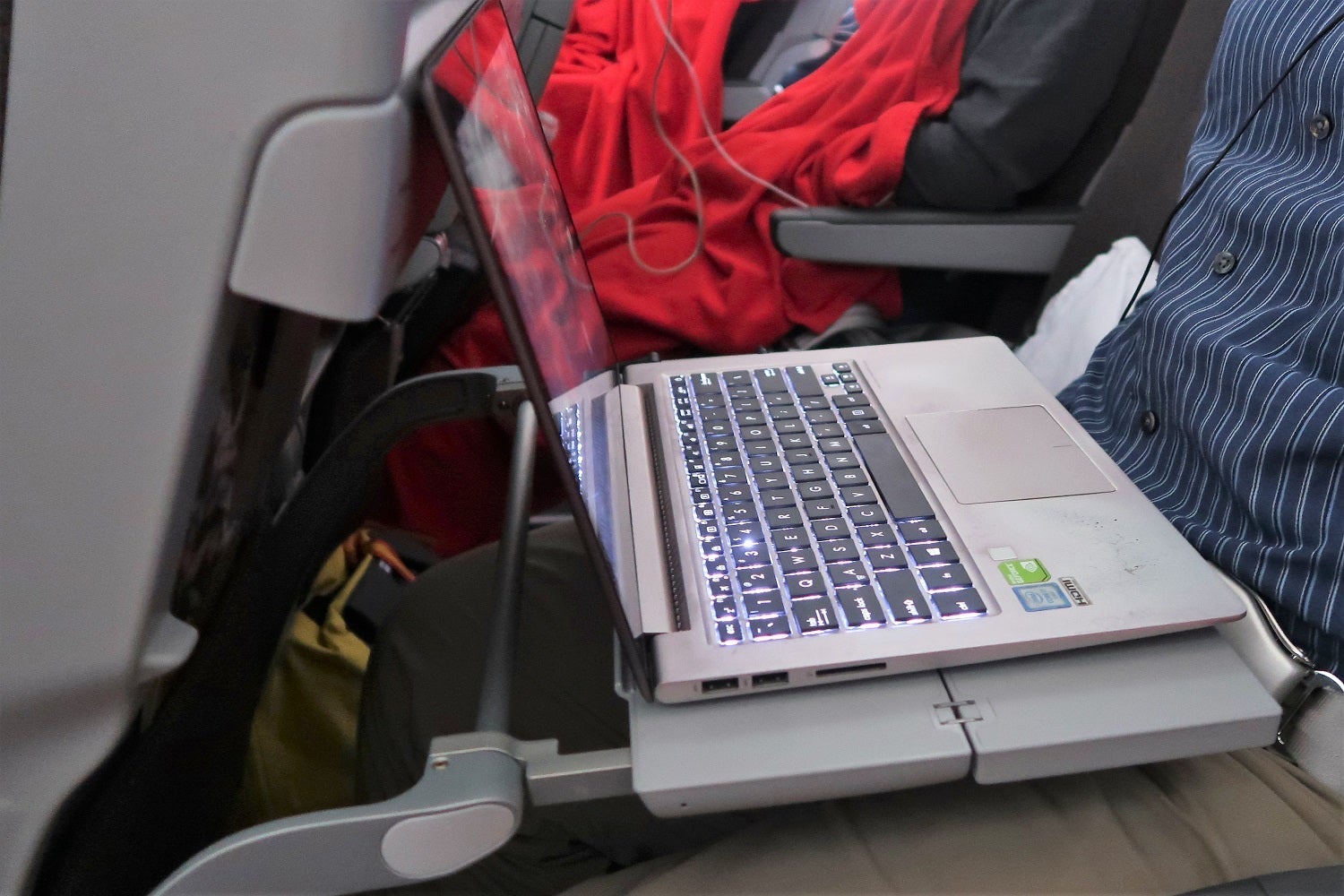
To fit the literature pouch, the tray table is a bifold design, measuring 15.5 inches wide by 9 inches deep fully extended. The table extends a critical 1.5 inches, making working on a small laptop possible when the seat in front of me wasn't reclined. (Thankfully the passenger in front of me didn't recline at all during the flight... not all heroes wear capes.)
The only exception to the 3-3-3 seating arrangement is the exit row at the front of the rear economy cabin (Row 38) and the last row in the back of the rear economy cabin (Row 54). In both of these places, the window-side sections have only two seats instead of three.
The missing window seat in Row 38 creates two seats with extra legroom: 39A and 39L. They have the benefits of a window, lots of legroom and aisle access. While both seats were occupied for my flight, when I checked the seat map on ExpertFlyer about 90 minutes before boarding, these seats were still showing up as blocked.
Seats 21A through C and J through L also have plenty of legroom because there's no bulkhead between the premium-economy cabin and economy. Bassinet mounts were only in the middle seats at the front of each cabin (Row 21 and Row 38).
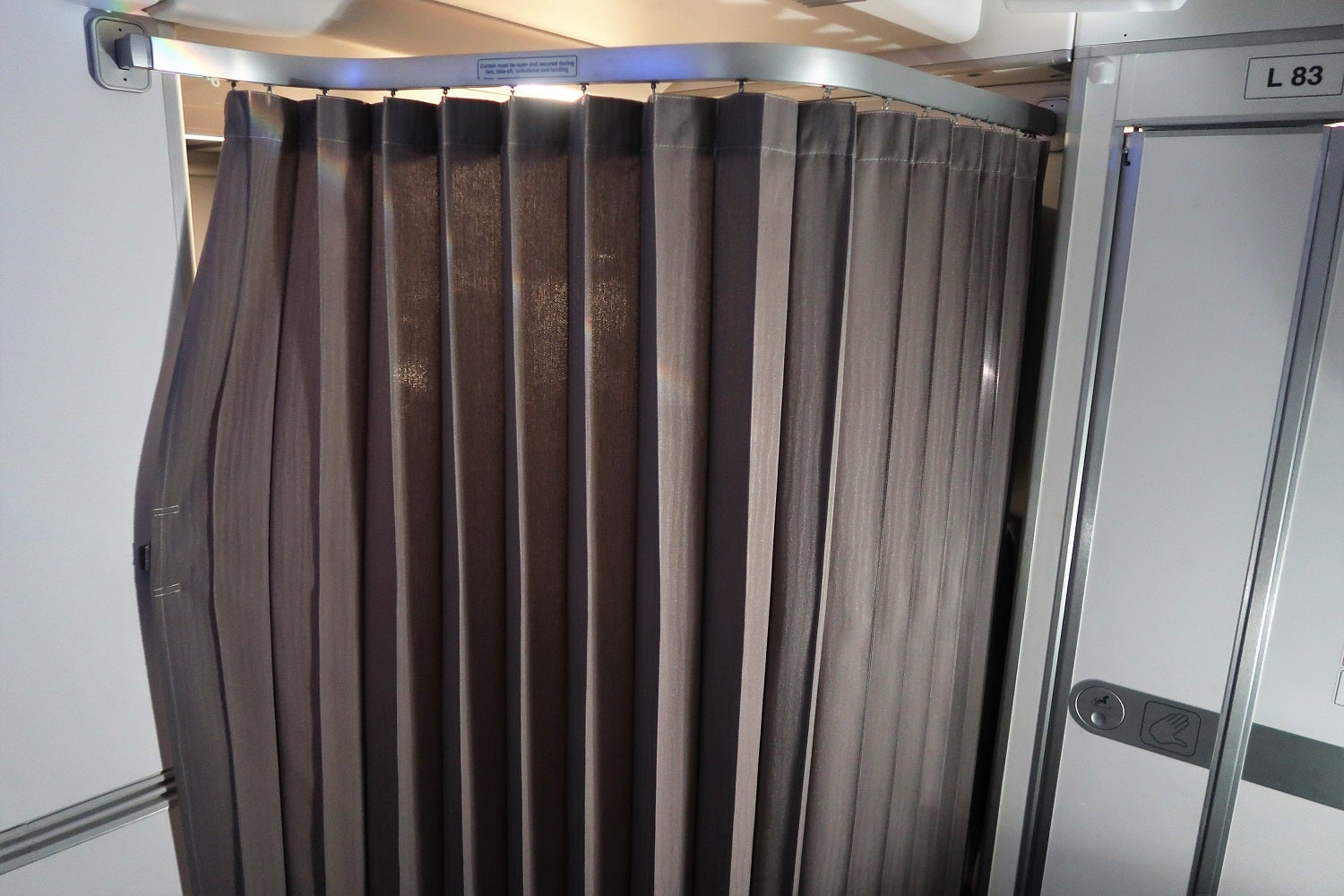
There are six bathrooms in total for the 293 economy-class seats: four between the economy cabins and two in the rear of the aircraft. Besides the galley in the front of the premium-economy cabin and the galley in the rear of the aircraft, there was no way of switching from one side of the aircraft to the other. And flight attendants snapped the galley curtains closed to try to prevent visitors from doing that. So passengers had to use the bathrooms on their side of the aircraft — unless they wanted to risk irritating the flight attendants.
The middle seats in rows 49 through 53 have significantly lower overhead bins and head space because of the crew rests built in above these seats. If you struggle to get your bags in the overhead bin, you may want to select seats in this area of the cabin. While the headroom was fine for seated passengers, the reduced height could lead passengers to hit their heads when crossing the middle seats.
Unlike Boeing's 787 Dreamliner, which came to market about the same time and features electronically dimmable windows, the A350 has standard window shades. This meant that passengers flooded the cabin with light every time they peeked outside while flight attendants were trying to keep a dark cabin for much of the flight.
Amenities
A bright, crisp 9.75-inch diagonal screen is built in to each seatback. The screen tilts a few degrees to make it clearly visible even when the seat in front is reclined.
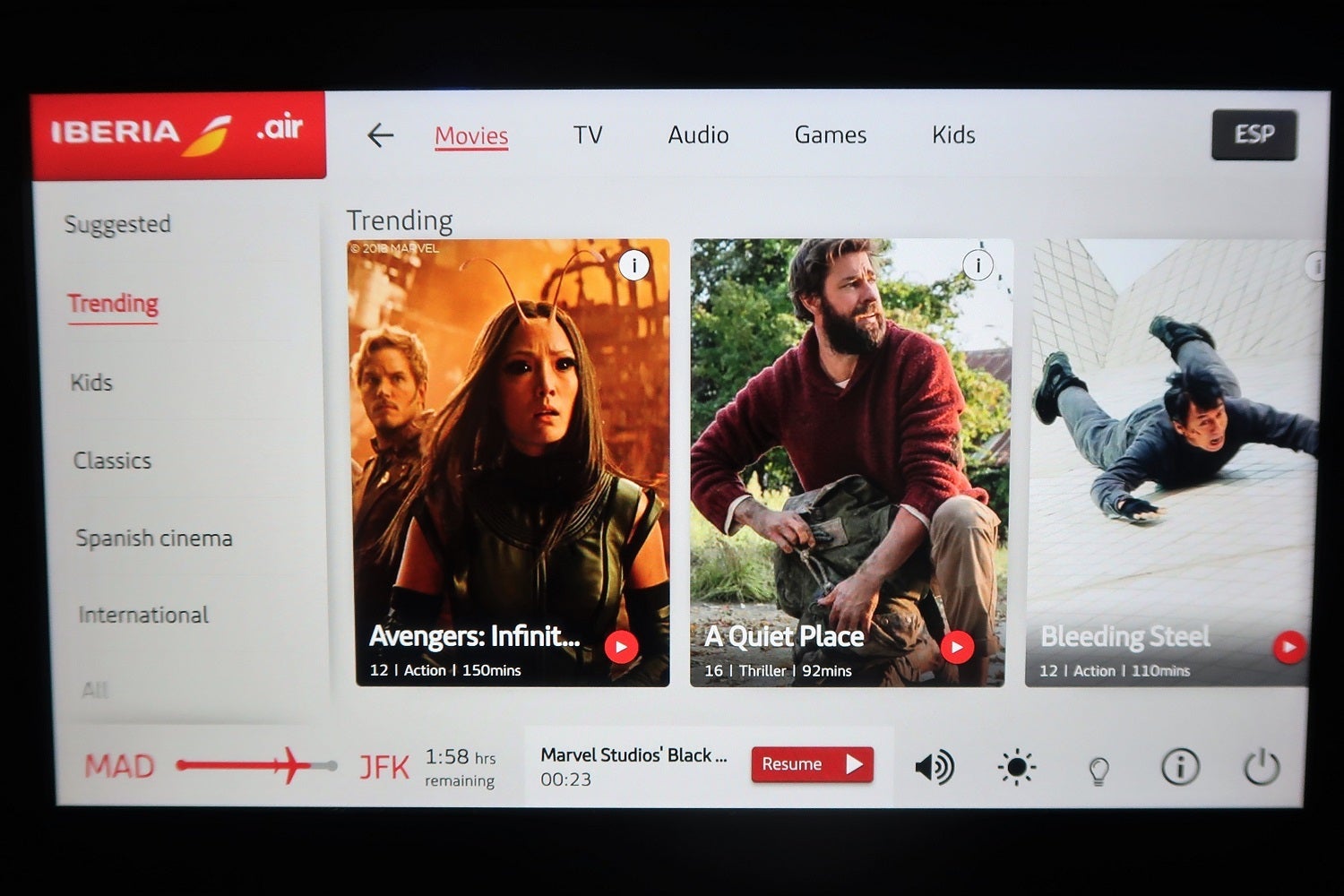
I found a fairly extensive entertainment selection, including about 70 movies broken into a number of folders (six suggested, 38 trending, 12 kids, 32 classic, 15 Spanish cinema, four international, 14 action, 20 comedy, 16 drama, 12 family, eight thriller) with lots of overlap among the folders.
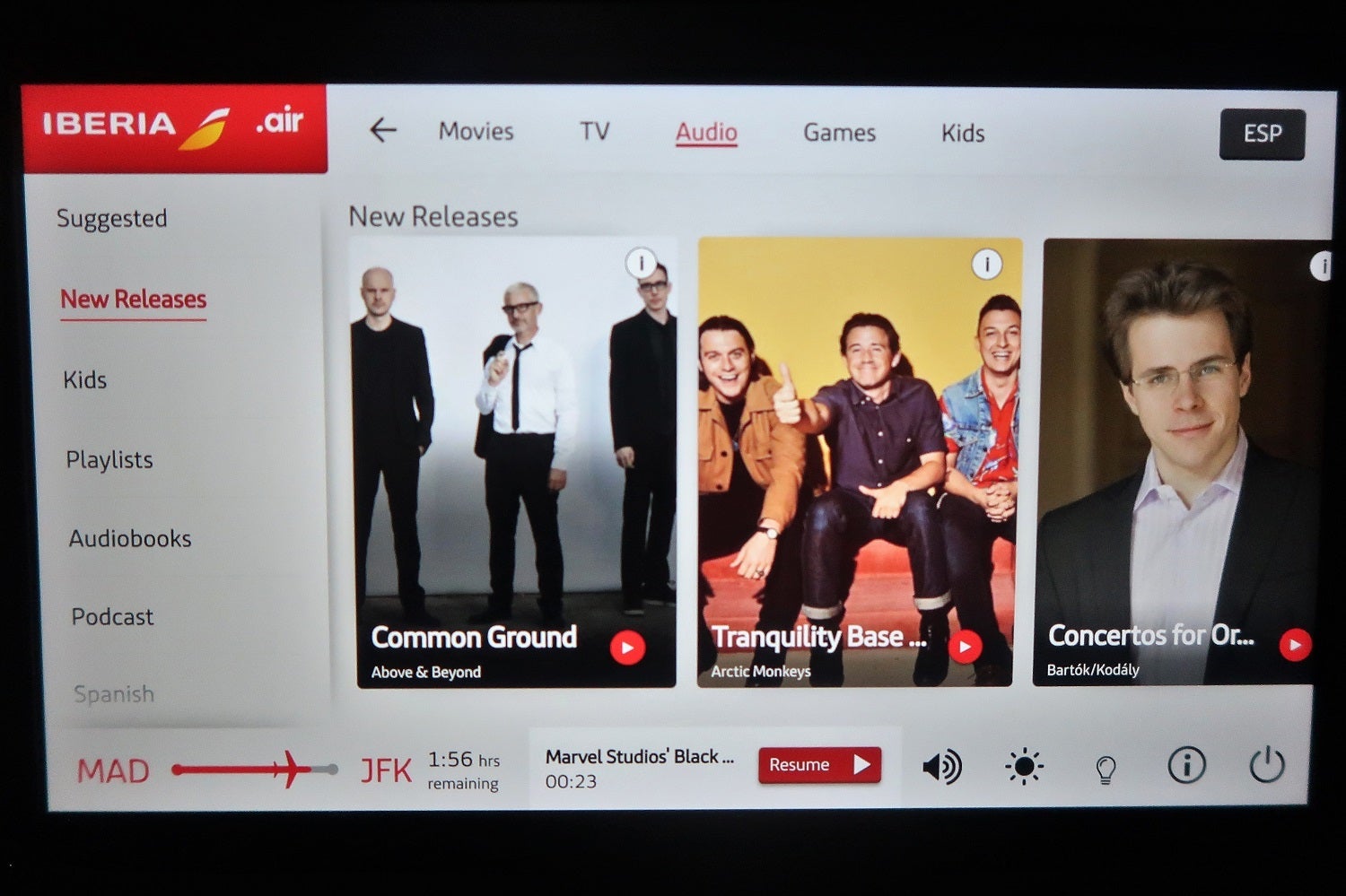
There were also 62 TV titles, each with somewhere between one and six episodes. The audio option included dozens of full albums (bonus points for Iberia including the newest album by my favorite DJs, Above & Beyond) and 23 hourlong mixes from a wide variety of genres.
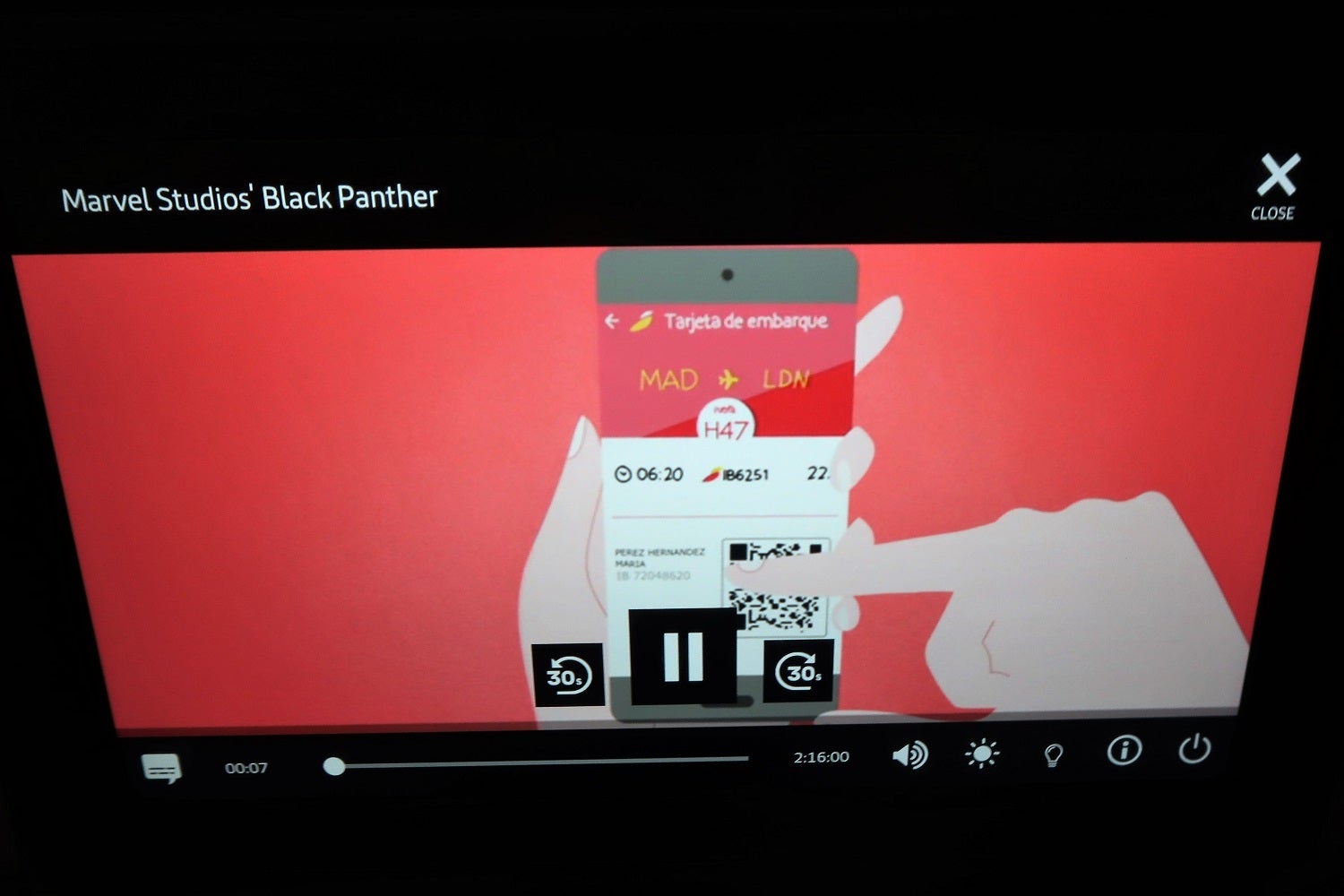
Movies begin with approximately one minute and 15 seconds of advertisements, which I could skip with the fast-forward button on the IFE menu.
The headphone jack is just below the IFE screen. It's a dual jack, but you could use either outlet with your own headphones for full sound — no adapter needed. Next to these plugs are USB power outlets for each passenger.
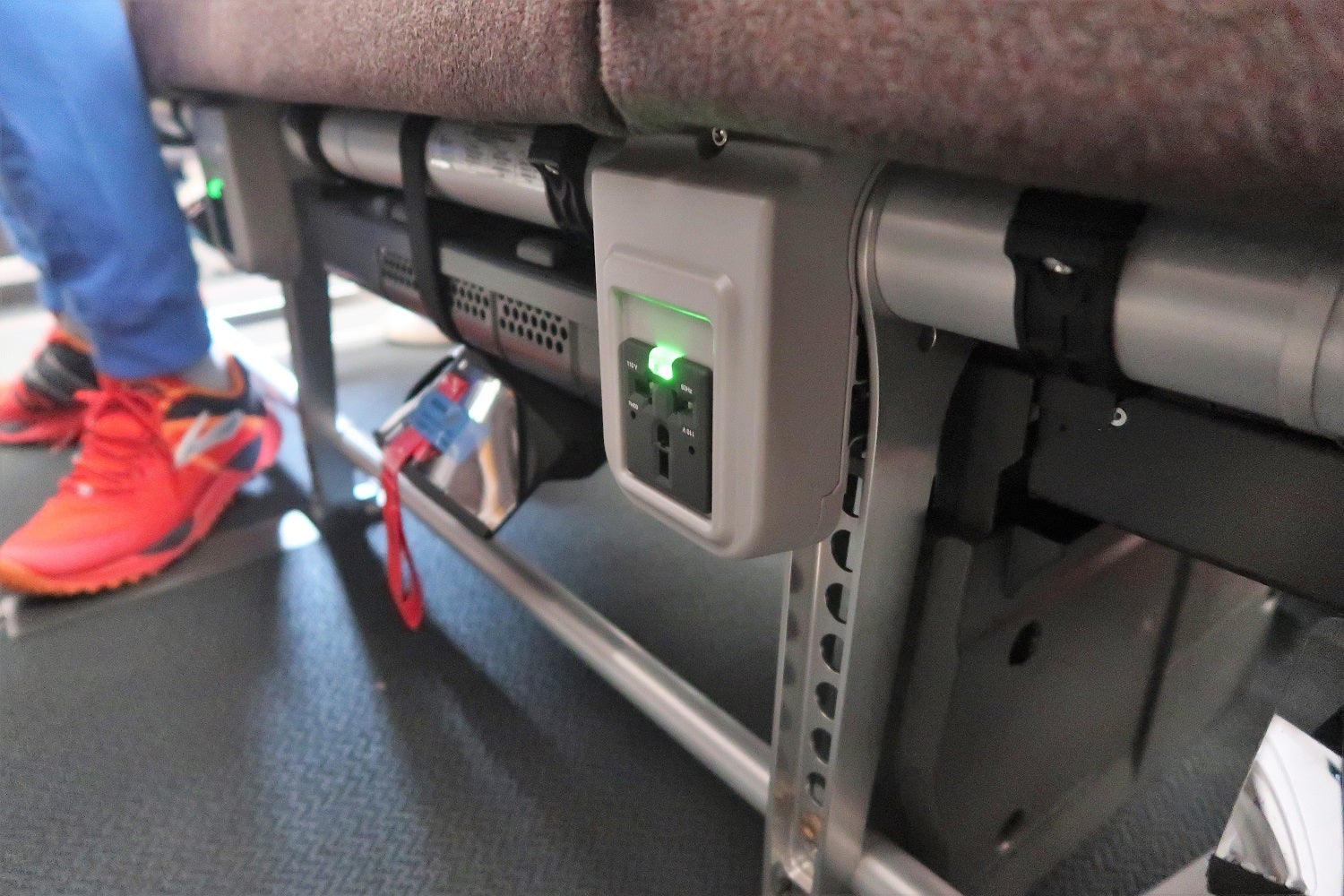
Universal power outlets are also present under and between each seat. This means that there are just two outlets per three-seat row, so you're going to want to claim your outlet early. The power outlets provided enough amps that my nearly zeroed-out battery recharged quickly.
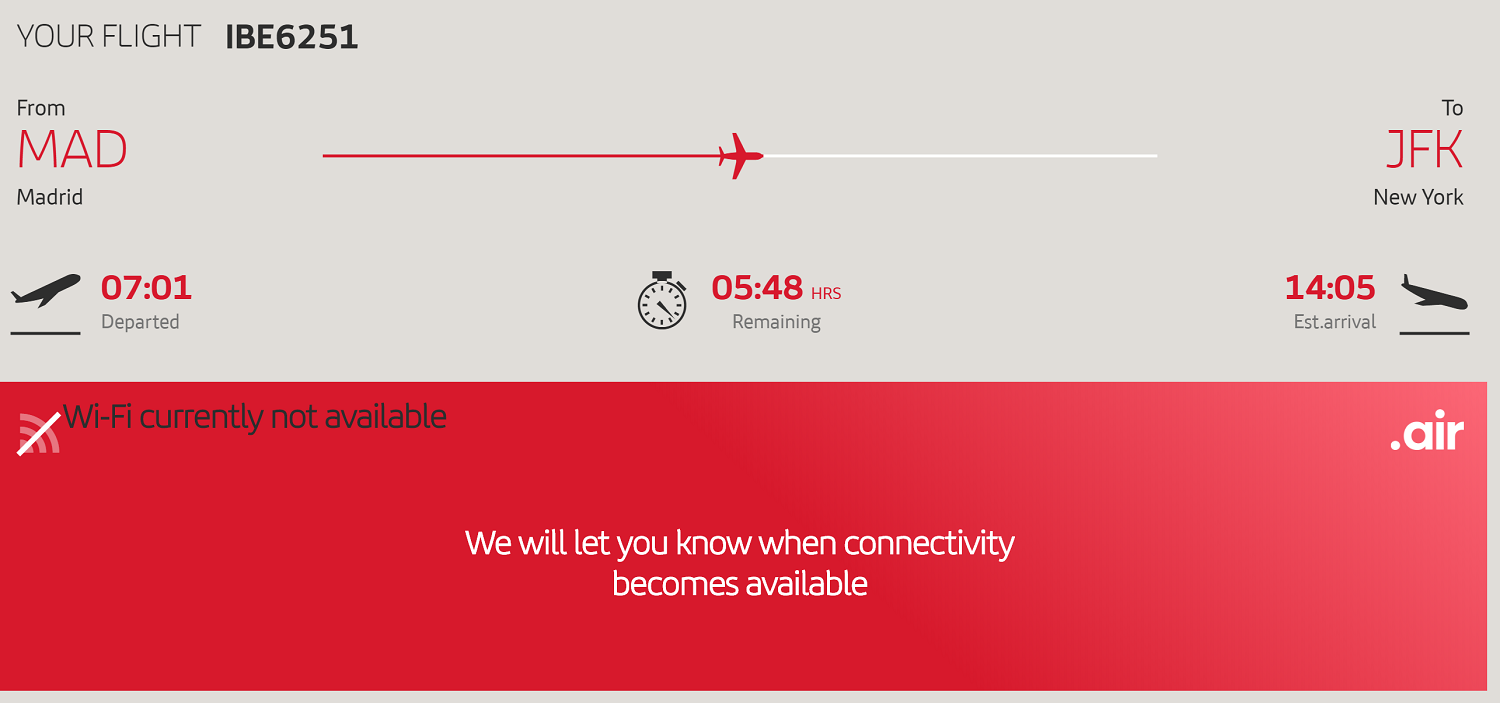
The Wi-Fi network was on from gate to gate, but the landing page inaccurately claimed that Wi-Fi wasn't available the entire time.
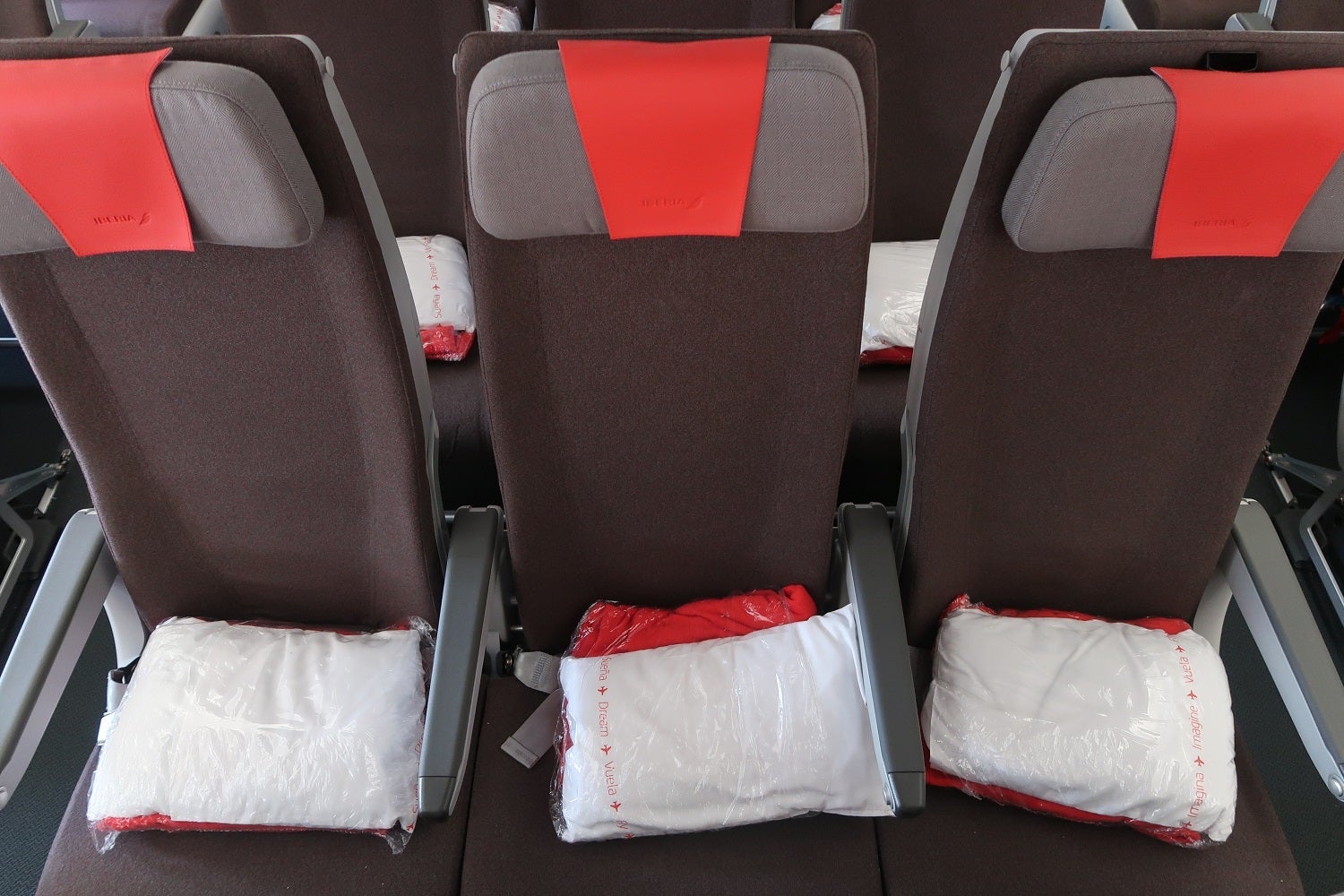
At boarding, seats were stocked with a plastic-wrapped bundle containing a bright-red cotton blanket and small but soft pillow.
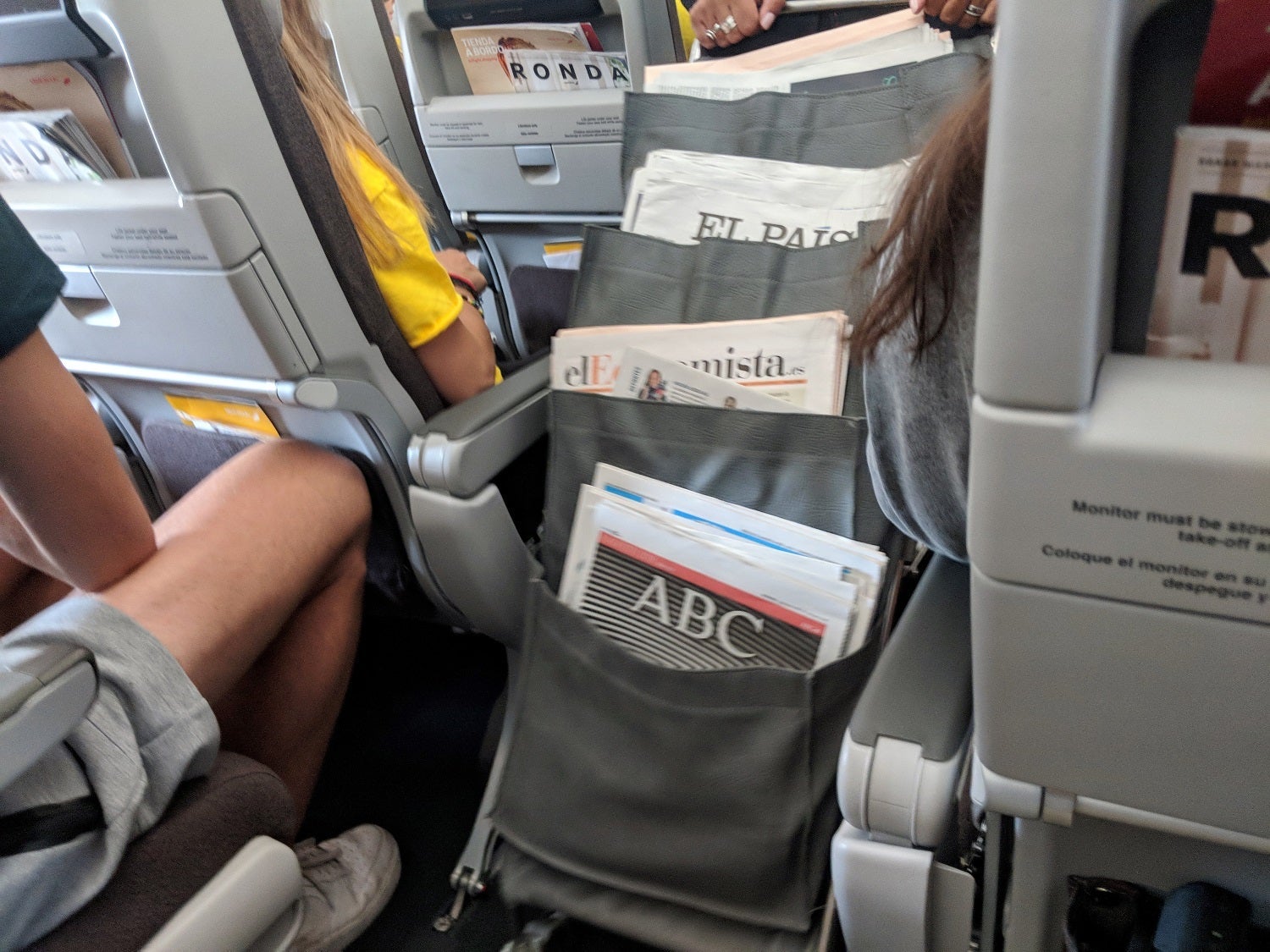
As boarding concluded, flight attendants wheeled a cart down the aisles offering economy passengers a selection of Spanish-language newspapers. Then they passed through again with newspapers in hand, seemingly trying to find takers.
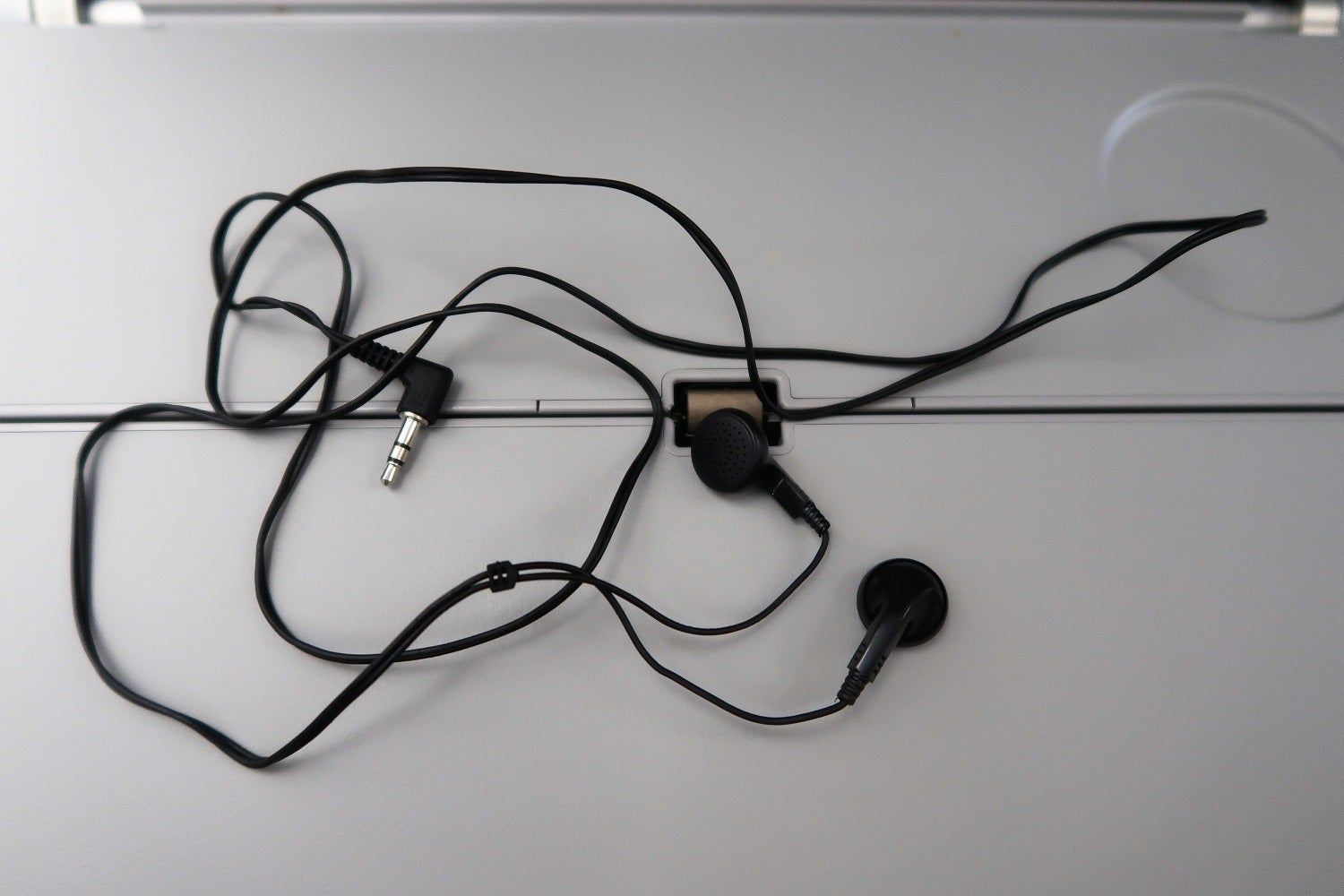
As we waited out a short delay blamed on air-traffic control, flight attendants handed out plastic-wrapped earbuds. While of rather poor quality, at least they were available for free for those passengers who forgot to bring their own.
No amenity kit was provided, and no amenities were provided in the lavatories.
Food and Beverage
While the cabin and service felt much more like that of a low-cost carrier than a mainline carrier, the food and beverage options were decent.
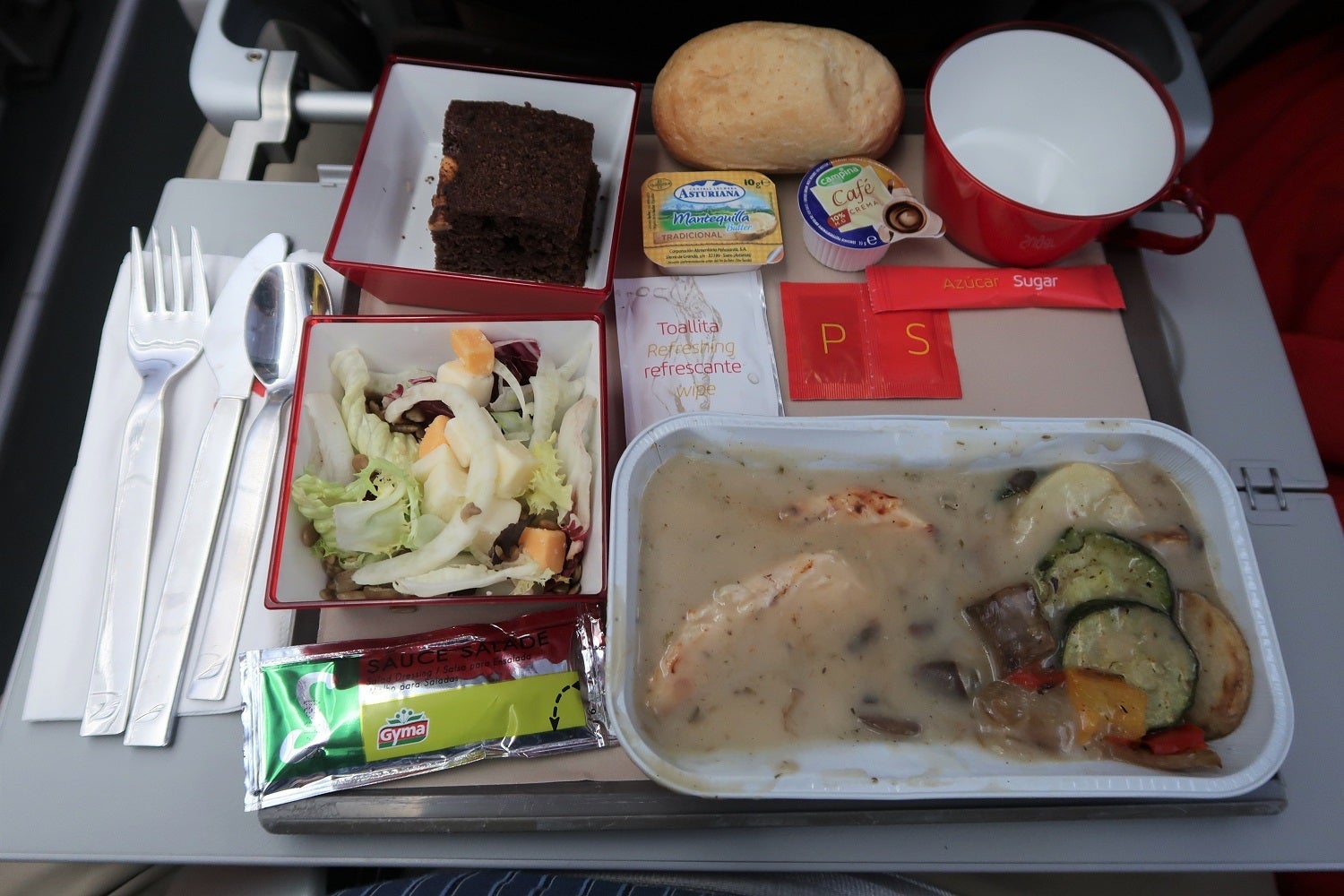
Lunch service started about an hour after takeoff with special meals. The last economy passengers got their meals about 35 minutes later. Lunch choices weren't announced, but when flight attendants got to the last few rows of the back cabin, where I was sitting, the choices were pasta or chicken. I chose the chicken.
The main course consisted of two large cuts of tender white meat served with grilled vegetables and covered with mushroom gravy. The main was complemented by a side salad containing quite a lot of cheese and a creamy vinegar-mustard dressing, as well as an unheated, but not stale, roll and brownie. Notably, lunch was served with real metal silverware.
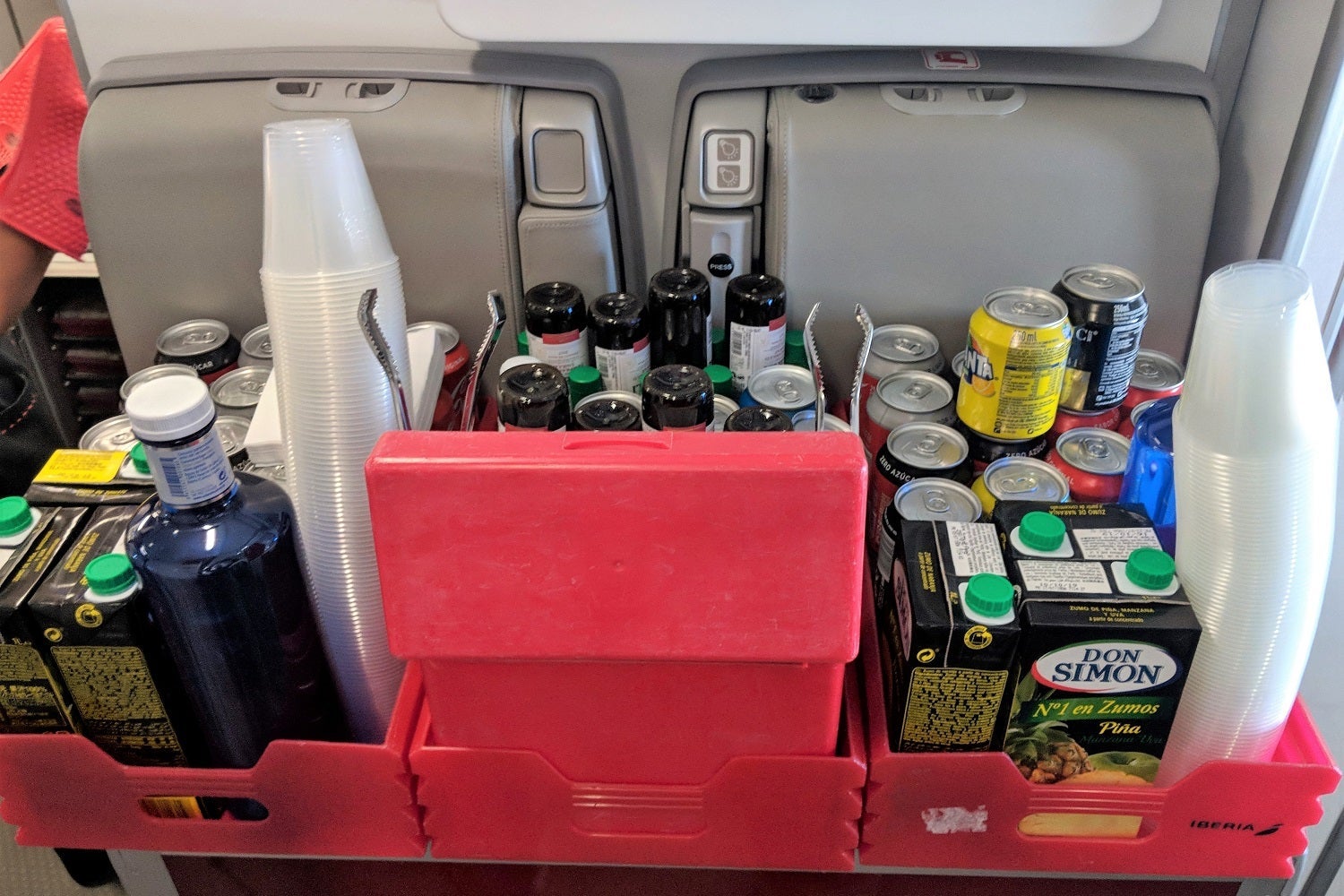
Shortly after meals were served, flight attendants passed through the cabin with a drink cart offering sodas, juices, Spanish beer and Spanish wine.
Flight attendants finished off the meal service with a choice of tea or coffee, served from pots carried down the aisle.
Between meals, water and juice sat out in the back galley, seemingly for passengers. But because they were located deep into the galley and flight attendants kept the galley curtains buttoned closed, it was pretty awkward to ask for a drink.
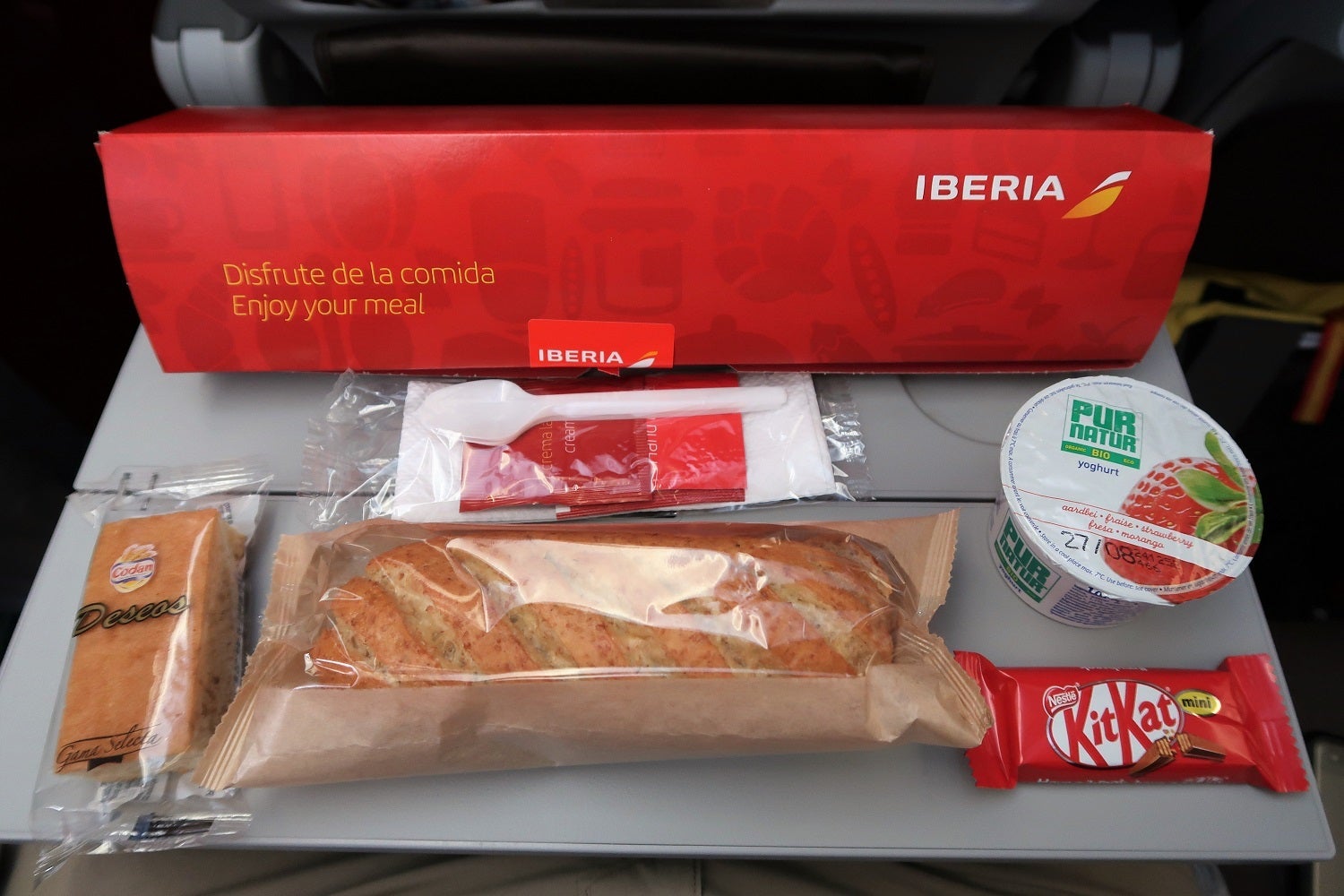
About an hour before landing, flight attendants passed through the cabin handing out box lunches containing a cold ham-and-cheese sandwich, yogurt, biscuit and Kit Kat bar. From the same cart, FAs also offered another drink from the same selection as before (sodas, juices, wine, beer).
My interactions with FAs weren't notably warm or cold, but rather they were simply transactional. Outside of meal service, they had little interest in helping passengers — with one exception. When I approached the galley to inquire about the Wi-Fi connection during meal preparation, a flight attendant took a few seconds to try to help before seeing the no-connectivity error and concluding that we wouldn't have Wi-Fi connection this flight.
One concerning aspect of the service: The flight attendants didn't seem prepared at all for landing. On final approach and at 1,000 feet of altitude, one was retrieving items from an overhead bin and another was returning a bag to another overhead bin. Both emergency-exit doors that I could see from my seat were unmanned. Although all was settled by wheels down, it seemed concerning that they weren't at their stations sooner.
My Oneworld Emerald status wasn't recognized by the lead flight attendant, and I received no special service such as an early meal choice or a welcome drink. This isn't something that I expect in economy, but some Oneworld carriers (Cathay Pacific, Japan Airlines, Sri Lankan Airlines) have impressed me by adding this service element.
Overall Impression
For an economy flight across the Atlantic, Iberia's A350 isn't a bad option. There's plenty of in-flight entertainment, decent storage, better-than-average seat width, a well-designed headrest and good food to make the trip easier. However, the 30-inch pitch makes personal space a little tight, and flight attendants aren't going to make the trip a pleasure.
All photos by the author.
This story has been edited to specify that the 30 inches of pitch between seats measured by the author are different from the official measurement published by the airline.
By commenting, you agree to our Community Guidelines to help create a positive space for conversation. The responses below are not provided or commissioned by the bank advertiser, our partners, or The Points Guy (“TPG”). They have not been reviewed, approved, or otherwise endorsed by any of these parties. All responses are submitted by individual contributors, and neither the bank advertiser, our partners, nor TPG are responsible for ensuring that all posts and/or questions are answered.