A day in the life: What it's like to travel through an airport and on a plane as a wheelchair user

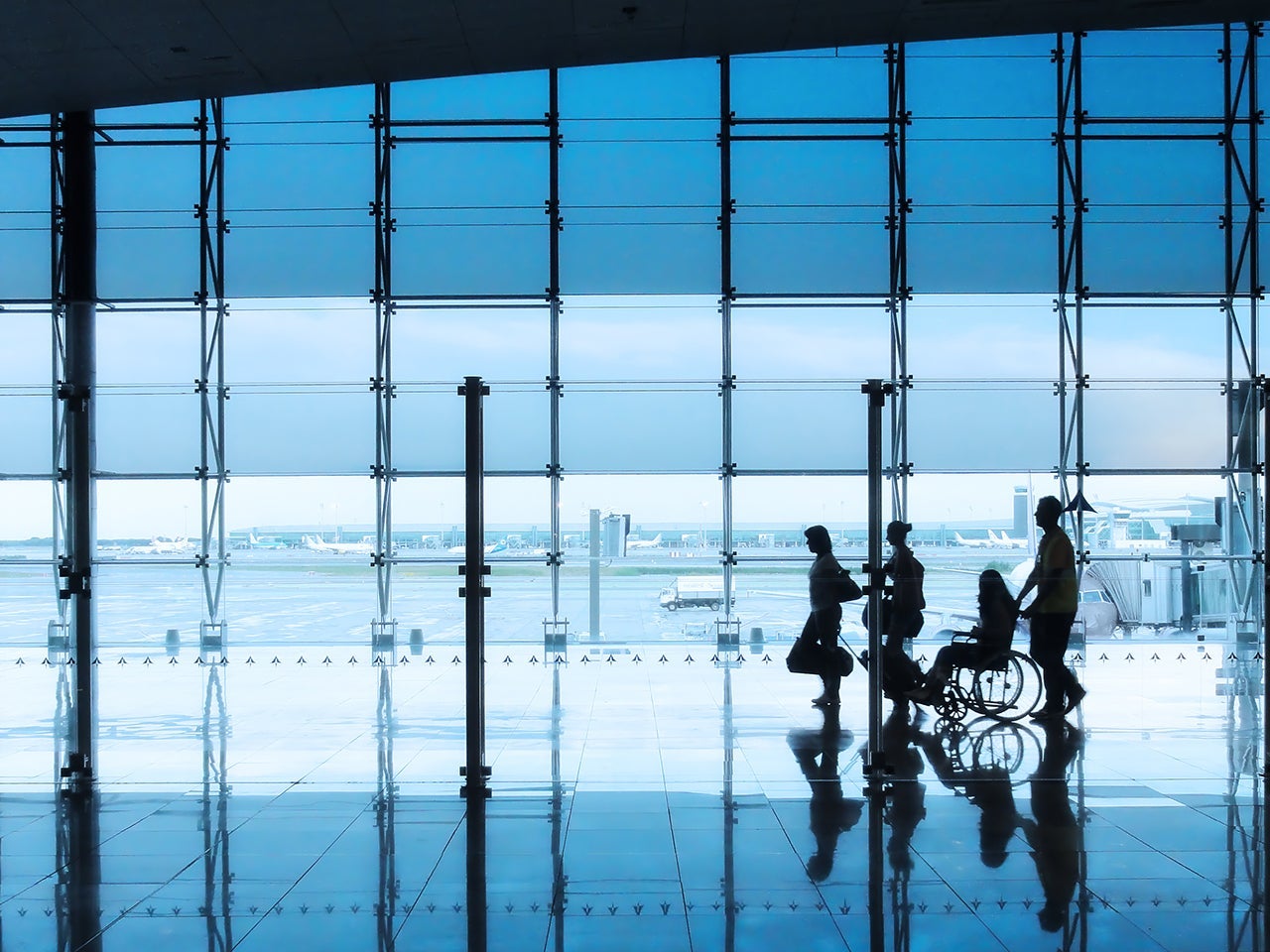
Gabrielle deFiebre was heading from New York to Phoenix on Delta flight 733 back in May when her wheelchair was damaged by employees in an incident recorded in a now-viral video.
As heartbreaking as it is to watch deFiebre, a quadriplegic, have to explain through tears, stranded on the jetbridge, that the chair that's just been broken "is her life," incidents like these are not uncommon: In 2019, airlines damaged more than 10,000 wheelchairs, according to the Washington Post. We're not talking about a damaged Away suitcase here — we're talking about an extension of someone's body. Not only does it happen frequently, but when it does, it often takes not days but weeks or months for the airlines to fix these chairs.
When I spoke to deFiebre for this interview almost a month after the incident she was still waiting for the parts needed to fix her chair. TPG contributor Cory Lee recently had a similar experience and is also waiting for the parts needed for him to be able to use his chair again. (To hear more about Lee's experience, watch his interview with TPG's Benét Wilson.)
In the interest of putting the passenger experience of someone like deFiebre in perspective, we sat down with her to find out what the process is like from the start of her travel journey to the very end.
Choosing a destination & accommodations
deFiebre's journey starts long before she gets to the airport. When traveling, first she must confirm the accessibility of a destination. That means considering the public transportation situation, like whether or not there are accessible cabs or accessible public transportation.
Related: These are the most wheelchair-accessible cities around the world
The same goes for hotels, which also need to be accessible — not just accessible in theory, but truly functional. A common frustration among those in wheelchairs is that often in "accessible bathrooms" the faucets are on the opposite side of the shower from the bench, making them, well, inaccessible. Even with these shortcomings, deFiebre says hotels are generally more accessible than Airbnbs.
Related: 4 tips for finding wheelchair-accessible home rentals
In terms of booking flights, deFiebre says some airlines are better than others, and that she tends to fly the ones with "fewer horror stories" such as Delta, United and JetBlue. "Even before I get [to the airport], I book my flights online and say that I need assistance, so [the airlines] know I need the aisle chair. (Editor's note: Because airplanes are inaccessible to passengers in their own wheelchair, chair users must be transferred and then strapped into a much smaller aisle chair provided by the airline that's designed specifically to fit down the narrow aisle of the airplane). Then I call to make sure everything went through online. If I'm traveling with someone, I request for the person to sit next to me and additional legroom because it helps with the transfer to the chair."

deFiebre says she books the window seat so people don't have to climb over her.
Her preferred method of getting to the airport is an accessible Uber or Lyft. "Public transportation is quite a journey, especially pushing a suitcase and with elevators being out of service," says deFiebre.
At the airport
deFiebre typically arrives two hours in advance for domestic flights and three hours for international flights.
Once she gets to the airport she does "the normal stuff." deFiebre's home airport is LaGuardia and says that all airports are similar in terms of accessibility thanks to standardized ADA regulations.
Related: 7 air travel tips for wheelchair users
For getting through security, deFiebre swears by TSA PreCheck even when there's a line designated for those with a disability. deFiebe explains that if a wheelchair user doesn't have PreCheck, they can't go through the metal detectors — they have to go through the full-body pat-down instead. Having PreCheck means a quicker, less invasive experience.
"When I get [to the disability line, I] always have to wait. The average person puts their bag on the belt to get scanned and you go through the metal detector. I have to wait until they call for a female assist and wait for someone to come and do the pat-down. If they're really busy it takes even longer. My stuff is either waiting [on the belt] or an agent will grab it and put it aside."
Usually, there's not enough time to hit the lounge since she boards first. She gets to the gate more than 30 minutes ahead of time.
"When I get to the gate I double-check that [the airline has] the aisle chair. They give me a tag for my wheelchair, and I usually also ask to speak to the person putting the chair onto the plane. It helps to have the person put a face to the chair. I explain how to lift the chair, and remind them to be careful — this is my entire life. Sometimes they are rushing and I can't have this conversation," which deFiebre notes was the case on her trip to Phoenix.
It should also be noted that often the employees handling these wheelchairs are not airline employees, they are contracted out by the airline.
deFiebre says she does her best to give the handlers as much information as she can. "I put two signs on my chair: One has a photo of the chair and one sign says where to lift the chair." This is important because deFiebre's chair can't be picked up by the wheels — it must be picked up by the side. She also takes off all removable parts.
Related: Planning an accessible trip? These travel resources can help.
"I'm the first one to board. I ask for two people to lift me to the aisle chair and strap me in. It's almost straight jacket-esque," says deFiebre. "You have to hope [the handlers] know what they're doing. I've had to instruct them on how to strap me in properly."
All the while, deFiebre is hoping they don't let everyone else onto the jetbridge until she's settled in her seat. "It's stressful having 50 people standing there watching you do something that's personal."
"Then I hope the chair ends up on the plane and in the cargo hold," says deFierbre, whose chair she says has been left on the jetbridge in the past.
On the plane
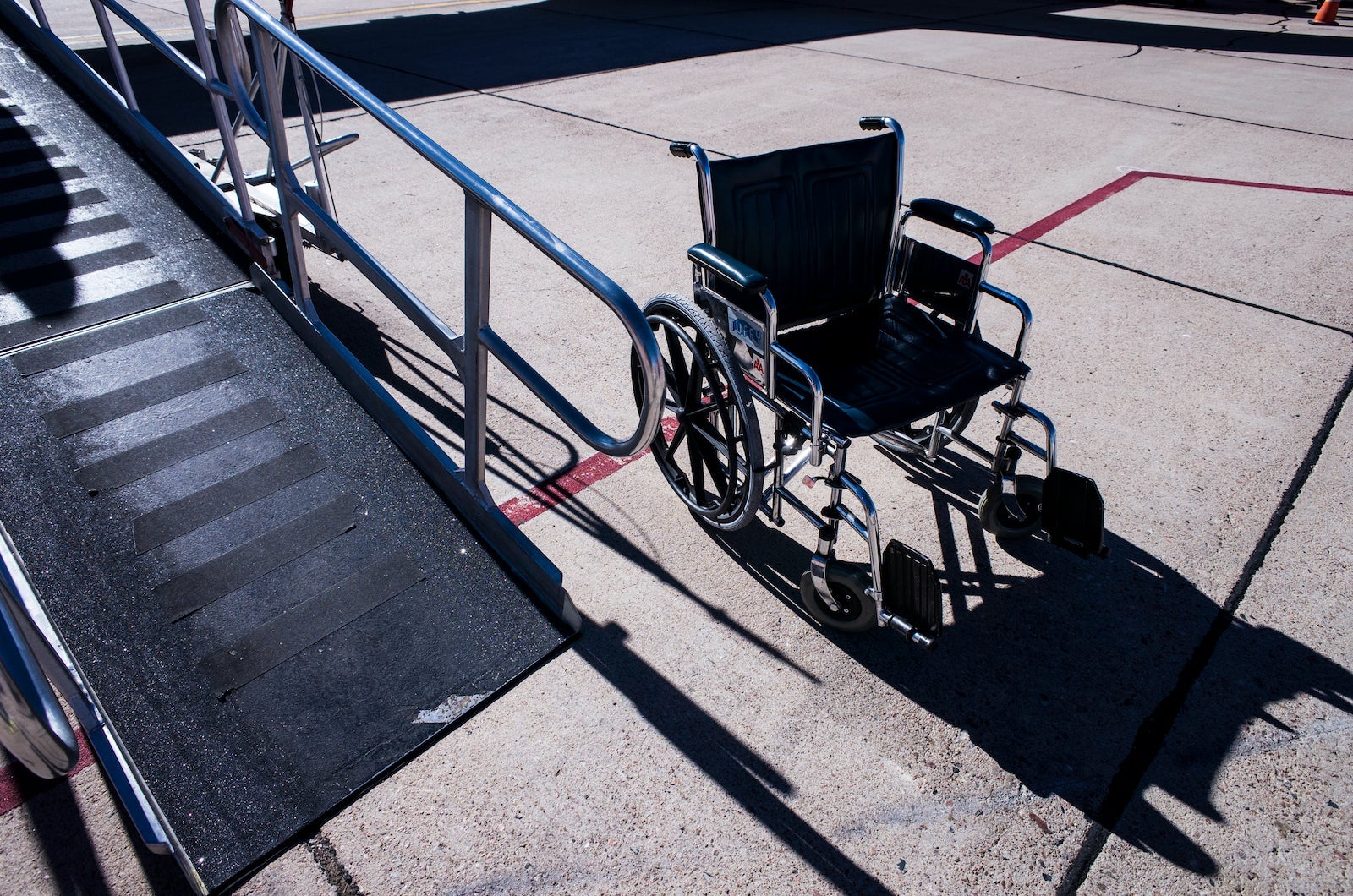
"It's an ordeal to be pulled down the aisle and transferred to an airplane seat," says deFiebre.
When asked if sitting in first class is an option, deFiebre told me it would definitely be easier because it's more spacious, but is too cost-prohibitive.
A common passenger complaint during the pandemic has been the lack of food and beverage service on aircraft. But for many wheelchair users, enjoying a drink or a snack on the plane is not an option.
"I don't eat very much or drink because I can't access the bathroom on the plane," says deFiebre. "I obviously can't drink [alcohol]. I don't want to risk having to use the bathroom."
On longer flights, there are aisle chairs that can be used to access the bathroom, but the passenger needs to be able to transfer themselves into the chair (and onto the toilet). On shorter flights, deFiebre just assumes she will not be able to use the bathroom and plans accordingly. "I literally have to dehydrate myself to get through an airplane ride. It's been years since I've seen the inside of an airplane bathroom," she says.
When the plane lands, deFiebre has to wait for everyone to get off first.
"I'm nervous waiting for the chair to arrive. I've seen them unloading it, and have seen it fall off the conveyor belt," says deFiebre. "Sometimes they try to get me to get off before my chair is unloaded, which I won't do because the aisle chair is incredibly tiny and I'm restricted by all the straps."
Once the chair has been unloaded and is on the jetbridge, the inspection process begins. "I look over the chair to make sure it's ok, then reassemble it and test it to make sure everything is working," says deFiebre.
Because of the time this process takes, deFiebre purposely does not book connecting flights. She pays extra for nonstop flights.
Related: What does accessible travel mean to you?
Once inside the airport, deFiebre says the search is on for a wheelchair-accessible bathroom, which is typically easy to find but often occupied.
Bottom line
In a normal year, deFiebre says she typically flies four to five times. "I travel via train more often because i's more accessible," says deFiebre. "Amtrak is pretty good."
"Flying is stressful for everyone. [As a wheelchair user] it's a stressful experience from start to finish to an extreme. It takes a lot more planning and preparation. I'm trying to make sure my chair is ok and I'm worried about it until I get where I'm going," says deFiebre.
Organizations like All Wheels Up are working to make travel a little less stressful for passengers like deFiebre by advocating for wheelchair users to be able to stay in their own chairs during flight. For more information about their work, visit their website.
TPG featured card

at American Express's secure site
Terms & restrictions apply. See rates & fees.
| 3X | Earn 3X Miles on Delta purchases. |
| 1X | Earn 1X Miles on all other eligible purchases. |
Pros
- Delta SkyClub access when flying Delta
- Annual companion ticket for travel on Delta (upon renewal)
- Ability to earn MQDs through spending
- Various statement credits for eligible purchases
Cons
- Steep annual fee of $650
- Other Delta cobranded cards offer superior earning categories
- Earn 100,000 Bonus Miles after you spend $6,000 or more in purchases with your new Card within the first 6 months of Card Membership and an additional 25,000 bonus miles after you make an additional $3,000 in purchases on the Card within your first 6 months, starting from the date that your account is opened. Offer Ends 04/01/2026.
- Delta SkyMiles® Reserve American Express Card Members receive 15 Visits per Medallion® Year to the Delta Sky Club® when flying Delta and can unlock an unlimited number of Visits after spending $75,000 in purchases on your Card in a calendar year. Plus, you’ll receive four One-Time Guest Passes each Medallion Year so you can share the experience with family and friends when traveling Delta together.
- Enjoy complimentary access to The Centurion® Lounge in the U.S. and select international locations (as set forth on the Centurion Lounge Website), Sidecar by The Centurion® Lounge in the U.S. (see the Centurion Lounge Website for more information on Sidecar by The Centurion® Lounge availability), and Escape Lounges when flying on a Delta flight booked with the Delta SkyMiles® Reserve American Express Card. § To access Sidecar by The Centurion® Lounge, Card Members must arrive within 90 minutes of their departing flight (including layovers). To access The Centurion® Lounge, Card Members must arrive within 3 hours of their departing flight. Effective July 8, 2026, during a layover, Card Members must arrive within 5 hours of the connecting flight.
- Receive $2,500 Medallion® Qualification Dollars with MQD Headstart each Medallion Qualification Year and earn $1 MQD for each $10 in purchases on your Delta SkyMiles® Reserve American Express Card with MQD Boost to get closer to Status next Medallion Year.
- Enjoy a Companion Certificate on a Delta First, Delta Comfort, or Delta Main round-trip flight to select destinations each year after renewal of your Card. The Companion Certificate requires payment of government-imposed taxes and fees of between $22 and $250 (for itineraries with up to four flight segments). Baggage charges and other restrictions apply. Delta Basic experiences are not eligible for this benefit.
- $240 Resy Credit: When you use your Delta SkyMiles® Reserve American Express Card for eligible purchases with U.S. Resy restaurants, you can earn up to $20 each month in statement credits. Enrollment required.
- $120 Rideshare Credit: Earn up to $10 back in statement credits each month after you use your Delta SkyMiles® Reserve American Express Card to pay for U.S. rideshare purchases with select providers. Enrollment required.
- Delta SkyMiles® Reserve American Express Card Members get 15% off when using miles to book Award Travel on Delta flights through delta.com and the Fly Delta app. Discount not applicable to partner-operated flights or to taxes and fees.
- With your Delta SkyMiles® Reserve American Express Card, receive upgrade priority over others with the same Medallion tier, product and fare experience purchased, and Million Miler milestone when you fly with Delta.
- Earn 3X Miles on Delta purchases and earn 1X Miles on all other eligible purchases.
- No Foreign Transaction Fees. Enjoy international travel without additional fees on purchases made abroad.
- $650 Annual Fee.
- Apply with confidence. Know if you're approved for a Card with no impact to your credit score. If you're approved and you choose to accept this Card, your credit score may be impacted.
- Terms Apply.
- See Rates & Fees