A third carrier joins the party as airlines fall in line to be friendlier to families


Editor's note: This is a recurring post, regularly updated with new information and offers.
If you have young children in your family, traveling together just got a lot easier.
On March 3, Alaska Airlines became the third major airline to guarantee that families can sit together, regardless of fare type and at no extra charge.
With spring break and summer travel on the horizon, a long overdue shake-up of family seating policies – first from United Airlines and followed by ultra-low-cost carrier Frontier Airlines – has sent ripples across the industry. It is transforming how families and groups of travelers choose their airline, fare type and even schedule.
Last week, just days after United and Frontier broke ranks on seating policies by eliminating seat fees for families regardless of fare type, Alaska Airlines reinforced its long-standing family seating policy. The carrier clarified it would allow children under 14 to be seated automatically with at least one parent or guardian at no additional charge.
In comparison, United's new "dynamic seat map feature" will enable passengers to book two seats together — one for a traveler under 12 years old and one for an adult companion in the party — for free on economy tickets, including basic economy fares. (This new policy does not apply to Polaris, first-class or Economy Plus tickets.)
Similarly, Frontier Airlines, which typically charges for all seat assignments, will now allow children under 14 to be seated automatically with at least one parent or guardian at no additional charge.
And American Airlines' freshly amended customer service plan now reads: "We guarantee children 14 and under will be seated adjacent to an accompanying adult at no additional cost, including Basic Economy fares."
These changes mark a monumental shift in family seating policies — and we expect the remaining airlines will fall into line.

U.S. airlines have continued to flout Department of Transportation warnings that failures to guarantee families seats together at no additional charge would result in regulatory action.
While stripped-down, unbundled fares can provide value to travelers who are price sensitive, for many — especially families and groups — the booking process can be difficult to navigate, and essential add-on fees can effectively double the initial fare price displayed on a search engine.
Many families spend more than $200 each way to purchase seats together in order to avoid separation anxiety. Families with young children are also the most likely passengers to check bags, dropping between $30 and $89 a pop.
These policy shifts from United, Frontier and American are a huge win for both consumers and airline passenger advocacy groups that have petitioned against ancillary fees for a decade.
As the Biden administration steps up its opposition to these so-called junk fees and airlines start seeking a competitive advantage, we can't help but wonder what will happen next.
Follow the leader
U.S. airlines, especially the "Big Three" legacy carriers, are adept at playing follow the leader. When one carrier rewrites the playbook, the others typically fall in line shortly thereafter.
"When United Airlines makes an announcement, key competitors take notice and I think that the other airlines are probably trying to assess what their strategies should be," Henry Harteveldt, aviation analyst at Atmosphere Research Group, told TPG last week.
"Do they match what United is doing? Do they do more than what United is doing or do they do something different?"
It's not the first time United has made waves by breaking airline unity. In August 2020, the Chicago-based carrier became the first major airline to permanently eliminate ticket change fees on all standard economy and premium cabin tickets for travel within the U.S.; the fees had been waived temporarily during the pandemic. Other airlines promptly followed suit.
Similarly, Delta Air Lines was the first U.S. carrier to extend elite status due to the pandemic. United followed suit later the same afternoon. Within weeks, Alaska, American, JetBlue and Southwest Airlines also extended status.
Why the change in policy?
Last July, the DOT called on U.S. airlines to make seating children next to accompanying adults available to "the maximum extent practicable and at no additional cost."
But not much changed.
As airlines continued to ignore the Biden administration's warnings, consumer frustration intensified at being constantly milked dry by ever-spiraling "junk" fees while base fares soared.
The first airline to throw down the gauntlet, United's new family seating policy came less than two weeks after President Joe Biden's State of the Union address. During his speech, he berated airlines (and hotels over resort fees) and called on Congress to pass his Junk Fee Prevention Act.
"Baggage fees are bad enough," Biden said. "They can't just treat your child like a piece of luggage."
On Monday, the DOT rolled out a family seating dashboard. This will bring transparency to families faced with hefty seating fees and work to crack down on these junk fees.
United's first move was likely a result of increased pressure from the Biden administration and a determination to take the high ground rather than be forced to capitulate due to costly legislation.
In a statement, the carrier attributed the timing of its policy shift to "investments United has made in its technology and tools" that allow the airline's seat engine to prioritize families who did not have seats assigned before their day of travel.
Starting in early March, United's new "dynamic seat map feature … reviews all available free Economy seats and then opens complimentary upgrades to available Preferred Seats, if needed."
If there is no adjacent seat availability, passengers will also be able to switch to a different flight to the same destination that has availability in the same cabin, with no additional charge, regardless of the new fare price.
Daniel Shurz — Frontier Airlines' senior vice president, commercial — echoed United's line about "improving systems." He said Frontier has been improving its systems since October to ensure that families with children under 14 can sit together on flights.
An impending domino effect
These policy shifts are a major win for airline passenger advocates who have been fighting ancillary revenue — especially fees imposed on families to sit together.
"The FTA has been advocating for this change for many years, and it's great to see United act on this issue," Kenneth Shapiro, board president of the Family Travel Association, told TPG. "Hopefully, more carriers will follow its lead."
A spokesperson for Alaska Airlines told TPG that parents should feel comforted that they will be seated with their children. The spokesperson pointed to a technology tool that will work on seating the entire family together and automatically prioritize any child under 12 with a seat next to an adult on the same reservation.
Delta pointed out to TPG last week that it already has a generous family seating policy. The airline "does not charge family seating fees and, regardless of the ticket class purchased, will always work with customers on a case-by-case basis to ensure their family seating needs are met," a spokesperson for Delta said.
Certainly, over recent years, Delta has moved in the right direction. In 2022, the carrier rolled out a "dynamic seat-map algorithm" aimed toward those traveling as part of a group of three or more; it did so by blocking a handful of rows in the main economy cabin, so solo travelers or two-person parties couldn't get assigned there. The policy, which was rolled out quietly in 2019, uses historical booking and seat assignment data to determine how many rows to hold back on any given flight.
Related: Airlines, just let families with children sit together for free already!
But blocking seat rows falls far short of any "guarantee."
Seats that are "free" (even when upgrading to a main cabin ticket) are few and far between. Not paying for a seat in advance is something of a wild card and often means arriving at your gate with assigned seats spread across multiple rows (even with very young children).
American Airlines' new customer service plan provides families a "guarantee" but depends on certain conditions, such as the availability of adjacent seats in the same cabin at the time of booking. It also assumes there are no plane swaps. American is also going further than United in extending its policy to include children under 14 years old (versus 12 years old).
Trends among some low-cost carriers have also been encouraging. Last year, Southwest Airlines began experimenting with its family boarding process, allowing families with children under 6 to preboard; it was also allowing travelers with children as old as 13 to board between A and B groups, as had customarily been the case for families with children under 6. However, the airline has yet to formally change its family seating policy.
On the other hand, Spirit Airlines keeps its advice plain and simple: Families still need to pay up. The airline did not respond to a request for comment on its family seating policies, but according to the website: "Spirit will randomly assign you a seat at check-in for free, but we can't guarantee that you'll get to sit with your friends or family. If Guests with children aged 13 and under do not opt to pre-select seats at the time of booking, our gate agents and Flight Attendants will work to provide adjacent seats when possible."
Related: Don't leave it to chance: How to make sure your family sits together on a plane
Who is falling in line?
With more and more airlines committing to seating parents and children together without additional fees, the DOT has made it easier for travelers to keep track of which airlines are in compliance and which are not.
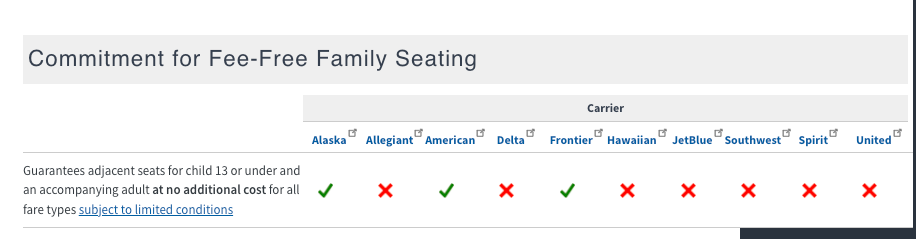
As part of an expansion of the DOT's airline customer service dashboard, the new family seating dashboard will indicate which airlines guarantee adjacent seats for children under 13 and one accompanying adult with no additional fee regardless of fare type by displaying a simple green check mark or red "X."
The golden egg
Airlines (especially low-cost carriers) have become highly dependent on ancillary fees that enable them to weather economic uncertainty, skyrocketing fuel prices and even a global pandemic — and still claw back lost revenue.
Ancillary revenue "ranges anywhere from 20% of total revenue for major airlines to 50% for low-cost carriers," Skift reported. Advance seat fees (which groups and families are most likely to spend extra for) make up a huge portion of that revenue.
In an annual ancillary report, IdeaWorks revealed that a la carte revenue for U.S. and Canadian airlines totaled $66.8 billion in 2022.
Clearly, junk fees are not going away anytime soon. And if the government were to outlaw them, the result — higher ticket prices that force budget travelers out of the market — would likely not be the most desirable outcome for consumers.
Bottom line
Guaranteeing that families are assigned seats together is a win-win for all passengers.
"Nobody wants to be turned into a de facto babysitter when a young child is forced to sit separately from his or her parent," Shapiro told TPG.
The timing of these new policies, ahead of what is sure to be a hectic summer travel season, should help streamline the boarding process and reduce stress — not just for families but for everyone.
And few things will make a passenger switch allegiance quicker than guaranteed seats without yet another hefty "gotcha" fee.
Related reading:
- When is the best time to book flights for the cheapest airfare?
- The best airline credit cards
- What exactly are airline miles, anyway?
- 6 real-life strategies you can use when your flight is canceled or delayed
- Maximize your airfare: The best credit cards for booking flights
- The best credit cards to reach elite status
- What are points and miles worth? TPG's monthly valuations
TPG featured card

at Capital One's secure site
Terms & restrictions apply. See rates & fees.
| 5X miles | Earn 5X miles on hotels, vacation rentals and rental cars booked through Capital One Travel |
| 2X miles | Earn unlimited 2X miles on every purchase, every day |
Pros
- Stellar welcome offer of 75,000 miles after spending $4,000 on purchases in the first three months from account opening. Plus, a $250 Capital One Travel credit to use in your first cardholder year upon account opening.
- You'll earn 2 miles per dollar on every purchase, which means you won't have to worry about memorizing bonus categories
- Rewards are versatile and can be redeemed for a statement credit or transferred to Capital One’s transfer partners
Cons
- Highest bonus-earning categories only on travel booked via Capital One Travel
- LIMITED-TIME OFFER: Enjoy $250 to use on Capital One Travel in your first cardholder year, plus earn 75,000 bonus miles once you spend $4,000 on purchases within the first 3 months from account opening - that’s equal to $1,000 in travel
- Earn unlimited 2X miles on every purchase, every day
- Earn 5X miles on hotels, vacation rentals and rental cars booked through Capital One Travel
- Miles won't expire for the life of the account and there's no limit to how many you can earn
- Receive up to a $120 credit for Global Entry or TSA PreCheck®
- Use your miles to get reimbursed for any travel purchase—or redeem by booking a trip through Capital One Travel
- Enjoy a $50 experience credit and other premium benefits with every hotel and vacation rental booked from the Lifestyle Collection
- Transfer your miles to your choice of 15+ travel loyalty programs
- Top rated mobile app