What happens when a baby is born in flight?

Editor's note: This post has been updated with the latest information.
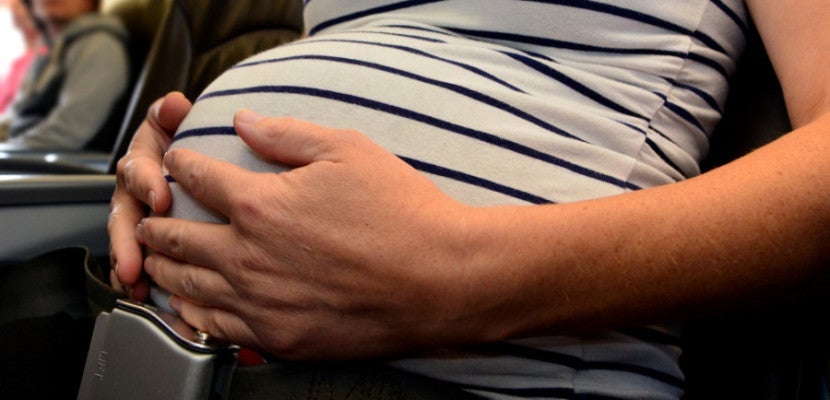
What happens if a baby is born at 35,000 feet in the air over the Pacific Ocean, as happened in 2021? Or more recently, on a Frontier Airlines flight scheduled to travel from Denver to Orlando (coincidentally on a plane with a tail featuring mother and daughter wolves)?
Well, the answer isn't always cut and dried. In fact, there isn't even an answer that applies to every birth that happens in the skies.
If considering flying while pregnant, verify your carrier's restrictions regarding how late into a pregnancy you're allowed to travel.
Beyond the logistical concerns of delivering a baby midflight without medical staff or equipment, there are other concerns that follow inflight births related to the location of delivery and how that might affect the baby's citizenship.
[table-of-contents /]
Rules for traveling while pregnant vary by airline
How far into pregnancy people are eligible to fly depends on the airline.
For example, Southwest Airlines recommends against air travel beginning the 38th week of pregnancy, without explicitly prohibiting it.
Like Southwest, Delta does not restrict flying for pregnant people at all, so no certificate is required to travel.

Frontier and United both require pregnant passengers to provide a medical certificate if traveling during the 36th week of pregnancy. United also asks for two copies of an obstetrician's certificate dated within 72 hours of the departure.
American Airlines says that if the due date is within four weeks days of flying, there must be a doctor's note stating the passenger is fit to fly.
Similarly, JetBlue requires pregnant passengers expecting to deliver within seven days of travel to present a doctor's certificate within 72 hours of travel, saying the passenger is fit to fly.
Read more: How I've kept traveling -- even after having a baby
How airline crew members act to deliver a baby on board
In the rare instance when a pregnant passenger does board — with or without a doctor's certificate — and gives birth while the plane is in the air, the flight attendants and crew do roughly what they do in the event of other in-air medical situations. Obviously, they are not specifically trained to deliver babies, so the first step is usually to consult with the passengers in hopes that there are medical professionals on board.
In the case of the recent baby born on the Frontier Airlines flight, there were no medical personnel identified on board, so the flight attendant aided the mother until the plane could divert to the nearby Pensacola airport where paramedics were reportedly waiting on the ground.
The airline handles these situations on a case-by-case basis to determine if a diversion is necessary or if the best outcome is for the flight to continue as planned.
Logistical considerations follow

Let's say the baby is delivered on board with no issues. Everyone is happy (though perhaps shocked) and a healthy baby is now in its parent's arms with the plane landing with one more passenger than it left with.
But in the case of some more complicated itineraries, then the questions begin: What is the baby's citizenship? Is it that of the parent or the airline? Or does the baby become a citizen of the country the plane happened to be flying over at the time of its birth?
Unfortunately, those answers aren't clear and can vary from case to case, although most countries do have a "jus sanguinis" principle that gives the baby the same citizenship as its parents, as outlined by the U.S. Department of State.
The status of the baby's citizenship also depends on the location of the aircraft when the baby is delivered. Generally, if the baby is born over the ocean, there are a number of legal possibilities.
The first is that the baby may be a citizen of the country that the aircraft is registered in, so if the aircraft is registered in Norway, the baby could be Norwegian. The second possibility is that the baby takes the parent's citizenship, so if the parent is Italian, the baby could also be Italian.
As for births that occur over land, there are different possibilities for the baby's citizenship in addition to the jus sanguinis principle.
Some countries have made broad claims about how much airspace they own above their respective borders, ranging from 43-99 miles up. Some countries grant citizenship to flyover babies (meaning babies born in their airspace) while others do not.
The United States, for example, grants citizenship to babies born in its airspace even if the newborn has foreign parents, so long as the birth takes place in U.S. airspace or waters, while babies born in British airspace are not granted United Kingdom citizenship.
Bottom line
Obviously, giving birth in flight is not the most ideal or most likely situation for those who are pregnant, but it does seem to happen at least a few times a year.
If you are at all concerned that this may happen in your family, be sure to double-check the policies related to flying while pregnant with your airline and, of course, consult your doctor.
Related: Is less really more? What you actually need to bring when traveling with a baby
Additional reporting by Caroline Tanner.
TPG featured card

at Capital One's secure site
Terms & restrictions apply. See rates & fees.
| 5X miles | Earn 5X miles on hotels, vacation rentals and rental cars booked through Capital One Travel |
| 2X miles | Earn unlimited 2X miles on every purchase, every day |
Pros
- Stellar welcome offer of 75,000 miles after spending $4,000 on purchases in the first three months from account opening. Plus, a $250 Capital One Travel credit to use in your first cardholder year upon account opening.
- You'll earn 2 miles per dollar on every purchase, which means you won't have to worry about memorizing bonus categories
- Rewards are versatile and can be redeemed for a statement credit or transferred to Capital One’s transfer partners
Cons
- Highest bonus-earning categories only on travel booked via Capital One Travel
- LIMITED-TIME OFFER: Enjoy $250 to use on Capital One Travel in your first cardholder year, plus earn 75,000 bonus miles once you spend $4,000 on purchases within the first 3 months from account opening - that’s equal to $1,000 in travel
- Earn unlimited 2X miles on every purchase, every day
- Earn 5X miles on hotels, vacation rentals and rental cars booked through Capital One Travel
- Miles won't expire for the life of the account and there's no limit to how many you can earn
- Receive up to a $120 credit for Global Entry or TSA PreCheck®
- Use your miles to get reimbursed for any travel purchase—or redeem by booking a trip through Capital One Travel
- Enjoy a $50 experience credit and other premium benefits with every hotel and vacation rental booked from the Lifestyle Collection
- Transfer your miles to your choice of 15+ travel loyalty programs
- Top rated mobile app