The Points Guy believes that credit cards can transform lives, helping you leverage everyday spending for cash back or travel experiences that might otherwise be out of reach. That's why we publish a variety of editorial content and card comparisons: to help you find a great card to turn your goals into reality.
Our site may earn compensation when a customer clicks on a link, when an application is approved, or when an account is opened with our partners, and this may impact how or where these products appear. While we don't cover all available credit cards, our editorial team creates and maintains all of the analysis of these cards, and our content is not influenced nor subject to review by any credit card company, bank or partner prior to (or after) publication. Please view our advertising policy and product review methodology for more information.
Advertiser disclosure
The Points Guy believes that credit cards can transform lives, helping you leverage everyday spending for cash back or travel experiences that might otherwise be out of reach. That's why we publish a variety of editorial content and card comparisons: to help you find a great card to turn your goals into reality.
Our site may earn compensation when a customer clicks on a link, when an application is approved, or when an account is opened with our partners, and this may impact how or where these products appear. While we don't cover all available credit cards, our editorial team creates and maintains all of the analysis of these cards, and our content is not influenced nor subject to review by any credit card company, bank or partner prior to (or after) publication. Please view our advertising policy and product review methodology for more information.
News
United is getting the terminal of its dreams at Washington Dulles. How will it change?
Edward Russell is a contributor for TPG. An AvGeek at heart, he covered the airline business at FlightGlobal for eight years and previously covered finance in New York and Hong Kong.
August 5, 2026 • 9 min read
The cards we feature here are from partners who compensate us when you are approved through our site, and this may impact how or where these products appear. We don't cover all available credit cards, but our analysis, reviews, and opinions are entirely from our editorial team. Terms apply to the offers listed on this page. Please view our advertising policy and product review methodology for more information.Editorial disclaimer: Opinions expressed here are the author's alone, not those of any bank, credit card issuer, airline or hotel chain, and have not been reviewed, approved or otherwise endorsed by any of these entities.
Comments
By commenting, you agree to our Community Guidelines to help create a positive space for conversation. The responses below are not provided or commissioned by the bank advertiser, our partners, or The Points Guy (“TPG”). They have not been reviewed, approved, or otherwise endorsed by any of these parties. All responses are submitted by individual contributors, and neither the bank advertiser, our partners, nor TPG are responsible for ensuring that all posts and/or questions are answered.
Related stories
Quick summary
United Airlines is significantly expanding its hub at Dulles International Airport, with seat capacity projected to rise 24% compared to 2019.
A $22.5 billion redevelopment plan will overhaul terminals, concourses and transit systems, adding 5 million square feet of space over the next decade.
The project will introduce new international and domestic facilities, including a luxury lounge and expanded gate capacity, enabling more routes and larger aircraft.
Preservation of the iconic main terminal's architecture is a priority, despite concerns from preservationists about the scale of the expansion.
What to consider
The redevelopment's high cost could lead to increased airport fees or airfares unless offset by federal funding or higher passenger volumes.
The exact number of new gates is not finalized, but the plan could increase United's gate count by 25% by 2045.
Balancing expansion with preservation of the historic terminal remains a key challenge for airport authorities.
What you'll miss from the article
A detailed breakdown of each redevelopment phase and how new facilities will impact United's future operations at Dulles.
Generated by AI with support from our editorial team.
United Airlines’ hub at Dulles International Airport (IAD) has long been on the cusp of something big.
In 2018, Scott Kirby, then-president and now CEO of United, said growth at IAD was doing “really well” and hinted at more to come. A year later, the airline added gates at the airport to support more flights. Then, the COVID-19 pandemic erased much of those gains.
Fast forward to 2026, and things are looking up again for United at the Washington, D.C.-area airport.
United’s hub at the airport is bigger — a lot bigger — than it was during its previous peak in 2019. Seats are set to jump 24% this year compared to seven years ago, according to schedule data from aviation analytics firm Cirium. The growth at IAD is second only to United’s strategic mid-continent hub at Denver International Airport (DEN).
And its growth at IAD is about to be super-charged, thanks to the July 29 agreement to build out the airport’s master plan over the next decade. This means travelers will finally be able to say goodbye to the dated and cramped “temporary” Concourse C-D and jet-age mobile lounges in the next few years. It also means a lot more space for United to play with.
United Airlines planes at Dulles International Airport. EDWARD RUSSELL FOR THE POINTS GUY
The Dulles plan
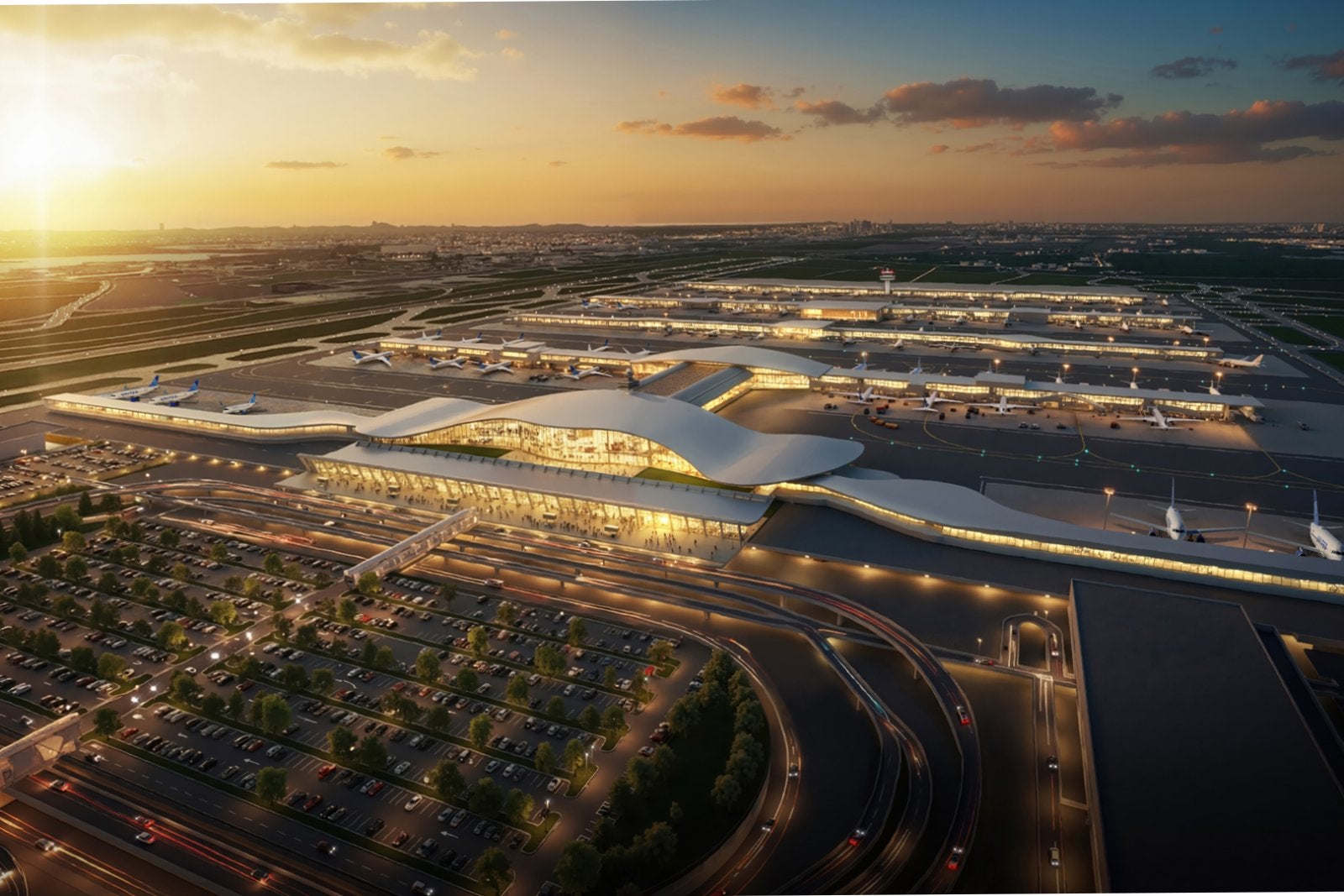
Unveiled July 29 at the White House, the estimated $22.5 billion redevelopment of IAD will completely revamp the airport into what Kirby said will be a “world-class airport experience.” The program is not actually new but rather a greatly accelerated buildout of the airport’s 2025 master plan.
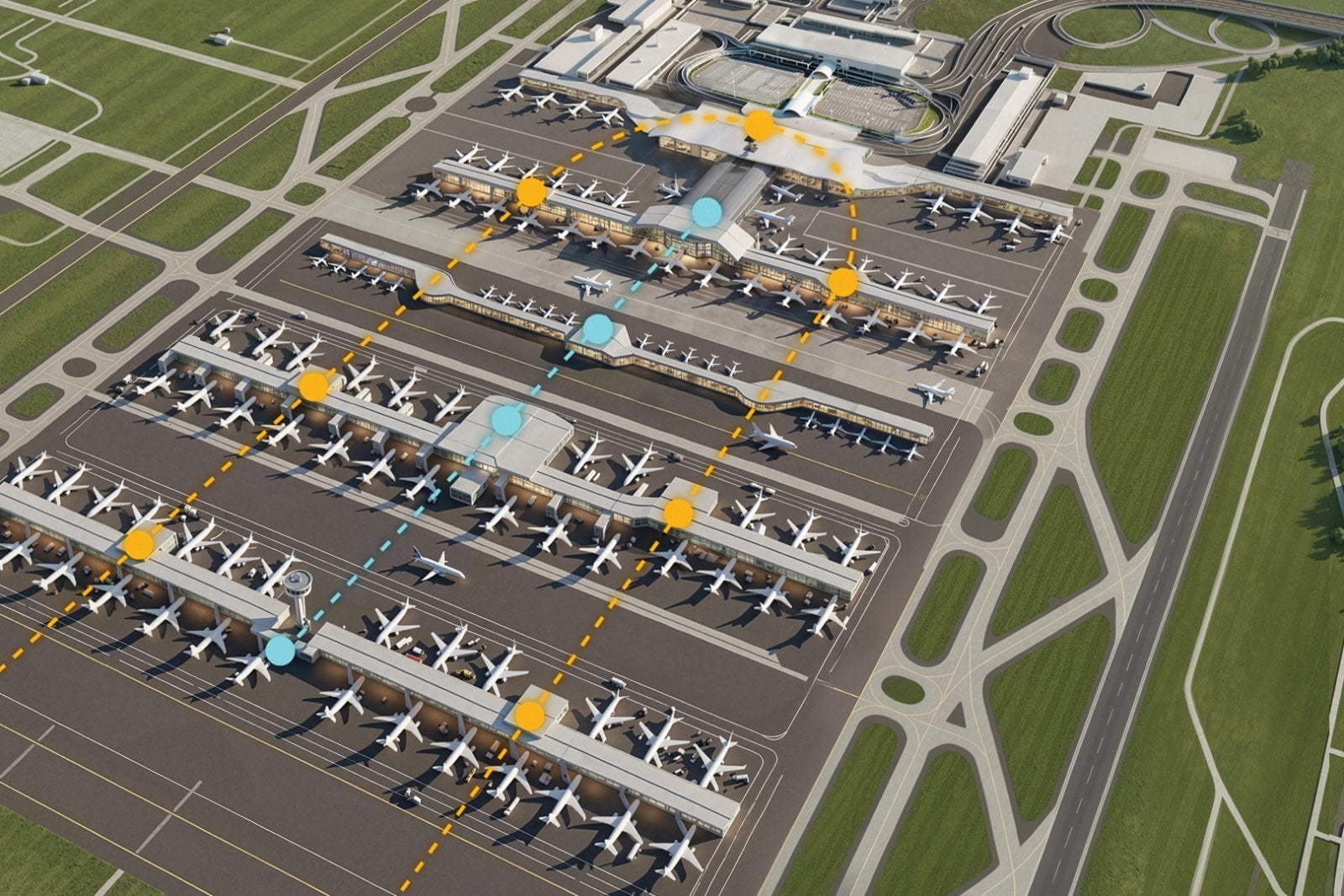
The work is split into five key pieces:
Main Terminal and Concourse A: Known as Package A, the highlight of this phase is the expansion of IAD’s iconic main terminal, designed by Eero Saarinen. It's also a reconfiguration of the space, so ticket counters and bag drop are perpendicular to the drop-off curb rather than parallel. It includes a new above-ground connector to Concourse A (currently known as Concourse A-B) as well as an expanded international arrivals facility, an expanded Concourse Z, a renovation of Concourse A and a 14-16 gate extension of Concourse A on the site of the current ground-level United Express gates.
AeroTrain and pedestrian tunnel: This piece includes an extension of the AeroTrain to two new stations and all concourses, and a new pedestrian tunnel linking the main terminal with all of the concourses.
Concourse E: This is the full build-out of Concourse E, the first phase of which is set to open this fall. It will be renamed Concourse C.
Concourse D: This is a new Concourse D south of the current Concourse E for domestic airlines.
Concourse B: This is a new regional concourse situated on the site of the current-day Concourse C-D.
The future layout of Dulles. UNITED AIRLINES
The redevelopment will add an estimated 5 million square feet of additional terminal and concourse space for travelers. It's unclear how many additional gates the project will add.
United's dream terminal
“We designed it by and large,” Kirby said of the IAD plan in June. “We’re excited about it.”
And United has good reason to be excited. The master plan includes both more and better terminal facilities for the airline, enabling significant growth. It is expected to move all international flights to the renovated Concourse A and expanded Concourse Z; meanwhile, the under-construction Concourse E and future Concourse B will be the backbone of its domestic operations.
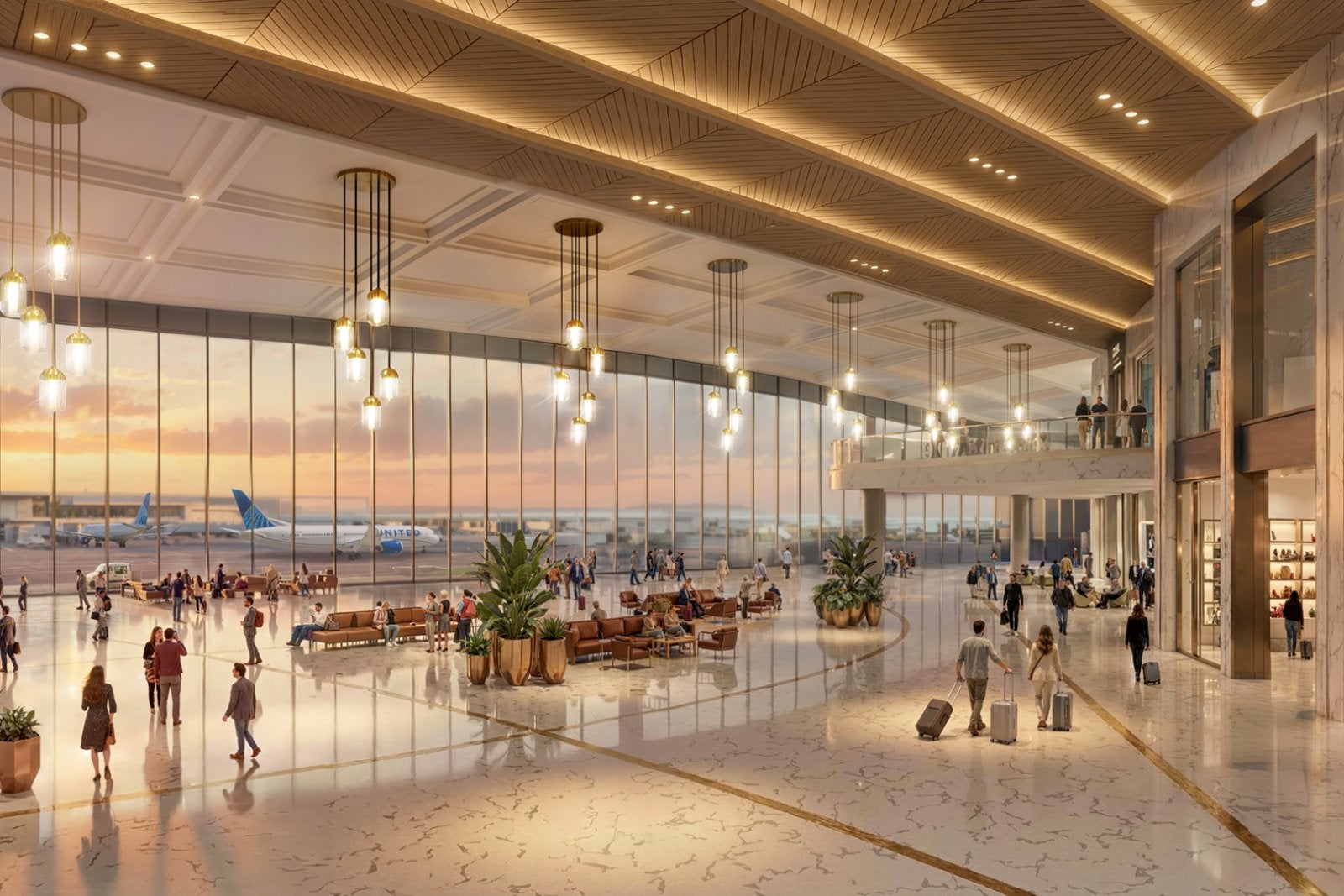
Executives have already hinted at some of its plans. A new luxe Polaris lounge is planned for the above-ground connector between the terminal and Concourse A, United chief commercial officer Andrew Nocella let slip in March. That is on top of the 40,000-square-foot, Washington, D.C.-themed United Club that is under construction in the new Concourse E.
The number of gates United will gain is uncertain.
In 2024, the airline had 89 “narrowbody-equivalent” gates, a standardized measure based on the space needed for Airbus A320- or Boeing 737-sized aircraft. The actual number of physical gates is lower because some are large enough to accommodate wide-body aircraft, such as the Boeing 787, as shown in the airport’s master plan. The number includes both gates on Concourse C-D and the 31 ground-level regional gates on Concourse A.
United’s count would rise by a quarter to 111 narrowbody-equivalent gates by 2045 under the master plan.
More gates would mean room for new international and domestic flights at IAD.
Cartagena is notable as one of United’s newest Latin American destinations, with the airline choosing Dulles International Airport (IAD) for its new nonstop service rather than Newark Liberty International Airport (EWR), its New York-area hub. Historically, the carrier has connected destinations in Latin America to either its George Bush Intercontinental Airport (IAH) or EWR hubs before IAD.
That may be changing as IAD has space to grow, and EWR suffers from severe space constraints and airspace congestion.
“We can connect all kinds of cities to the nation’s capital because there’s more demand than we ever appreciated,” Kirby said in December 2024, adding that the airline saw an opportunity to “double the size” of its international footprint at IAD.
United also plans to base an undisclosed number of its new long-haul Airbus A321XLRs at IAD for new flights to Europe, Kirby has said.
Obstacles to Dulles' expansion
As beneficial as IAD’s expansion could be to United, neither the redevelopment nor the airline’s growth is a sure thing.
The project's price tag, an estimated $22.5 billion, is extremely steep for an airport that last year handled just 29 million passengers. In comparison, Los Angeles International Airport (LAX) is building out a $30 billion capital program for the 2028 Olympics, yet the airport served 73.7 million passengers in 2025.
The IAD redevelopment is an order of magnitude more expensive per passenger than the LAX capital program.
Without federal grants or other outside funding, airlines and travelers could ultimately bear the cost of the IAD project through higher airport fees — and potentially higher airfares.
Still, United CEO Scott Kirby pushed back against projections that the project could result in costs of $90 per passenger. “The $90 CPE is not correct because there’s going to be more Es,” Kirby said in June. CPE, or “cost per enplanement,” is the average amount an airline pays an airport for each passenger it boards. By “more Es,” Kirby was referring to United’s expected growth at IAD: As more passengers travel through the airport, the project’s costs would be spread across a larger number of enplanements, potentially reducing the cost per passenger.
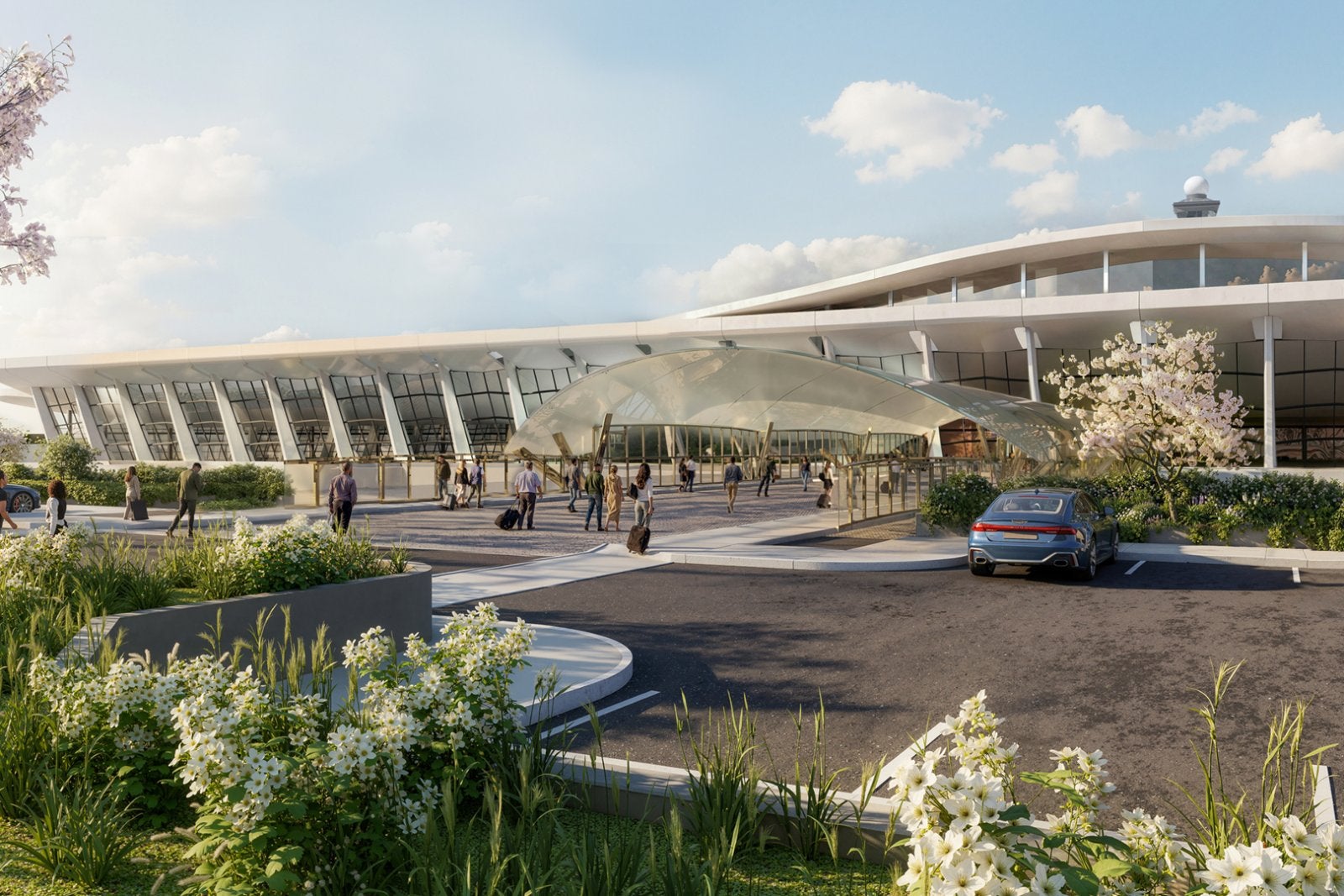
Another obstacle is how challenges to the plan could affect Saarinen’s landmark terminal. Renderings released by the Trump administration show the building dwarfed and almost subsumed by a new expansion.
A proposed expansion of the main terminal at Dulles could dwarf the historic Eero Saarinen structure. UNITED AIRLINES
“The Dulles Main Terminal is one of the most significant works of modern architecture in the United States and a globally recognized masterpiece by Eero Saarinen,” modern architecture preservation organization Docomomo DC wrote in a comment to the U.S. Department of Transportation in January.
The organization “strongly opposes any revitalization approach that would compromise the essential form, structure, materials, or spatial qualities of Saarinen’s design,” it added.
The Metropolitan Washington Airports Authority, which operates Dulles, appears ready to thread the needle between the need to redevelop IAD and the need to preserve the main terminal.
SKYHOBO/GETTY IMAGES
“The Authority intends to maintain the iconic architectural design while undertaking a comprehensive transformation of the interior spaces,” MWAA wrote in its June solicitation for a design-builder of the terminal expansion.
By commenting, you agree to our Community Guidelines to help create a positive space for conversation. The responses below are not provided or commissioned by the bank advertiser, our partners, or The Points Guy (“TPG”). They have not been reviewed, approved, or otherwise endorsed by any of these parties. All responses are submitted by individual contributors, and neither the bank advertiser, our partners, nor TPG are responsible for ensuring that all posts and/or questions are answered.