United Airlines announces deal with Boom Supersonic for faster-than-sound commercial flights

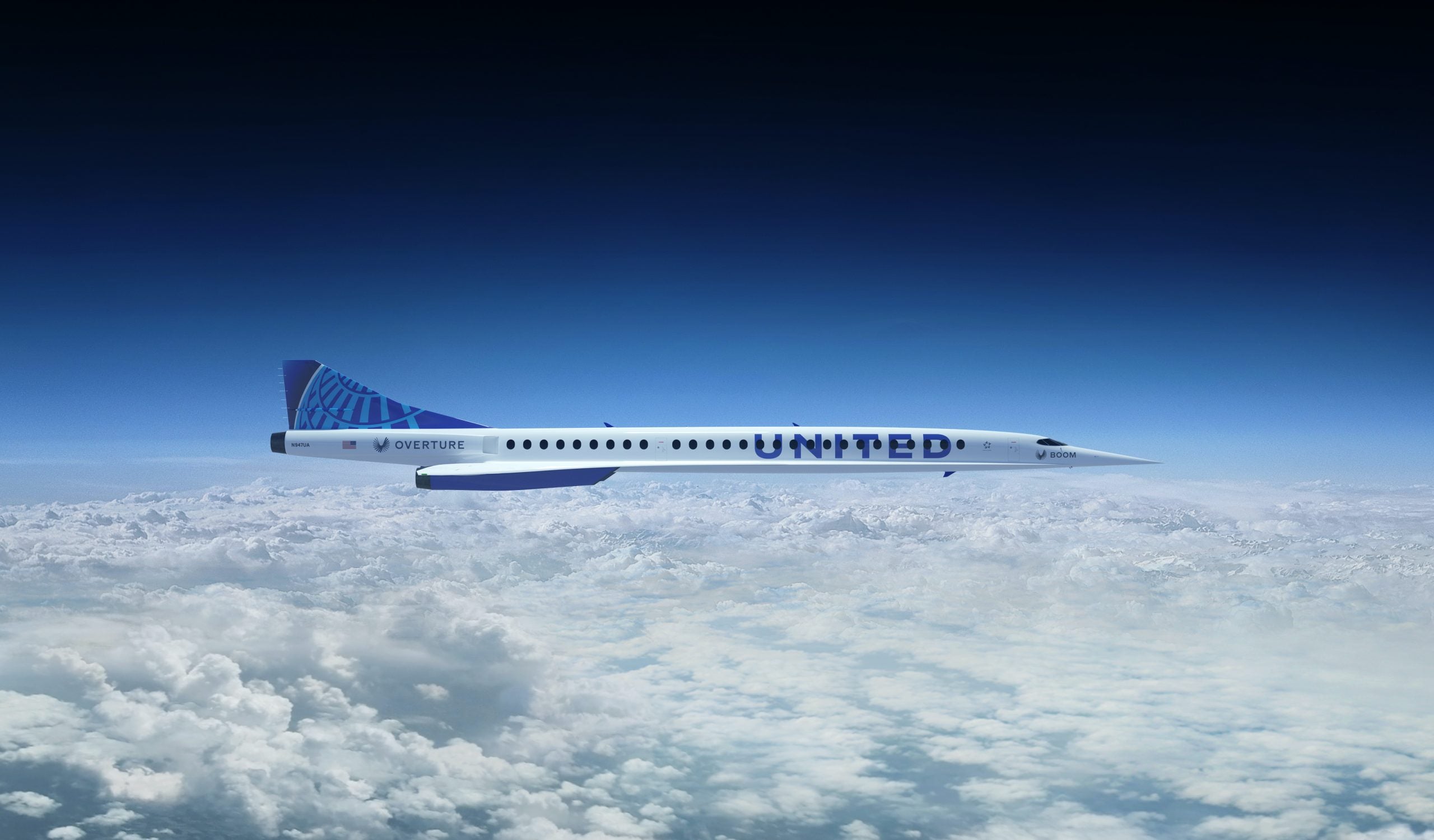
United Airlines said on Thursday that it had signed a deal with Boom Supersonic, a startup working to develop the first supersonic commercial jet since the Concorde, to purchase up to 50 of the company's planned passenger jet.
Under the deal, United would purchase 15 of Boom's Overture jet, which the startup plans to enter into commercial service in 2029, with the option for up to 35 more.
Sign up to receive the daily TPG newsletter for more airline and travel news!
The Concorde was retired in 2003 after it proved to be economically unsustainable for airlines, in a market that had for decades been focused on lowering costs and improving operating efficiency, rather than speed.
Boom, however, has insisted that it can make supersonic flight practical for the current airline market and more affordable for passengers.
Boom and United said on Thursday that United's future supersonic fleet would be considered net-zero carbon, and would fly entirely on sustainable aviation fuel (SAF).
"United continues on its trajectory to build a more innovative, sustainable airline and today's advancements in technology are making it more viable for that to include supersonic planes," United CEO Scott Kirby said in a statement. "Our mission has always been about connecting people and now working with Boom, we'll be able to do that on an even greater scale."
Boom, which introduced a conceptual single-seat tester aircraft in 2020, said it plans to introduce the prototype Overture aircraft, an 88-seat commercial airliner, in 2025, with the jet making its first flight the following year, before entering service in 2029.
While Boom CEO Blake Scholl has insisted that modern design tools and technology can help Boom overcome many of the challenges faced by the Concorde, the plane will still create a sonic boom when traveling at faster-than-sound speeds, limiting its use to over-ocean routes.

Still, the startup previously told this reporter during an interview that it had identified 500 different routes on which supersonic travel was viable, and said that its lower costs would translate to less-expensive fares, making the plane more viable than the Concorde was.
"The primary limitation on Concorde was economic. Because of the plane's fuel inefficiency, tickets were $20,000 a pop," Scholl said in October. "And you just can't fill 100 seats at $20,000. It made some money from here to London, but you can't build a business around that."
Fares are expected to be similar to today's business-class fares, Scholl said at the time, although the limited number of seats on the plane, combined with the high relative cost of SAF, make that optimistic.
Of course, airlines could also choose to charge more if the market exists, and may in fact need to — reducing weight will be a key to achieving efficiency, meaning it's unlikely that supersonic planes would earn additional revenue from carrying cargo, like many commercial flights today.
While United's agreement with Boom lends considerable legitimacy to the startup's plans, it's ultimately a low-risk investment for the airline.
"This is an order, but to call it a firm order is inaccurate," Mike Leskinen, United's head of corporate development, told The Air Current. "They have to deliver. And we've got a number of years to deliver on that," he added, citing financial protections built into the agreement.
Despite plans for the aircraft to be carbon net-zero, critics have cited the potential environmental impact of supersonic flight development. A report from NASA earlier this year cited numerous environmental hazards of faster-than-sound commercial travel, although the paper did not examine specific designs such as Boom's.
Although United will be the launch customer for the Overture, if and when the plane is certified by the FAA, it is not the first airline to link with the startup. Japan Airlines invested $10 million in 2018. The company was awarded a contract with the U.S. Air Force in 2020 to develop an executive jet for government officials — potentially including an Air Force One.
Notably, numerous airlines placed orders for the Concorde in the 1970s, including American Airlines, TWA, Continental and United, before eventually canceling.
TPG featured card

at American Express's secure site
Terms & restrictions apply. See rates & fees.
| 4X | Earn 4X Membership Rewards® points per dollar spent on purchases at restaurants worldwide, on up to $50,000 in purchases per calendar year, then 1X points for the rest of the year. |
| 4X | Earn 4X Membership Rewards® points per dollar spent at US supermarkets, on up to $25,000 in purchases per calendar year, then 1X points for the rest of the year. |
| 5X | Earn 5X Membership Rewards® points on prepaid hotel stays booked through AmexTravel.com or the Amex Travel App™. |
| 3X | Earn 3X Membership Rewards® points on flights booked through AmexTravel.com, the Amex Travel App™, or purchased directly from airlines. |
| 2X | Earn 2X Membership Rewards® points on prepaid car rentals booked through AmexTravel.com or the Amex Travel App™ and cruises booked and paid through AmexTravel.com. |
| 1X | Earn 1X Membership Rewards® point per dollar spent on all other eligible purchases. |
Pros
- Valuable dining and food-related credits
- Flexible rewards with airline and hotel transfer partners
- Multiple travel and purchase protections
- No foreign transaction fees
- Access to Amex Offers for additional savings (enrollment required)
Cons
- Not as useful for those living outside the U.S.
- Some may have trouble using Uber and other dining credits
- You may be eligible for as high as 100,000 Membership Rewards® Points after you spend $8,000 in eligible purchases on your new Card in your first 6 months of Card Membership. Welcome offers vary and you may not be eligible for an offer. Apply to know if you’re approved and find out your exact welcome offer amount – all with no credit score impact. If you’re approved and choose to accept the Card, your score may be impacted.
- Earn 4X Membership Rewards® points per dollar spent on purchases at restaurants worldwide, on up to $50,000 in purchases per calendar year, then 1X points for the rest of the year.
- Earn 4X Membership Rewards® points per dollar spent at US supermarkets, on up to $25,000 in purchases per calendar year, then 1X points for the rest of the year.
- Earn 5X Membership Rewards® points on prepaid hotel stays booked through AmexTravel.com or the Amex Travel App™.
- Earn 3X Membership Rewards® points on flights booked through AmexTravel.com, the Amex Travel App™, or purchased directly from airlines.
- Earn 2X Membership Rewards® points on prepaid car rentals booked through AmexTravel.com or the Amex Travel App™ and cruises booked and paid through AmexTravel.com.
- Earn 1X Membership Rewards® point per dollar spent on all other eligible purchases.
- Pay It® lets you tap in the American Express® App to quickly pay for small purchase amounts throughout the month and still earn rewards the way you usually do. Plan It® gives you the option to split up big purchases into equal monthly payments with a fixed fee. You’ll know upfront exactly how much you’ll pay.
- $120 Dining Credit: Earn up to a total of $10 in statement credits monthly when you pay with the Gold Card at Grubhub (including Seamless), Buffalo Wild Wings, Five Guys, The Cheesecake Factory, and Wonder. This can be an annual savings of up to $120. Enrollment required.
- $100 Resy Credit: Get up to $100 in statement credits each calendar year at over 10,000 qualifying U.S. Resy restaurants after you pay for eligible purchases with the American Express® Gold Card. That’s up to $50 in statement credits semi-annually. Enrollment required.
- $84 Dunkin' Credit: Earn up to $7 in monthly statement credits after you pay with the American Express® Gold Card at U.S. Dunkin’ locations. Enrollment required.
- $120 Uber Cash on Gold: Enjoy up to $120 in Uber Cash annually with your Gold Card. Just add your Card to your Uber account and you'll get $10 in Uber Cash each month to use on orders and rides in the U.S. when you select an Amex Card for your transaction.
- Enjoy complimentary Hertz Five Star® Status benefits like skipping the counter at select locations, adding an additional driver at no additional cost*, and vehicle upgrades**. Benefit enrollment and Hertz Gold+ registration are required. *Additional drivers must meet standard rental qualifications and must be a spouse or domestic partner to qualify as complimentary. Other additional drivers subject to fees. **Benefits are subject to availability and vary by location. Additional Hertz program Terms and Conditions including age restrictions apply.
- Book two nights or more with The Hotel Collection through AmexTravel.com or the Amex Travel App™ and receive a $100* credit towards eligible charges at over 1,400 upscale hotels worldwide. *Eligible charges vary by property.
- Book your travel through the Amex Travel App™ with added peace of mind – backed by American Express® service and support. Only for American Express® Card Members.
- Whenever you need us, we're here. Our Member Services team will ensure you are taken care of. From lost Card replacement to statement questions, we are available to help 24/7.
- No Foreign Transaction Fees.
- Annual Fee is $325.
- Terms Apply.