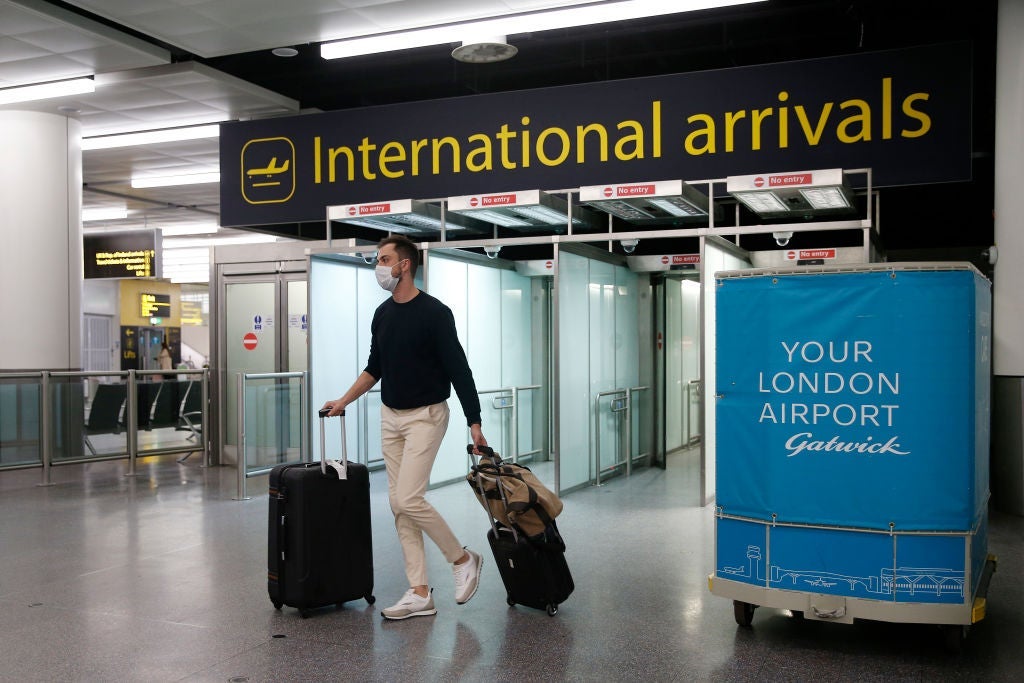

Health Secretary Matt Hancock told the Commons on Tuesday that as of Monday, that all quarantining arrivals will have to take a coronavirus test on days two and eight of their mandatory 10-day isolation period. The two-time testing requirement will apply to all travelers, regardless if they’re undergoing their quarantine in a hotel or at home, and travelers will have to book their tests through an online portal before they travel.
Sign up to receive the daily TPG newsletter for more travel news!
Additionally, as of Feb. 15 when the hotel quarantine takes effect, travelers will have to pay £1,750 in order to spend their 10 days in a government-supervised self-isolation setting if they’re arriving from a travel ban country. Passengers will be escorted from the airport to the hotel and cannot leave their room.
Related: Hotel quarantine begins 15 February: All 33 countries that are on the UK’s travel ban list
According to Hancock, 4,600 rooms have been procured at 16 hotels across the country. Rooms will have to be booked via an online portal before departure. The portal will go live on Thursday, Feb. 11.
The £1,750 price tag will include room, two tests (on days two and eight) and transfers. There will be a fine of up to £10,000 for those who break the rules.
The fines break down as follows: £1,000 for any international arrival who fails to take a mandatory COVID-19 test; £2,000 for any arrival who fails to take a second test and quarantine will be automatically extended to 14 days; and fines of between £5,000 and £10,000 for failing to quarantine in a designated hotel.
All passengers continue to be required to fill out a passenger locator form prior to traveling to the U.K. Hancock outlined on Tuesday that anyone who has been found to lie on their passenger locator form will face a prison sentence of up to 10 years.
Tuesday's announcements apply to England, but Hancock said that the government is "working on similarly tough schemes with the devolved administrations."
The new two-time testing requirements are in addition to the pre-departure testing requirement the U.K. implemented last month. As of Jan. 18, all travelers entering the U.K. from abroad by boat, train or plane are required to have proof of a negative COVID-19 test, taken no more than 72 hours prior to scheduled departure.
With the new two-time testing in quarantine, all travelers heading to the U.K. will be required to take three COVID-19 tests at minimum — one prior to traveling and two while in quarantine.
If a traveler tests positive in quarantine, they will be required to self-isolate for an additional 10 days from the date when the test was administered.
Interestingly, the traveler who is quarantining at home can still utilize the Test to Release scheme in England, which allows the person to take a test after five days of quarantine. If the test returns a negative result, they will be allowed to forgo the rest of their 10-day quarantine. However, they will still be required to take a test on their eighth day of entering in the country.
Related: Everything we know about the Test to Release scheme
Travelers entering from a travel ban country are not eligible for the Test to Release scheme.
By implementing a testing requirement whilst in quarantine, the Department of Health said that it will be able to better track new variants that are imported.
The move comes amid growing concern that existing vaccines may not be as effective in protecting against new strains of the virus. Early trials of the Oxford-AstraZeneca vaccine suggest it may only offer “minimal protection” against the variant of the virus that was first detected in South Africa.
Hancock declined to state when these measures may be lifted.