Everything you need to know about State Department travel advisories

When traveling abroad, the top concern for many Americans is safety.
Whether it is due to ongoing conflict, special events such as the 2024 Paris Olympics, natural disasters like a volcano currently erupting in Iceland or an uptick in crime, conditions of countries can change rapidly, affecting both travelers and locals.
To help keep American travelers safe, the U.S. Department of State issues and maintains travel advisories for U.S. citizens based on current circumstances.
These advisories can be particularly helpful for first-time and younger travelers, though the agency encourages all people to review them for their desired destination ahead of travel.
What are travel advisories based on?
Although travel warnings originate from the State Department and live on its website, they are a joint effort between the State Department's Office of Overseas Citizens Services and U.S. consulates and embassies worldwide.
"We've got our diplomats and consular officers on the ground in all those places, who have more up-to-date information than anyone in Washington could have," said Angela Kerwin, deputy assistant secretary for Overseas Citizens Services, during a Zoom interview Thursday. "But we use a variety of information in order to look at the criteria that go into our travel advisories around the world."
In addition to crime reports, nongovernmental organization reports and those from international organizations such as the United Nations, the government considers nine risk factors in determining the level at which each country's advisory should be set:
- C — Crime: Widespread violence or organized crime is present in areas of the country. Local law enforcement may have limited ability to respond to serious crimes.
- T — Terrorism: Terrorist attacks have occurred and/or specific threats against civilians, groups or other targets may exist.
- U — Civil Unrest: Political, economic, religious and/or ethnic instability exists and may cause violence, major disruptions and/or safety risks.
- H — Health: Health risks, including current disease outbreaks or a crisis that disrupts a country's medical infrastructure. The issuance of a Centers for Disease Control and Prevention Travel Health Notice may also be a factor.
- N — Natural Disaster: A natural disaster, or its aftermath, poses danger.
- E — Time-limited Event: Short-term events, such as elections, sporting events or other incidents that may pose safety risks.
- K — Kidnapping or Hostage Taking: Criminal or terrorist individuals or groups have threatened to and/or have seized or detained and threatened to kill, injure or continue to detain individuals in order to compel a third party (including a governmental organization) to do or abstain from doing something as a condition of release.
- D — Wrongful Detention: The risk of wrongful detention of U.S. nationals exists.
- O — Other: Potential risks are not covered by previous risk indicators. Read the country's travel advisory for details.
Although the most recently added category, Wrongful Detention, only applies to a handful of countries, it's an important criterion for travelers to note when a country has detained a U.S. citizen without cause.

Level 1 to 4 tiered warning system
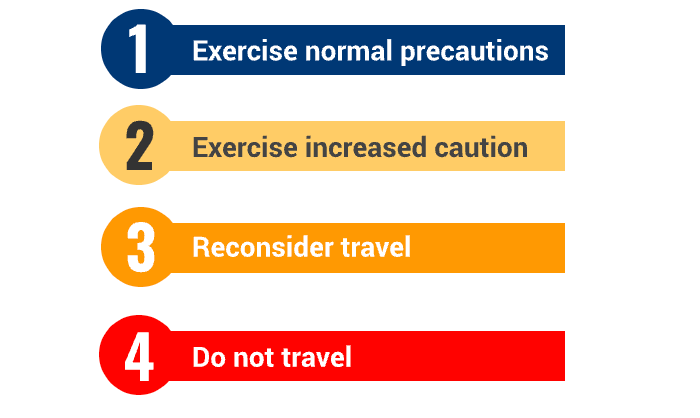
Based on that nine-rubric system, plus reports and input from U.S. consulates and embassies in these countries, the agency assigns each country a Level 1 to 4 tiered warning, with 1 being the lowest level, indicating relative safety, and 4 being the highest, meaning travelers should not visit.
Level 1: Exercise normal precautions
This is the lowest level a country can achieve, making it among the safest for Americans to visit. As with any travel, there is always some risk, so every country will always have at least a Level 1 advisory.
Level 2: Exercise increased caution
Under a Level 2 designation, a country has increased safety or security risks, but they likely won't preclude you from traveling there.
Level 3: Reconsider travel
A Level 3 advisory tells travelers to potentially defer trips to the country in question, as serious potential risks exist.
Level 4: Do not travel
The most serious advisories are Level 4 recommendations, which alert you to avoid travel to designated countries and areas due to a greater threat of potentially life-threatening risks and limited resources to help Americans.
What else to know about travel advisories
In addition to the State Department's general travel advisory, a country's information page will also provide any timely alerts from the corresponding U.S. embassy and/or consulate to consider.
There are also certain countries where the agency can provide "carve-outs" to communicate information related to specific areas or regions within a particular country.
"Perhaps the country itself is a Level 3 country, but there is one particular border area that has ongoing kinetic activity of some sort, and we'd say that would be a Level 4," Kerwin explained.
These carve-outs are most often found in Mexico, as the U.S. shares a border with the country and more Americans travel to Mexico for tourism than elsewhere.
"Mexico is a special case. We also have more U.S. consulates than we do in any other country in the world, and for that reason, we are able to provide state-by-state travel advisory levels in Mexico," Kerwin said. "[With] other countries around the world, [we] just simply don't have the ability to have that level of detail; the specificity is greater for Mexico."

Because data is the main source of information for crafting these advisories, not all alerts can be created equally.
"It is impossible to say that we can apply all nine criteria exactly the same in country A as we do in country B. You're going to have more statistical data of a reliable type for ... Germany than you would Chad," Kerwin explained. "So to compare the exact same report for Germany with the exact same report for Chad is not something that makes sense because it's generally not going to be available."
In those cases, the government relies on its embassies and consulates, which are present in most of these countries, to help inform its alerts.
"We've got people on the ground who are often best positioned to help us evaluate the number of kidnappings, the level of civil unrest, how many terrorist attacks reported or not reported," she said.
Note that a lack of readily available or accurate data doesn't make the country inherently riskier or more dangerous for travelers.
"It just means that we don't have the exact type of data that we would have in another country," Kerwin said. "We would have to rely more heavily on embassy reporting and our folks there, but it does not necessarily mean it is a more dangerous country."
Does a Level 4 alert mean I should avoid traveling there?
In short, the answer is yes.
At the time of publication, there were 19 countries with Level 4 alerts, per the State Department.
"These are the places we deem as the most dangerous for U.S. citizens to travel to, and we would really like U.S. citizens to look at other destinations," Kerwin said. In part, that's because of the limited consular or embassy services available in these places should an American need help.
"Every U.S. citizen gets to make up their own mind on where they want to travel. That's all we can do as a government," she continued. "If a U.S. citizen finds themselves in a situation where they need to travel to one of these countries for whatever reason, we would ask that they look at our travel advisories in advance, read our country information sheet. We would certainly recommend if we have a functioning embassy, that they save that information on their phone so they can contact the embassy if necessary."
But overall, travelers should avoid traveling to Level 4 countries if possible.
"Each of these Level 4 countries will tell you what our concerns are with these countries and [that] our criteria has been met," Kerwin said. "We believe it is quite dangerous to go there."
How often are State Department travel advisories updated?

When viewing a travel advisory, you'll note at the top the date it was last updated, as alerts are updated on a rolling basis.
Generally speaking, Level 4 and Level 3 alerts are updated at least once every six months, while Level 1 and Level 2 alerts are examined at least once per year, pending evolving circumstances.
"If something changes or some precipitating event, we would do it earlier as needed," Kerwin said.
For example, on Thursday, the U.S. Embassy in Reykjavik issued its own alert regarding a volcanic eruption in southwest Iceland that morning. When embassy alerts are issued for isolated events in a particular region of a country, it does not necessarily reflect the overall level of the country as a whole.
Despite the volcano warning, Iceland remained at Level 1, as it has since July. If it had been a more widespread eruption affecting general European air travel, that would have prompted the agency to update the travel advisory as a whole.
"Right now, by sending out that security alert, we're saying stay away from the volcano, but if you wanna go have dinner in Reykjavik, follow our regular information we have on our travel advisory," Kerwin said.
That volcano alert also went out via the agency's Smart Traveler Enrollment Program, which sends relevant security updates from the nearest U.S. Consulate, and which Kerwin advised travelers to enroll in as another way to stay safe abroad.
"So anybody who is registered in STEP traveling to or who is living in Iceland would've gotten an email to say, 'Hey, be aware the volcano erupted again today, we're watching it closely; pay attention,'" she explained. "We have those various security alerts that we can send out at any time in a country based on late-breaking events."
Special events, such as the upcoming 2024 Paris Olympics, will also trigger additional and/or more frequent alerts.
"We will be paying special attention to that. We expect there will be a large number of U.S. citizens that are headed in that direction to cheer on our team, and we want to make sure that we are giving them the best information we can about their time when they're traveling," Kerwin said.
Other things to consider when traveling abroad
As with travel in general, the State Department advises Americans heading overseas to prepare in advance.
"We have a slogan we've been using, and I like it; it's called 'travel smart from the start,' and that starts even before you decide what destination," Kerwin said. That slogan applies to details like checking that you have enough validity on your passport (most countries require six months at the time of entry) and buying travel insurance.
Kerwin also advises procuring the contact information for the nearest U.S. government presence (i.e., the embassy or consulate) via the State Department's list of U.S. embassies and consulates.
"Jot down on paper, take a picture on your phone and save the U.S. Embassy/Consulate phone number or email address so you can get in contact with us if there's a problem," she said. "And always be aware of your surroundings ... a heightened level of awareness ... is important for travelers no matter where they're going."
Bottom line

With travel comes an inherent risk, and the government aims to help travelers remain safe domestically and abroad.
While the decision to travel is ultimately up to the traveler, these travel advisories should be taken seriously.
"Our goal is to always provide the best advice and information we can for U.S. citizens so they can make their decisions as to where they wish they travel," Kerwin said.
Therefore, heed these travel warnings from the State Department via U.S. embassies, consulates and the department's STEP program.
"The final thing — and this is an important one — is to have fun," Kerwin added. "Travel is fantastic — you get to see new cultures, and you get to experience new languages and beautiful countries and beautiful cities. We want U.S. citizens to travel and have fun on their adventures around the world."
Related reading:
TPG featured card

at Capital One's secure site
Terms & restrictions apply. See rates & fees.
| 5X miles | Earn 5X miles on hotels, vacation rentals and rental cars booked through Capital One Travel |
| 2X miles | Earn unlimited 2X miles on every purchase, every day |
Pros
- Stellar welcome offer of 75,000 miles after spending $4,000 on purchases in the first three months from account opening. Plus, a $250 Capital One Travel credit to use in your first cardholder year upon account opening.
- You'll earn 2 miles per dollar on every purchase, which means you won't have to worry about memorizing bonus categories
- Rewards are versatile and can be redeemed for a statement credit or transferred to Capital One’s transfer partners
Cons
- Highest bonus-earning categories only on travel booked via Capital One Travel
- LIMITED-TIME OFFER: Enjoy $250 to use on Capital One Travel in your first cardholder year, plus earn 75,000 bonus miles once you spend $4,000 on purchases within the first 3 months from account opening - that’s equal to $1,000 in travel
- Earn unlimited 2X miles on every purchase, every day
- Earn 5X miles on hotels, vacation rentals and rental cars booked through Capital One Travel
- Miles won't expire for the life of the account and there's no limit to how many you can earn
- Receive up to a $120 credit for Global Entry or TSA PreCheck®
- Use your miles to get reimbursed for any travel purchase—or redeem by booking a trip through Capital One Travel
- Enjoy a $50 experience credit and other premium benefits with every hotel and vacation rental booked from the Lifestyle Collection
- Transfer your miles to your choice of 15+ travel loyalty programs
- Top rated mobile app