Singapore presents new details on Changi’s future Terminal 5

When you are consistently ranking year after year at the very top of your field, the expectation bar is set particularly high. Singapore is not a country to shy away from big undertakings, though.
During a speech at that country's National Day Rally on Aug. 21, Singapore's prime minister, Lee Hsien Loong, unveiled his government's vision for the construction of a new Terminal 5 at Singapore Changi Airport (SIN), which included some interesting details about this massive piece of infrastructure.
In the meantime, Singapore is preparing to reopen Changi's Terminal 4 this week on Sept. 13. This very modern facility, capable of handling 16 million passengers has been temporarily closed since May 2020. The reopening of that terminal is yet another sign that air traffic is recovering in the region after the long pandemic hiatus.
What to expect at the new Terminal 5
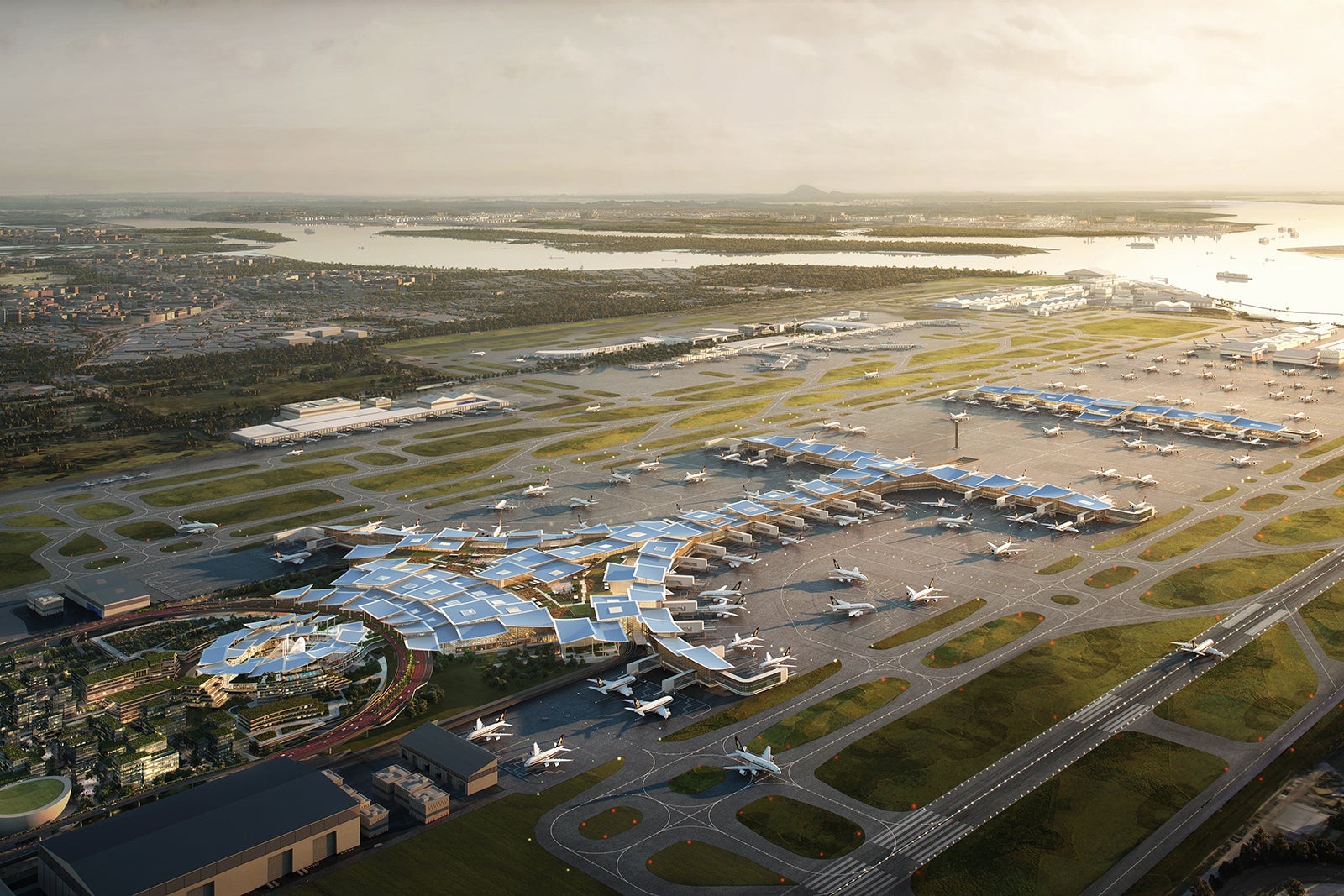
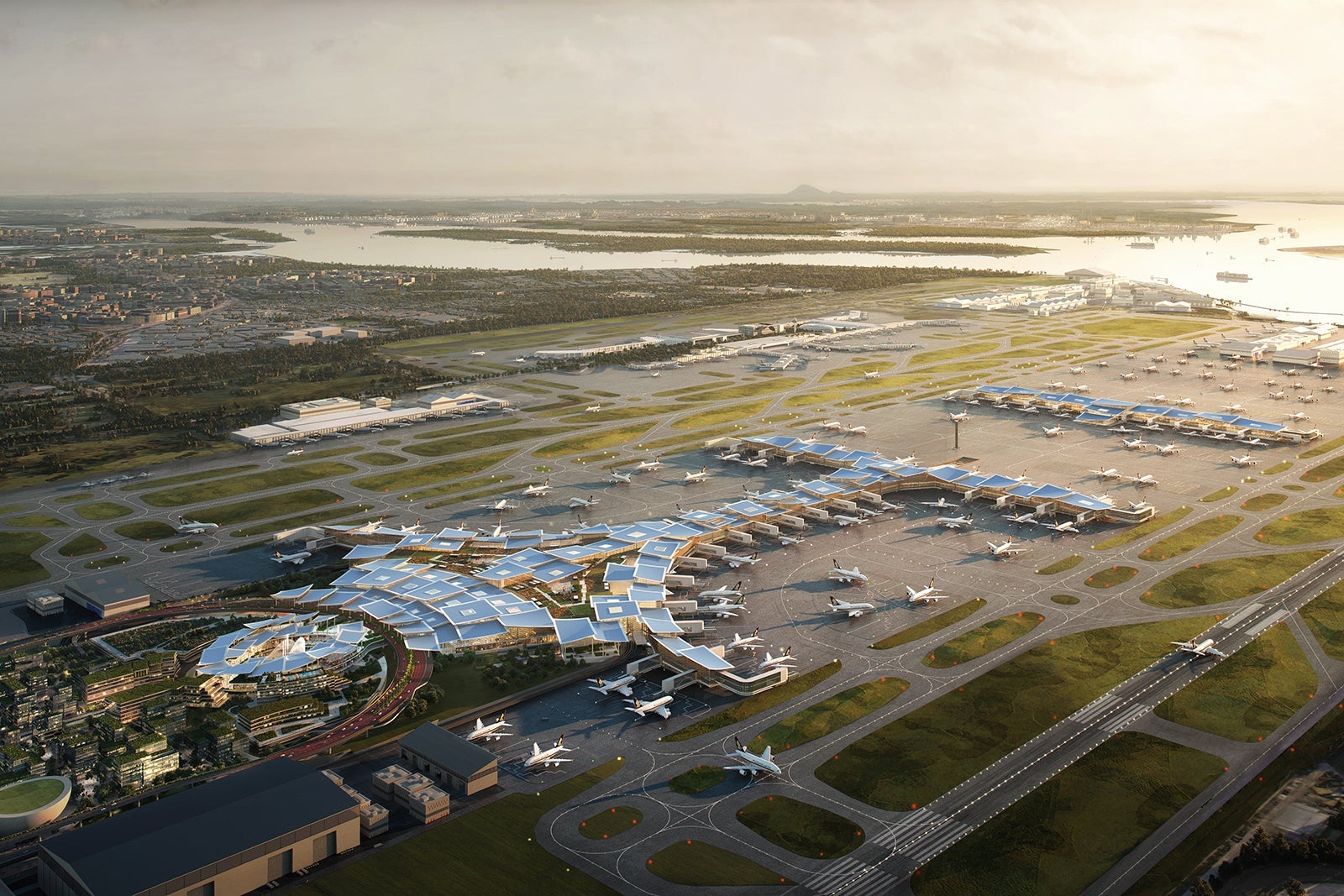
The new Terminal 5, which will be larger than all of Changi's existing terminals combined, will offer enough space to welcome 50 million additional passengers per year. That means the airport could possibly accommodate nearly twice as many passengers as before, as 68 million passengers passed through Changi's four existing terminals in 2019.
The new facility will include a whole set of adjacent urban development projects and will be built on a 2,668-acre plot of land just east of the existing terminals at the eastern tip of Singapore's island. It will use an existing runway currently set aside for Singapore's military that will be extended to handle large airliners. Its design is expected to feature Changi's signature airy spaces and greenery, plus a focus on sustainability through the use of solar panels and other eco-friendly measures.
Renderings show the new terminal will have a roughly triangular design, with an elongated "T"-shaped structure protruding from its vertex that will be lined with aircraft piers. Additional piers will be located in a satellite building situated some distance away between two runways. Tunnels will link T5 to the existing terminals, allowing the whole ensemble to operate as an integrated three-runway airport.
In addition to the terminal itself, at each end of the new airport perimeter there will be two districts currently under development: the Changi East Urban District and the Changi East Industrial Zone. Both are in line with the airport-city concept that Singapore has long embraced.
Related: Singapore Changi's Terminal 5 is coming sooner than you think
How the COVID-19 pandemic affected the new terminal's design
This expansion project at Changi isn't exactly new. It has been in the cards since at least 2013. However, it wasn't until 2018 that engineering and architectural design consultants began working on the project.

Planning was already underway by the time the COVID-19 pandemic took hold across the globe in 2020, but then all work was halted for the next couple of years. During this time, officials involved with the project reevaluated plans for the new terminal in light of the uncertainties the country had encountered when travel was at a standstill.
Once the travel industry began rebounding and the decision was made to reactivate the project, those involved proposed some important changes based on what the country had learned from the pandemic period.
For example, the new terminal's modular design makes it possible to divide the facility into smaller, independent sections, meaning areas can be closed if there's another drop in air traffic or a need to alter passenger traffic flows. The current design also features touchless technology and enhanced air ventilation systems.
Related: A first-timer's guide to Singapore's hawker centers
Bottom line
At the end of the day, the fundamentals underpinning this massive airport investment remain the same: It's a bet on the continued relevance of air travel for Singapore's economy and the larger Asia-Pacific region.
Although construction is expected to start within the next couple of years, know that there will be two phases due to the scale of the project and plans to space out the rollout of the new terminal. As a result, travelers can expect T5 to open in the mid-2030s.
While the airport's construction timeline may seem long, based on these latest details, we expect the wait will be more than worth the effort.
Here's a video announcing the latest details on the new terminal.
TPG featured card

at Capital One's secure site
Terms & restrictions apply. See rates & fees.
| 5X miles | Earn 5X miles on hotels, vacation rentals and rental cars booked through Capital One Travel |
| 2X miles | Earn unlimited 2X miles on every purchase, every day |
Pros
- Stellar welcome offer of 75,000 miles after spending $4,000 on purchases in the first three months from account opening. Plus, a $250 Capital One Travel credit to use in your first cardholder year upon account opening.
- You'll earn 2 miles per dollar on every purchase, which means you won't have to worry about memorizing bonus categories
- Rewards are versatile and can be redeemed for a statement credit or transferred to Capital One’s transfer partners
Cons
- Highest bonus-earning categories only on travel booked via Capital One Travel
- LIMITED-TIME OFFER: Enjoy $250 to use on Capital One Travel in your first cardholder year, plus earn 75,000 bonus miles once you spend $4,000 on purchases within the first 3 months from account opening - that’s equal to $1,000 in travel
- Earn unlimited 2X miles on every purchase, every day
- Earn 5X miles on hotels, vacation rentals and rental cars booked through Capital One Travel
- Miles won't expire for the life of the account and there's no limit to how many you can earn
- Receive up to a $120 credit for Global Entry or TSA PreCheck®
- Use your miles to get reimbursed for any travel purchase—or redeem by booking a trip through Capital One Travel
- Enjoy a $50 experience credit and other premium benefits with every hotel and vacation rental booked from the Lifestyle Collection
- Transfer your miles to your choice of 15+ travel loyalty programs
- Top rated mobile app