When you get sick on a plane, the airlines call this company
Nobody wants to have a medical emergency inflight.
But if you do, you're in excellent hands: You are guaranteed that there are a doctor and a team ready to assist you. It just so happens that they're physically located in an emergency room in Phoenix, Arizona, at a company called MedAire. There, MedAire helps passengers, airlines and flight crew around the world with medical issues ranging from routine to deadly serious.
I recently visited the MedAire operations center to see how the company does its job. This story, however, starts at 38,000 feet above Wisconsin.
***
Aboard a U.S. transpacific flight
The voice from the ground came through amid some static.
"Please hold on the line for the MedAire doctor."
"OK, we'll hold. Over," the flight attendant said.
Then, a brief pause.
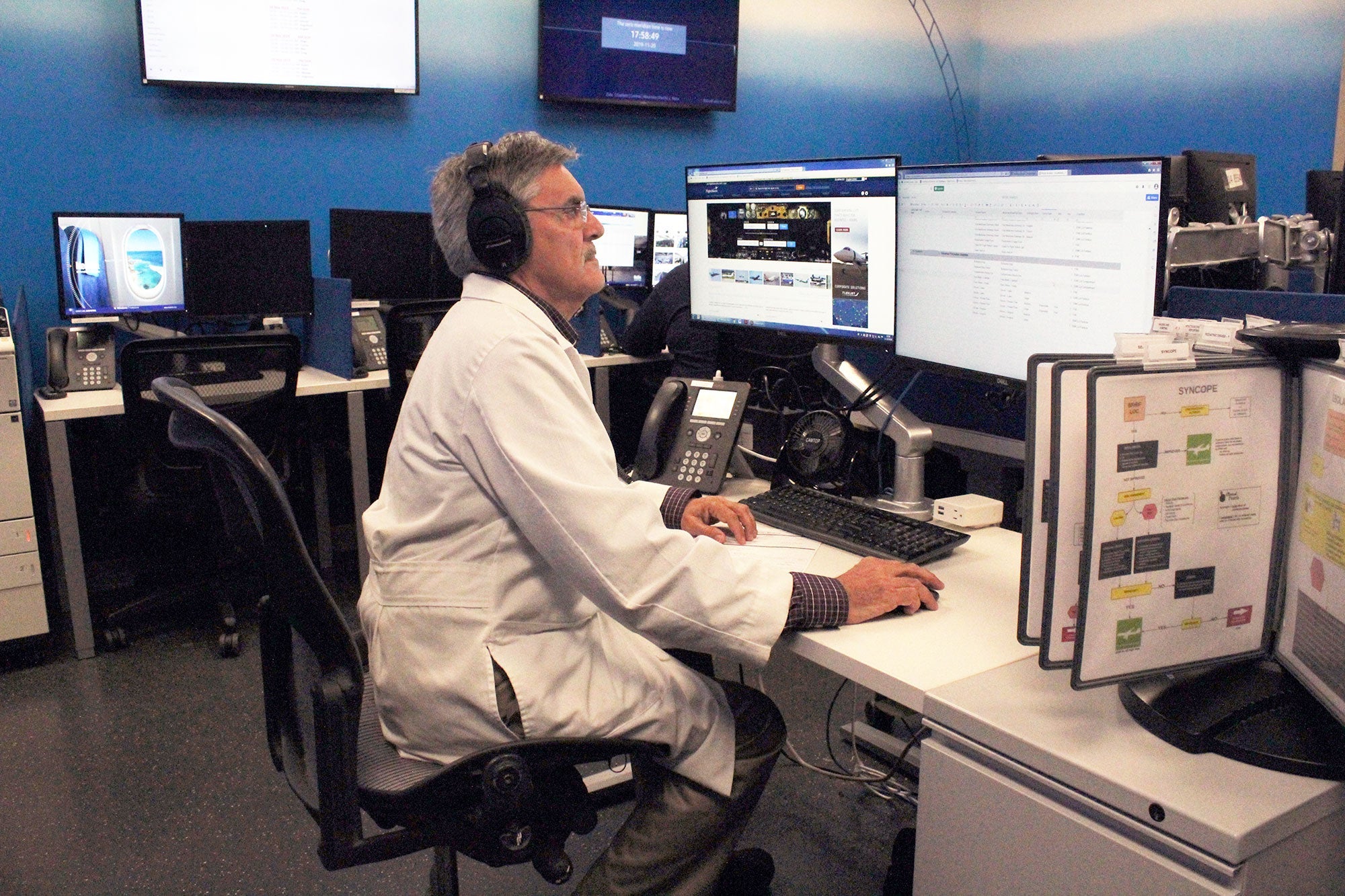
A few thousand miles away at the MedAire center, Dr. Steven Reinhart donned a Sennheiser headset and reviewed a report with the reported symptoms, passenger age, vital signs, the airline and flight info. Reinhart was calm, cool and collected. He'd been at the company since the beginning, a doctor for 40 years, and inflight medical expert for 30.

On a computer screen in front of him, Reinhart pulled up the flight on FlightAware — the same app you use when you're wondering why your plane is late. This particular flight was bound from the mainland U.S. to Hawaii. On a separate screen, he loaded a detailed list of the contents of the emergency medical kit onboard that particular type of aircraft, for that airline. Band-Aids, yes, but also epinephrine and nitroglycerin, among others.
"Hi, this is Dr. Reinhart. I understand you have a 24-year old male passenger, seeking medical assistance?"
"Yes," came the voice of a flight attendant, sounding level-headed. "He says he vomited three times in the past hour, can't hold down water, is complaining of chest pain. I can see he is sweating a lot. He took a Xanax an hour ago. He has been treated previously for anxiety but says he has no other medical conditions."
Reinhart got to work.
***
Calls just like this one rang in about once every seven minutes or so at MedAire. They have since 1985, when the company was founded by a flight nurse named Joan Sullivan Garrett. Garrett recognized the need for a proper emergency medical kit on board beyond bandages, and for seamless, ground-to-sky medical advice for commercial passenger travel. At the time, she was working at Banner University Medical Center in Phoenix and knew the emergency-room doctors well. They joined her team to create MedAire. To this day, MedAire doctors practice emergency medicine at Banner Medical and with MedAire as part of their work, like a rotation.
MedAire's main operations center sits, in fact, inside the emergency room facilities at Banner. There, a team of medical professionals handles around 100 such calls per day. In 2018, MedAire took in a whopping 42,000 inflight calls.
Nowadays, MedAire's client list is who's who of some 150 international airlines that you've almost certainly traveled on, be it short haul in the U.S. or long haul around the world.
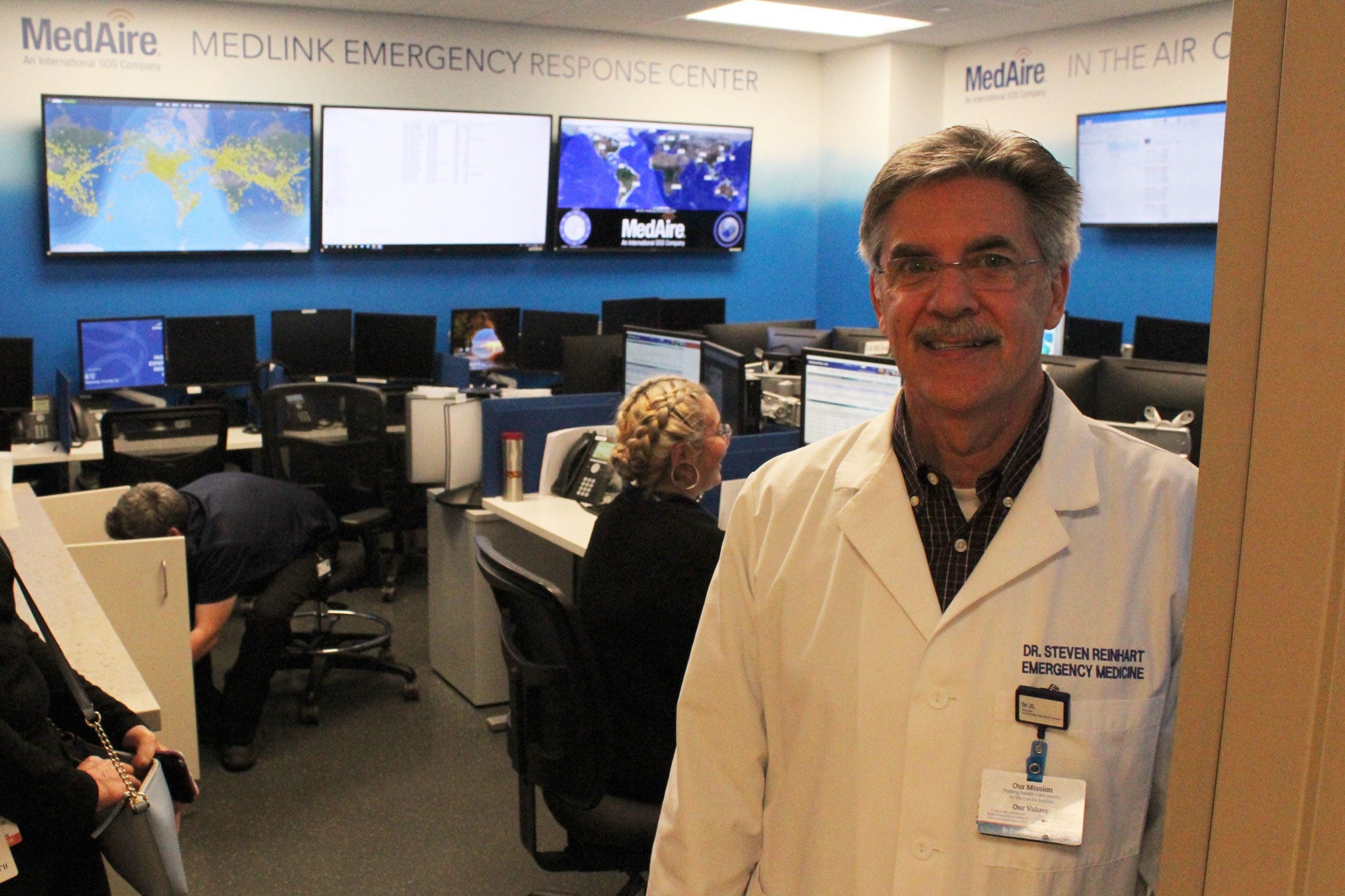
During my visit, I listened in on calls about:
- Our 24-year-old male passenger with profuse sweating, severe vomiting and anxiety;
- A female passenger with severe vomiting aboard a flight from the Middle East to Europe; and
- A 48-year-old male with asthma, whose inhaler was in his checked baggage, having difficulty breathing aboard a flight from Asia to the U.S.
That was typical. According to the company, the most common inflight medical events are:
- Gastrointestinal/Nausea (31%)
- Neurological, such as fainting or seizures (26%)
- Respiratory (7%)
- Cardiovascular (5%)
- Dermatological (5%)
I'm told there's plenty of X-rated medical issues. "If it happens on the ground, it happens in the air, too," Reinhart laughed.
Calls to MedAire are initiated from the flight deck. In the operations center, there are always four communications specialists who handle inbound calls. During my visit, they greeted calmly the pilot or flight attendant on the other end, not knowing what to expect.
Communications between the aircraft and Phoenix are made by a variety of systems, with satellite phone the preferred method. The calls I heard on my visit were relatively clear and crisp. Alternatively, the call comes via High Frequency radio, a technology in place since the 1960s. The pilots also can communicate directly from the fight deck via ACARS (Aircraft Communications Addressing and Reporting System), a messaging system similar to email and transmitted by radio. One such message came in while I was there.
***
Continuing Westbound: A French Doctor and an American Nurse Volunteer
Reinhart asked several questions of the flight attendant helping our 24-year-old passenger in distress. Based on his analysis, he suggested that the passenger take anti-nausea medication from the emergency medical kit and supplemental oxygen, among other treatments.
He told me that is sometimes hard to diagnose the exact cause of distress — profuse sweating coupled with the other symptoms is not a good sign. "Here, the passenger is 24, not, say, 66. This is not likely a heart attack," he later told me.
A few minutes passed and the flight called back. A nurse and doctor on board the plane had volunteered to help. The doctor had a heavy French accent that was hard to understand. The American nurse onboard was a better communicator; she relayed that the doctor wanted to administer the passenger a saline IV, something that is part of the medical kit. Dr. Reinhart did not object to the request of "the good doctor", as he put it.
"Could you call us back in 30 minutes to let us know how he's doing, please," Reinhart said, the situation under control. A few minutes later, more calls from other airlines came in.
***
The airlines' typical protocol is not to ask whether there is a doctor on board. Most airlines want to liaise directly with MedAire, a known quantity to them and a center of aeromedical experts. Airlines (and their captains) like orderly procedures, checklists and established protocols. They also don't want the burden of verifying the credentials of medical professionals on board, let alone making announcements likely to distress other passengers. Nevertheless, some airlines do make the call on the PA.
MedAire suggests the flight contact the company as soon as possible; many times airlines do both things simultaneously. The crew will contact MedLink, MedAire's response center, while also paging for a medical professional onboard. Doctors on the ground will often work with the onboard medical volunteer, and assist with the administration of any recommended treatment.
Reinhart told me he is grateful to have medical professionals on board who volunteer to help. Ultimately, however, the medical decisions rest with the attending physician at MedAire, and with the captain of the plane. Of course, captains defer to the MedAire doctors on all things medical.
"I mean, you don't want me flying the plane, right?" Reinhart laughed.
{"tpgImage":{"id":128705,"src":"https://runway-media-production.global.ssl.fastly.net/us/originals/2019/11/pregnant.jpg","alt":"","width":2000,"height":1333,"title":"pregnant","caption":"Nearby the doctor's desk are flow charts for procedures ranging from Ebola symptoms to pregnant passengers.","description":"<html><head></head><body></body></html>","type":"image/jpeg","credit":"","cropOffsetX":50,"cropOffsetY":50,"sizes":null}}
Near the doctor's desks are flow charts for situations ranging from Ebola symptoms to inflight labor. The latter occurs at an approximate rate of one in 26 million passengers. Count Dr. Reinhart lucky; he's got at least two cases under his belt.
A recent case came from a Middle Eastern carrier, at the time flying over India; a woman in her mid-20s was complaining of abdominal cramps. As the cramping got worse, the woman rang the flight attendants and indicated she was in distress. The crew called MedAire.
At the request of the doctor, the flight attendants felt the woman's stomach, which was hard. But the woman denied being pregnant. "This kind of situation is hard to diagnose, especially given the passenger said she wasn't pregnant," Reinhart explained. However, as her pain increased, the woman admitted that she was indeed pregnant — "probably around eight or nine months," Reinhart said. MedAire recommended that the captain divert the plane to Mumbai.
"Once it was determined that she was in labor, I instructed the flight attendant to lie her down and place her on oxygen," Reinhart said. The descent was quick, and MedAire had no further contact with the flight before it arrived in Mumbai.
The woman gave birth inflight, as the plane landed.
And what about deaths in the sky? Like births, they are extremely rare, although they occur about three times more often than births: According to MedAire data, there is approximately one inflight death per eight million passengers. Reinhart said that in the course of his 30-year career, a dozen emergencies proved fatal. "We and the flight attendants will do everything in our power to keep going with procedures and equipment if we can, but sometimes — after a certain period has passed and steps taken — there is nothing that can be done," he said.
On a happier note, passengers who have suffered heart attacks in the air undoubtedly owe their lives to Joan Sullivan Garrett and the MedAire professionals; her 2001 congressional testimony led to the requirement that US airlines carry defibrillators on all flights. (In 2019, she was inducted into the International Air & Space Hall of Fame for her contribution to medical care and safety solutions for the aviation industry.)
MedAire's team is also available for questions from gate agents around the world, who may want to know if a particular passenger is fit to fly. This might occur when a passenger is feeling ill prior to departure or when there are questions about a passenger's symptoms at the gate. Think someone who is trying to fly a day after a major surgery, or who is visibly ill or incoherent. In these cases, the gate agents can call for support from a MedAire nurse at a separate facility in Phoenix. And they do, 300 times per day from around the world. With the backing of the information and assessment provided by a nurse, the gate agent can feel comfortable allowing or denying the passenger travel.
Less than 2% of inflight medical cases where MedAire is called result in a diversion to a nearby airport. It's a joint decision between MedAire, the captain and the airline dispatch team, which MedAire has on speed dial.
What happens if you need to divert and you're over a country with limited medical services? MedAire and its parent company, International SOS, have assessed the medical facilities in cities at some 9,000 airports worldwide. The operations team can quickly input the IATA code of any of these airports and understand the availability and quality of care for passengers. For example, GYD is Baku, Azerbaijan. The system showed that the capital city has cardiology and a variety of other specialities and 24-hour care. The country itself, however, is rated as a high risk if you're not in Baku itself. Similarly, options for diversions in developing countries may not be great for passengers suffering from a complex condition, such as cardiac arrest or stroke.
***
The Looming Pacific: Contact Dispatch?
Meanwhile, the flight continued steaming on its Pacific-bound route. Reinhart's team prepared to contact the airline dispatch to consider a diversion. "Better to do that long before the airplane gets to the Pacific Ocean," the doctor said. But then, 30 minutes later, the flight attendant called again.
"The passenger has stopped sweating and is feeling better," was the report.
Reinhart was happy with the outcome.
On to the next call.
***
In most cases, MedAire doctors will recommend that a passenger see a doctor on arrival. But if needed, the communications team will contact the local airport operations and designated ambulance providers, at 9,000 airports worldwide, to coordinate care. It's an impressive command center.
So, eat your vegetables. And if you're allergic to something or have a condition, make sure you have your EpiPen or medications with you and not in the cargo hold. But if the need strikes, know that MedAire and its team are ready to respond within moments.
Mike Arnot is the founder of Boarding Pass NYC, a New York-based travel brand, and a marketing consultant to airlines, none of which appear in this article.
All photos by the author.
TPG featured card

at American Express's secure site
Terms & restrictions apply. See rates & fees.
| 4X | Earn 4X Membership Rewards® points per dollar spent on purchases at restaurants worldwide, on up to $50,000 in purchases per calendar year, then 1X points for the rest of the year. |
| 4X | Earn 4X Membership Rewards® points per dollar spent at US supermarkets, on up to $25,000 in purchases per calendar year, then 1X points for the rest of the year. |
| 5X | Earn 5X Membership Rewards® points on prepaid hotel stays booked through AmexTravel.com or the Amex Travel App™. |
| 3X | Earn 3X Membership Rewards® points on flights booked through AmexTravel.com, the Amex Travel App™, or purchased directly from airlines. |
| 2X | Earn 2X Membership Rewards® points on prepaid car rentals booked through AmexTravel.com or the Amex Travel App™ and cruises booked and paid through AmexTravel.com. |
| 1X | Earn 1X Membership Rewards® point per dollar spent on all other eligible purchases. |
Pros
- Valuable dining and food-related credits
- Flexible rewards with airline and hotel transfer partners
- Multiple travel and purchase protections
- No foreign transaction fees
- Access to Amex Offers for additional savings (enrollment required)
Cons
- Not as useful for those living outside the U.S.
- Some may have trouble using Uber and other dining credits
- You may be eligible for as high as 100,000 Membership Rewards® Points after you spend $8,000 in eligible purchases on your new Card in your first 6 months of Card Membership. Welcome offers vary and you may not be eligible for an offer. Apply to know if you’re approved and find out your exact welcome offer amount – all with no credit score impact. If you’re approved and choose to accept the Card, your score may be impacted.
- Earn 4X Membership Rewards® points per dollar spent on purchases at restaurants worldwide, on up to $50,000 in purchases per calendar year, then 1X points for the rest of the year.
- Earn 4X Membership Rewards® points per dollar spent at US supermarkets, on up to $25,000 in purchases per calendar year, then 1X points for the rest of the year.
- Earn 5X Membership Rewards® points on prepaid hotel stays booked through AmexTravel.com or the Amex Travel App™.
- Earn 3X Membership Rewards® points on flights booked through AmexTravel.com, the Amex Travel App™, or purchased directly from airlines.
- Earn 2X Membership Rewards® points on prepaid car rentals booked through AmexTravel.com or the Amex Travel App™ and cruises booked and paid through AmexTravel.com.
- Earn 1X Membership Rewards® point per dollar spent on all other eligible purchases.
- Pay It® lets you tap in the American Express® App to quickly pay for small purchase amounts throughout the month and still earn rewards the way you usually do. Plan It® gives you the option to split up big purchases into equal monthly payments with a fixed fee. You’ll know upfront exactly how much you’ll pay.
- $120 Dining Credit: Earn up to a total of $10 in statement credits monthly when you pay with the Gold Card at Grubhub (including Seamless), Buffalo Wild Wings, Five Guys, The Cheesecake Factory, and Wonder. This can be an annual savings of up to $120. Enrollment required.
- $100 Resy Credit: Get up to $100 in statement credits each calendar year at over 10,000 qualifying U.S. Resy restaurants after you pay for eligible purchases with the American Express® Gold Card. That’s up to $50 in statement credits semi-annually. Enrollment required.
- $84 Dunkin' Credit: Earn up to $7 in monthly statement credits after you pay with the American Express® Gold Card at U.S. Dunkin’ locations. Enrollment required.
- $120 Uber Cash on Gold: Enjoy up to $120 in Uber Cash annually with your Gold Card. Just add your Card to your Uber account and you'll get $10 in Uber Cash each month to use on orders and rides in the U.S. when you select an Amex Card for your transaction.
- Enjoy complimentary Hertz Five Star® Status benefits like skipping the counter at select locations, adding an additional driver at no additional cost*, and vehicle upgrades**. Benefit enrollment and Hertz Gold+ registration are required. *Additional drivers must meet standard rental qualifications and must be a spouse or domestic partner to qualify as complimentary. Other additional drivers subject to fees. **Benefits are subject to availability and vary by location. Additional Hertz program Terms and Conditions including age restrictions apply.
- Book two nights or more with The Hotel Collection through AmexTravel.com or the Amex Travel App™ and receive a $100* credit towards eligible charges at over 1,400 upscale hotels worldwide. *Eligible charges vary by property.
- Book your travel through the Amex Travel App™ with added peace of mind – backed by American Express® service and support. Only for American Express® Card Members.
- Whenever you need us, we're here. Our Member Services team will ensure you are taken care of. From lost Card replacement to statement questions, we are available to help 24/7.
- No Foreign Transaction Fees.
- Annual Fee is $325.
- Terms Apply.