What's the difference between a passport book and passport card?

Editor's Note
If you've ever applied for or renewed a U.S. passport, you may have noticed the option to purchase both a passport book and a passport card.
Although both serve as proof of your U.S. citizenship and identity, they are used for different travel purposes.
Here's all you need to know about the differences between a passport book and a passport card, as well as which one you should get.
What is a passport book?
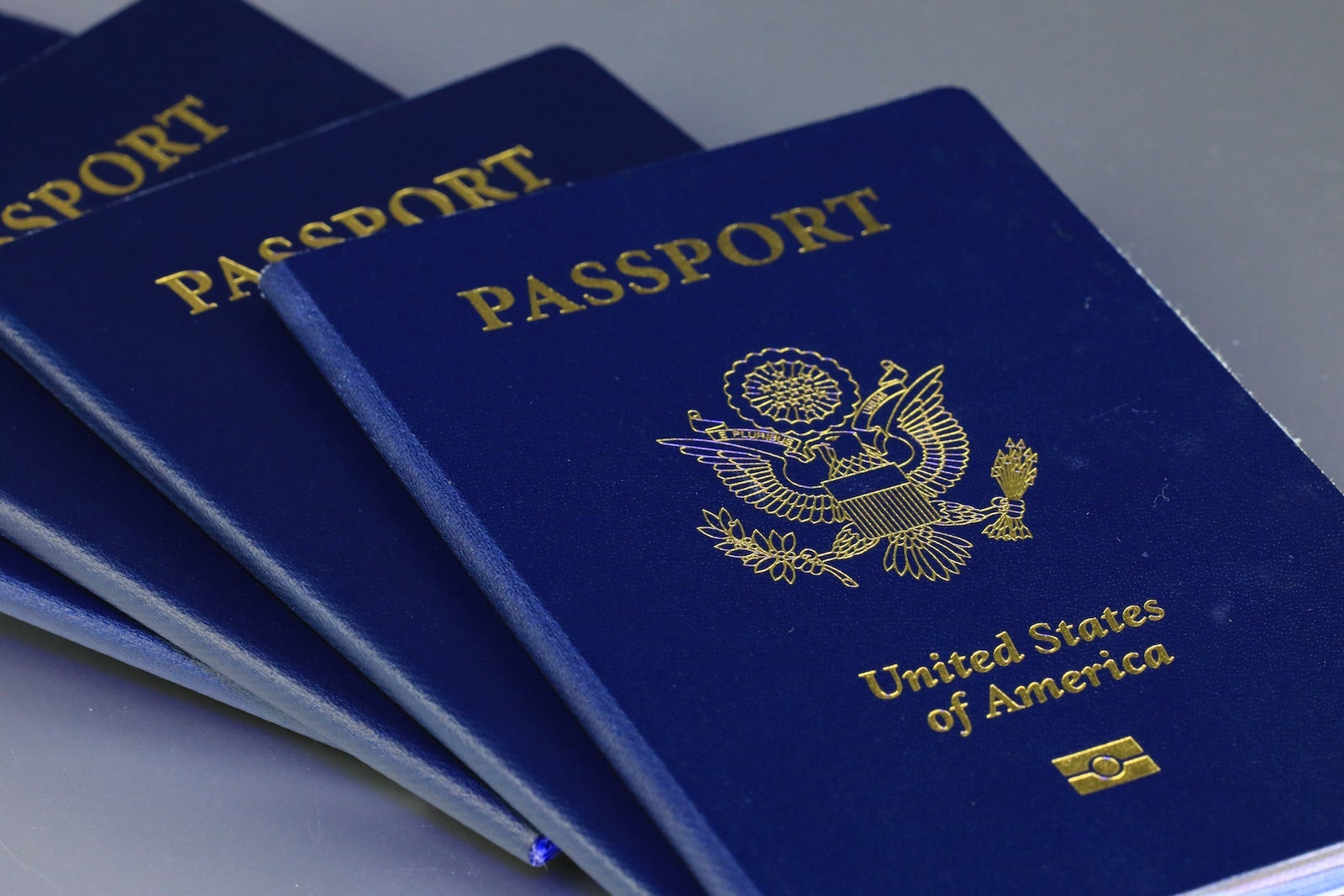
A passport book is likely the document travelers are most familiar with, as it's used for international travel to and from the U.S., including by air, sea or land.
All U.S. citizens and non-citizen nationals are eligible for a U.S. passport book.
Passport books contain identifying details, including your full name, nationality, date and place of birth, sex, place of issuance, birthplace, issuance and expiration dates, and an alphanumeric eight-digit passport number.
Biometric passport books come in the form of a booklet with a navy blue cover containing 28 pages, where border agents stamp each time you cross into a new country. Should you ever receive a visa to enter a country, that information will also be documented on those pages.
For travelers aged 16 or older at the date of issue, passport books are valid for 10 years. Otherwise, they're valid for five years, and these travelers must renew their passports at that time.
What is a passport card?
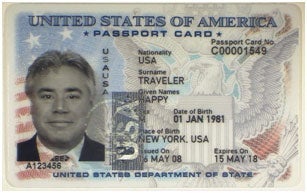
Unlike passport books, a passport card is wallet-sized, similar to the size of a driver's license. Passport cards can be used for land and sea entry to the U.S. from Canada, Mexico, Bermuda and the Caribbean.

These contain almost identical information as passport books, specifically your full name, nationality, date/place of birth, sex, issue and expiration dates, plus a unique passport card number.
All U.S. citizens and non-citizen nationals are eligible for a U.S. passport card.
Unlike passport books, a passport card can be used in Ready Lanes in Canada and Mexico, which provide expedited vehicle and pedestrian border entry for approved users by U.S. Customs and Border Protection.
Like passport books, passport cards are also valid for 10 years for travelers aged 16 and older, and five years for those under age 16 at the time of issuance.
Differences between the passport book and passport card
Size
The passport book is larger than a passport card, measuring 5 inches by 3.5 inches when closed. The passport card is the size of a standard credit card.
Cost
Overall, obtaining a U.S. passport book is much more expensive, at $165 for first-time applicants aged 16 and older, $135 for those under 16 and $130 for those who renew their passport book by mail, regardless of age.
It only costs first-time applicants aged 16 and older $65 to get a passport card, while it's $50 for younger applicants. Passport cards are renewable by mail for just $30.
Purpose
Both serve as acceptable alternatives to a state-issued ID (driver's license) for U.S. citizenship identification for travel and other purposes. However, only passport books are valid for international air travel.
Can I have both a passport book and a card?
You can apply for both a passport book and passport card at the same time, either in person using Form DS-11 or via mail using Form DS-82, simply by checking the appropriate box at the top of the form indicating that you would like to apply for both products. You cannot renew one without the other.
If you have a passport book and are eligible for mail renewal, you can also apply for a passport card renewal via mail, even if it is your first passport card.
For eligibility rules regarding mail renewal, see here.
Which should I get?
You can technically obtain both documents. However, it doesn't make sense to pay for both when a U.S. passport book grants international air, land and sea access to the U.S. from all destinations the passport card does.
Having said that, you may want to consider also applying for a passport card if you frequently travel both by air and land, as a passport card is a smaller document to travel with and potentially more convenient than carrying a traditional passport book.
Either way, both a passport book and card are accepted as forms of Real ID. As a reminder, Real-ID-compliant driver's licenses will be required to pass through TSA security lines at airports for all travelers aged 18 and older starting May 7, 2025.
Bottom line
Passport books and passport cards serve different purposes. Passport books are required as identification verification for international air travel. Passport cards serve that purpose but can only be used for land travel into the U.S. from specific destinations.
Travelers can apply for one or both documents, as they both are acceptable as U.S. citizenship identification.
TPG featured card
at American Express's secure site
Terms & restrictions apply. See rates & fees.
| 4X | Earn 4X Membership Rewards® points per dollar spent on purchases at restaurants worldwide, on up to $50,000 in purchases per calendar year, then 1X points for the rest of the year. |
| 4X | Earn 4X Membership Rewards® points per dollar spent at US supermarkets, on up to $25,000 in purchases per calendar year, then 1X points for the rest of the year. |
| 5X | Earn 5X Membership Rewards® points on prepaid hotel stays booked through AmexTravel.com or the Amex Travel App™. |
| 3X | Earn 3X Membership Rewards® points on flights booked through AmexTravel.com, the Amex Travel App™, or purchased directly from airlines. |
| 2X | Earn 2X Membership Rewards® points on prepaid car rentals booked through AmexTravel.com or the Amex Travel App™ and cruises booked and paid through AmexTravel.com. |
| 1X | Earn 1X Membership Rewards® point per dollar spent on all other eligible purchases. |
Pros
- Valuable dining and food-related credits
- Flexible rewards with airline and hotel transfer partners
- Multiple travel and purchase protections
- No foreign transaction fees
- Access to Amex Offers for additional savings (enrollment required)
Cons
- Not as useful for those living outside the U.S.
- Some may have trouble using Uber and other dining credits
- You may be eligible for as high as 100,000 Membership Rewards® Points after you spend $8,000 in eligible purchases on your new Card in your first 6 months of Card Membership. Welcome offers vary and you may not be eligible for an offer. Apply to know if you’re approved and find out your exact welcome offer amount – all with no credit score impact. If you’re approved and choose to accept the Card, your score may be impacted.
- Earn 4X Membership Rewards® points per dollar spent on purchases at restaurants worldwide, on up to $50,000 in purchases per calendar year, then 1X points for the rest of the year.
- Earn 4X Membership Rewards® points per dollar spent at US supermarkets, on up to $25,000 in purchases per calendar year, then 1X points for the rest of the year.
- Earn 5X Membership Rewards® points on prepaid hotel stays booked through AmexTravel.com or the Amex Travel App™.
- Earn 3X Membership Rewards® points on flights booked through AmexTravel.com, the Amex Travel App™, or purchased directly from airlines.
- Earn 2X Membership Rewards® points on prepaid car rentals booked through AmexTravel.com or the Amex Travel App™ and cruises booked and paid through AmexTravel.com.
- Earn 1X Membership Rewards® point per dollar spent on all other eligible purchases.
- Pay It® lets you tap in the American Express® App to quickly pay for small purchase amounts throughout the month and still earn rewards the way you usually do. Plan It® gives you the option to split up big purchases into equal monthly payments with a fixed fee. You’ll know upfront exactly how much you’ll pay.
- $120 Dining Credit: Earn up to a total of $10 in statement credits monthly when you pay with the Gold Card at Grubhub (including Seamless), Buffalo Wild Wings, Five Guys, The Cheesecake Factory, and Wonder. This can be an annual savings of up to $120. Enrollment required.
- $100 Resy Credit: Get up to $100 in statement credits each calendar year at over 10,000 qualifying U.S. Resy restaurants after you pay for eligible purchases with the American Express® Gold Card. That’s up to $50 in statement credits semi-annually. Enrollment required.
- $84 Dunkin' Credit: Earn up to $7 in monthly statement credits after you pay with the American Express® Gold Card at U.S. Dunkin’ locations. Enrollment required.
- $120 Uber Cash on Gold: Enjoy up to $120 in Uber Cash annually with your Gold Card. Just add your Card to your Uber account and you'll get $10 in Uber Cash each month to use on orders and rides in the U.S. when you select an Amex Card for your transaction.
- Enjoy complimentary Hertz Five Star® Status benefits like skipping the counter at select locations, adding an additional driver at no additional cost*, and vehicle upgrades**. Benefit enrollment and Hertz Gold+ registration are required. *Additional drivers must meet standard rental qualifications and must be a spouse or domestic partner to qualify as complimentary. Other additional drivers subject to fees. **Benefits are subject to availability and vary by location. Additional Hertz program Terms and Conditions including age restrictions apply.
- Book two nights or more with The Hotel Collection through AmexTravel.com or the Amex Travel App™ and receive a $100* credit towards eligible charges at over 1,400 upscale hotels worldwide. *Eligible charges vary by property.
- Book your travel through the Amex Travel App™ with added peace of mind – backed by American Express® service and support. Only for American Express® Card Members.
- Whenever you need us, we're here. Our Member Services team will ensure you are taken care of. From lost Card replacement to statement questions, we are available to help 24/7.
- No Foreign Transaction Fees.
- Annual Fee is $325.
- Terms Apply.