How (and why) Lufthansa trains its pilots in Phoenix, Arizona
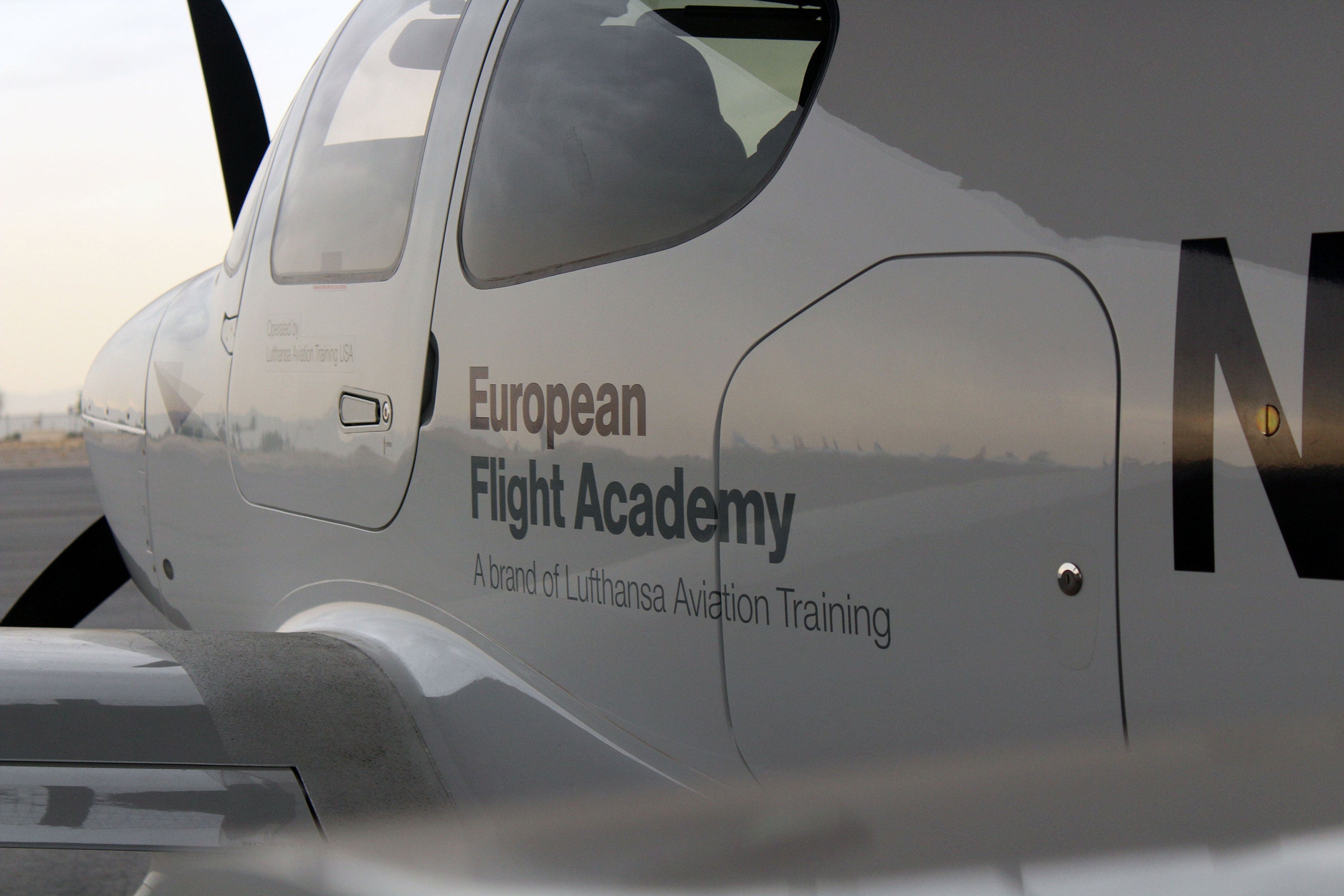
Airlines will need 800,000 pilots over the next 20 years, according to forecasts. Demand risks outpacing the supply of people trained to fly commercial aircraft.
Lufthansa is one airline that has long taken matters into its own hands when it comes to finding, training and hiring pilots. Since the 1960s, the German airline has been training its pilots in a program it owns and operates. Part of that training takes place in a surprising locale: Phoenix, Arizona.
I recently visited the facilities of Lufthansa Aviation Training USA for a look behind the scenes.
The school was originally started by American WWII vets returning from service, and developed as part of the now-defunct Pacific Southwest Airlines. Lufthansa recognized the need for consistent flight training for its recruits, and fickle German weather wasn't helping. In partnership with the U.S school, PSA began training Lufthansa and Japan Airlines pilots in 1967. In 1992, the school was sold to Lufthansa.
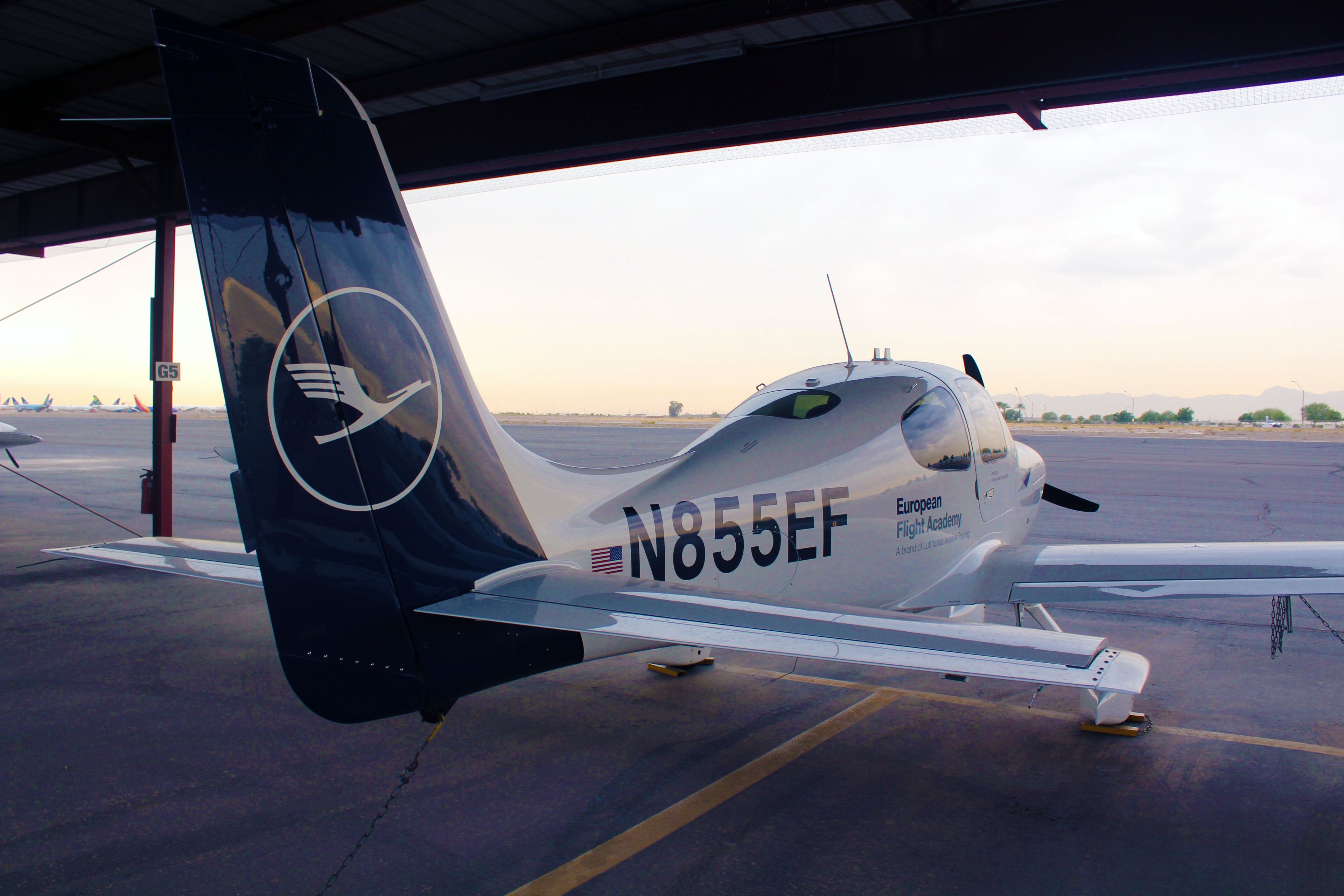
Lufthansa's methods are well-established in the 50 years it has been operating in Arizona.
"It's all about screening applicants and quality training," said Tom Lippincott, the CEO of Lufthansa's US flight training program. Lippincott carries himself exactly as you would expect —he's a former US naval aviator, airline pilot and industry veteran. He runs a tight ship, as one expects from Lufthansa; even the bathrooms were spotless.
The first thing that I noticed was the German. It seemed strange in Phoenix to hear the language. And, the pilots are young.
The Lufthansa program begins in Germany, where pilots apply to join. Echoing Lippincott's statement, Lufthansa takes only one in 10 applicants. Before acceptance, they'll go through a battery of tests and interviews, both individual and in a group setting. The individual skills test gauges English ability, math and logical thinking, multitasking ability and even motor skills. The group testing phase considers behavior, teamwork and personality. Some 10% of the student pilots and instructors in Arizona are female, mirroring industry rates; Lufthansa is making efforts to recruit more female pilots.
The induction process is relatively quick. One student I spoke with, Sebastian S. — who asked that only the initial be used for privacy reasons — applied in May 2018, had an interview within two months, and began training in November 2018. The 24-year old would have started in the summer, but had to finish some college obligations.

Students like Sebastian spend one full year working on written exams, 14 of them, as the first step before setting foot in an airplane. This program is called an ab initio program — where a pilot is trained from zero hours all the way to the right seat on the airline, where first officers sit. The ground course takes place in Bremen, Germany, and is a full-time occupation for the pilots, led by Lufthansa instructors. These are standard exams for all European airline pilots mandated by EASA, the European Union's equivalent of the US Federal Aviation Administration. The topics range from weather to communications and navigation. In Sebastian's case, 11 months later he completed the exams, and in October 2019 he arrived at Phoenix - Goodyear Airport (GYR), where the Lufthansa center is based.
Once they get to Phoenix, the recruits will start their primary flying training. They'll spend between four and six months at Goodyear, earning between 85 and 110 hours of flying time.
Students come from Lufthansa Group Airlines including Swiss, as well as ANA (All Nippon Airways) and the German Air Force.
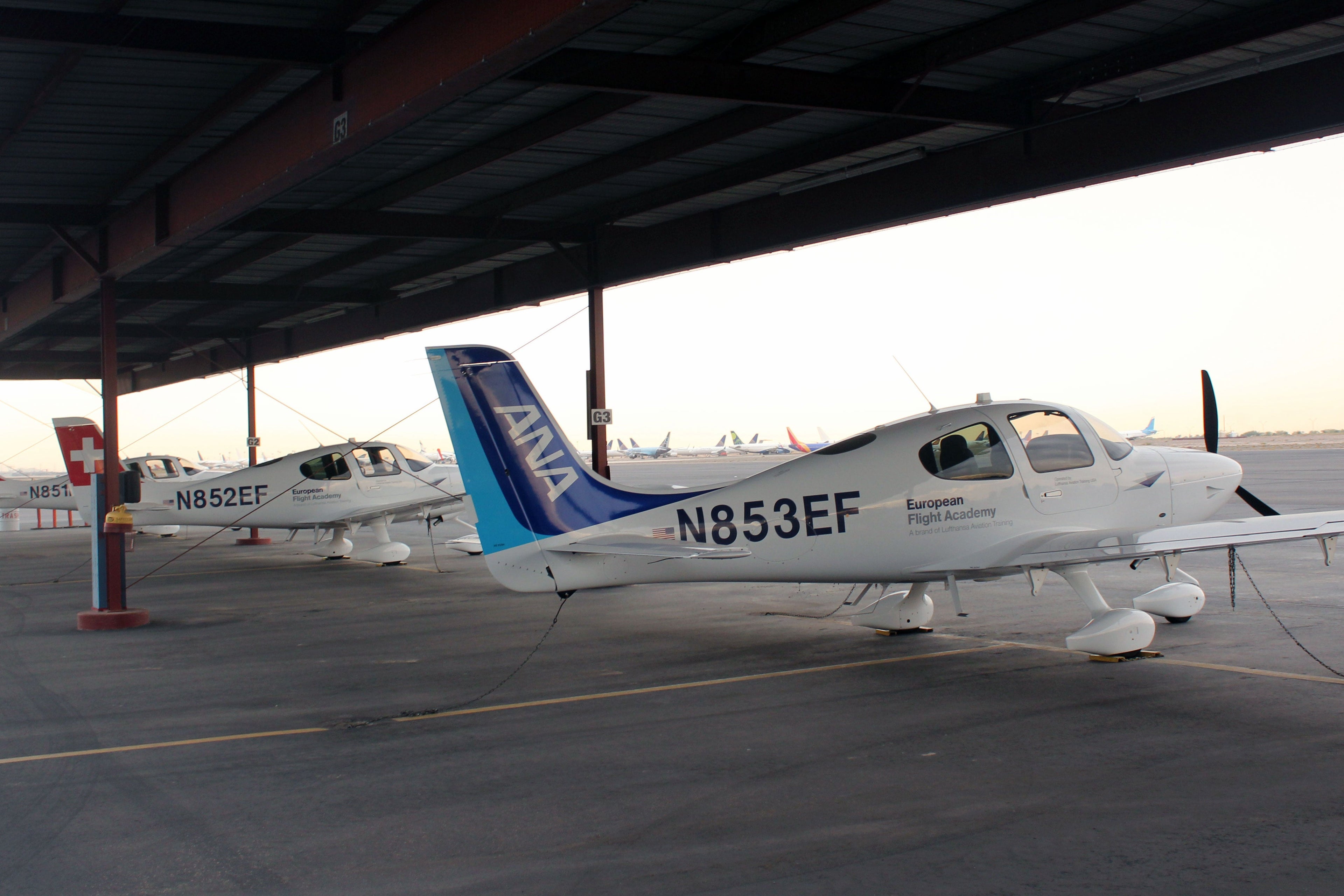
At Goodyear, Lufthansa is flying some 25 Cirrus SR20 G6 and 18 Beechcraft Bonanza F33A aircraft. The Cirrus are equipped with an aircraft parachute for emergency recovery. It's an impressive campus, with private dorm, pool and gym, cafe and coffee shop.
"We don't really get to spend much time playing football (soccer)," said Clemens R., another student pilot, noting that they did play from time to time on a nearby tennis court. That said, they did enjoy the local sights, such as Camelback mountain. Part of their flying training will include stops in Sedona, Arizona, a particularly scenic airport.
How much time they spend in Arizona depends on which track they are on: the Airline Transport Pilot License or the Multi-Crew Pilot License.
The ATPL track is more akin to a US program, with single-engine pilot training, followed by two months of multi-engine pilot training in Rostock-Laage, Germany. Then, after training on how to operate with two crew members, they'll be sent to the full-motion simulators for the Airbus A320, the smallest airplane in the mainline Lufthansa fleet. It's a two-year process to get the ATPL, which will lead them to Lufthansa's subsidiary Eurowings.
In contrast, the MPL is an accelerated track that is more like a direct path into the cockpit, akin to "vocational training," as Lipincott explained. The MPL leads to Lufthansa mainline and regional operations, as well as Austrian Airlines. The training is identical, except the trainees will spend less time in Arizona flying single-engine aircraft. They'll move back to Bremen after about four months, and learn to fly a Citation CJ1+ jet and how to operate with two crew members. After successfully passing those phases, they'll begin type-rating on full-motion simulators for the Airbus A320 or Embraer aircraft.
"Most likely I'll be with Eurowings flying the A320," said Sebastian, noting that his expected graduation is September 2019. When I spoke with him, he was around one month in and had 14 hours of flying time under his belt, but had yet to solo.
The airline will push through some 300 students per year through the program, with 140 students in training at any one time. This is with a complement of around 40 flight instructors.
U.S. versus European Airline Pilot training
In the US, before ending up at a regional airline, pilots are required to have their ratings under their belt along with 1,500 hours of flying time, most of which will be in several hundred hours of flight instruction at a flight school. They will complete a private pilot's license, instrument rating, commercial pilot's license, and then typically various flight-instructor certifications. Only then will the prospective pilot be interviewed and hired by a regional airline such as Skywest, Endeavor or Encore, which cover regional flights for the mainline carriers, who will train them on jet aircraft in simulators and pay for the final step, the Airline Transport Pilot rating. For those pilots, the ideal career progression is to graduate from the regional airline to a right seat of the main carrier, such as Delta, American or United.
It's different in Europe. Indeed, a pilot at Eurowings or Lufthansa could land in the right seat with 250 hours — albeit 250 hours of specific, intense training for the rigors of airline transport. That said, these new pilots will not have seen much in the way of bad weather, be it rain, fog, snow, sleet or icing conditions, but they are directly trained for the end goal: the Airbus A320 family of aircraft.
Sebastian estimated that his out-of-pocket cost would be €40,000 ($44,000), paid back from salary deductions once he's hired on by the airline. It's a great deal; a U.S. pilot will incur some $80,000-$85,000 in costs to earn the certifications allowing them to be an instructr, and get to 1,500 hours of total time. On top of that, they'll need to pony up or be sponsored for their Airline Transport Pilot certificate, an additional $5,000. But the situation is getting better for U.S. pilots, with signing bonuses by the regional airlines and much better pay for pilots.
Who ARE the Instructors?
Lufthansa relies on U.S-trained flight instructors to teach, and has a person dedicated to recruiting flight instructors from around the U.S. The flying portion of the program is designed with a rigorous syllabus where each lesson is mapped out, as is a student's progression through the elements of flying training, from learning how to land to controlling the airplane in stalls or other procedures.
The atmosphere during my visit was jovial but serious. Two pilots were paired with an instructor; the school has a 3-to-1 student to instructor ratio.
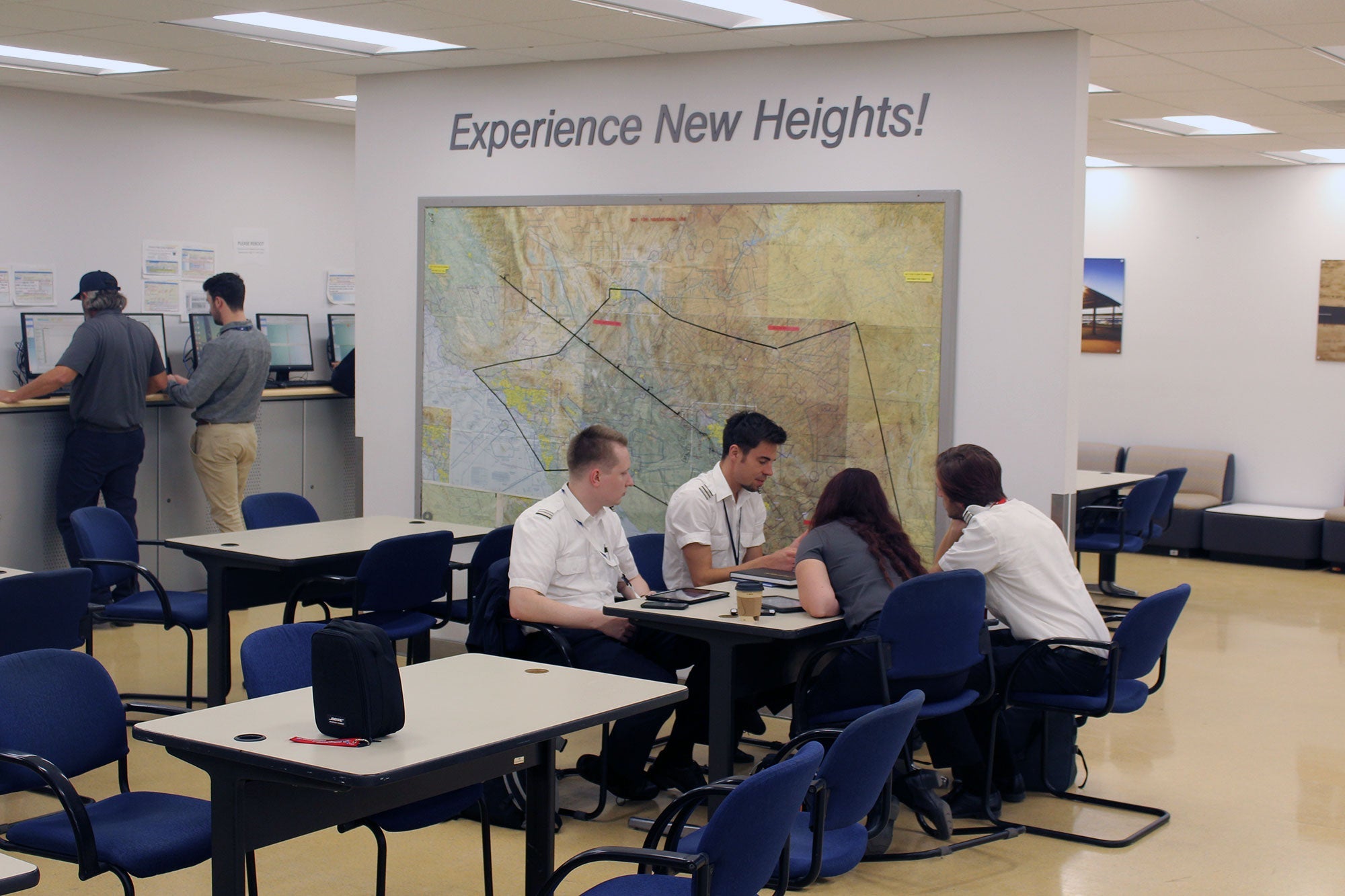
One instructor I spoke with served in the U.S. military before becoming a pilot and flight instructor. After some 700 hours at a Utah-based school, he decamped to Arizona and persuaded three other instructors to join. He struck me as exactly the kind of flight instructor you'd want for your airline and as a pilot-in-training. Calm and measured, he's on his way to a United Airlines regional airline once he hits his required 1,500 hours of flight time.
Why Phoenix?
Arizona boasts weather perfect for the most amount of training days. One flight instructor I spoke with estimated that in a year, there may be five days that are cancelled outright due to weather in the area. On the day I visited, a cold front, unusual clouds and a series of thunderstorms rolled through. But this doesn't create fair-weather pilots; trainees will see more than their fair share of poor weather as they progress with their training.
The objective is to teach the principles of flight, communication and navigation and the attendant motor skills required.
In addition, Phoenix Goodyear airport is right between Luke Air Force Base and Phoenix Sky Harbor International Airport, with its busy airspace. This is good training for the new pilots as the airspace is complex and radio chatter proceeds at a quick pace. (It's quick for any student pilot, let alone those whose first language is German or Japanese.)
Attention U.S. Flight Instructors: Lufthansa Wants You
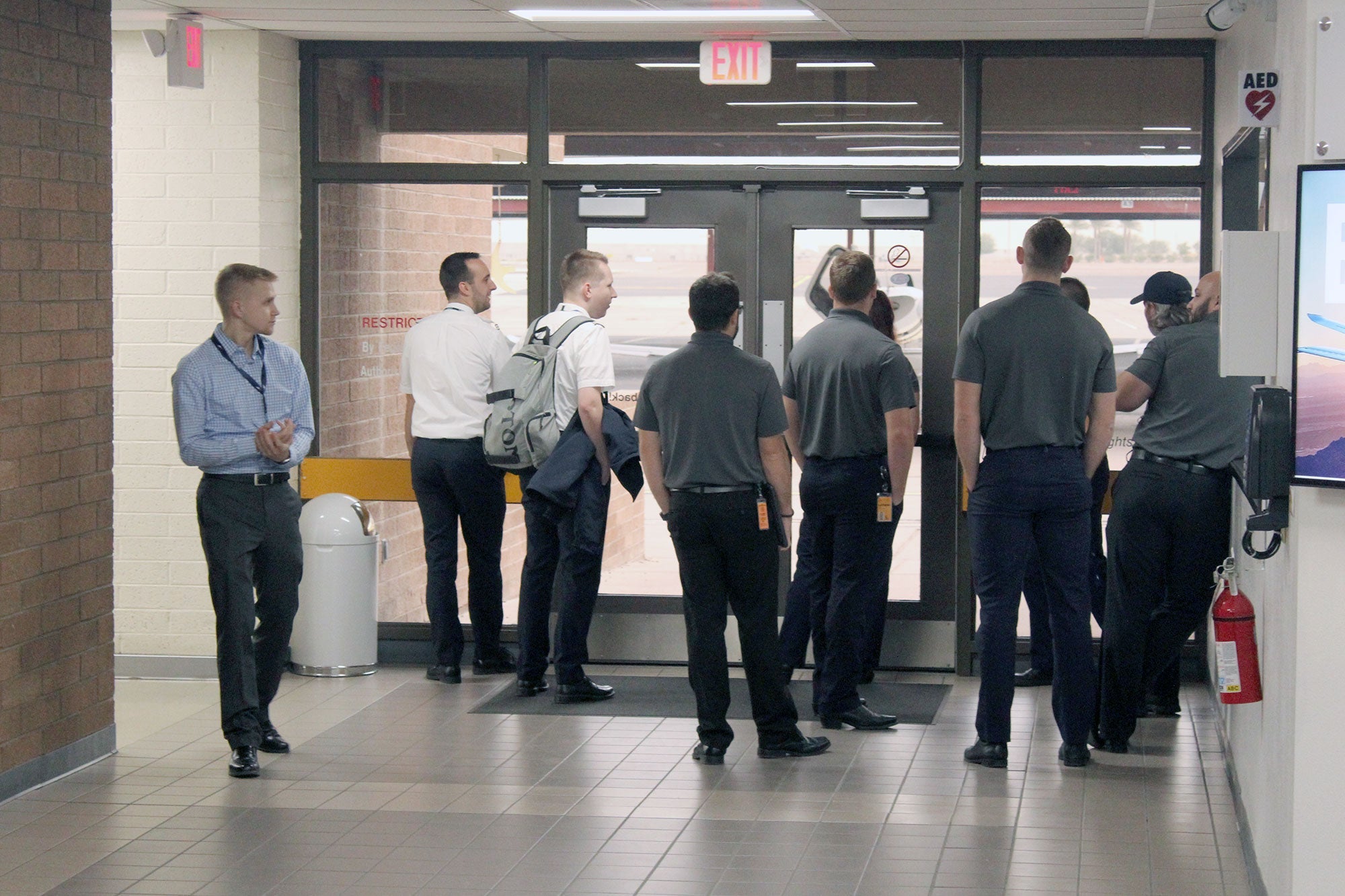
The airline is offering signing bonuses of $12,000 for U.S. certified flight instructors to join the ranks of Lufthansa instructors in Arizona. While a typical flight school runs its instructors on a six-day week of 12-hour days, Lufthansa caps its training a five days a week on an eight-hour shift. The pay is also better per hour and there are 401Ks and healthcare benefits.
What About the U.S. Airlines?
To date, no U.S. airlines own and operate their own ab initio programs; JetBlue contracted with Canada-based CAE to create its Gateway program, which brings pilots from zero to 1,500 hours and then to the airline. The cost? $125,000 per pilot, which is paid back to the airline over a period of 15 years.
However, this program is expensive compared to earning one's ratings at a local flying school or larger flying program. And it locks a pilot into a contract with one airline. Could we see a U.S. airline mirror the Lufthansa approach? Lipincott thinks so. For an airline like Delta Airlines — or more likely its regional affiliates like Skywest — such an investment might be worthwhile. They could create a Delta-ready syllabus.
And then, they'll attack the demand for pilots just the same as Lufthansa has been doing for a long time in the Arizona desert.
Mike Arnot is the founder of Boarding Pass NYC, a New York-based travel brand and a marketing consultant to airlines, none of which appear in this story.
All images by the author.
TPG featured card
at American Express's secure site
Terms & restrictions apply. See rates & fees.
| 4X | Earn 4X Membership Rewards® points per dollar spent on purchases at restaurants worldwide, on up to $50,000 in purchases per calendar year, then 1X points for the rest of the year. |
| 4X | Earn 4X Membership Rewards® points per dollar spent at US supermarkets, on up to $25,000 in purchases per calendar year, then 1X points for the rest of the year. |
| 5X | Earn 5X Membership Rewards® points on prepaid hotel stays booked through AmexTravel.com or the Amex Travel App™. |
| 3X | Earn 3X Membership Rewards® points on flights booked through AmexTravel.com, the Amex Travel App™, or purchased directly from airlines. |
| 2X | Earn 2X Membership Rewards® points on prepaid car rentals booked through AmexTravel.com or the Amex Travel App™ and cruises booked and paid through AmexTravel.com. |
| 1X | Earn 1X Membership Rewards® point per dollar spent on all other eligible purchases. |
Pros
- Valuable dining and food-related credits
- Flexible rewards with airline and hotel transfer partners
- Multiple travel and purchase protections
- No foreign transaction fees
- Access to Amex Offers for additional savings (enrollment required)
Cons
- Not as useful for those living outside the U.S.
- Some may have trouble using Uber and other dining credits
- You may be eligible for as high as 100,000 Membership Rewards® Points after you spend $8,000 in eligible purchases on your new Card in your first 6 months of Card Membership. Welcome offers vary and you may not be eligible for an offer. Apply to know if you’re approved and find out your exact welcome offer amount – all with no credit score impact. If you’re approved and choose to accept the Card, your score may be impacted.
- Earn 4X Membership Rewards® points per dollar spent on purchases at restaurants worldwide, on up to $50,000 in purchases per calendar year, then 1X points for the rest of the year.
- Earn 4X Membership Rewards® points per dollar spent at US supermarkets, on up to $25,000 in purchases per calendar year, then 1X points for the rest of the year.
- Earn 5X Membership Rewards® points on prepaid hotel stays booked through AmexTravel.com or the Amex Travel App™.
- Earn 3X Membership Rewards® points on flights booked through AmexTravel.com, the Amex Travel App™, or purchased directly from airlines.
- Earn 2X Membership Rewards® points on prepaid car rentals booked through AmexTravel.com or the Amex Travel App™ and cruises booked and paid through AmexTravel.com.
- Earn 1X Membership Rewards® point per dollar spent on all other eligible purchases.
- Pay It® lets you tap in the American Express® App to quickly pay for small purchase amounts throughout the month and still earn rewards the way you usually do. Plan It® gives you the option to split up big purchases into equal monthly payments with a fixed fee. You’ll know upfront exactly how much you’ll pay.
- $120 Dining Credit: Earn up to a total of $10 in statement credits monthly when you pay with the Gold Card at Grubhub (including Seamless), Buffalo Wild Wings, Five Guys, The Cheesecake Factory, and Wonder. This can be an annual savings of up to $120. Enrollment required.
- $100 Resy Credit: Get up to $100 in statement credits each calendar year at over 10,000 qualifying U.S. Resy restaurants after you pay for eligible purchases with the American Express® Gold Card. That’s up to $50 in statement credits semi-annually. Enrollment required.
- $84 Dunkin' Credit: Earn up to $7 in monthly statement credits after you pay with the American Express® Gold Card at U.S. Dunkin’ locations. Enrollment required.
- $120 Uber Cash on Gold: Enjoy up to $120 in Uber Cash annually with your Gold Card. Just add your Card to your Uber account and you'll get $10 in Uber Cash each month to use on orders and rides in the U.S. when you select an Amex Card for your transaction.
- Enjoy complimentary Hertz Five Star® Status benefits like skipping the counter at select locations, adding an additional driver at no additional cost*, and vehicle upgrades**. Benefit enrollment and Hertz Gold+ registration are required. *Additional drivers must meet standard rental qualifications and must be a spouse or domestic partner to qualify as complimentary. Other additional drivers subject to fees. **Benefits are subject to availability and vary by location. Additional Hertz program Terms and Conditions including age restrictions apply.
- Book two nights or more with The Hotel Collection through AmexTravel.com or the Amex Travel App™ and receive a $100* credit towards eligible charges at over 1,400 upscale hotels worldwide. *Eligible charges vary by property.
- Book your travel through the Amex Travel App™ with added peace of mind – backed by American Express® service and support. Only for American Express® Card Members.
- Whenever you need us, we're here. Our Member Services team will ensure you are taken care of. From lost Card replacement to statement questions, we are available to help 24/7.
- No Foreign Transaction Fees.
- Annual Fee is $325.
- Terms Apply.