Insider Series: How Do Flight Attendants Get Their Routes?
Our TPG Insider Flight Attendant Carrie A. Trey delves back into life at 35,000 feet, this time explaining how exactly flight attendants' hectic schedules work, and what goes into putting them together.

"Is this your route?"
If I had a nickel for every time I was asked that question, I would definitely be doing something other than writing this article right now. (Like, say, sipping Ruinart Champagne on Necker Island after I bought it from Sir Richard Branson.) Instead, I'm here to save you from asking that question, because 99.9% of the time, the answer is "no." Though they may fly one route a lot, flight attendants are not assigned to specific routes.
Now I imagine that some of you are now thinking, "My friend Trina flies for XYZ Airlines and she says she only flies to Tokyo on Tuesdays." And yes, that's possible — but allow me to explain how bidding works, how schedules are awarded and why that still is not "her route."
Many European carriers have crews based in Asia and India, and sometimes South America. They're local crews who fill in one to two positions on the trip so that there will be attendants onboard who can communicate easily with foreign-language speakers. For example, Virgin Atlantic had a Hong Kong (HKG) crew base that often took over several positions on their HKG-Sydney (SYD) route; these same HKG-based flight attendants would also sometimes go to London Heathrow (LHR), Shanghai (PVG), Tokyo-Narita (NRT) or even North America. In other words, even though they mostly flew HKG-SYD, they did have other trips as well, and no one flight attendant was dedicated to just one route.
Fortunately, the United States being the cultural melting pot that it is, airlines here have little use for foreign bases because it's easier to source multi-lingual crew within the country. American Airlines has bases in South America, and Delta in Asia, but it's not for a lack of US-based staff who speak other languages. (Delta inherited those bases from NorthWest in their merger and is actually closing them down in favor of flying with all US-based crews.) At United (sub-Continental or sCO), for instance, if you're qualified as a speaker of German, you can be based in Newark (EWR) or Houston (IAH) and you'll fly mostly to German-speaking destinations; however, you'll still have the opportunity to pick up trips to other places.
Bidding works a few different ways. There is line-bidding, which is still done at American Airlines, Southwest and United (sCO). Flight attendants bid for a pre-assembled line of trips, which are then awarded in seniority order. So a flight attendant flying out of American's domestic base at Dallas/Fort Worth (DFW) might have trips for all of April that are essentially the same: DFW-Chicago (ORD)-Los Angeles (LAX) on day one, LAX-New York-JFK on day two, and JFK-Miami (MIA)-DFW on day three. So all month long, that flight attendant could potentially be working the same flights. However, what you can hold every month does change, and flight attendants also have the flexibility to trade trips amongst themselves.
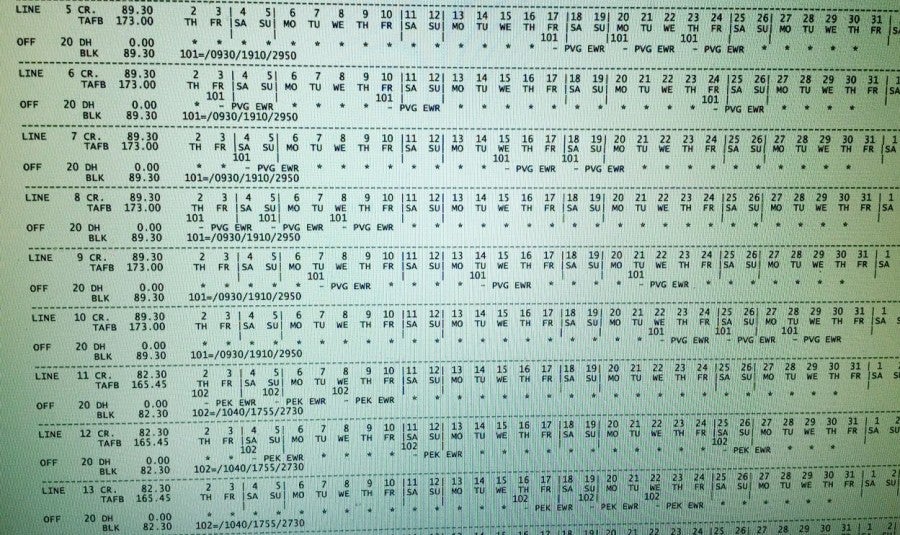
Out of the EWR international base, a line might be EWR-PVG every Tuesday of the month, returning on Thursday — as you'll see on line 9 on the United Airlines bid packet pictured below. So an attendant could potentially be flying the same trip for a month. However, what an attendant can hold each month depends on seniority and changes constantly, as colleagues take vacation or head out on leaves — and some folks just enjoy bidding for different things every month. Variety is the spice of life, after all.
In other words, that flight attendant pal of yours who flies Tokyo on Tuesdays may well be flying that route this month, but if her friend from training who is one number senior decides next month that she wants Tokyo, the company will award it to the senior and your friend Trina will have to fly somewhere else.

Also, in case of irregular operations (e.g., weather, delays, mechanical issues — all the things that we hate to think about but we know happen all too often), scheduling might shuffle crews around if need be. Most US airlines are fairly liberal about letting their crews swap trips amongst themselves, so the line you're awarded at the beginning of the month may not be at all reflective of what you'll actually end up flying.
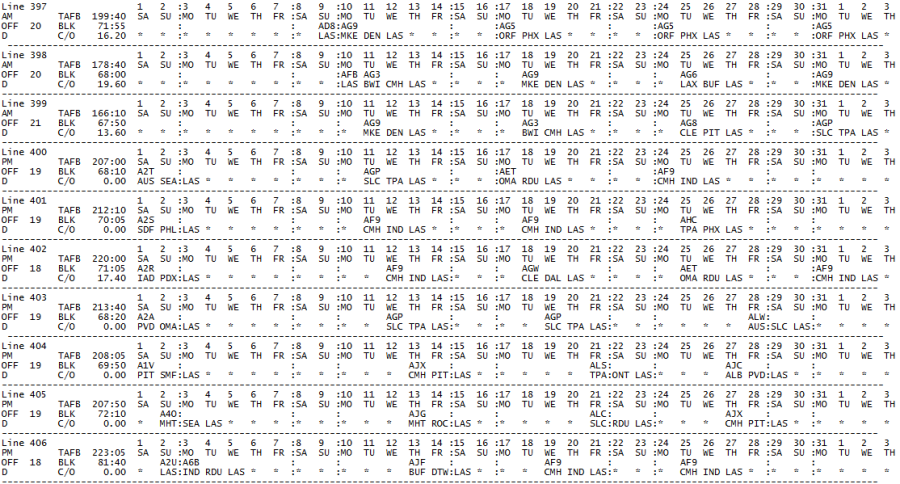
At Southwest, as you can see in the example of a bid packet below, you might have a trip every Monday (as in line 397), but the layovers and legs flown will likely all be different.
Another system is called the Preferential Bidding System (PBS). This is a more popular system than line-bidding, as it provides more benefit to the company by leaving fewer trips uncovered. Delta, JetBlue and Air Canada use this system, as do most airlines in Europe and Asia. PBS allows flight attendants to input a series of requests, then does its best to adhere to those requests when awarding schedules, honoring them in seniority order. This system is bound by certain built-in constraints, such as a schedule value (that is, how much the airline needs each flight attendant to work in order to cover the entire operation), language qualifications, etc. Some airlines award schedules once a month, and some (like KLM) award them on a rolling basis.
Regardless of how bids are made, a lot goes into building a schedule. There are minimum time-off restrictions based on the length of a trip flown, minimum days off, and in Europe, flight attendants aren't allowed to work more than 900 hours a year. (There are similar restrictions in place in the United States for pilots, but nothing is officially on the books for flight attendants.)
At Cathay Pacific, for instance, crews are only allowed to fly two trans-polar trips a month, in order to reduce crews' exposure to harmful radiation. At KLM, the length of a trip dictates the number of days off that a crew member is required to have off after that trip. A transatlantic trip to the East Coast of the US, for instance, must have three calendar days off built in after the trip, whereas a longer trip [e.g., to Lima (LIM) or Singapore (SIN)] will have eight days of rest built in before the crew member is legally allowed to fly again.
The result of these various scheduling systems, changing network/operational demands and government regulations mean that no flight attendant has a regular route. Most airlines do use something more along the lines of PBS, and at some airlines — such as South African Airways, for instance — crews are just given a schedule every month and must fly what they get.

So chances are that no, your particular flight attendant is not flying his/her specified route, unless said attendant has seniority, in which there's a good chance this route is his or her comfort zone. And if the attendant is lucky enough to fly for a US airline that has a complex bidding system that rewards seniority, then yes, he or she will fly the same thing pretty often.
The rest of us simply get to live the dream and see the world — which suits me just fine!
TPG featured card

at Capital One's secure site
Terms & restrictions apply. See rates & fees.
| 5X miles | Earn 5X miles on hotels, vacation rentals and rental cars booked through Capital One Travel |
| 2X miles | Earn unlimited 2X miles on every purchase, every day |
Pros
- Stellar welcome offer of 75,000 miles after spending $4,000 on purchases in the first three months from account opening. Plus, a $250 Capital One Travel credit to use in your first cardholder year upon account opening.
- You'll earn 2 miles per dollar on every purchase, which means you won't have to worry about memorizing bonus categories
- Rewards are versatile and can be redeemed for a statement credit or transferred to Capital One’s transfer partners
Cons
- Highest bonus-earning categories only on travel booked via Capital One Travel
- LIMITED-TIME OFFER: Enjoy $250 to use on Capital One Travel in your first cardholder year, plus earn 75,000 bonus miles once you spend $4,000 on purchases within the first 3 months from account opening - that’s equal to $1,000 in travel
- Earn unlimited 2X miles on every purchase, every day
- Earn 5X miles on hotels, vacation rentals and rental cars booked through Capital One Travel
- Miles won't expire for the life of the account and there's no limit to how many you can earn
- Receive up to a $120 credit for Global Entry or TSA PreCheck®
- Use your miles to get reimbursed for any travel purchase—or redeem by booking a trip through Capital One Travel
- Enjoy a $50 experience credit and other premium benefits with every hotel and vacation rental booked from the Lifestyle Collection
- Transfer your miles to your choice of 15+ travel loyalty programs
- Top rated mobile app