Skip to content

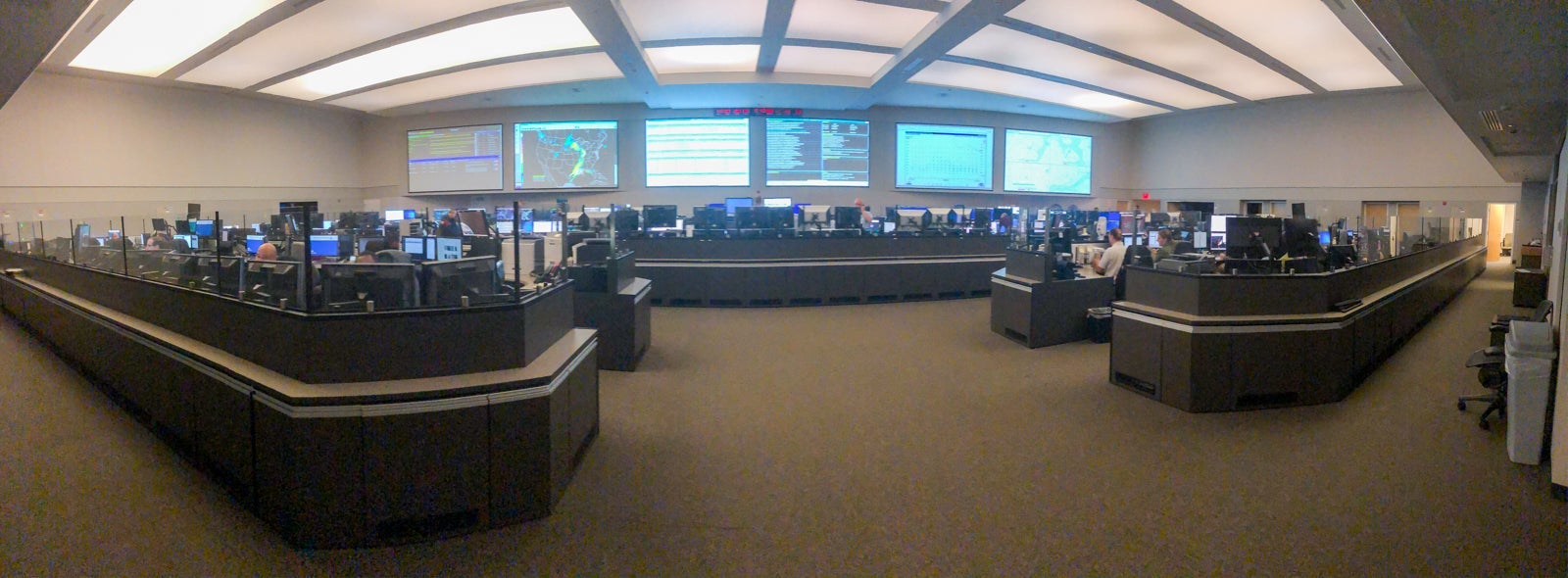
Inside the room where the FAA controls US airspace

Oct. 23, 2019
5 min read
FAA Command Center
Inside the room where the FAA controls US airspace
The cards we feature here are from partners who compensate us when you are approved through our site, and this may impact how or where these products appear. We don’t cover all available credit cards, but our analysis, reviews, and opinions are entirely from our editorial team. Terms apply to the offers listed on this page. Please view our advertising policy and product review methodology for more information.

I felt like I'd arrived at a super cool, progressive high school in the Virginia suburbs.

After driving through subdivisions of huge cookie-cutter houses, I pulled up to a gatehouse, with two modern-looking buildings in the distance. I was directed into the visitor's parking lot.

I cleared security, and the guard took me over to a big map on the wall.

"We have two buildings on this campus," he said, pointing to the diagram. "TRACON is this big building, and the command center is the smaller one." He took me to the door. "You're going to walk over to that second flag pole."

I was definitely not in high school.

I was at the Federal Aviation Administration's Air Traffic Control System Command Center, a world heavy with acronyms — TRACON stands for "terminal radar approach control" — where US airspace is managed every day.

In the hierarchy of air traffic control, this facility sits at the very top. It tells all the other ATC facilities around the country what to do with their airspace every day. The command center is basically the puzzle master, synthesizing the needs of airlines and industry stakeholders against constraints like weather, runway closures and other issues that affect the free movement of airplanes through the skies.

According to Jennifer Ross, the national operations manager, the command center has to "mediate competing interests to do what's best for national airspace."

To that end, the command center has seats on the floor for industry organizations to take part in the decision-making process. There's Airlines for America, the airlines' industry group; IATA, their international association; the National Business Aviation Association; and others, who are all represented every day as FAA employees figure out the best air traffic patterns to move planes safely and efficiently.

Daily Newsletter
Reward your inbox with the TPG Daily newsletter
Join over 700,000 readers for breaking news, in-depth guides and exclusive deals from TPG’s experts

But these decisions aren't made spontaneously.

The command center tries to plan as far in advance as possible. Planning around the weather can begin two to four days ahead of time, but coordination about pre-planned events like the Super Bowl or rocket launches, which cause extra traffic and/or airspace closures, can begin even earlier.

Generally, one person (with the backing of an advanced planning team) is in charge of coordinating and executing a plan from start to finish. When the day is done, the outcomes of the day's execution are reviewed, so a refined version of the plan can be used in similar circumstances in the future.

On the day I visited, a front passing across the middle of the country — the green, yellow and white shape in the image below — was affecting air traffic in Houston and Chicago. Some planes traveling west to Houston had to fly past the city, and then approach in an easterly direction to avoid the worst of the weather.

Although the day's rules are applied broadly to every plane in US airspace, the system still has some flexibility on a case-by-case basis.

Ross explained that exceptions can always be made to the day's traffic pattern if the rules unduly affect certain flights.

The example she used: if all flights from New York to Seattle were routed on a northerly track over Canada, but one specific plane would have to stop to refuel if it followed that route, that plane could apply for an alternative flight path.

To keep stakeholders informed, there are planning webinars every two hours that include controllers around the country, airline representatives, airport operators and others. The regular updates help ensure the traffic plan is being executed efficiently, and is appropriate for real-world conditions in the moment. Ahead of those planning sessions, operational employees are given a briefing about weather conditions, so they can update the plan as needed. Weather briefings are also available to supervisors and specialists as needed.

During major events like snowstorms, airport operators are intimately involved in the planning process, keeping controllers in the command center up-to-date on how quickly they can clear runways and how much traffic their facilities can handle.

Airlines and other stakeholders have access to a limited version of much of the information synthesized by the command center, allowing individual companies to figure out how to best respond to reduced capacity in certain regions and at certain airports.

In times of crisis, special teams assemble in what's known as the Joint Air Traffic Operations Center, in a special room just off the main command center floor, where those most affected by the event can coordinate more closely.

Every day brings different challenges, but the national command center is ultimately responsible for keeping the airspace over the US safe and moving efficiently, no matter what obstacles Mother Nature or anyone else tries to put in the way.

All photos by Zach Wichter/The Points Guy.

TPG featured card

Best for businesses with high spending
TPG Editor‘s Rating
4.5 / 5
Go to review

Rewards

2 - 10X miles

Intro offer

LIMITED-TIME OFFER: Earn up to 400K bonus miles

Annual Fee

$395

Recommended Credit

740-850
Excellent

Why We Chose It

The Capital One Venture X Business Card has all the Capital One Venture X Rewards Credit Card has to offer and more. It offers an incredible welcome bonus and requires an equally impressive spend to qualify. In addition, the card comes with premium travel perks like annual travel credit. (Partner offer)

Pros

  • The Capital One Venture X business card has a very lucrative welcome offer.
  • In addition, the card comes with many premium travel perks such as an annual $300 credit for bookings through Capital One Business Travel.
  • Business owners are also able to add employee cards for free.

Cons

  • The card requires significant spending to earn the welcome offer.
  • Another drawback is that the annual travel credit can only be used on bookings made through Capital One Business Travel.
  • LIMITED-TIME OFFER: Earn up to 400K bonus miles: 200K miles when you spend $30K in the first 3 months, and an additional 200k miles when you spend $150k in the first 6 months
  • Earn unlimited 2X miles on every purchase, everywhere—with no limits or category restrictions
  • Earn 10X miles on hotels and rental cars and 5X miles on flights and vacation rentals booked through Capital One Business Travel
  • With no preset spending limit, enjoy big purchasing power that adapts so you can spend more and earn more rewards
  • Empower your teams to make business purchases while earning rewards on their transactions, with free employee and virtual cards. Plus, automatically sync your transaction data with your accounting software and pay your vendors with ease
  • Redeem your miles on flights, hotels and more. Plus, transfer your miles to any of the 15+ travel loyalty programs
  • Every year, you'll get 10,000 bonus miles after your account anniversary date. Plus, receive an annual $300 credit for bookings made through Capital One Business Travel
  • Receive up to a $120 credit for Global Entry or TSA PreCheck®. Enjoy access to 1,300+ airport lounges worldwide, including Capital One Lounge locations and Priority Pass™ lounges, after enrollment
  • Enjoy a $100 experience credit and other premium benefits with every hotel and vacation rental booked from the Premier Collection
  • This is a pay-in-full card, so your balance is due in full every month
Apply for Capital One Venture X Business
at Capital One's secure site
Terms & restrictions apply. See rates & fees
Best for businesses with high spending
TPG Editor‘s Rating
4.5 / 5
Go to review

Rewards Rate

2X miles2 miles per dollar on every purchase
5X miles5 miles per dollar on flights and vacation rentals booked through Capital One Business Travel
10X miles10 miles per dollar on hotels and rental cars booked through Capital One Business Travel
  • Intro Offer

    LIMITED-TIME OFFER: Earn up to 400K bonus miles
  • Annual Fee

    $395
  • Recommended Credit

    740-850
    Excellent

Why We Chose It

The Capital One Venture X Business Card has all the Capital One Venture X Rewards Credit Card has to offer and more. It offers an incredible welcome bonus and requires an equally impressive spend to qualify. In addition, the card comes with premium travel perks like annual travel credit. (Partner offer)

Pros

  • The Capital One Venture X business card has a very lucrative welcome offer.
  • In addition, the card comes with many premium travel perks such as an annual $300 credit for bookings through Capital One Business Travel.
  • Business owners are also able to add employee cards for free.

Cons

  • The card requires significant spending to earn the welcome offer.
  • Another drawback is that the annual travel credit can only be used on bookings made through Capital One Business Travel.
  • LIMITED-TIME OFFER: Earn up to 400K bonus miles: 200K miles when you spend $30K in the first 3 months, and an additional 200k miles when you spend $150k in the first 6 months
  • Earn unlimited 2X miles on every purchase, everywhere—with no limits or category restrictions
  • Earn 10X miles on hotels and rental cars and 5X miles on flights and vacation rentals booked through Capital One Business Travel
  • With no preset spending limit, enjoy big purchasing power that adapts so you can spend more and earn more rewards
  • Empower your teams to make business purchases while earning rewards on their transactions, with free employee and virtual cards. Plus, automatically sync your transaction data with your accounting software and pay your vendors with ease
  • Redeem your miles on flights, hotels and more. Plus, transfer your miles to any of the 15+ travel loyalty programs
  • Every year, you'll get 10,000 bonus miles after your account anniversary date. Plus, receive an annual $300 credit for bookings made through Capital One Business Travel
  • Receive up to a $120 credit for Global Entry or TSA PreCheck®. Enjoy access to 1,300+ airport lounges worldwide, including Capital One Lounge locations and Priority Pass™ lounges, after enrollment
  • Enjoy a $100 experience credit and other premium benefits with every hotel and vacation rental booked from the Premier Collection
  • This is a pay-in-full card, so your balance is due in full every month