How to Avoid a $500 Fine at Customs and Border Protection

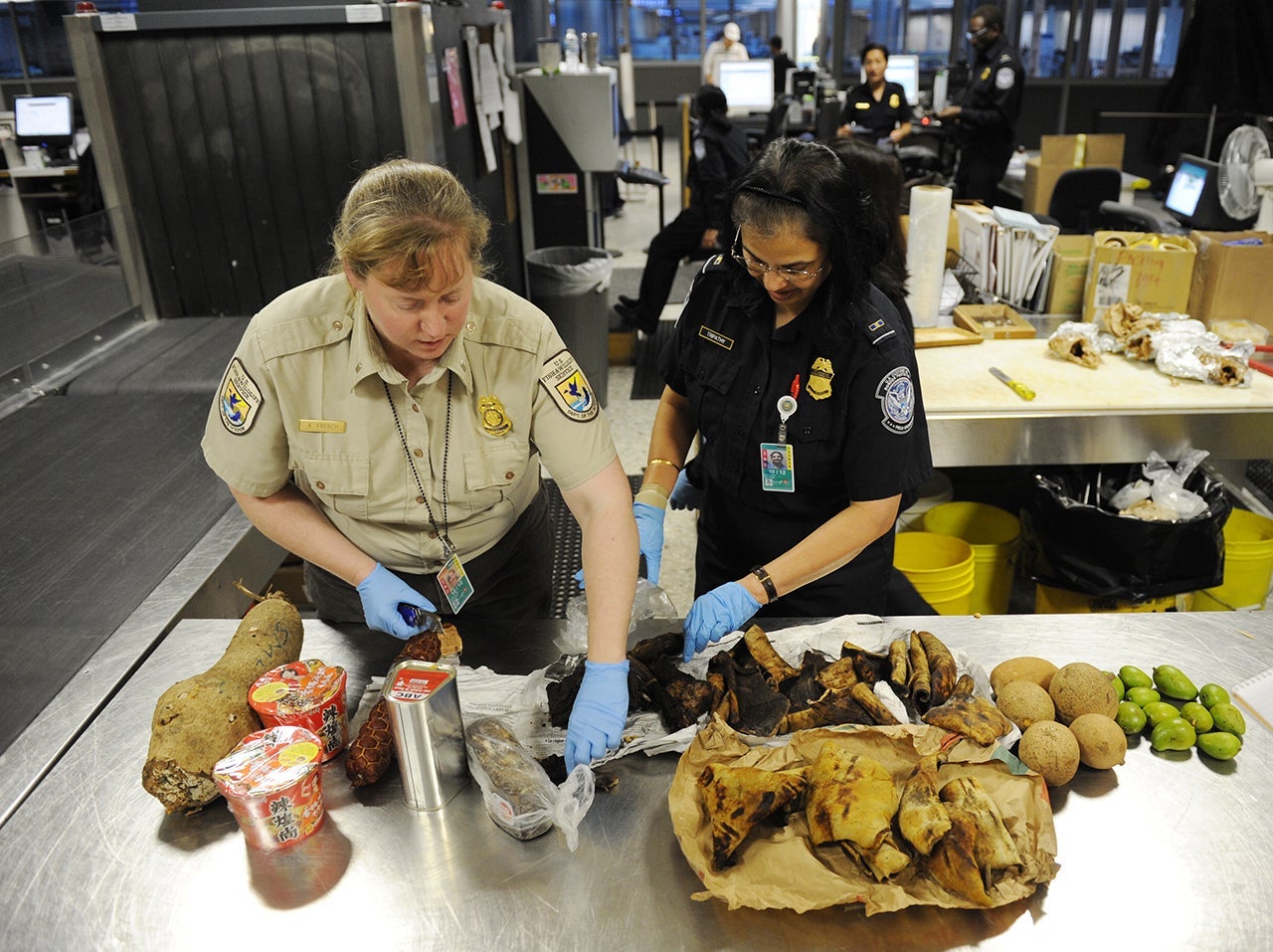
Whether you're filling out a familiar blue customs declaration form or tapping the screen of an Automated Passport Control or Global Entry kiosk, you're going to have to answer Question 11, Part A.
Are you bringing fruits, vegetables, plants, seeds, food or insects into the United States?
Admit it. Even as a frequent flier, you've paused here to consider the in-flight peanuts stowed in your purse or the loose orange you snagged at the airport lounge. After all, it's not always obvious whether or not these items need to be declared.
"With food and agriculture products, the best advice to travelers is to always declare it," a US Customs and Border Protection public affairs officer told The Points Guy.
"While many [items] may be permissible, it's best to declare them to avoid possible fines and penalties if they are deemed prohibited."
A firm statement on the US Customs and Border Protection website warns passengers that "all food products" must be declared, and that failure to do so "can result in up to $10,000 in fines and penalties."
The short answer, therefore, is that you should always check "yes" if there's anything edible in your suitcase.
But not all foods are equally concerning in the eyes of CBP agents. Generally speaking, processed items (including crackers, candy and even roasted coffee beans) are admissible.
Don't worry about prepared foods.
Because restrictions are in place to avoid causing injury or harm (CBP cites the example of a single piece of contaminated produce that caused a Mediterranean fruit fly outbreak in the 1980s) it's mostly raw fruits, vegetables, meats, seeds and nuts that raise a red flag for US Customs and Border Protection agents.

To that point, once a fruit has been dried, it's typically permissible — as are nuts that have been boiled, cooked, ground, oven-dried, roasted, pureed or steamed.
Chocolate bars, granola bars and souvenir jars of Vegemite or Marmite are also generally fine.
Though it's best to avoid traveling with particularly pungent cheeses as a courtesy to your fellow travelers, many can be brought into the United States.
Among those cheeses that have general pre-approval are Brie, Camembert and Buffalo Mozzarella. (It's not included on the list, but we're inclined to think a CBP agent would let you cross the border with a stack of Kraft American Singles, too.)
But absolutely declare that piece of fruit.
Yes, even one you got on a plane or picked up at the airport prior to departure. Eat it, toss it, or declare it to Customs and Border Protection.
According to the CBP website, failing to declare agricultural items (and again, the seemingly harmless saran-wrapped airport apple does count) can result in a $300 first-time fine. And if you're a repeat offender, expect to pay $500 or more.
Failing to properly declare items is one way to lose your Global Entry membership, meaning if you have even a shadow of a doubt about a food item in your suitcase, it's best to be overly-cautious.
It never hurts to declare something at customs, but there are a few foods that probably won't make it out of the airport with you. Among them? Products containing raw eggs and most meats, even if they've been cooked, canned, cured or dried.
Bad news for that exotic jerky and raw trail mix in your backpack.
TPG featured card

at Capital One's secure site
Terms & restrictions apply. See rates & fees.
| 5X miles | Earn 5X miles on hotels, vacation rentals and rental cars booked through Capital One Travel |
| 2X miles | Earn unlimited 2X miles on every purchase, every day |
Pros
- Stellar welcome offer of 75,000 miles after spending $4,000 on purchases in the first three months from account opening. Plus, a $250 Capital One Travel credit to use in your first cardholder year upon account opening.
- You'll earn 2 miles per dollar on every purchase, which means you won't have to worry about memorizing bonus categories
- Rewards are versatile and can be redeemed for a statement credit or transferred to Capital One’s transfer partners
Cons
- Highest bonus-earning categories only on travel booked via Capital One Travel
- LIMITED-TIME OFFER: Enjoy $250 to use on Capital One Travel in your first cardholder year, plus earn 75,000 bonus miles once you spend $4,000 on purchases within the first 3 months from account opening - that’s equal to $1,000 in travel
- Earn unlimited 2X miles on every purchase, every day
- Earn 5X miles on hotels, vacation rentals and rental cars booked through Capital One Travel
- Miles won't expire for the life of the account and there's no limit to how many you can earn
- Receive up to a $120 credit for Global Entry or TSA PreCheck®
- Use your miles to get reimbursed for any travel purchase—or redeem by booking a trip through Capital One Travel
- Enjoy a $50 experience credit and other premium benefits with every hotel and vacation rental booked from the Lifestyle Collection
- Transfer your miles to your choice of 15+ travel loyalty programs
- Top rated mobile app