Airlines Are Cracking Down on Hidden-City Tickets — Even for Top Elites


When Lufthansa recently took legal action against a paying passenger for engaging in a practice known as hidden-city ticketing, the story made headlines all over the world. The practice isn't uncommon; retaliating this harshly against it, though, is — but may become more commonplace as airlines crack down on it.
Hidden-city ticketing, in short, is when an itinerary is booked in which the final destination is never reached. This is because the itinerary to a city where the traveler has no plans of going is less expensive than an itinerary stopping at the city where the traveler is bound. In some cases, booking such itineraries, with a final throwaway segment, can save hundreds or even thousands of dollars.
Airlines across the globe routinely take action against passengers that skip flights to save money. However, unlike the most recent case involving an unnamed passenger and Lufthansa, punitive measures are rarely pursued in court. More usually, airlines go after frequent flyer accounts as a way to punish passengers who use hidden-city itineraries. That's what happened recently to a TPG reader, who got an email from the world's largest airline, American Airlines, informing them — an elite-level frequent flyer — that they must pay for skipped flight legs or lose their AAdvantage account.
In our coverage of the on-going Lufthansa hidden-city lawsuit, the practice of booking hidden-city itineraries was covered in great detail. Travelers looking to save money through hidden-city ticketing might scour online flight aggregators for hours to find the ideal itinerary. The time and effort, as well as the risks associated with hidden-city ticketing, has likely prevented the practice from becoming commonplace. To better explain what hidden-city ticketing is, take the following example:
Let's say I want to travel round-trip from St. Louis, MO (STL) to Los Angeles (LAX) this weekend. Here are two ways in which I could fly from St. Louis to LA.
- American Airlines is selling a one-way ticket from St. Louis to Los Angeles for $276 with two stops at its hubs in Dallas and Phoenix or for $504 nonstop
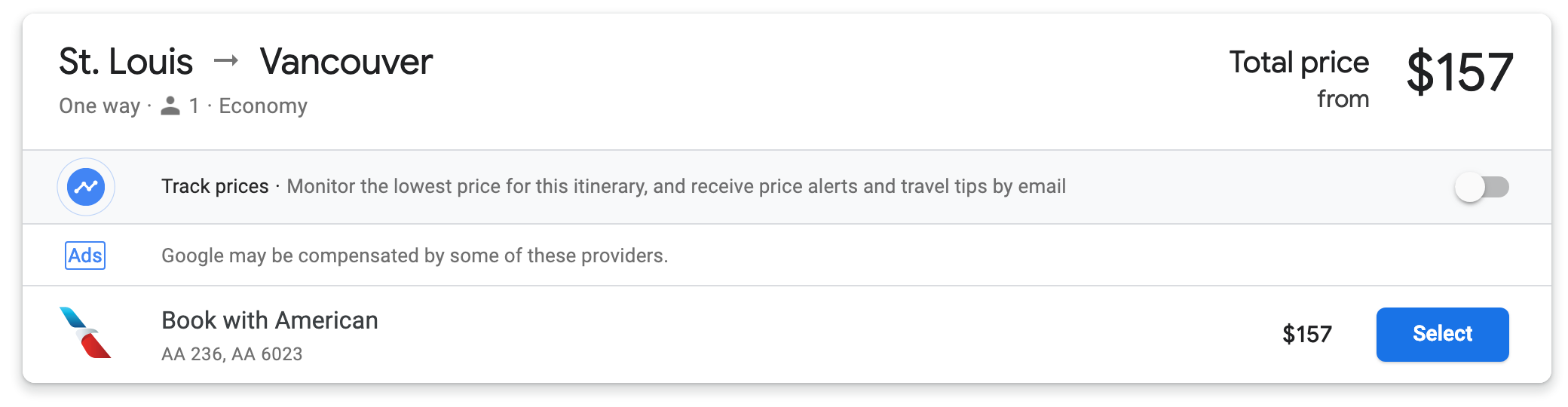
- One the same day, American Airlines is also selling a one-way ticket from St. Louis to Vancouver (YVR) with one stop in Los Angeles for just $157
- If I were to book the second option (STL-YVR via LAX), I could fly STL to LAX nonstop and save $347. Of course, I would just simply not show up for the final leg of my flight to Vancouver.
Why Is This Problematic?
The first thought that pops into most people's minds is, "Wow, this is really smart, I should start doing this." Rarely does one immediately ask, "Wow, is that ethical? What about the airline?"
Airlines use dynamic pricing, typically calculated and priced by a computer with little human intervention, and it could be argued that making it cheaper to drop the last leg of a multi-sector flight is the fault of those computer-driven, dynamic-price models. But airlines don't like lost revenue; no business does. So that leaves one very important question. Is hidden-city ticketing legal?

The Short Answer: No, But...
When you book an airline ticket you are entering a contract of carriage. For example, these are the contracts for the big three US legacy airlines:
- American Airlines Contract of Carriage
- Delta Air Lines Contract of Carriage
- United Airlines Contract of Carriage
The main argument an airline will use when claiming hidden-city ticketing is illegal or against the rules is its contract of carriage. Many airlines now include an "exploitation of fare" clause in their contracts of carriage, which give them the right to pursue punitive action. However, that punitive action is quite limited; according to American Airlines, it has the right to invalidate your ticket. That is essentially all American Airlines can do, according to the contract of carriage. Additionally, it's very difficult for any airline to prove that you booked a ticket with the intention of skipping one or more legs of that itinerary. Still, airlines have entire teams dedicated to tracking down passengers who engage in that "exploitation of fare."
Can Airlines Pursue Legal Action or Cancel My Frequent Flyer Account?
If one is to go with what an airline has included in the contract, the answer should be no. Airlines can cancel your fare, which means you forfeit earning frequent flyer miles or credit towards elite status. But that's if they catch you. Still, even if they do, so what? The airline might ding you for the frequent-flyer miles and earnings tied to the fare it says you exploited. But that's it. You should be able to go right back to flying with that airline earning frequent flyer miles and credit towards elite status.
But airlines have done far more than that: they have terminated frequent-flyer accounts, set mileage balances to zero, demanded the fare difference, and even pursued legal action.
Not even top-tier elite frequent flyers are immune from the wrath of angry airlines. TPG received an email from a reader who holds American Airlines's top elite status, Executive Platinum. One day, AA emailed our reader, bluntly stating this: You've gone on hidden-city routings a lot. We know you did, and here's when, and here's how much it cost us — so pay that difference, or you lose all your miles. Oh, and you can never come back, because you'll be banned from our frequent-flyer program, forever.
In this case, American Airlines alleged that the account holder engaged in hidden-city ticketing 15 times over the course of about three years. This is someone, mind you, who spent over $15,000 on paid fares with American, and flew either 100,000 elite qualifying miles and/or 120 elite qualifying segments in a year to earn Executive Platinum status.
Nonetheless, those hidden-city tickets were enough for American Airlines to send this Executive Platinum an email demanding the outstanding fare difference, which according to American was $1,315. If the frequent flyer failed to pay American Airlines that $1,315 within a week from receipt of the email, they would not only lose their status but also all accrued miles and they would receive a permanent ban from the AAdvantage program.

This isn't the first time an airline has gone after passengers threatening to close their frequent flyer account. It also won't be the last. While the contract of carriage should be linked to the terms and conditions of frequent flyer programs, the purchase of a ticket and frequent flyer programs operate under two separate terms and conditions. Airlines do not tell passengers that violating the exploitation of fares clause in their contract of carriage can result in the closure of frequent flyer accounts.
So, Should You Book Hidden-City Tickets?
The short answer boils down to, "It's up to you." It's entirely up to you to assume the risk of violating the contract of carriage and an airline's frequent flyer program. If you get caught and an airline wants to pursue punitive measures, it probably will. What are the odds that you will get caught? Actually, higher than you might think.
In later 2018, my travel plans changed and I ended up not completing the final leg of a flight. When I approached a ticket agent to discuss my options, I was immediately accused of booking a hidden-city ticket. In this case, I hadn't booked a hidden-city ticket. I came down with the flu and wanted to end my trip early. I was at a major hub and figured I'd catch a flight home.
That ticketing agent went on to explain that one of her roles in the late 1980s and early 1990s, prior to the widespread adoption of computers, was to go through stacks of itineraries and tickets and decide which fares were legit and which fares were hidden-city fares. She would then send what she believed were hidden-city itineraries to upper-level management, where punitive steps would be assessed. "You know, we have a lot of people who spend their entire time looking for people that book hidden-city tickets," she told me. "We don't play around with cheaters."
In other words: hidden-city ticketing saves money, but the savings might not outweigh the costs of any punitive action.
Lufthansa's original lawsuit against a passenger accused of hidden-city ticketing was ultimately dropped by a German district court. However, the airline appealed. Europe, compared to the United States, is far more passenger- and consumer-friendly as a whole. It will be interesting to see what the German courts decide in this case, especially considering the decision made by a judge in a fellow EU member state.
A few months ago in Spain, a judge ruled in favor of a passenger who was accused of hidden-city ticketing by Iberia, essentially saying that it's up to the passenger to do what they chose with their ticket. For now, understand that hidden-city fares are in direct violation of a binding contract between the traveler and the airline. You are assuming the risks associated with breaking that contract when you book a hidden-city ticket. Book at your own risk.
TPG featured card

at Capital One's secure site
Terms & restrictions apply. See rates & fees.
| 5X miles | Earn 5X miles on hotels, vacation rentals and rental cars booked through Capital One Travel |
| 2X miles | Earn unlimited 2X miles on every purchase, every day |
Pros
- Stellar welcome offer of 75,000 miles after spending $4,000 on purchases in the first three months from account opening. Plus, a $250 Capital One Travel credit to use in your first cardholder year upon account opening.
- You'll earn 2 miles per dollar on every purchase, which means you won't have to worry about memorizing bonus categories
- Rewards are versatile and can be redeemed for a statement credit or transferred to Capital One’s transfer partners
Cons
- Highest bonus-earning categories only on travel booked via Capital One Travel
- LIMITED-TIME OFFER: Enjoy $250 to use on Capital One Travel in your first cardholder year, plus earn 75,000 bonus miles once you spend $4,000 on purchases within the first 3 months from account opening - that’s equal to $1,000 in travel
- Earn unlimited 2X miles on every purchase, every day
- Earn 5X miles on hotels, vacation rentals and rental cars booked through Capital One Travel
- Miles won't expire for the life of the account and there's no limit to how many you can earn
- Receive up to a $120 credit for Global Entry or TSA PreCheck®
- Use your miles to get reimbursed for any travel purchase—or redeem by booking a trip through Capital One Travel
- Enjoy a $50 experience credit and other premium benefits with every hotel and vacation rental booked from the Lifestyle Collection
- Transfer your miles to your choice of 15+ travel loyalty programs
- Top rated mobile app