Frontier, Spirit announce blockbuster merger that would create giant ultra-low-cost airline

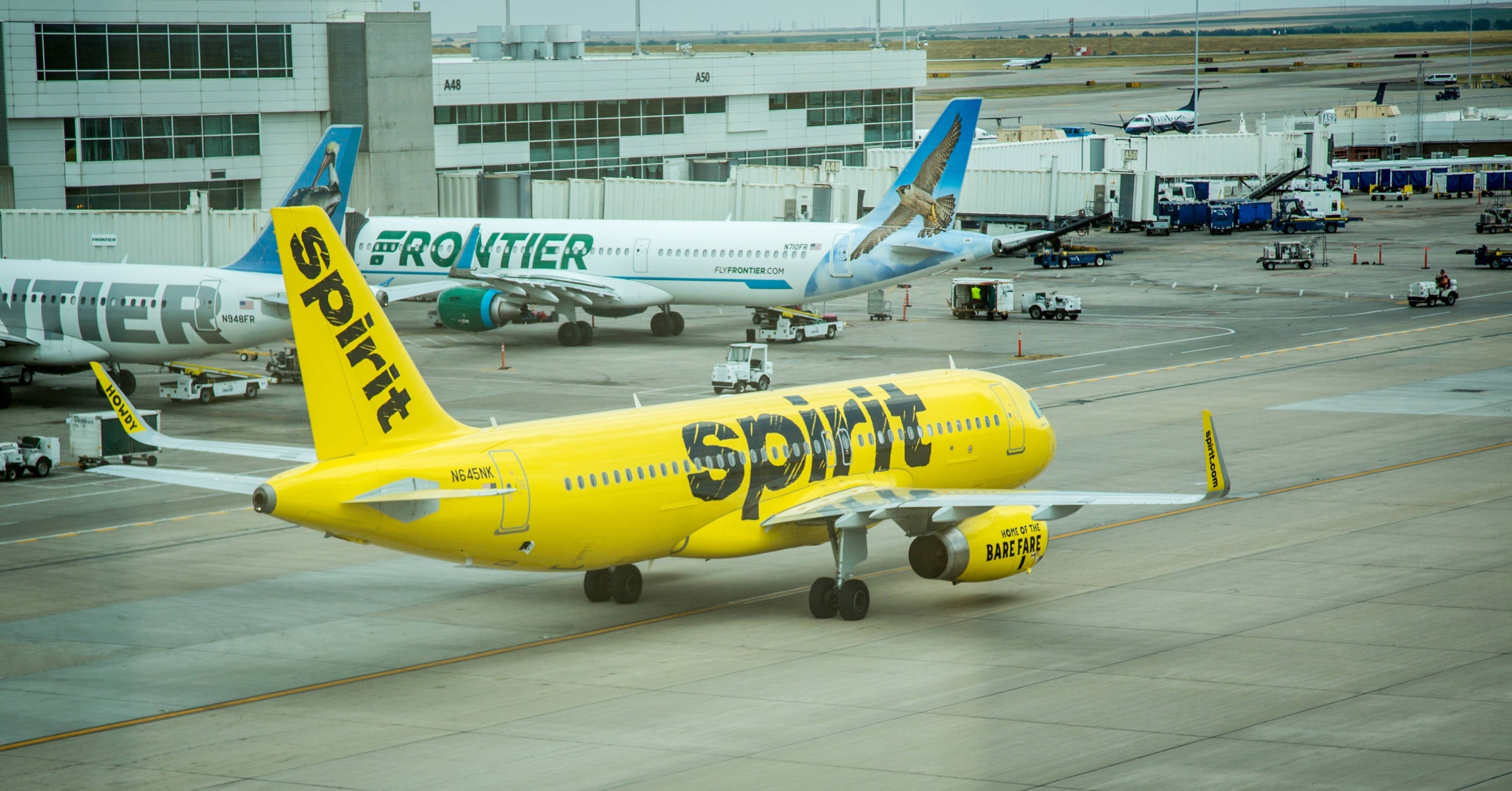
Frontier and Spirit airlines unveiled a blockbuster merger Monday, announcing plans to combine operations and fly as a single company.
The move marries two ultra-low-cost carriers that have complementary fleets and route networks. If approved, it would create an ultra low-cost juggernaut that would dominate the segment in the U.S.
Monday's announcement gave few details on the consumer-facing make-up of the new airline, including whether Frontier and Spirit will continue to exist as separate brands, combine under one of the existing brands or combine under a new airline. Spirit CEO Ted Christie said in an appearance on CNBC Monday morning that the combined company's name and headquarters location will be revealed "in due time."
Frontier and its private equity firm parent company Indigo Partners are expected to take a leading role in the company's management. The airlines said that Frontier equity holders will own roughly 51.5% of the combined airline, while Spirit will own 48.5% after closing.
Currently, Frontier is headquartered in Denver while Spirit is based in Miramar in South Florida, while Indigo Partners is based in Phoenix.
Indigo Partners was previously the majority shareholder of Spirit Airlines, but divested its stake in July, 2013. The company purchased Frontier towards the end of the year.
Impact on prices and consumers
Both airlines framed the merger as a win for everyone affected, including customers.
"I'm confident that today's announcement will change the industry for the benefit of consumers, shareholders, as well as the team members for both Spirit and Frontier," Bill Franke, chairman of Frontier's board and managing partner of Indigo Partners, said during an investor presentation on Monday.
"This transaction will take us from the event and eighth-largest airlines in the United States by [available seat miles] to fifth, enabling us to be a more effective alternative against the 'big four,' among others," Christie said during the presentation.

"When you combine this with the fact of our greater scale and our low fares, we become an even better option for consumers," he added.
Frontier had about 2% of the U.S. commercial air travel market by capacity in 2021, while Spirit owned about 3% of the market, according to Cirium.
A combined Spirit-Frontier network
The combined airline would serve upwards of 145 destinations with more than 600 nonstop routes across the United States, Latin America and the Caribbean, the airlines said.
"The combined airline will also have the ability to succeed in cities our companies have previously exited such as Jackson, Mississippi, as well as expand into new small cities like Eugene, Oregon," Christie said.
By combining resources and coordinating their schedules, particularly in cities where the airlines overlap, the post-merger airline "will be able to utilize efficient scheduling and high utilization to drive ultra-low-costs," he added.
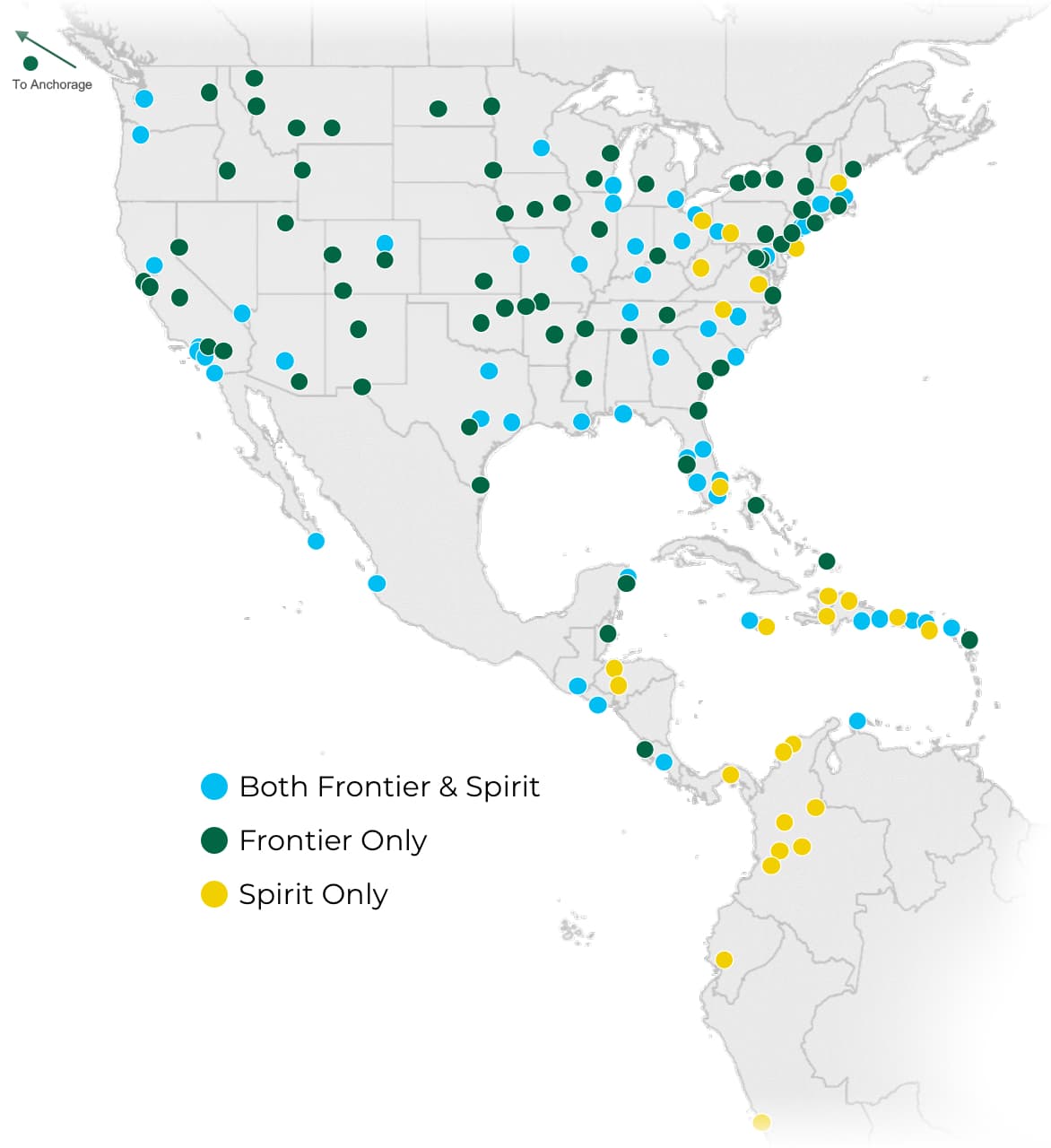
Although the airlines operate in many of the same markets, only 519 of their combined 2,832 routes overlap, or 18%, according to data from Cirium.
The combined fleet would also help the airlines recover from operational disruptions, Christie said, something that low-cost carriers have had particularly difficult times managing.
"The combined airline will offer strengthened operational reliability through a variety of efficiencies," Christie said. "Further, with a larger combined fleet and deepened services to cities across the United States, we will be better positioned to improve recoverability during irregular operations."
The point was unintentionally underscored on Monday, when Frontier appeared to suffer a complete operational meltdown. The airline's entire fleet was on the ground at noon, ET, according to FlightRadar24. As of 12:30 p.m. ET, 111 of Frontier's flights for the day had been canceled and 112 were significantly delayed — about 44% of the airline's operations for the day, according to FlightAware.
A young and modern fleet
Both airlines exclusively operate the Airbus A320 family of aircraft, making for a relatively easy task integrating the two airlines' fleets.
The two carriers combined have 354 new aircraft on order as of Dec. 31, according to Airbus. The airlines are scheduled to take delivery of the new aircraft through 2026, growing the combined fleet size by 75%, according to the airlines, from 283 aircraft in 2021 to 493 by the end of 2026.
The combined airlines will operate the largest fleet of A320neo family aircraft in the U.S., Christie said. By the end of 2026, nearly 80% of the airline's fleet will consist of neo aircraft, with older generation A320ceo aircraft making up the remainder.
Indigo Partners signed a purchase agreement for 255 new A320neo-family aircraft at the Dubai Airshow in November, including 91 A321neos designated for Frontier.
"We will be America's greenest airline, operating the youngest, most modern fleet in the United States," Franke said.
Challenges Ahead
One of the most immediate challenges for the new carrier will be winning regulatory approval for the new carrier. A raft of airline mergers reshaped the U.S. industry during the 2000s and 2010s, but there's thought to be a cooler sentiment from the current administration in Washington after the previous wave of consolidation.
The Biden administration has previously given indications of reluctance to approve mergers and coordination in the airline sector. In 2021, the Department of Justice filed an antitrust suit against American Airlines and JetBlue, alleging that their "Northeast alliance" amounts to unfair, uncompetitive practices.
American and JetBlue have argued that by coordinating in the Northeast, they can better compete against entrenched airlines Delta and United.
It's possible that Spirit and Frontier would use a similar argument. The combined airline would be the fifth-largest in the U.S., behind only American, United, Delta and Southwest. It appears likely that they will argue that the combined size would allow them to compete against the majors, driving fares down across the board.
On the other hand, combining the nation's two largest ultra-low-cost operators into one would eliminate one of the nation's biggest budget airlines in the process.
Frontier and Spirit addressed that in their merger announcement, pledging that the tie-up would enable faster growth and allow the combined carrier to "compete even more aggressively, especially against the dominant 'Big Four' airlines."
"Our all-in costs for the consumer is the lowest of any airline in the United States, at $108 on average. The big four airlines charge over 80% more than us," Christie said during the investor briefing. "When you combine this with the fact of our greater scale and our low fares, we'll become an even better option for consumers."
"In a competitive industry like ours, the lowest cost always wins, and we're proud to continue to deliver that for our customers day in and day out," he added.
The companies valued the deal at $6.6 billion when accounting for the assumption of net debt and operating lease liabilities.
This story has been updated to reflect the latest information. Additional reporting by Ben Mutzabaugh.
TPG featured card
at American Express's secure site
Terms & restrictions apply. See rates & fees.
| 4X | Earn 4X Membership Rewards® points per dollar spent on purchases at restaurants worldwide, on up to $50,000 in purchases per calendar year, then 1X points for the rest of the year. |
| 4X | Earn 4X Membership Rewards® points per dollar spent at US supermarkets, on up to $25,000 in purchases per calendar year, then 1X points for the rest of the year. |
| 5X | Earn 5X Membership Rewards® points on prepaid hotel stays booked through AmexTravel.com or the Amex Travel App™. |
| 3X | Earn 3X Membership Rewards® points on flights booked through AmexTravel.com, the Amex Travel App™, or purchased directly from airlines. |
| 2X | Earn 2X Membership Rewards® points on prepaid car rentals booked through AmexTravel.com or the Amex Travel App™ and cruises booked and paid through AmexTravel.com. |
| 1X | Earn 1X Membership Rewards® point per dollar spent on all other eligible purchases. |
Pros
- Valuable dining and food-related credits
- Flexible rewards with airline and hotel transfer partners
- Multiple travel and purchase protections
- No foreign transaction fees
- Access to Amex Offers for additional savings (enrollment required)
Cons
- Not as useful for those living outside the U.S.
- Some may have trouble using Uber and other dining credits
- You may be eligible for as high as 100,000 Membership Rewards® Points after you spend $8,000 in eligible purchases on your new Card in your first 6 months of Card Membership. Welcome offers vary and you may not be eligible for an offer. Apply to know if you’re approved and find out your exact welcome offer amount – all with no credit score impact. If you’re approved and choose to accept the Card, your score may be impacted.
- Earn 4X Membership Rewards® points per dollar spent on purchases at restaurants worldwide, on up to $50,000 in purchases per calendar year, then 1X points for the rest of the year.
- Earn 4X Membership Rewards® points per dollar spent at US supermarkets, on up to $25,000 in purchases per calendar year, then 1X points for the rest of the year.
- Earn 5X Membership Rewards® points on prepaid hotel stays booked through AmexTravel.com or the Amex Travel App™.
- Earn 3X Membership Rewards® points on flights booked through AmexTravel.com, the Amex Travel App™, or purchased directly from airlines.
- Earn 2X Membership Rewards® points on prepaid car rentals booked through AmexTravel.com or the Amex Travel App™ and cruises booked and paid through AmexTravel.com.
- Earn 1X Membership Rewards® point per dollar spent on all other eligible purchases.
- Pay It® lets you tap in the American Express® App to quickly pay for small purchase amounts throughout the month and still earn rewards the way you usually do. Plan It® gives you the option to split up big purchases into equal monthly payments with a fixed fee. You’ll know upfront exactly how much you’ll pay.
- $120 Dining Credit: Earn up to a total of $10 in statement credits monthly when you pay with the Gold Card at Grubhub (including Seamless), Buffalo Wild Wings, Five Guys, The Cheesecake Factory, and Wonder. This can be an annual savings of up to $120. Enrollment required.
- $100 Resy Credit: Get up to $100 in statement credits each calendar year at over 10,000 qualifying U.S. Resy restaurants after you pay for eligible purchases with the American Express® Gold Card. That’s up to $50 in statement credits semi-annually. Enrollment required.
- $84 Dunkin' Credit: Earn up to $7 in monthly statement credits after you pay with the American Express® Gold Card at U.S. Dunkin’ locations. Enrollment required.
- $120 Uber Cash on Gold: Enjoy up to $120 in Uber Cash annually with your Gold Card. Just add your Card to your Uber account and you'll get $10 in Uber Cash each month to use on orders and rides in the U.S. when you select an Amex Card for your transaction.
- Enjoy complimentary Hertz Five Star® Status benefits like skipping the counter at select locations, adding an additional driver at no additional cost*, and vehicle upgrades**. Benefit enrollment and Hertz Gold+ registration are required. *Additional drivers must meet standard rental qualifications and must be a spouse or domestic partner to qualify as complimentary. Other additional drivers subject to fees. **Benefits are subject to availability and vary by location. Additional Hertz program Terms and Conditions including age restrictions apply.
- Book two nights or more with The Hotel Collection through AmexTravel.com or the Amex Travel App™ and receive a $100* credit towards eligible charges at over 1,400 upscale hotels worldwide. *Eligible charges vary by property.
- Book your travel through the Amex Travel App™ with added peace of mind – backed by American Express® service and support. Only for American Express® Card Members.
- Whenever you need us, we're here. Our Member Services team will ensure you are taken care of. From lost Card replacement to statement questions, we are available to help 24/7.
- No Foreign Transaction Fees.
- Annual Fee is $325.
- Terms Apply.