Free Wi-Fi in Business and First Class - the Weekly Wish

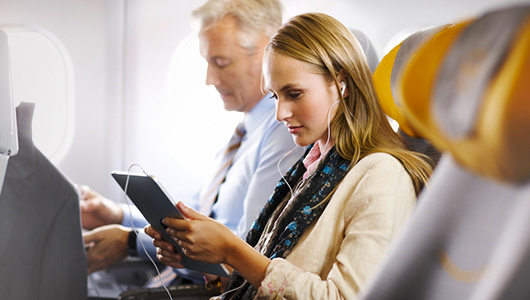
Today TPG Contributor Nick Ewen continues his series The Weekly Wish, looking at flaws, shortcomings, and room for improvement in the world of travel and loyalty programs.
There's no doubt that we live in a connected world. With smartphones, tablets, laptops, and all the other ways we communicate, access, and share information, it's oftentimes hard to go even five minutes without an active Internet connection. For a while, we had to endure this very thing on flights, though more and more airlines are now adding Wi-Fi to their planes. Unfortunately, internet access at 35,000 feet doesn't come cheap. However, I envision a world where premium travelers no longer have to suffer the agony and humiliation of being offline. Today's Weekly Wish: long-haul international flights should offer free Wi-Fi for first and business class passengers.

For starters, let's talk a little bit about the technical details of offering WiFi on an aircraft. There are essentially two ways a plane can connect to Wi-Fi: using ground stations (much like our cell phones do), or using satellite technology (obviously required for overseas flying). Installing this feature on existing planes can set airlines back at least $100,000 per aircraft. Those of you who travel domestically often have likely used GoGo at least once; their network is powered by ground stations. Participating airlines are Air Canada, AirTran, Alaska, American, Delta, United, US Airways, and Virgin America. Depending on the number of users and the specific location, the speed and reliability of the connection can leave something to be desired.
GoGo's ground-based installations won't do you any good if traveling overseas, and many airlines are recognizing the importance of keeping long-haul international passengers connected while in the air. TPG gave an overview of Wi-Fi coverage on both U.S. and foreign airlines last year, but here's a quick rundown of notable current offerings:
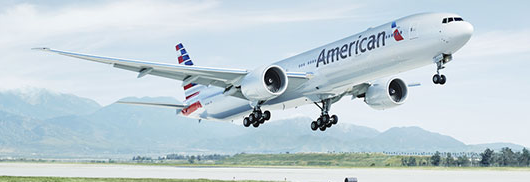
American: Last year, TPG had a chance to fly from JFK-GRU in first class on American's brand new Boeing 777-300ER, the airline's first international plane to be equipped with Wi-Fi. Though it was free at the time, it now would set travelers back $12 for two hours, $17 for four hours, or $19 for the duration of the flight.
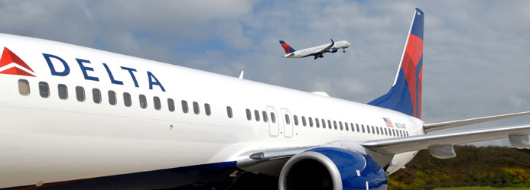
Delta: Back in June 2012, Delta announced plans to equip their entire long-haul fleet with satellite-based Wi-Fi coverage, though this didn't actually become a reality until earlier this year. Introductory pricing is available for $14/hour ($8/hour for mobile devices) or $24.95/flight ($14.95/flight for mobile devices). The target completion date for fleet-wide Wi-Fi is 2015, though it will be interesting to see if they can reach that goal.
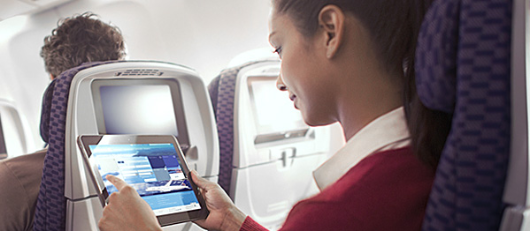
United: United actually differs from the other legacy carriers in that they manage their own Wi-Fi network (aside from their 757 p.s. service from JFK to LAX/SFO, which is managed by GoGo). This coverage is delivered via satellite, so it includes many of their long-haul aircraft. As I write this, almost all of their 747-400 planes have the technology installed, with plans to equip their 767/777 by July, 2015 and their 787 fleet at a later date. Pricing varies by the distance of the flight and is charged on a segment-by-segment basis (aside from DIRECTV-equipped planes, which charge a fixed hourly rate). For more information, visit this page.
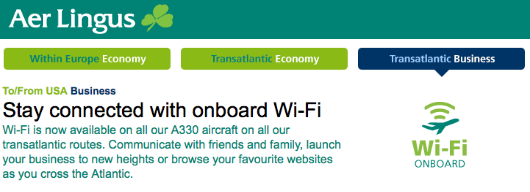
Aer Lingus: The Ireland-based carrier has actually fulfilled my wish in advance! All of their transatlatic A330 flights are equipped with Wi-Fi, and business class passengers can surf for free (one-hour of access usually costs €10.95/$14.95, and 24-hour passes are available for €19.95/$24.95).
British Airways: Despite their global reach, British Airways is VERY limited with their Internet access; the only international WiFi offering is on their all business class flight from London City to JFK. Even that is only provided for mobile phones, and passengers need to have international roaming enabled and be prepared to pay data charges directly through their mobile provider.

Emirates: The Dubai-based airline is full of bling, but in-flight WiFi is only available on most A380 flights and select Boeing 777 flights. Prices start at $2.75 for smartphones and $7.50 for laptops. TPG experienced first class on Emirates' A380 back in November of 2013, but sadly the Internet wasn't working, so he had no first-hand experience to report!
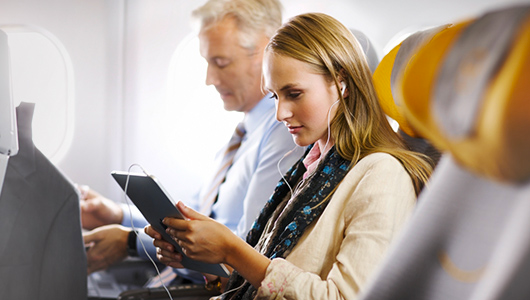
Lufthansa: In addition to being ahead of the game in soccer, the Germans also lead in international WiFi connectivity. Lufthansa's FlyNet platform offers internet access on over 90% of its long-haul fleet (and is currently being added to the airline's A380s). This service costs €10.95/hour or €19.95 for a 24-hour pass that can be used on any FlyNet-equipped aircraft.
As indicated by these examples, airlines are all over the Wi-Fi map, though just about every carrier has at least announced plans to equip its planes with some form of connectivity. However, with the high cost of installation, limited international offerings, and (relatively) high prices, why would an airline want to offer first and business class passengers free Wi-Fi? Well, it comes down to one key economic term: marginal revenue.
In an ideal world, airlines could adjust prices on each and every route to ensure that their planes left with every seat occupied and that the total revenue for each flight would make it profitable. However, price is just one aspect of an airline's offerings. Travelers consider many other things when booking flights, such as convenience of times/connections, frequent flyer benefits, and on-board service offerings. Any extra incentive an airline provides could be enough to sway travelers toward them and away from the competition, and in today's connected world, I strongly believe that free Wi-Fi is such an incentive. A single additional revenue passenger per flight would more than cover the small cost of providing free access for all premium travelers. For long-haul passengers, knowing they won't be out of touch for 6+ hours is powerful peace of mind. They may not want or need access for the entire flight, but it would sure be nice to have the option!
Implementation would be straightforward. On each flight, the airline (or Wi-Fi provider) could generate a promotional code that would only be good for the duration of the flight, and would be limited to the number of first- and business-class passengers on the plane. There could even be an added layer of security where a traveler would need to input his/her first and last names to "verify" that he/she truly is a premium passenger. That would prevent a coach passenger from guessing the code and using up one of the free logins.
Until Wi-Fi becomes a standard feature on long-haul flights, we likely won't see this wish come true. Why would Lufthansa offer something for free when they already stand out for simply HAVING the technology on almost their entire long-haul fleet? However, it may come to fruition sooner than you may think. As I mentioned before, there are two ways that airplanes access the Internet: ground stations and satellites. Until recently, satellite coverage was slow and quite expensive, because it was accessed using lower frequency L-band technology. That's gradually changing, as more companies have begun using Ku-band technology to provide greater bandwidth and faster speeds (Lufthansa, for example). Even more promising is Ka-band technology, which could represent an exponential growth in bandwidth at a fraction of the cost. Though this technology is still very new, JetBlue has begun rolling it out on their Airbus planes, and plans to add it to their entire fleet over the next couple of years.
At the end of the day, free internet is a relatively insignificant aspect of international travel. Bring able to access the Internet at all from a metal tube flying at hundreds of miles per hour several miles above the Earth's surface is an incredible feat of technology. However, as a GoGo monthly pass holder on Delta, I would welcome any improvement that would help improve bandwidth and lower prices.
Would free Wi-Fi be enough to sway you toward one airline over another? Please share your thoughts in the comments below!
[card card-name='United MileagePlus® Explorer Card' card-id='22035884' type='javascript' bullet-id='1']
TPG featured card

at Capital One's secure site
Terms & restrictions apply. See rates & fees.
| 5X miles | Earn 5X miles on hotels, vacation rentals and rental cars booked through Capital One Travel |
| 2X miles | Earn unlimited 2X miles on every purchase, every day |
Pros
- Stellar welcome offer of 75,000 miles after spending $4,000 on purchases in the first three months from account opening. Plus, a $250 Capital One Travel credit to use in your first cardholder year upon account opening.
- You'll earn 2 miles per dollar on every purchase, which means you won't have to worry about memorizing bonus categories
- Rewards are versatile and can be redeemed for a statement credit or transferred to Capital One’s transfer partners
Cons
- Highest bonus-earning categories only on travel booked via Capital One Travel
- LIMITED-TIME OFFER: Enjoy $250 to use on Capital One Travel in your first cardholder year, plus earn 75,000 bonus miles once you spend $4,000 on purchases within the first 3 months from account opening - that’s equal to $1,000 in travel
- Earn unlimited 2X miles on every purchase, every day
- Earn 5X miles on hotels, vacation rentals and rental cars booked through Capital One Travel
- Miles won't expire for the life of the account and there's no limit to how many you can earn
- Receive up to a $120 credit for Global Entry or TSA PreCheck®
- Use your miles to get reimbursed for any travel purchase—or redeem by booking a trip through Capital One Travel
- Enjoy a $50 experience credit and other premium benefits with every hotel and vacation rental booked from the Lifestyle Collection
- Transfer your miles to your choice of 15+ travel loyalty programs
- Top rated mobile app