Skip to content

Flying to Santa's home: Why some commercial routes pass over the North Pole

Dec. 24, 2019
7 min read
On the 23rd of April 2016 the  Flight AB9669 started ist journey to the North Pole. Departure time was 9:44am and the airplane landed safely at 9.43pm back in Dusseldorf. The Routing to the North Pole took the 254 passengers over the arctic sea and huge m
Flying to Santa's home: Why some commercial routes pass over the North Pole
The cards we feature here are from partners who compensate us when you are approved through our site, and this may impact how or where these products appear. We don’t cover all available credit cards, but our analysis, reviews, and opinions are entirely from our editorial team. Terms apply to the offers listed on this page. Please view our advertising policy and product review methodology for more information.

Sometimes airlines play Santa Claus. On some flights from North America to Asia, the shortest route is right up over the North Pole — or at least, very close to it.

It's the polar route, and while it's flown many times every day by a variety of airlines, it still is one of the most awe-inspiring feats in commercial aviation.

Airlines operating polar flights include the Scandinavian carriers SAS and Finnair, United Airlines, Emirates (for example from Los Angeles to Dubai), Air Canada and Cathay Pacific. For an example of what flying the polar route entails, we'll take a closer look at Cathay Pacific 841, which leaves JFK at 9am for Hong Kong. After taking off, the Boeing 777 does not point its nose in the direction of Hong Kong on the atlas; instead it flies due north.

It will land at the HKG airport between 15 and 16 hours later, depending on the winds and routing chosen.

A Cathay Pacific 777-300ER in Hong Kong. (Photo by JT Genter / The Points Guy)

It's hard to tell from this FlightAware map, but this Cathay Pacific flight flies a so-called "great circle" route coming very, very close to the North Pole. (Great circle routes are the shortest possible between two points on a sphere.) On flight-tracker sites, you will see portions of polar routes as estimates, since flight-tracking systems currently available on the web don't follow at those high latitudes and in the middle of oceans (at least, the free versions).
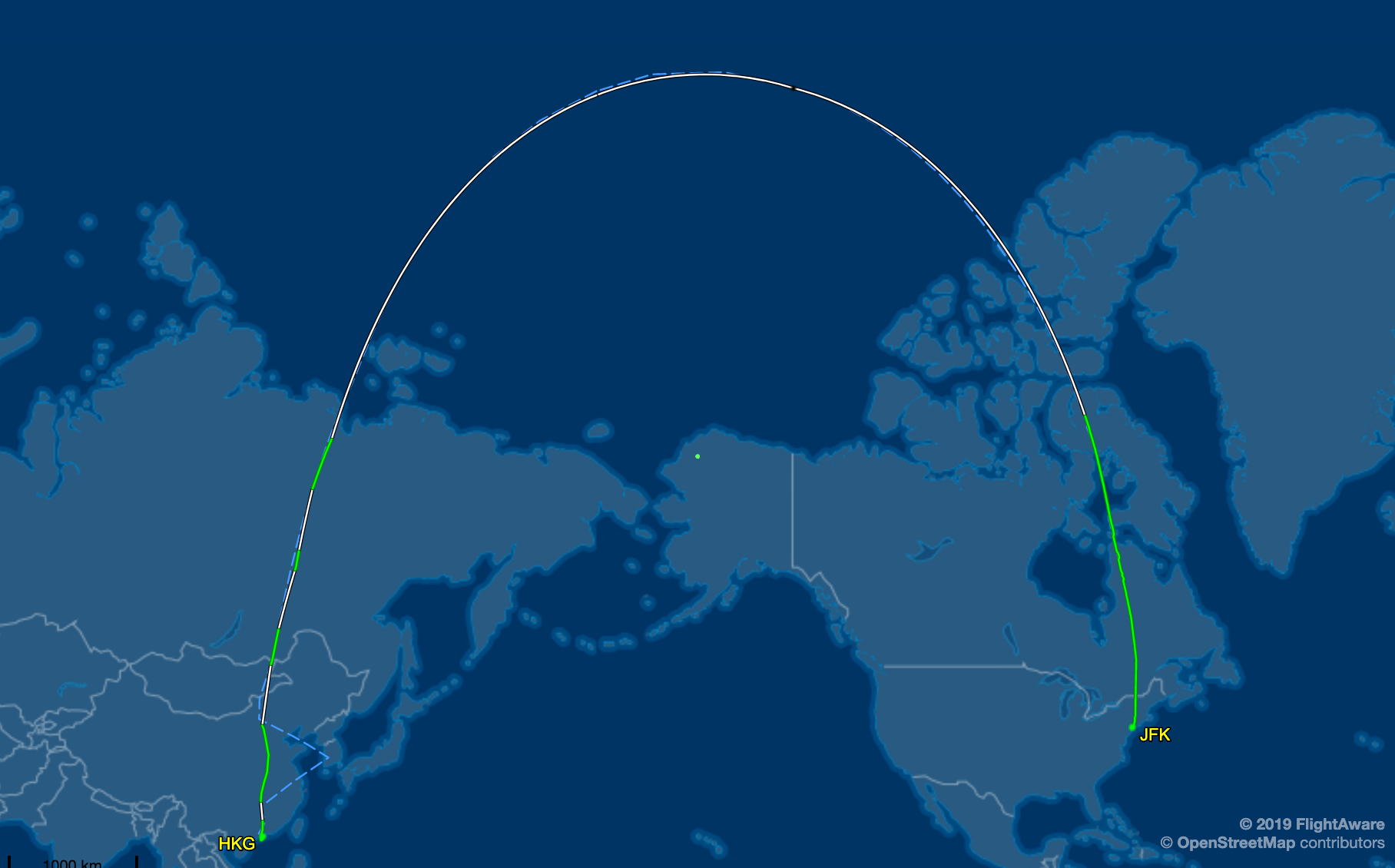
Cathay Pacific 841, as tracked by ADS-B receivers. Any portion in green is the actual route; portions in white are estimates. (Screen cap from FlightAware)

In fact, the closest our flight comes to the North Pole is 85.6 degrees north, with the North Pole being 90 degrees. Plotting it on Google Earth, the plane passes some 304 miles from Santa's workshop. If you're a passenger on board, look out the window, and you could see it. And if not, you're still gazing out over the most northern reaches of the planet, far inside the Arctic Circle.
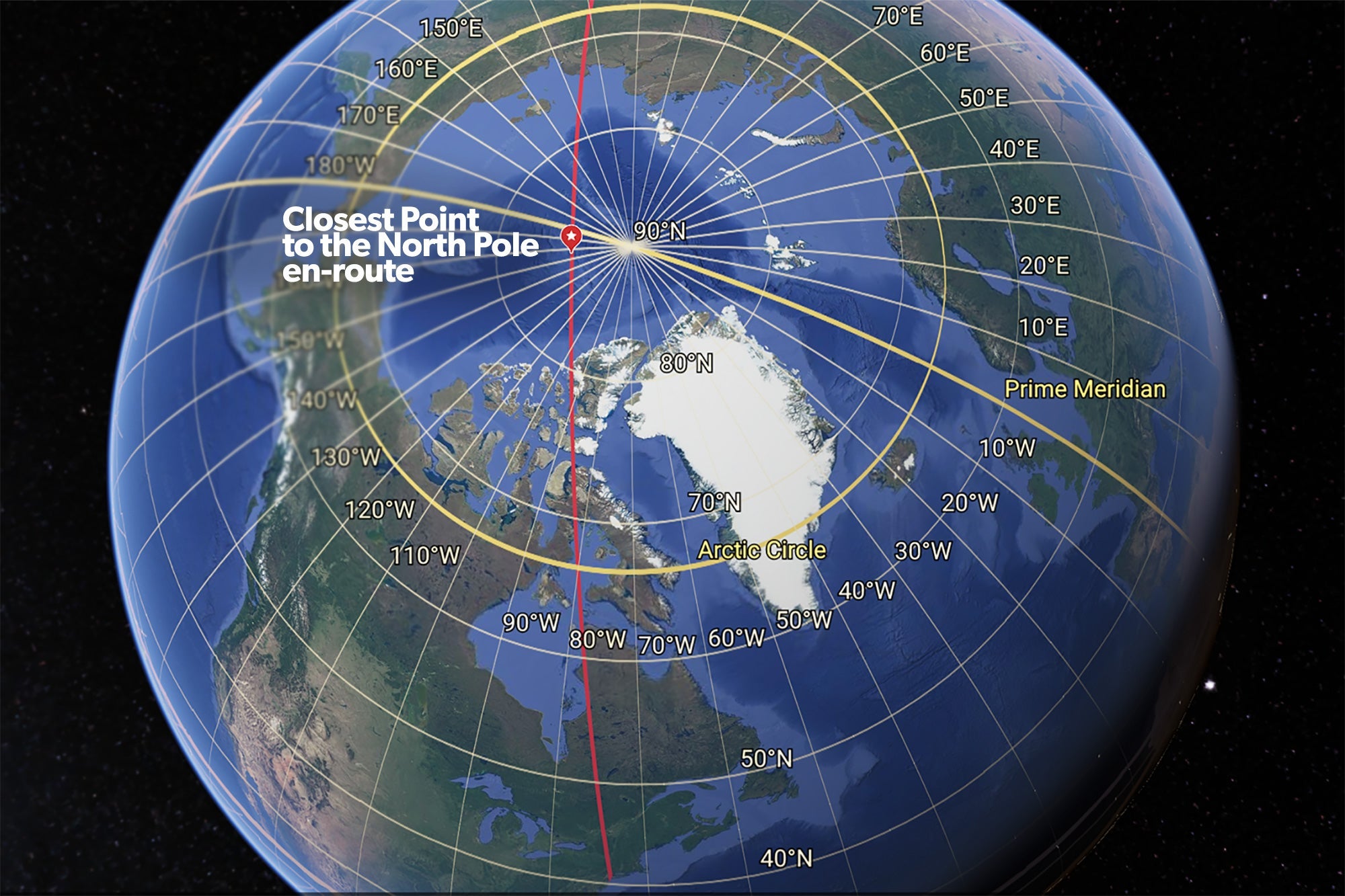
The trajectory of the flight, as seen on Google Earth. (Image via Google Earth, modified by the author)

But the flight isn't set up this way for the views and bucket-list items. The polar route can shave almost five hours off the conventional route between JFK and HKG for Cathay Pacific, involving a stop in Vancouver and generally hugging the northwest coast up to Alaska. Indeed, the difference is stark: the polar route is a touch over 8,000 miles and can be flown nonstop, but the more southerly one is closer to 9,000.

The savings for airlines is huge.

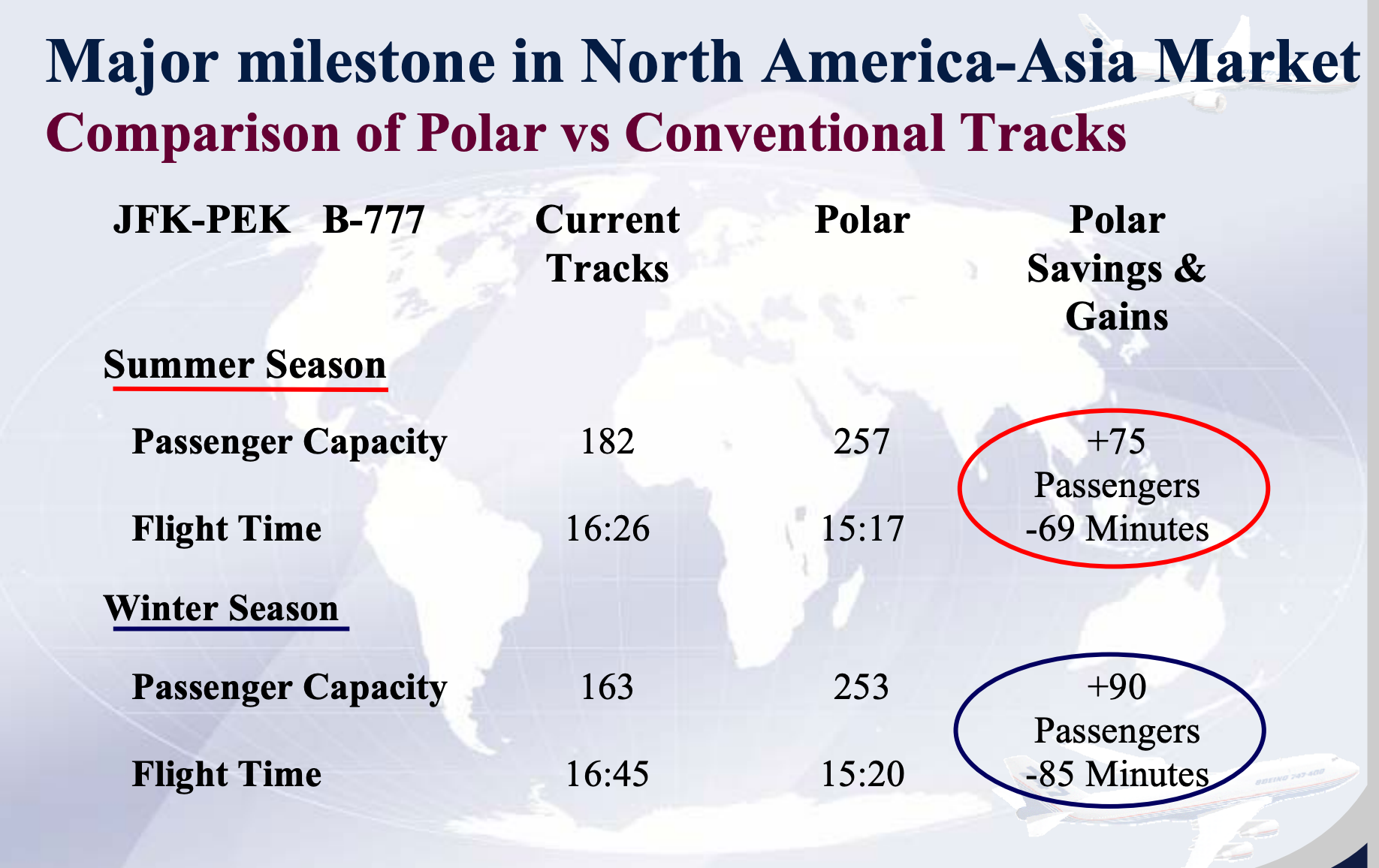
Consider this comparison made by the Federal Aviation Administration in 2001 for a route between JFK and Beijing (PEK). Compared to so-called conventional tracks, which did not overfly the Pole, the polar route could save around one hour of flight time, but crucially, a whopping additional 90 passengers could fly, representing possible additional revenue of hundreds of thousands of dollars per flight.

Daily Newsletter
Reward your inbox with the TPG Daily newsletter
Join over 700,000 readers for breaking news, in-depth guides and exclusive deals from TPG’s experts
Image courtesy of the FAA

Then why didn't airlines always fly the shortest possible polar routes? Two things: technology and geopolitics.

Flying over the North Pole isn't like flying over populated areas with many airports offering the possibility of a diversion in an emergency. In 2001, the FAA published guidance for certification of polar operations by commercial airlines. The regulations require airlines to consider alternate airports for diversion, strategies to handle very cold fuel, the ability for communications, emergency medical kits, and a minimum of two cold-weather anti-exposure suits for crew. In addition, the FAA required test flights. If you want to read more about the FAA requirements for Polar Operations, click here.

The twin-engine planes that dominate long-haul flying today weren't always able to cross such vast expanses, either. Twins need a special certification called ETOPS — "extended twin-engine operations" — in order to fly so far away from possible diversion airports, a precaution in case of engine failure. Four-engined planes like the 747, the reasoning goes, have three engines left to continue flying safely if one goes out; twins do not have that margin, so they need to demonstrate stringent engine performance.

Then there was the Cold War. Many nonstop polar routes overfly what used to be the Soviet Union, which restricted overflights by foreign civilian aircraft, and were not feasible until after the USSR collapsed and its successor nations opened their airspace.

Polar routes were possible in the Soviet era as well, for example between Europe and Asia, if they skirted the USSR and went through one or more fuel stop. For example, SAS, the Scandinavian carrier, claims to be the first commercial airline to fly the polar route, during the middle of the Cold War. According to SAS, "on November 19, 1952, the Arild Viking, a DC-6B, took off from Los Angeles, with 22 dignitaries on board, en route to Copenhagen [...making] stops in Edmonton, Canada, and Thule, Greenland, and landed in Copenhagen 28 hours after it left Los Angeles."

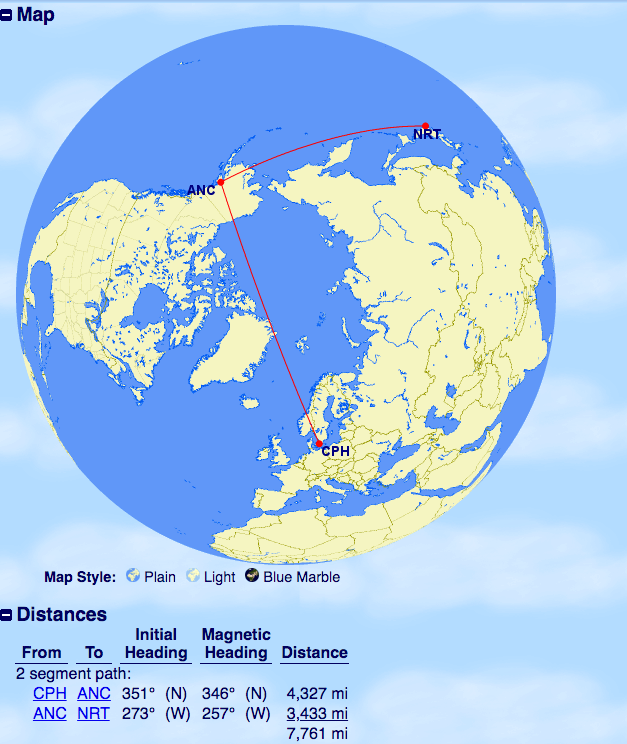
When the jet age began, SAS was able to fly one-stop over the pole, for example with Douglas DC-8 and DC-10 jets from Copenhagen to Tokyo via a fuel stop in Anchorage.
After the Cold War, Finnair flew non-stop over the Arctic between Tokyo and Helsinki, with a DC-10. As more modern jets entered service with nonstop ranges that went beyond 8,000 miles, routes such as New York to Hong Kong nonstop became possible. It wasn't until 1998 that Cathay Pacific operated the first non-stop service between Hong Kong and JFK, dubbed Polar One for its polar route trajectory, which it flew with a four-engine Boeing 747-400. United later began flying a twin-engine 777 on the Newark to HKG route.

Where can flights divert?

Much of the route between North America and Asia overflies the far north reaches of Canada. So, how many cities are up there? Statistics Canada reports that "the land area of Northwest Territories [of Canada] is 1,143,793.47 square kilometres with a population density of 0.0 persons per square kilometre."

That is particularly sparse.

That said, there are still several options for diversion in the case of medical emergencies or mechanical issues. For example, Whitehorse, Yukon, Yellowknife, Northwest Territories, and Anchorage, Alaska all have modern medical facilities; the latter is a full-fledged city. At the furthest point north on Cathay Pacific 841, Anchorage is around 1,400 nautical miles away, a two-hour diversion. Barrow, Alaska (now known as Utqiagvik, with a population over 4,000), would only be around 850 nautical miles away, around a one-hour diversion. And there's also Alert, the closest settlement to the North Pole, home of a Canadian Armed Forces base — and the reason that Canadians can claim Santa as one of their own. (Then again, so do Finns.)

A C-17 military cargo landing at Alert, Nunavut, Canada. (Image of courtesy of Canadian Armed Forces)

You can explore Cathay 841's great circle route over the North Pole in Google Earth.

And the next time you fly a polar route, open your window shade when you're near Santa's workshop.

Mike Arnot is the founder of Boarding Pass NYC, a New York-based travel brand, and a marketing consultant to airlines, none of which appear in this article.

Featured image by ullstein bild via Getty Images

TPG featured card

Best for dining at restaurants
TPG Editor‘s Rating
4 / 5
Go to review
Apply for American Express® Gold Card
at American Express's secure site

Rewards

1 - 4X points

Intro offer

As High As 100,000 points. Find Out Your Offer.

Annual Fee

$325

Recommended Credit

Excellent to Good

Why We Chose It

There’s a lot to love about the Amex Gold. It’s a fan favorite thanks to its fantastic bonus-earning rates at restaurants worldwide and at U.S. supermarkets. If you’re hitting the skies soon, you’ll also earn bonus Membership Rewards points on travel. Paired with up to $120 in Uber Cash annually (for U.S. Uber rides or Uber Eats orders, card must be added to Uber app and you can redeem with any Amex card), up to $120 in annual dining statement credits to be used with eligible partners, an up to $84 Dunkin’ credit each year at U.S. Dunkin Donuts and an up to $100 Resy credit annually, there’s no reason that foodies shouldn’t add the Amex Gold to their wallet. These benefits alone are worth more than $400, which offsets the $325 annual fee on the Amex Gold card. Enrollment is required for select benefits. (Partner offer)

Pros

  • 4 points per dollar spent on dining at restaurants worldwide and U.S. supermarkets (on the first $50,000 in purchases per calendar year; then 1 point per dollar spent thereafter and $25,000 in purchases per calendar year; then 1 point per dollar spent thereafter, respectively)
  • 3 points per dollar spent on flights booked directly with the airline or with amextravel.com
  • Packed with credits foodies will enjoy
  • Solid welcome bonus

Cons

  • Not as useful for those living outside the U.S.
  • Some may have trouble using Uber and other dining credits
  • You may be eligible for as high as 100,000 Membership Rewards® Points after you spend $6,000 in eligible purchases on your new Card in your first 6 months of Card Membership. Welcome offers vary and you may not be eligible for an offer. Apply to know if you’re approved and find out your exact welcome offer amount – all with no credit score impact. If you’re approved and choose to accept the Card, your score may be impacted.
  • Earn 4X Membership Rewards® points per dollar spent on purchases at restaurants worldwide, on up to $50,000 in purchases per calendar year, then 1X points for the rest of the year.
  • Earn 4X Membership Rewards® points per dollar spent at US supermarkets, on up to $25,000 in purchases per calendar year, then 1X points for the rest of the year.
  • Earn 3X Membership Rewards® points per dollar spent on flights booked directly with airlines or on AmexTravel.com.
  • Earn 2X Membership Rewards® points per dollar spent on prepaid hotels and other eligible purchases booked on AmexTravel.com.
  • Earn 1X Membership Rewards® point per dollar spent on all other eligible purchases.
  • $120 Uber Cash on Gold: Add your Gold Card to your Uber account and get $10 in Uber Cash each month to use on orders and rides in the U.S. when you select an American Express Card for your transaction. That’s up to $120 Uber Cash annually. Plus, after using your Uber Cash, use your Card to earn 4X Membership Rewards® points for Uber Eats purchases made with restaurants or U.S. supermarkets. Point caps and terms apply.
  • $84 Dunkin' Credit: With the $84 Dunkin' Credit, you can earn up to $7 in monthly statement credits after you enroll and pay with the American Express® Gold Card at U.S. Dunkin' locations. Enrollment is required to receive this benefit.
  • $100 Resy Credit: Get up to $100 in statement credits each calendar year after you pay with the American Express® Gold Card to dine at U.S. Resy restaurants or make other eligible Resy purchases. That's up to $50 in statement credits semi-annually. Enrollment required.
  • $120 Dining Credit: Satisfy your cravings, sweet or savory, with the $120 Dining Credit. Earn up to $10 in statement credits monthly when you pay with the American Express® Gold Card at Grubhub, The Cheesecake Factory, Goldbelly, Wine.com, and Five Guys. Enrollment required.
  • Explore over 1,000 upscale hotels worldwide with The Hotel Collection and receive a $100 credit towards eligible charges* with every booking of two nights or more through AmexTravel.com. *Eligible charges vary by property.
  • No Foreign Transaction Fees.
  • Annual Fee is $325.
  • Terms Apply.
Apply for American Express® Gold Card
at American Express's secure site
Terms & restrictions apply. See rates & fees
Best for dining at restaurants
TPG Editor‘s Rating
4 / 5
Go to review

Rewards Rate

4XEarn 4X Membership Rewards® points per dollar spent on purchases at restaurants worldwide, on up to $50,000 in purchases per calendar year, then 1X points for the rest of the year.
4XEarn 4X Membership Rewards® points per dollar spent at US supermarkets, on up to $25,000 in purchases per calendar year, then 1X points for the rest of the year.
3XEarn 3X Membership Rewards® points per dollar spent on flights booked directly with airlines or on AmexTravel.com.
2XEarn 2X Membership Rewards® points per dollar spent on prepaid hotels and other eligible purchases booked on AmexTravel.com.
1XEarn 1X Membership Rewards® point per dollar spent on all other eligible purchases.
  • Intro Offer

    As High As 100,000 points. Find Out Your Offer.
  • Annual Fee

    $325
  • Recommended Credit

    Excellent to Good

Why We Chose It

There’s a lot to love about the Amex Gold. It’s a fan favorite thanks to its fantastic bonus-earning rates at restaurants worldwide and at U.S. supermarkets. If you’re hitting the skies soon, you’ll also earn bonus Membership Rewards points on travel. Paired with up to $120 in Uber Cash annually (for U.S. Uber rides or Uber Eats orders, card must be added to Uber app and you can redeem with any Amex card), up to $120 in annual dining statement credits to be used with eligible partners, an up to $84 Dunkin’ credit each year at U.S. Dunkin Donuts and an up to $100 Resy credit annually, there’s no reason that foodies shouldn’t add the Amex Gold to their wallet. These benefits alone are worth more than $400, which offsets the $325 annual fee on the Amex Gold card. Enrollment is required for select benefits. (Partner offer)

Pros

  • 4 points per dollar spent on dining at restaurants worldwide and U.S. supermarkets (on the first $50,000 in purchases per calendar year; then 1 point per dollar spent thereafter and $25,000 in purchases per calendar year; then 1 point per dollar spent thereafter, respectively)
  • 3 points per dollar spent on flights booked directly with the airline or with amextravel.com
  • Packed with credits foodies will enjoy
  • Solid welcome bonus

Cons

  • Not as useful for those living outside the U.S.
  • Some may have trouble using Uber and other dining credits
  • You may be eligible for as high as 100,000 Membership Rewards® Points after you spend $6,000 in eligible purchases on your new Card in your first 6 months of Card Membership. Welcome offers vary and you may not be eligible for an offer. Apply to know if you’re approved and find out your exact welcome offer amount – all with no credit score impact. If you’re approved and choose to accept the Card, your score may be impacted.
  • Earn 4X Membership Rewards® points per dollar spent on purchases at restaurants worldwide, on up to $50,000 in purchases per calendar year, then 1X points for the rest of the year.
  • Earn 4X Membership Rewards® points per dollar spent at US supermarkets, on up to $25,000 in purchases per calendar year, then 1X points for the rest of the year.
  • Earn 3X Membership Rewards® points per dollar spent on flights booked directly with airlines or on AmexTravel.com.
  • Earn 2X Membership Rewards® points per dollar spent on prepaid hotels and other eligible purchases booked on AmexTravel.com.
  • Earn 1X Membership Rewards® point per dollar spent on all other eligible purchases.
  • $120 Uber Cash on Gold: Add your Gold Card to your Uber account and get $10 in Uber Cash each month to use on orders and rides in the U.S. when you select an American Express Card for your transaction. That’s up to $120 Uber Cash annually. Plus, after using your Uber Cash, use your Card to earn 4X Membership Rewards® points for Uber Eats purchases made with restaurants or U.S. supermarkets. Point caps and terms apply.
  • $84 Dunkin' Credit: With the $84 Dunkin' Credit, you can earn up to $7 in monthly statement credits after you enroll and pay with the American Express® Gold Card at U.S. Dunkin' locations. Enrollment is required to receive this benefit.
  • $100 Resy Credit: Get up to $100 in statement credits each calendar year after you pay with the American Express® Gold Card to dine at U.S. Resy restaurants or make other eligible Resy purchases. That's up to $50 in statement credits semi-annually. Enrollment required.
  • $120 Dining Credit: Satisfy your cravings, sweet or savory, with the $120 Dining Credit. Earn up to $10 in statement credits monthly when you pay with the American Express® Gold Card at Grubhub, The Cheesecake Factory, Goldbelly, Wine.com, and Five Guys. Enrollment required.
  • Explore over 1,000 upscale hotels worldwide with The Hotel Collection and receive a $100 credit towards eligible charges* with every booking of two nights or more through AmexTravel.com. *Eligible charges vary by property.
  • No Foreign Transaction Fees.
  • Annual Fee is $325.
  • Terms Apply.
