The EU has postponed the ETIAS 'e-visa' until November 2023
The European Union has quietly postponed the rollout of the long-awaited European Travel Information and Authorisation System visa program, meaning American and British travelers will no longer need to apply for the European visa waivers before next summer.
Originally, the new "e-visa" program was slated to begin May 2023. It would require that travelers from countries outside of the Schengen Area be fingerprinted and pay a fee to visit France, Spain and other EU nations.
European Commission bigwigs have now decided to delay the scheme until November 2023.
"ETIAS is indeed now scheduled to enter into operation as of November 2023, according to current planning," a spokesperson for the European Commission told TPG.
Related: Europe to require new entry fee for visitors
What is ETIAS?

ETIAS is a visa-waiver scheme similar to the current Electronic System for Travel Authorization used in the U.S. The form will act as a preauthorization system to allow travelers from 63 third countries (the list is here) outside of the Schengen Area — including the United Kingdom and U.S. — to enter the region for up to 90 days within a 180-day period, without a full visa.
Similar to ESTA in the U.S., ETIAS will cross-check visitor information with government databases and watchlists before issuing authorization to enter. The information collected will also be used in data tracking for business and tourism purposes.
ETIAS covers European countries that are part of the Schengen Area travel agreement; the region includes most the EU, with the addition of Iceland, Norway, Switzerland and Liechtenstein but minus Ireland. An individual's ETIAS authorization will be valid for an unlimited number of entries over three years.
Countries in the Schengen Area that will require ETIAS include:

- Austria.
- Belgium.
- The Czech Republic.
- Denmark.
- Estonia.
- Finland.
- France.
- Germany.
- Greece.
- Hungary.
- Iceland.
- Italy.
- Latvia.
- Liechtenstein.
- Lithuania.
- Luxembourg.
- Malta.
- The Netherlands.
- Norway.
- Poland.
- Portugal.
- Slovakia.
- Slovenia.
- Spain.
- Sweden.
- Switzerland.
"The ETIAS will be an automated IT system created to identify any security or irregular migratory risks posed by visa-exempt visitors traveling to the Schengen area, whilst at the same time facilitate crossing borders for the vast majority of travellers who do not pose such risks," according to the European Commission.
How much will it cost and what information will I have to provide?
The ETIAS will cost 7 euros (about $7) for a three-year permit that allows "third-country nationals" to enter the Schengen Area for up to 90 days within a 180-day period. Only visitors who are between the ages of 18 and 70 will need to pay the application fee, but those of all ages will still need ETIAS authorization to enter.
Travelers will be asked to provide details of health, education and any criminal convictions, as well as their fingerprints and a facial biometric.
Who needs to apply for ETIAS?
American citizens (and those from the 62 other non-EU countries that are not currently required to apply for visas) will need ETIAS authorization to enter the EU for visits of up to 90 days; this includes transit passengers.
If you have applied separately for a visa to enter Europe, you will not need to complete the ETIAS application.
Related: What is the Schengen Area and what European countries are included?
When and where will ETIAS go into effect?
This launch of this long-planned system has been pushed from May 2023 to November 2023.
At that point, airlines and other transport systems will be required to check for ETIAS authorization prior to allowing passenger boarding, and visitors will be required to complete the application process prior to travel. At land borders, visitors can complete the application at an electronic kiosk. British citizens will benefit from using an online application system to apply for ETIAS.
How do you apply for ETIAS?
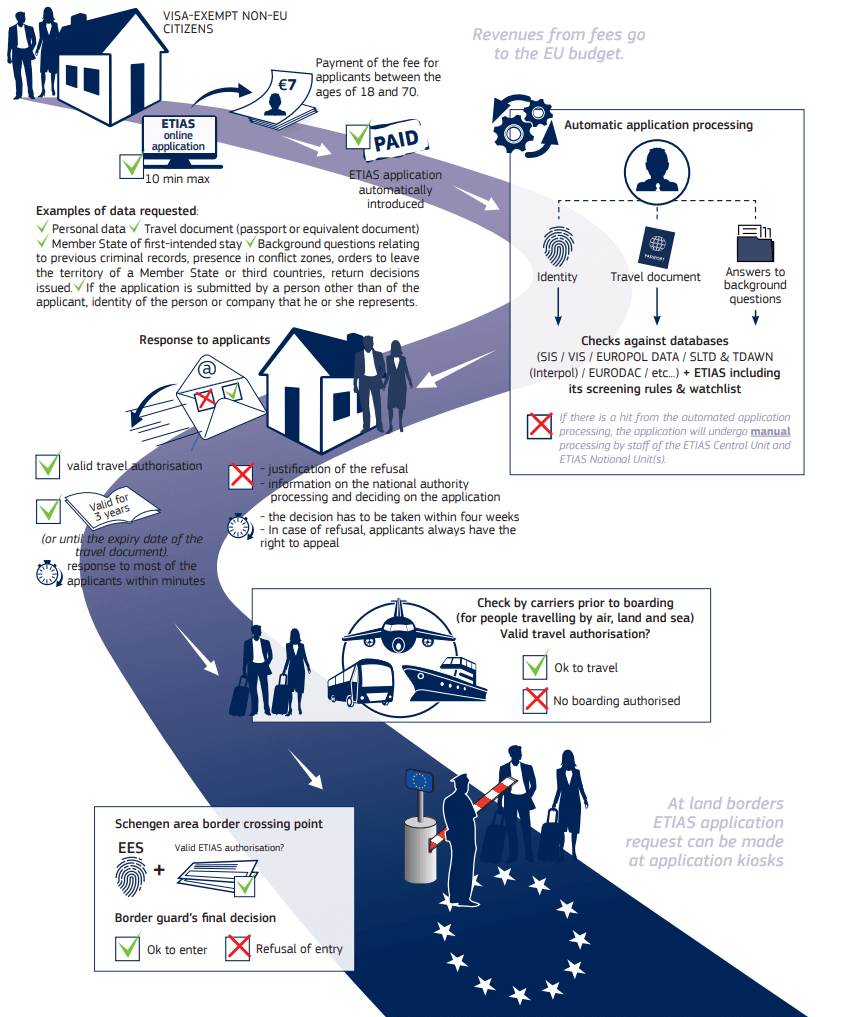
Before traveling, you'll need to access the ETIAS online application to input passport information, name, date and place of birth, an email address, phone number, and a credit or debit card to submit the payment fee. You'll also need to provide your destination, as well as answer a few background and profile questions. The ETIAS website indicates the form should take about 10 minutes to complete.
Approval for most applicants should take a matter of minutes. However, if an item is flagged in the application, a manual review must take place. The applicant can then either correct the improperly entered information or appeal a denial decision.
What does the postponement mean for travel?
For American travelers, it simply means they will be spared the fuss of having to apply for the ETIAS e-visa until November 2023.
However, on a more practical level, it also gives the European transport industry more time to smooth out issues that have plagued the industry this summer; some of these issues include long wait times at airports and Channel crossings, as well as flight delays and cancellations.
Related: Relax: Americans won't need a visa to travel to Europe anytime soon
British ferry operators have voiced concerns regarding the extra time it could take to process travelers under the new system at the borders. They do not want a repeat of last month's "critical incident" that brought motorways to a standstill as vacationers flocked to British ports to get away for the first week of the school summer holidays.
In the extra time, they hope to implement a streamlined enrollment system, so travelers can preregister their biometric information instead of doing it in person at the border. In-person registration, they say, could cripple their operational capacity.
Moving the launch from May to November will also give operators the chance to ease into the new system at a time when demand for European travel is low.
How will my personal data be stored?
The European Commission has attempted to soften privacy fears, insisting that the ETIAS is not a visa and therefore includes a far less intrusive application process.
"There is no need to go to a consulate to make an application, no biometric data is collected and significantly less information is gathered than during a visa application procedure," the European Commission said.
Bottom line
Americans planning to visit Europe don't need to take any immediate action. However, be prepared to go through one more step and pay one more fee in the traveling process as part of the ETIAS implementation in November 2023. Stay tuned to TPG for further developments related to this program.
Additional reporting by Bill Fink.
TPG featured card

at American Express's secure site
Terms & restrictions apply. See rates & fees.
| 4X | Earn 4X Membership Rewards® points per dollar spent on purchases at restaurants worldwide, on up to $50,000 in purchases per calendar year, then 1X points for the rest of the year. |
| 4X | Earn 4X Membership Rewards® points per dollar spent at US supermarkets, on up to $25,000 in purchases per calendar year, then 1X points for the rest of the year. |
| 5X | Earn 5X Membership Rewards® points on prepaid hotel stays booked through AmexTravel.com or the Amex Travel App™. |
| 3X | Earn 3X Membership Rewards® points on flights booked through AmexTravel.com, the Amex Travel App™, or purchased directly from airlines. |
| 2X | Earn 2X Membership Rewards® points on prepaid car rentals booked through AmexTravel.com or the Amex Travel App™ and cruises booked and paid through AmexTravel.com. |
| 1X | Earn 1X Membership Rewards® point per dollar spent on all other eligible purchases. |
Pros
- Valuable dining and food-related credits
- Flexible rewards with airline and hotel transfer partners
- Multiple travel and purchase protections
- No foreign transaction fees
- Access to Amex Offers for additional savings (enrollment required)
Cons
- Not as useful for those living outside the U.S.
- Some may have trouble using Uber and other dining credits
- You may be eligible for as high as 100,000 Membership Rewards® Points after you spend $8,000 in eligible purchases on your new Card in your first 6 months of Card Membership. Welcome offers vary and you may not be eligible for an offer. Apply to know if you’re approved and find out your exact welcome offer amount – all with no credit score impact. If you’re approved and choose to accept the Card, your score may be impacted.
- Earn 4X Membership Rewards® points per dollar spent on purchases at restaurants worldwide, on up to $50,000 in purchases per calendar year, then 1X points for the rest of the year.
- Earn 4X Membership Rewards® points per dollar spent at US supermarkets, on up to $25,000 in purchases per calendar year, then 1X points for the rest of the year.
- Earn 5X Membership Rewards® points on prepaid hotel stays booked through AmexTravel.com or the Amex Travel App™.
- Earn 3X Membership Rewards® points on flights booked through AmexTravel.com, the Amex Travel App™, or purchased directly from airlines.
- Earn 2X Membership Rewards® points on prepaid car rentals booked through AmexTravel.com or the Amex Travel App™ and cruises booked and paid through AmexTravel.com.
- Earn 1X Membership Rewards® point per dollar spent on all other eligible purchases.
- Pay It® lets you tap in the American Express® App to quickly pay for small purchase amounts throughout the month and still earn rewards the way you usually do. Plan It® gives you the option to split up big purchases into equal monthly payments with a fixed fee. You’ll know upfront exactly how much you’ll pay.
- $120 Dining Credit: Earn up to a total of $10 in statement credits monthly when you pay with the Gold Card at Grubhub (including Seamless), Buffalo Wild Wings, Five Guys, The Cheesecake Factory, and Wonder. This can be an annual savings of up to $120. Enrollment required.
- $100 Resy Credit: Get up to $100 in statement credits each calendar year at over 10,000 qualifying U.S. Resy restaurants after you pay for eligible purchases with the American Express® Gold Card. That’s up to $50 in statement credits semi-annually. Enrollment required.
- $84 Dunkin' Credit: Earn up to $7 in monthly statement credits after you pay with the American Express® Gold Card at U.S. Dunkin’ locations. Enrollment required.
- $120 Uber Cash on Gold: Enjoy up to $120 in Uber Cash annually with your Gold Card. Just add your Card to your Uber account and you'll get $10 in Uber Cash each month to use on orders and rides in the U.S. when you select an Amex Card for your transaction.
- Enjoy complimentary Hertz Five Star® Status benefits like skipping the counter at select locations, adding an additional driver at no additional cost*, and vehicle upgrades**. Benefit enrollment and Hertz Gold+ registration are required. *Additional drivers must meet standard rental qualifications and must be a spouse or domestic partner to qualify as complimentary. Other additional drivers subject to fees. **Benefits are subject to availability and vary by location. Additional Hertz program Terms and Conditions including age restrictions apply.
- Book two nights or more with The Hotel Collection through AmexTravel.com or the Amex Travel App™ and receive a $100* credit towards eligible charges at over 1,400 upscale hotels worldwide. *Eligible charges vary by property.
- Book your travel through the Amex Travel App™ with added peace of mind – backed by American Express® service and support. Only for American Express® Card Members.
- Whenever you need us, we're here. Our Member Services team will ensure you are taken care of. From lost Card replacement to statement questions, we are available to help 24/7.
- No Foreign Transaction Fees.
- Annual Fee is $325.
- Terms Apply.