Here's how the new EU recommendation affects travel from the US to Europe


American travelers could face new restrictions and roadblocks to visiting the European Union, which announced on Aug. 30 it would remove the U.S. from its "safe list."
The EU on Aug. 30 recommended that member states reimplement travel restrictions for U.S. visitors. The move is the result of the continued spread of the coronavirus in the United States. The recommendation, which is not mandatory, removes the U.S. from the EU's "safe list" but gives member states the ability to make their own rules.
"Following a review under the recommendation on the gradual lifting of the temporary restrictions on nonessential travel into the EU, the Council updated the list of countries, special administrative regions and other entities and territorial authorities for which travel restrictions should be lifted," the Council of the EU said in a statement.
The new recommendation may come as a surprise for people with upcoming trips to Europe, but there's a lot we're still learning. So, will the recommendation put a damper on your European travel plans? It depends on your vaccination status. Here's what you need to know.
What is the EU's new recommendation for travel?
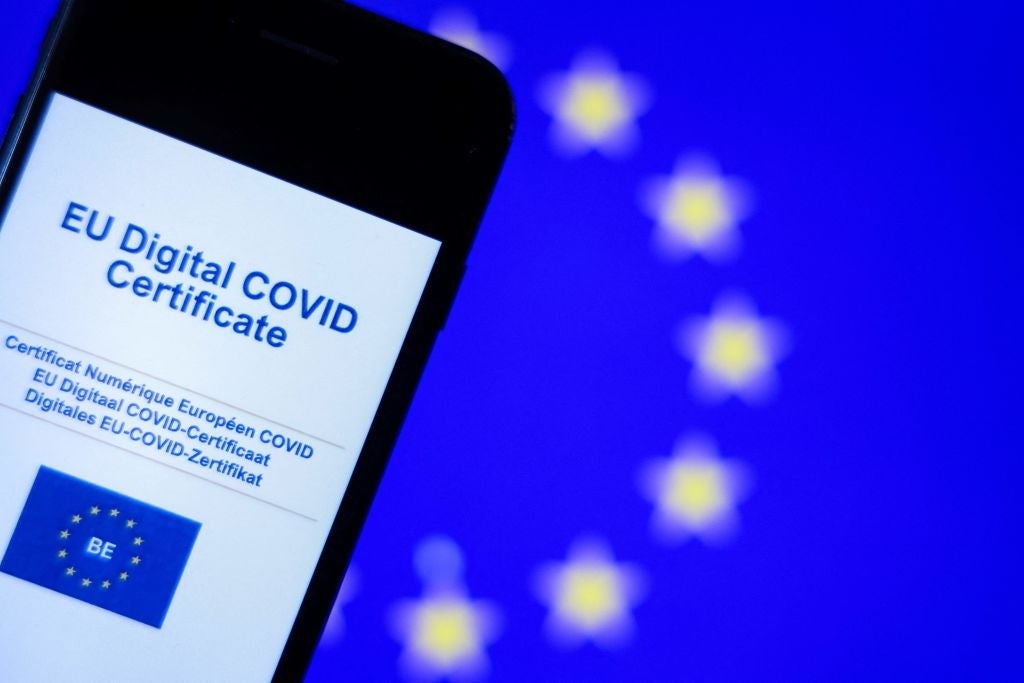
The European Union announced that nonessential travel to the EU from countries not on its "safe list" is subject to temporary travel restrictions. The U.S., Israel, Kosovo, Lebanon, Montenegro and North Macedonia were removed from the list.
It's important to note that this is a recommendation -- not a mandate -- and EU member states can choose to adopt the restrictions (or not). And the EU reviews this list every two weeks, which means that, in theory, it could revisit the recommendation very shortly if the COVID-19 situation in the U.S. improves.
Unvaccinated U.S. travelers are likely to face the most stringent restrictions if countries decided to reimpose entry requirements, such as additional testing and quarantine requirements.
However, the new restrictions (if imposed) would not likely apply to vaccinated travelers or children traveling with their vaccinated parents if they also show a negative COVID-19 PCR test. The EU has said vaccinated travelers should still be allowed entry if it has been at least 14 days since their final dose.
Should you cancel your trip to Europe?

Deciding whether you should cancel or postpone a trip is a profoundly personal decision. But some tourists are increasingly less comfortable with travel (particularly international flights) as the delta variant surges in the U.S. and worldwide.

If you're thinking about canceling or postponing your travel, make sure to take a good look at your itinerary to ensure your travel plans are fully refundable or have modest change or cancellation fees.
You can start by checking to see if you booked a refundable fare. Delta Air Lines, American Airlines and United Airlines all eliminated change fees for most flights, and Delta and United took it further by waiving change fees for basic economy fares through the end of the year. You can read additional information on specific airline, hotel, cruise and train changes and cancellation policies here.
General travel insurance usually does not cover epidemics and pandemics, so you should make sure to book travel insurance that covers COVID-19 costs. You can use a site such as InsureMyTrip to quickly compare numerous policy options that include various types of coverage — including coverage for COVID-19.
Just be sure to thoroughly read and understand any terms or exclusions before making a (potentially expensive) purchase.
Why is the EU changing its stance?

The recommendation is almost certainly related to a surge of COVID-19 cases in the United States related to the delta variant.
The EU says countries on its "safe list" must have a limit of no more than 75 cases per 100,000 inhabitants. The U.S. is well past that figure and is currently averaging over 300 cases per 100,000 inhabitants daily, according to U.S. Centers for Disease Control and Prevention (CDC) data. Additionally, eight states and Guam currently record more than 75 cases per 100,000 daily, with Mississippi topping the list.
The EU also considers how a country has progressed in having its citizens vaccinated against COVID-19 -- and just 52% of Americans are fully vaccinated. More than half of U.S. states are below the national average, according to Johns Hopkins University.
Finally, the EU also uses what it calls an "emergency brake mechanism," a temporary restriction on all travel into the EU if a country's epidemiological situation has worsened or if a variant of concern is found.
Which countries are changing their rules?

It's important to point out that individual member nations can decide when to relax — or tighten — entry requirements.
And there will likely be varied responses (or non-responses) to the recommendation because EU member states don't act in a bloc. And because this is a recommendation and not an order, some countries have already bungled their responses. Unfortunately for travelers, unclear directions can be anxiety-inducing and can throw your travel plans in limbo.
For instance, there have already been conflicting reports on Italy's requirements.
Italy's official website lists two contrasting requirements: one that states U.S. travelers must show a negative COVID-19 test taken within the previous 72 hours, regardless of vaccination status, while another that states that the test must be taken within 48 hours. We've reached out to the Italian National Tourist Board for clarification and will update this post if we get more guidance.
Elsewhere in the EU, Belgium added the U.S. to a "white list" of red zone countries, which also include Israel, Lebanon and Azerbaijan. It's unclear why Belgium further separated red list countries, but this list means nonessential travel is still allowed despite the EU recommendation. Vaccinated travelers still don't have to quarantine or test before arrival, while unvaccinated travelers must show a negative PCR test taken at least 72 hours before arrival.
Generally, your best bet is to consult a country's official tourism, local news organizations or government website for the most updated entry restrictions due to COVID-19. Additionally, the U.S. Department of State maintains a country page with the information most relevant to Americans and international travel via the U.S. Embassy in each location.
What if you're a dual citizen?
The EU says the "emergency brake" should not apply to EU citizens or long-term residents, meaning if you hold dual citizenship with the U.S. and a member country, you should be able to enter freely.
Bottom line
While the recommendation from the EU, at first, seems distressing, travelers should take some comfort in the fact that it's still just a recommendation. Despite rising cases of COVID-19 in the U.S., no EU country appears to have made significant travel policy changes yes, which is an encouraging sign. But we aren't entirely out of the water yet, as the EU can revisit its policy in two weeks.
Still, if you have travel plans to Europe coming up in the next few weeks or months, the best thing you can do for now is to monitor local news reports, purchase travel insurance and only book completely refundable flights and hotels.
TPG featured card

at Capital One's secure site
Terms & restrictions apply. See rates & fees.
| 5X miles | Earn 5X miles on hotels, vacation rentals and rental cars booked through Capital One Travel |
| 2X miles | Earn unlimited 2X miles on every purchase, every day |
Pros
- Stellar welcome offer of 75,000 miles after spending $4,000 on purchases in the first three months from account opening. Plus, a $250 Capital One Travel credit to use in your first cardholder year upon account opening.
- You'll earn 2 miles per dollar on every purchase, which means you won't have to worry about memorizing bonus categories
- Rewards are versatile and can be redeemed for a statement credit or transferred to Capital One’s transfer partners
Cons
- Highest bonus-earning categories only on travel booked via Capital One Travel
- LIMITED-TIME OFFER: Enjoy $250 to use on Capital One Travel in your first cardholder year, plus earn 75,000 bonus miles once you spend $4,000 on purchases within the first 3 months from account opening - that’s equal to $1,000 in travel
- Earn unlimited 2X miles on every purchase, every day
- Earn 5X miles on hotels, vacation rentals and rental cars booked through Capital One Travel
- Miles won't expire for the life of the account and there's no limit to how many you can earn
- Receive up to a $120 credit for Global Entry or TSA PreCheck®
- Use your miles to get reimbursed for any travel purchase—or redeem by booking a trip through Capital One Travel
- Enjoy a $50 experience credit and other premium benefits with every hotel and vacation rental booked from the Lifestyle Collection
- Transfer your miles to your choice of 15+ travel loyalty programs
- Top rated mobile app