DOJ filed an anti-trust suit challenging the American Airlines-JetBlue alliance

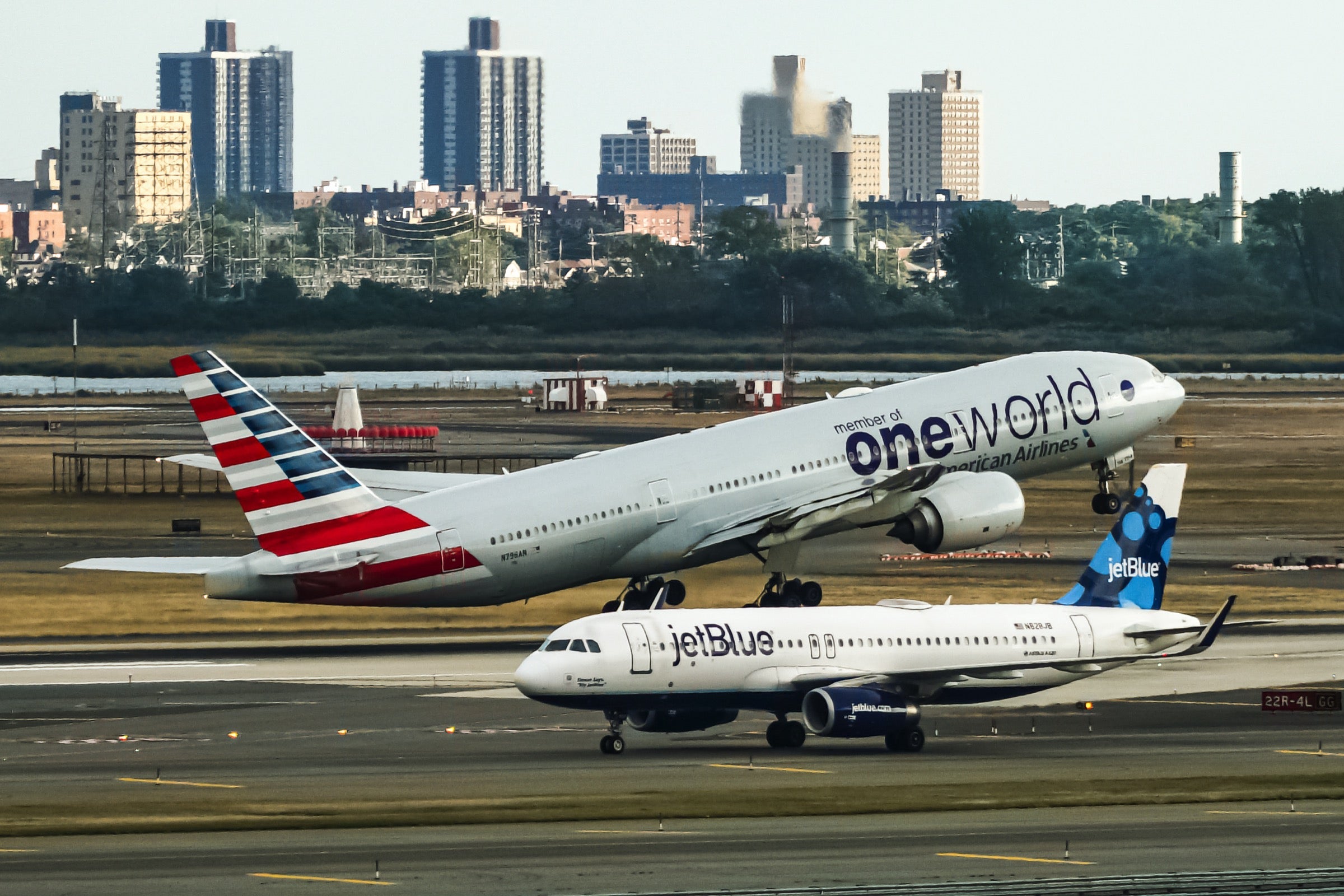
The Department of Justice filed an anti-trust lawsuit against the alliance between American Airlines and JetBlue.
Initial reports of the impending suit came amid increasing signs that the venture, dubbed the Northeast Alliance by the two airlines, would face challenges from the Justice Department.
In July, President Joseph Biden signed an executive order calling for increased competition across a range of sectors to counter increased consolidation over recent decades, "in order to promote the interests of American workers, businesses, and consumers."
On Friday, Sen. Richard Blumenthal (D-CT) wrote a letter to the Department of Transportation complaining that the partnership amounted to anti-competitive coordination between the two carriers.
"I write with grave concerns that the recent joint partnership between American Airlines and JetBlue Airways will lead to anticompetitive coordination at key air traffic hubs and result in the long-term inflation of airfares and related costs for airline passengers," Blumenthal wrote. "I urge the Department of Transportation to conduct a full public interest review and investigation of the Northeast Alliance cooperative agreement—consistent with President Biden's recent Executive Order on Competition—before taking any further action on merits of this venture."
Also on Friday, the Federal Aviation Administration (FAA) said it would award 16 available slots at Newark Liberty International Airport (EWR) to a low-cost carrier, citing the executive order and an effort to increase competition.
"The Department of Justice applauds the Department of Transportation's efforts to preserve competition from low-cost airlines at Newark airport," acting assistant attorney general Richard Powers said in a statement in support of the FAA. "Competition in the airline industry – and at Newark airport in particular – is in critically short supply."
American and JetBlue announced the alliance in July 2020, saying it would collectively allow them to better compete against Delta and United by codesharing on some routes and offering reciprocal frequent flyer benefits. Notably in New York, United and Delta are entrenched as dominant players at the city's capacity-controlled airports. American and JetBlue say their alliance allows them to compete at scale there, where expansion is hindered by the government's slot and capacity restrictions.
Questions about whether it violated anti-trust regulations emerged almost immediately following the airlines' announcement, and emerged again in recent weeks following the Biden Administration's executive order, which specifically noted airlines as a sector to be addressed.

The alliance had received approval in the last days of the Trump Administration after the airlines agreed to forfeit several slots in New York and Washington, and to avoid coordinating fares or revenue management.
The airlines implemented the alliance earlier this year, adding new routes and allowing users of both airlines' loyalty programs to earn miles on each other's flights.
The airlines have added nearly 60 routes under the alliance, while JetBlue has said that it has hired more than 1,800 workers to support it. The carriers have said that pressure from the alliance has led other carriers to lower fares.
"This has been the biggest catalyst of growth JetBlue has had since we were created," JetBlue CEO Robin Hayes told Bloomberg in an interview. "The ability to quadruple flights at LaGuardia, add flights at JFK and Newark. None of that would have been possible without the NEA."
Hayes added that he does not think the alliance is anti-competitive.
More: FAA will offer Newark slots to low-cost airline, spurring competition for United
"We don't believe there is any case," Hayes said. "We believe the overwhelming evidence is already pointing to more JetBlue routes, more low fares, more choice. Rather than DOJ looking at that they should continue to monitor and make sure those benefits continue to be delivered."
It was not immediately clear what the pending suit would mean for passengers, or whether the airlines would continue to roll out reciprocal benefits for their respective loyalty programs.
TPG featured card
at American Express's secure site
Terms & restrictions apply. See rates & fees.
| 4X | Earn 4X Membership Rewards® points per dollar spent on purchases at restaurants worldwide, on up to $50,000 in purchases per calendar year, then 1X points for the rest of the year. |
| 4X | Earn 4X Membership Rewards® points per dollar spent at US supermarkets, on up to $25,000 in purchases per calendar year, then 1X points for the rest of the year. |
| 5X | Earn 5X Membership Rewards® points on prepaid hotel stays booked through AmexTravel.com or the Amex Travel App™. |
| 3X | Earn 3X Membership Rewards® points on flights booked through AmexTravel.com, the Amex Travel App™, or purchased directly from airlines. |
| 2X | Earn 2X Membership Rewards® points on prepaid car rentals booked through AmexTravel.com or the Amex Travel App™ and cruises booked and paid through AmexTravel.com. |
| 1X | Earn 1X Membership Rewards® point per dollar spent on all other eligible purchases. |
Pros
- Valuable dining and food-related credits
- Flexible rewards with airline and hotel transfer partners
- Multiple travel and purchase protections
- No foreign transaction fees
- Access to Amex Offers for additional savings (enrollment required)
Cons
- Not as useful for those living outside the U.S.
- Some may have trouble using Uber and other dining credits
- You may be eligible for as high as 100,000 Membership Rewards® Points after you spend $8,000 in eligible purchases on your new Card in your first 6 months of Card Membership. Welcome offers vary and you may not be eligible for an offer. Apply to know if you’re approved and find out your exact welcome offer amount – all with no credit score impact. If you’re approved and choose to accept the Card, your score may be impacted.
- Earn 4X Membership Rewards® points per dollar spent on purchases at restaurants worldwide, on up to $50,000 in purchases per calendar year, then 1X points for the rest of the year.
- Earn 4X Membership Rewards® points per dollar spent at US supermarkets, on up to $25,000 in purchases per calendar year, then 1X points for the rest of the year.
- Earn 5X Membership Rewards® points on prepaid hotel stays booked through AmexTravel.com or the Amex Travel App™.
- Earn 3X Membership Rewards® points on flights booked through AmexTravel.com, the Amex Travel App™, or purchased directly from airlines.
- Earn 2X Membership Rewards® points on prepaid car rentals booked through AmexTravel.com or the Amex Travel App™ and cruises booked and paid through AmexTravel.com.
- Earn 1X Membership Rewards® point per dollar spent on all other eligible purchases.
- Pay It® lets you tap in the American Express® App to quickly pay for small purchase amounts throughout the month and still earn rewards the way you usually do. Plan It® gives you the option to split up big purchases into equal monthly payments with a fixed fee. You’ll know upfront exactly how much you’ll pay.
- $120 Dining Credit: Earn up to a total of $10 in statement credits monthly when you pay with the Gold Card at Grubhub (including Seamless), Buffalo Wild Wings, Five Guys, The Cheesecake Factory, and Wonder. This can be an annual savings of up to $120. Enrollment required.
- $100 Resy Credit: Get up to $100 in statement credits each calendar year at over 10,000 qualifying U.S. Resy restaurants after you pay for eligible purchases with the American Express® Gold Card. That’s up to $50 in statement credits semi-annually. Enrollment required.
- $84 Dunkin' Credit: Earn up to $7 in monthly statement credits after you pay with the American Express® Gold Card at U.S. Dunkin’ locations. Enrollment required.
- $120 Uber Cash on Gold: Enjoy up to $120 in Uber Cash annually with your Gold Card. Just add your Card to your Uber account and you'll get $10 in Uber Cash each month to use on orders and rides in the U.S. when you select an Amex Card for your transaction.
- Enjoy complimentary Hertz Five Star® Status benefits like skipping the counter at select locations, adding an additional driver at no additional cost*, and vehicle upgrades**. Benefit enrollment and Hertz Gold+ registration are required. *Additional drivers must meet standard rental qualifications and must be a spouse or domestic partner to qualify as complimentary. Other additional drivers subject to fees. **Benefits are subject to availability and vary by location. Additional Hertz program Terms and Conditions including age restrictions apply.
- Book two nights or more with The Hotel Collection through AmexTravel.com or the Amex Travel App™ and receive a $100* credit towards eligible charges at over 1,400 upscale hotels worldwide. *Eligible charges vary by property.
- Book your travel through the Amex Travel App™ with added peace of mind – backed by American Express® service and support. Only for American Express® Card Members.
- Whenever you need us, we're here. Our Member Services team will ensure you are taken care of. From lost Card replacement to statement questions, we are available to help 24/7.
- No Foreign Transaction Fees.
- Annual Fee is $325.
- Terms Apply.