Skip to content

Airplane Math: What Pilots Need to Know for Takeoff


July 10, 2019
6 min read
Co-pilot flying an aircraft
Airplane Math: What Pilots Need to Know for Takeoff
The cards we feature here are from partners who compensate us when you are approved through our site, and this may impact how or where these products appear. We don’t cover all available credit cards, but our analysis, reviews, and opinions are entirely from our editorial team. Terms apply to the offers listed on this page. Please view our advertising policy and product review methodology for more information.

Before a plane takes to the sky, its pilots need to do some serious math to make sure it can get where it's supposed to go.

These days that number-crunching is handled by a computer. Richard Anderson, director of the Eagle Flight Research Center at Embry-Riddle Aeronautical University, walked me through some of the metrics a pilot needs to know before a flight can depart.

Photo by Jaromir Chalabala/EyeEm via Getty Images

Maximum takeoff and landing weight

Planes don’t have an unlimited carrying capacity. If they’re too heavy, they simply cannot fly. Based on the weather and other external factors, a plane’s maximum takeoff weight is the first thing those computers calculate. Everything that gets brought aboard is tallied by weight and the total has to remain below the maximum for takeoff.

Planes also usually can’t land fully laden. The landing gear isn’t strong enough to absorb the impact of a totally full plane hitting the runway. And, remember that fuel is a major component toward a plane’s overall weight. That’s why, if an emergency happens early in the flight, pilots often have to dump fuel before they can return to the airport, or circle for a long enough time to burn off enough fuel. (Some planes are equipped with fuel-venting nozzles; others, particularly smaller ones, are not.)

An airplane gets refueled (Photo by Tobias Titz via Getty Images)

Fuel weight

Planes are generally required to have enough fuel to get to their destination, plus sufficient reserves to get to an alternate airport in the event of an emergency (and then 45 more minutes of flying beyond that).

Unlike in your car, where gas is measured in gallons or liters, airplane fuel is calculated in pounds and the total fuel load is usually the first thing counted toward the maximum takeoff weight.

“If you’re looking at a full flight, you would put the minimum fuel on board that you’re legally required to have and then you would take as many people as you can” (and their baggage or cargo) until you get to the maximum takeoff weight, Anderson said.

Daily Newsletter
Reward your inbox with the TPG Daily newsletter
Join over 700,000 readers for breaking news, in-depth guides and exclusive deals from TPG’s experts
Airport check-in counters (Photo by Matthias Balk/picture alliance via Getty Images)

Passenger and baggage weight

I’m lumping these together because they have a key commonality: The actual weight of you and your bags doesn’t matter when it comes to these calculations

Unless you’re flying on a tiny “puddle-jumper” plane, airlines use a standard, assumed weight for their passengers and the baggage that comes aboard.

“Unless it’s a small airliner where statistics would not be in their favor, they’re mostly weighing your bags to extract money from you,” Anderson said. “If you have way too many bags over 50 pounds, maybe that would flag something, but in big airliners they just use statistics.”

The Federal Aviation Administration in 2005 outlined the weight standards that airlines should use: 200 pounds for an adult male passenger, 179 pounds for an adult female passenger and 82 pounds for a child between the ages of 2 and 13. Those numbers include an estimated 16 pounds per person of carry-on baggage, and are all revised upwards by five pounds in the winter to account for heavier clothing. For checked baggage, the standard average weight is 30 pounds.
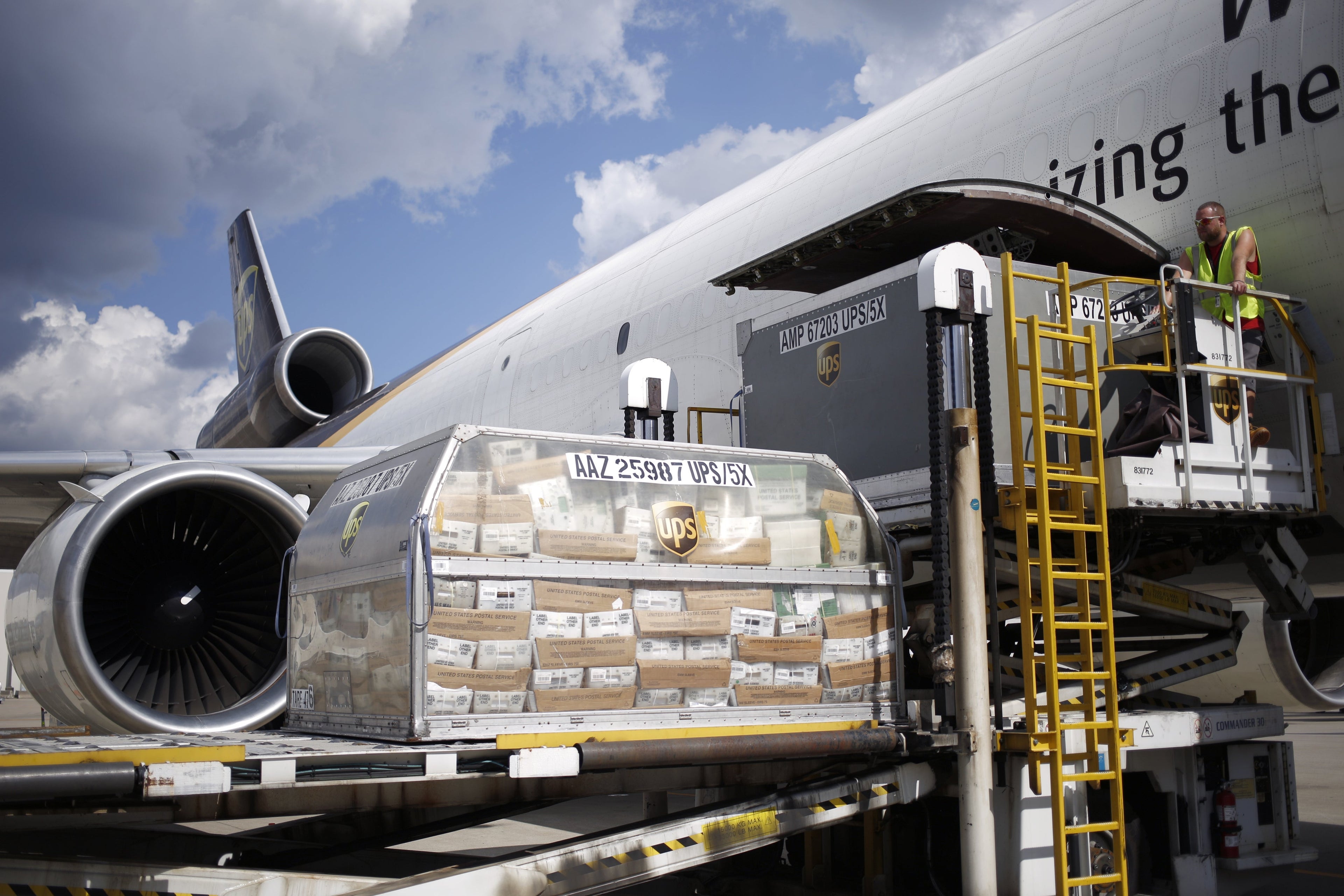
A shipping container of United States Postal Service mail is loaded onto a cargo jet on the tarmac at the United Parcel Service Inc. (UPS) Worldport facility in Louisville, Kentucky, Oct. 5, 2018. (Luke Sharrett/Bloomberg via Getty Images)

Cargo weight

The last component of a plane’s maximum weight is its cargo. Many passenger airlines fly cargo in the hold along with their customers’ bags. And, of course, planes that operate on behalf of couriers like FedEx or UPS fly all sorts of items all over the world.

According to Anderson, cargo, unlike passenger luggage, is usually weighed directly for takeoff calculations, because there’s too much variability in what can be shipped.

Small planes are more susceptible to balance issues than large commercial jets (Photo by Lance King/Getty Images)

Balance

Passengers, bags and cargo can’t just be loaded on willy-nilly. If too much weight is concentrated in one part of the aircraft, it can affect the pilot’s ability to control the plane. So, the supercomputers also calculate how everything has to be distributed.

A Lufthansa Airbus A380 of Lufthansa takes off at Frankfurt airport. (Photo by Boris Roessler/picture alliance via Getty Images)

V1, Vr

Once the pilots are satisfied that the plane is maximally full but also light enough to still fly, they’re ready to hurtle down the runway.

There are two more things that they need to know, however, in order to get airborne: V1 is the go/no-go speed. It’s the last moment at which a plane has enough room on the runway to reject its takeoff.

“If you are above V1 and you lose an engine and you’re still on the ground, it takes less room to continue to takeoff with the engines that are still good,” Anderson said. So, below V1, a takeoff can be rejected; above it, the flight must lift off.

And Vr, or rotation speed, is when that happens –- it’s the speed at which the front landing gear wheels can come off the ground.

Reader, you now know what it takes to take off, but don't try it unless you have a license.

This story has been edited to clarify the speed at which an airplane's wheels leave the ground is called Vr, not V2.

Featured image by Getty Images/iStockphoto

TPG featured card

Best for dining at restaurants
TPG Editor‘s Rating
4 / 5
Go to review
Apply for American Express® Gold Card
at American Express's secure site

Rewards

1 - 4X points

Intro offer

As High As 100,000 points. Find Out Your Offer.

Annual Fee

$325

Recommended Credit

Excellent to Good

Why We Chose It

There’s a lot to love about the Amex Gold. It’s a fan favorite thanks to its fantastic bonus-earning rates at restaurants worldwide and at U.S. supermarkets. If you’re hitting the skies soon, you’ll also earn bonus Membership Rewards points on travel. Paired with up to $120 in Uber Cash annually (for U.S. Uber rides or Uber Eats orders, card must be added to Uber app and you can redeem with any Amex card), up to $120 in annual dining statement credits to be used with eligible partners, an up to $84 Dunkin’ credit each year at U.S. Dunkin Donuts and an up to $100 Resy credit annually, there’s no reason that foodies shouldn’t add the Amex Gold to their wallet. These benefits alone are worth more than $400, which offsets the $325 annual fee on the Amex Gold card. Enrollment is required for select benefits. (Partner offer)

Pros

  • 4 points per dollar spent on dining at restaurants worldwide and U.S. supermarkets (on the first $50,000 in purchases per calendar year; then 1 point per dollar spent thereafter and $25,000 in purchases per calendar year; then 1 point per dollar spent thereafter, respectively)
  • 3 points per dollar spent on flights booked directly with the airline or with amextravel.com
  • Packed with credits foodies will enjoy
  • Solid welcome bonus

Cons

  • Not as useful for those living outside the U.S.
  • Some may have trouble using Uber and other dining credits
  • You may be eligible for as high as 100,000 Membership Rewards® Points after you spend $6,000 in eligible purchases on your new Card in your first 6 months of Card Membership. Welcome offers vary and you may not be eligible for an offer. Apply to know if you’re approved and find out your exact welcome offer amount – all with no credit score impact. If you’re approved and choose to accept the Card, your score may be impacted.
  • Earn 4X Membership Rewards® points per dollar spent on purchases at restaurants worldwide, on up to $50,000 in purchases per calendar year, then 1X points for the rest of the year.
  • Earn 4X Membership Rewards® points per dollar spent at US supermarkets, on up to $25,000 in purchases per calendar year, then 1X points for the rest of the year.
  • Earn 3X Membership Rewards® points per dollar spent on flights booked directly with airlines or on AmexTravel.com.
  • Earn 2X Membership Rewards® points per dollar spent on prepaid hotels and other eligible purchases booked on AmexTravel.com.
  • Earn 1X Membership Rewards® point per dollar spent on all other eligible purchases.
  • $120 Uber Cash on Gold: Add your Gold Card to your Uber account and get $10 in Uber Cash each month to use on orders and rides in the U.S. when you select an American Express Card for your transaction. That’s up to $120 Uber Cash annually. Plus, after using your Uber Cash, use your Card to earn 4X Membership Rewards® points for Uber Eats purchases made with restaurants or U.S. supermarkets. Point caps and terms apply.
  • $84 Dunkin' Credit: With the $84 Dunkin' Credit, you can earn up to $7 in monthly statement credits after you enroll and pay with the American Express® Gold Card at U.S. Dunkin' locations. Enrollment is required to receive this benefit.
  • $100 Resy Credit: Get up to $100 in statement credits each calendar year after you pay with the American Express® Gold Card to dine at U.S. Resy restaurants or make other eligible Resy purchases. That's up to $50 in statement credits semi-annually. Enrollment required.
  • $120 Dining Credit: Satisfy your cravings, sweet or savory, with the $120 Dining Credit. Earn up to $10 in statement credits monthly when you pay with the American Express® Gold Card at Grubhub, The Cheesecake Factory, Goldbelly, Wine.com, and Five Guys. Enrollment required.
  • Explore over 1,000 upscale hotels worldwide with The Hotel Collection and receive a $100 credit towards eligible charges* with every booking of two nights or more through AmexTravel.com. *Eligible charges vary by property.
  • No Foreign Transaction Fees.
  • Annual Fee is $325.
  • Terms Apply.
Apply for American Express® Gold Card
at American Express's secure site
Terms & restrictions apply. See rates & fees
Best for dining at restaurants
TPG Editor‘s Rating
4 / 5
Go to review

Rewards Rate

4XEarn 4X Membership Rewards® points per dollar spent on purchases at restaurants worldwide, on up to $50,000 in purchases per calendar year, then 1X points for the rest of the year.
4XEarn 4X Membership Rewards® points per dollar spent at US supermarkets, on up to $25,000 in purchases per calendar year, then 1X points for the rest of the year.
3XEarn 3X Membership Rewards® points per dollar spent on flights booked directly with airlines or on AmexTravel.com.
2XEarn 2X Membership Rewards® points per dollar spent on prepaid hotels and other eligible purchases booked on AmexTravel.com.
1XEarn 1X Membership Rewards® point per dollar spent on all other eligible purchases.
  • Intro Offer

    As High As 100,000 points. Find Out Your Offer.
  • Annual Fee

    $325
  • Recommended Credit

    Excellent to Good

Why We Chose It

There’s a lot to love about the Amex Gold. It’s a fan favorite thanks to its fantastic bonus-earning rates at restaurants worldwide and at U.S. supermarkets. If you’re hitting the skies soon, you’ll also earn bonus Membership Rewards points on travel. Paired with up to $120 in Uber Cash annually (for U.S. Uber rides or Uber Eats orders, card must be added to Uber app and you can redeem with any Amex card), up to $120 in annual dining statement credits to be used with eligible partners, an up to $84 Dunkin’ credit each year at U.S. Dunkin Donuts and an up to $100 Resy credit annually, there’s no reason that foodies shouldn’t add the Amex Gold to their wallet. These benefits alone are worth more than $400, which offsets the $325 annual fee on the Amex Gold card. Enrollment is required for select benefits. (Partner offer)

Pros

  • 4 points per dollar spent on dining at restaurants worldwide and U.S. supermarkets (on the first $50,000 in purchases per calendar year; then 1 point per dollar spent thereafter and $25,000 in purchases per calendar year; then 1 point per dollar spent thereafter, respectively)
  • 3 points per dollar spent on flights booked directly with the airline or with amextravel.com
  • Packed with credits foodies will enjoy
  • Solid welcome bonus

Cons

  • Not as useful for those living outside the U.S.
  • Some may have trouble using Uber and other dining credits
  • You may be eligible for as high as 100,000 Membership Rewards® Points after you spend $6,000 in eligible purchases on your new Card in your first 6 months of Card Membership. Welcome offers vary and you may not be eligible for an offer. Apply to know if you’re approved and find out your exact welcome offer amount – all with no credit score impact. If you’re approved and choose to accept the Card, your score may be impacted.
  • Earn 4X Membership Rewards® points per dollar spent on purchases at restaurants worldwide, on up to $50,000 in purchases per calendar year, then 1X points for the rest of the year.
  • Earn 4X Membership Rewards® points per dollar spent at US supermarkets, on up to $25,000 in purchases per calendar year, then 1X points for the rest of the year.
  • Earn 3X Membership Rewards® points per dollar spent on flights booked directly with airlines or on AmexTravel.com.
  • Earn 2X Membership Rewards® points per dollar spent on prepaid hotels and other eligible purchases booked on AmexTravel.com.
  • Earn 1X Membership Rewards® point per dollar spent on all other eligible purchases.
  • $120 Uber Cash on Gold: Add your Gold Card to your Uber account and get $10 in Uber Cash each month to use on orders and rides in the U.S. when you select an American Express Card for your transaction. That’s up to $120 Uber Cash annually. Plus, after using your Uber Cash, use your Card to earn 4X Membership Rewards® points for Uber Eats purchases made with restaurants or U.S. supermarkets. Point caps and terms apply.
  • $84 Dunkin' Credit: With the $84 Dunkin' Credit, you can earn up to $7 in monthly statement credits after you enroll and pay with the American Express® Gold Card at U.S. Dunkin' locations. Enrollment is required to receive this benefit.
  • $100 Resy Credit: Get up to $100 in statement credits each calendar year after you pay with the American Express® Gold Card to dine at U.S. Resy restaurants or make other eligible Resy purchases. That's up to $50 in statement credits semi-annually. Enrollment required.
  • $120 Dining Credit: Satisfy your cravings, sweet or savory, with the $120 Dining Credit. Earn up to $10 in statement credits monthly when you pay with the American Express® Gold Card at Grubhub, The Cheesecake Factory, Goldbelly, Wine.com, and Five Guys. Enrollment required.
  • Explore over 1,000 upscale hotels worldwide with The Hotel Collection and receive a $100 credit towards eligible charges* with every booking of two nights or more through AmexTravel.com. *Eligible charges vary by property.
  • No Foreign Transaction Fees.
  • Annual Fee is $325.
  • Terms Apply.