Everything you've ever wanted to know about airline safety cards
"Please give us your attention as we show you one of the safest worlds there is: the world of the safety card."
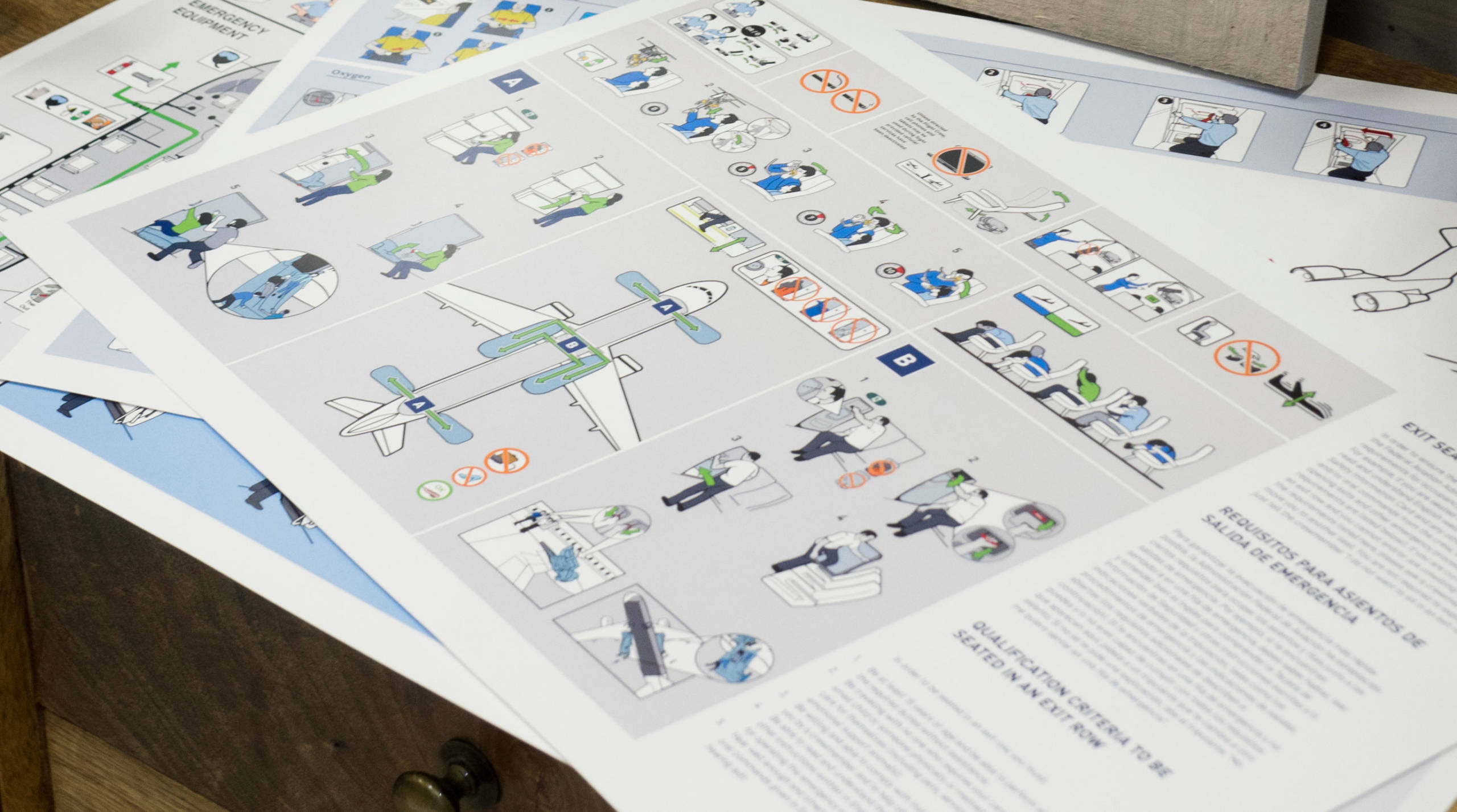
So says a clever Delta Air Lines inflight safety video. Commercial aviation is extremely safe, but as you read those safety cards, you might even admire the beautiful graphics.
Most of them are the product of Interaction Research Co., based in Olympia, Washington, and headed by CEO Trisha Ferguson. IRC has been designing the safety cards for the vast majority of airlines around the world since 1971.
"We've worked with 80% of the carriers worldwide over the last 50 years," Ferguson said in an interview. The company designs and prints millions of cards per year with airlines like JetBlue and American currently among IRC's major clients.

The safety card is actually critical to takeoff. "If you don't have a safety card on board, in every seat, the plane is grounded," Ferguson said, citing FAA rules. Regulations also require that the safety card be the tallest item in the seatback pocket, for ease of access.
IRC was founded in 1971 by Daniel Johnson, who had worked at Douglas Aircraft Corporation as an accident psychologist in the 1960s. "He's a human-factors and ergonomics psychologist," Ferguson explained. Johnson saw the need for passenger education and started IRC in his garage in Long Beach, California. In 1978, Dr. Johnson testified to Congress in favor of making safety briefing cards and videos mandatory throughout the industry.
"He knew that if passengers would have been educated, they could have saved their lives. There was too much emphasis on [listening to] crew instruction during an emergency," Ferguson said.
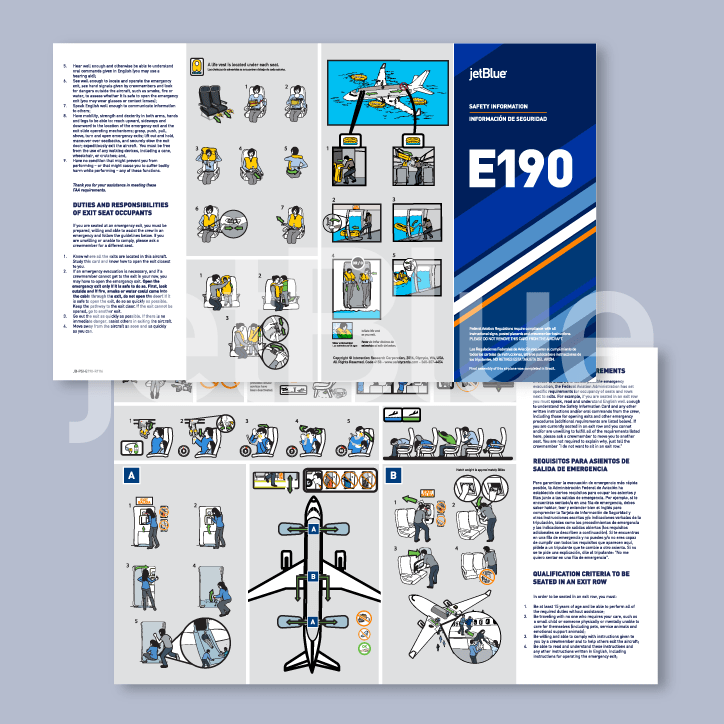
The cards that IRC designs vary by aircraft and airline -- an Embraer E190's card is different from a Boeing 787's. The U.S. Department of Transportation regularly releases advisory circulars with required updates, Ferguson said. The cards change because regulations change, and so can the onboard equipment the cards describe, such as life vests, rafts or emergency illumination of the floor. And when one airline purchases used aircraft from another airline, safety cards also need to change.
"Most of us think we are very educated. But every aircraft has so many variables," Ferguson said. "To give you an example, the emergency exit doors on the Boeing 737-300, compared to the Boeing 737-900, have different operations. On the [737-900], you simply pull the handle down and the door opens outward on a hinge. If you try to pull in the door inwards like on the 737-300, you will literally keep the door from opening."

Design Principles
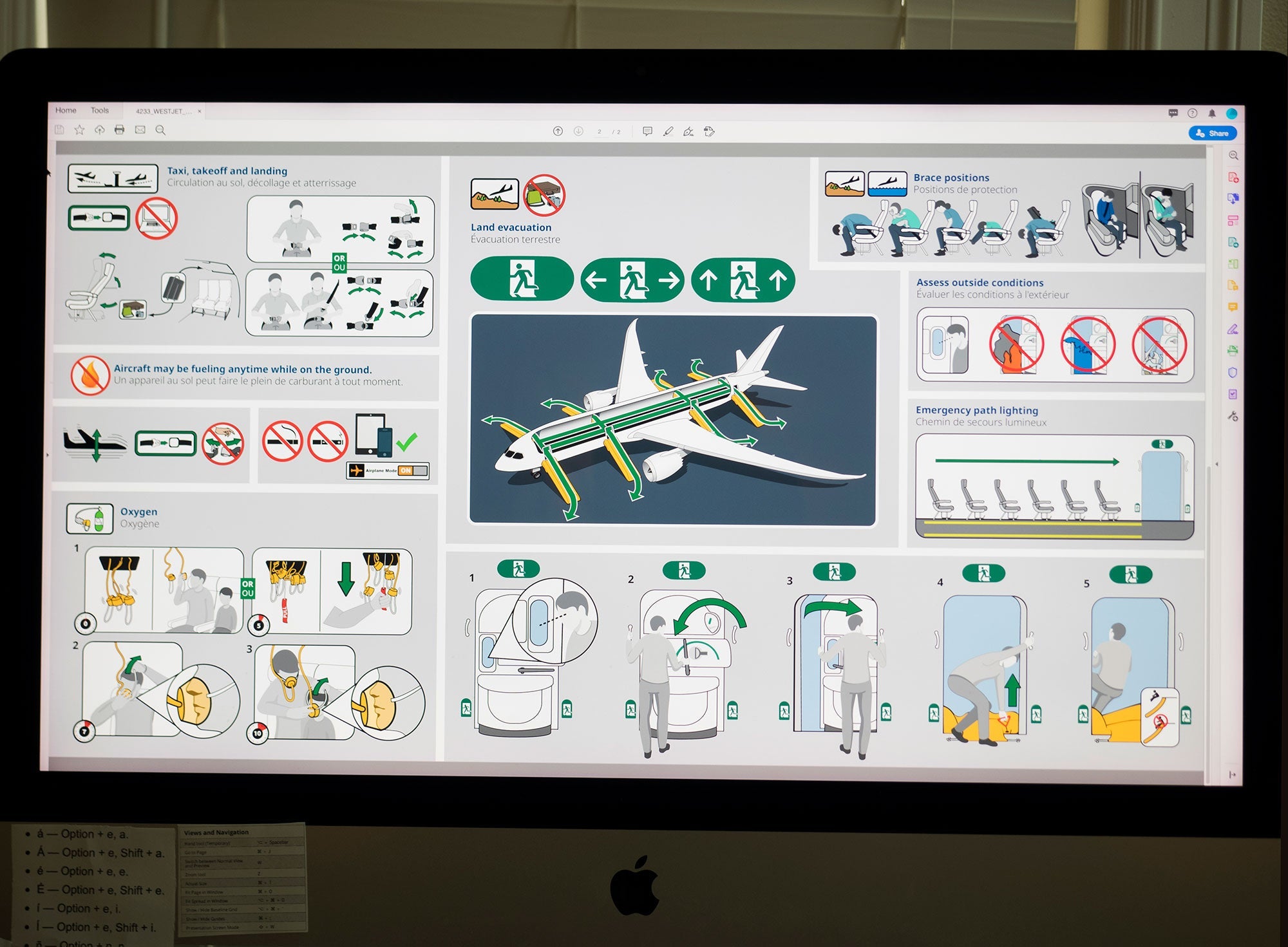
According to Ferguson, IRC's advantage is 50 years of designing cards based on how the human brain works. "If you looked at the early safety information provided to passengers, almost all of (the cards) were very heavy on text and words and light on illustrations," she said.
In contrast, Ferguson said, IRC, from the beginnning, researched how humans observe and consume information. "There are formulas, colors, content considerations, flow and sequence considerations. How we read in the U.S., for example, from left to right and top to bottom, differs from countries in the Middle East," where IRC's clients are also found. Whenever it designs a new illustration, IRC asks a third-party agency to perform one-on-one, on-the-street tests with up to 50 individuals. The goal is to have new artwork understood by at least 90% of the subjects.
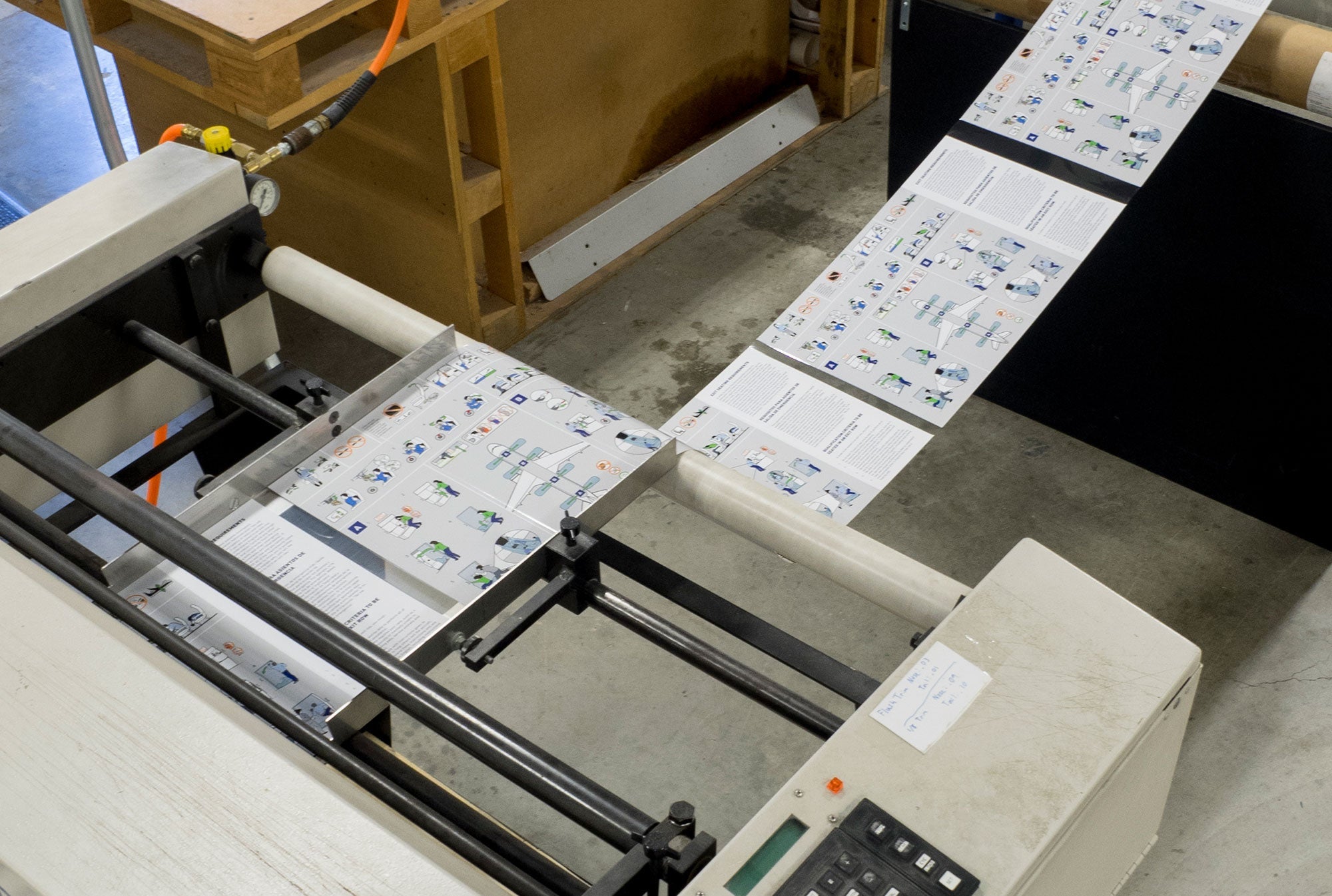
IRC can design cards using an airline's "house" style and look. That's the case for 80% of its clients, Ferguson said. Her company has a library of illustrations that can be modified and inserted into a templated design. (For graphic design nerds, the work is done with Adobe Illustrator and InDesign.) IRC now owns a subsidiary printing company and can get proofs done within 24 hours and cards out in two weeks or less.

But do passengers actually read the cards? There aren't any statistics, but clearly airlines want more people to read them.
Take the case of one airline which, Ferguson said, attempted humor in the late 1990s. The idea was to invite passengers to find a character, like a ballerina or a magician, hidden inside the pages of the safety card. "It lasted about five years before the airline went back to the standard characters. They tried to make the card novel and attractive to increase [the number of] people reading," she said, noting that it's a difficult task. Humor doesn't always translate well to such a serious subject.
Read Your Safety Card Before Every Flight
"On a personal level," Ferguson said, "I knew IRC was making a difference when an Ethiopian Boeing 767 crashed in 1996. It ran out of fuel after being hijacked, and the crash was caught on video. Of the 175 people aboard, 50 survived. And I woke up on the morning of the crash and saw a news report of a survivor saying the only reason they survived was because of reading our safety card."
"We know that the more educated you are, the higher the likelihood of survival and avoiding injury to you and others," she added. But does she read the cards on every flight she takes? "Yes," she said emphatically. And, apparently, so do her seatmates.
"Last night I was on a flight, and someone asked me what I did for a living. Nine times out of 10 when I explain, they'll pull out the safety card and give it a read."
You should, too.
Mike Arnot is the founder of Boarding Pass NYC, and a marketing consultant to airlines, none of which appear in this article.
TPG featured card

at American Express's secure site
Terms & restrictions apply. See rates & fees.
| 3X | Earn 3X Miles on Delta purchases. |
| 1X | Earn 1X Miles on all other eligible purchases. |
Pros
- Delta SkyClub access when flying Delta
- Annual companion ticket for travel on Delta (upon renewal)
- Ability to earn MQDs through spending
- Various statement credits for eligible purchases
Cons
- Steep annual fee of $650
- Other Delta cobranded cards offer superior earning categories
- Earn 100,000 Bonus Miles after you spend $6,000 or more in purchases with your new Card within the first 6 months of Card Membership and an additional 25,000 bonus miles after you make an additional $3,000 in purchases on the Card within your first 6 months, starting from the date that your account is opened. Offer Ends 04/01/2026.
- Delta SkyMiles® Reserve American Express Card Members receive 15 Visits per Medallion® Year to the Delta Sky Club® when flying Delta and can unlock an unlimited number of Visits after spending $75,000 in purchases on your Card in a calendar year. Plus, you’ll receive four One-Time Guest Passes each Medallion Year so you can share the experience with family and friends when traveling Delta together.
- Enjoy complimentary access to The Centurion® Lounge in the U.S. and select international locations (as set forth on the Centurion Lounge Website), Sidecar by The Centurion® Lounge in the U.S. (see the Centurion Lounge Website for more information on Sidecar by The Centurion® Lounge availability), and Escape Lounges when flying on a Delta flight booked with the Delta SkyMiles® Reserve American Express Card. § To access Sidecar by The Centurion® Lounge, Card Members must arrive within 90 minutes of their departing flight (including layovers). To access The Centurion® Lounge, Card Members must arrive within 3 hours of their departing flight. Effective July 8, 2026, during a layover, Card Members must arrive within 5 hours of the connecting flight.
- Receive $2,500 Medallion® Qualification Dollars with MQD Headstart each Medallion Qualification Year and earn $1 MQD for each $10 in purchases on your Delta SkyMiles® Reserve American Express Card with MQD Boost to get closer to Status next Medallion Year.
- Enjoy a Companion Certificate on a Delta First, Delta Comfort, or Delta Main round-trip flight to select destinations each year after renewal of your Card. The Companion Certificate requires payment of government-imposed taxes and fees of between $22 and $250 (for itineraries with up to four flight segments). Baggage charges and other restrictions apply. Delta Basic experiences are not eligible for this benefit.
- $240 Resy Credit: When you use your Delta SkyMiles® Reserve American Express Card for eligible purchases with U.S. Resy restaurants, you can earn up to $20 each month in statement credits. Enrollment required.
- $120 Rideshare Credit: Earn up to $10 back in statement credits each month after you use your Delta SkyMiles® Reserve American Express Card to pay for U.S. rideshare purchases with select providers. Enrollment required.
- Delta SkyMiles® Reserve American Express Card Members get 15% off when using miles to book Award Travel on Delta flights through delta.com and the Fly Delta app. Discount not applicable to partner-operated flights or to taxes and fees.
- With your Delta SkyMiles® Reserve American Express Card, receive upgrade priority over others with the same Medallion tier, product and fare experience purchased, and Million Miler milestone when you fly with Delta.
- Earn 3X Miles on Delta purchases and earn 1X Miles on all other eligible purchases.
- No Foreign Transaction Fees. Enjoy international travel without additional fees on purchases made abroad.
- $650 Annual Fee.
- Apply with confidence. Know if you're approved for a Card with no impact to your credit score. If you're approved and you choose to accept this Card, your credit score may be impacted.
- Terms Apply.
- See Rates & Fees