The Points Guy believes that credit cards can transform lives, helping you leverage everyday spending for cash back or travel experiences that might otherwise be out of reach. That's why we publish a variety of editorial content and card comparisons: to help you find a great card to turn your goals into reality.
Our site may earn compensation when a customer clicks on a link, when an application is approved, or when an account is opened with our partners, and this may impact how or where these products appear. While we don't cover all available credit cards, our editorial team creates and maintains all of the analysis of these cards, and our content is not influenced nor subject to review by any credit card company, bank or partner prior to (or after) publication. Please view our advertising policy and product review methodology for more information.
Advertiser disclosure
The Points Guy believes that credit cards can transform lives, helping you leverage everyday spending for cash back or travel experiences that might otherwise be out of reach. That's why we publish a variety of editorial content and card comparisons: to help you find a great card to turn your goals into reality.
Our site may earn compensation when a customer clicks on a link, when an application is approved, or when an account is opened with our partners, and this may impact how or where these products appear. While we don't cover all available credit cards, our editorial team creates and maintains all of the analysis of these cards, and our content is not influenced nor subject to review by any credit card company, bank or partner prior to (or after) publication. Please view our advertising policy and product review methodology for more information.
Guides
How much are Free Spirit points really worth under the new Free Spirit program?
Featured image by SOPA Images/LightRocket via Gett
Andrew Kunesh is TPG's Points & Miles editor. He has been active in the points and miles space since 2014, using them to travel far and wide around the world. He is originally from Chicago but moved to New York City after graduating from DePaul University. His work is featured on Credit Karma, UpgradedPoints, ValuePenguin and various other travel and finance publications. He currently holds Delta Diamond Medallion and Marriott Titanium status, and 20+ credit cards that each have a special place in Andrew's wallet.
January 27, 2021 • 9 min read
The cards we feature here are from partners who compensate us when you are approved through our site, and this may impact how or where these products appear. We don't cover all available credit cards, but our analysis, reviews, and opinions are entirely from our editorial team. Terms apply to the offers listed on this page. Please view our advertising policy and product review methodology for more information.Editorial disclaimer: Opinions expressed here are the author's alone, not those of any bank, credit card issuer, airline or hotel chain, and have not been reviewed, approved or otherwise endorsed by any of these entities.
Comments
By commenting, you agree to our Community Guidelines to help create a positive space for conversation. The responses below are not provided or commissioned by the bank advertiser, our partners, or The Points Guy (“TPG”). They have not been reviewed, approved, or otherwise endorsed by any of these parties. All responses are submitted by individual contributors, and neither the bank advertiser, our partners, nor TPG are responsible for ensuring that all posts and/or questions are answered.
Related stories
Quick summary
Spirit Airlines has overhauled its Free Spirit loyalty program, introducing new ways to earn and redeem points and updated elite status tiers.
Award flights now start at 2,500 points one-way, but the value per point varies based on route, timing and booking fees.
Average point value is around 1 cent each, but those with elite status or certain cobranded cards can achieve up to 1.23 cents per point, per TPG's valuations as of early 2021.
International flights and bookings made more than 28 days in advance typically yield the highest value for points.
What to consider
A $50 redemption fee applies to bookings within 28 days of departure unless you have elite status or a qualifying cobranded card.
Ultra-cheap fares may provide lower value per point, so comparing cash and award pricing is recommended before redeeming points.
Spirit points cannot be transferred from major credit card or hotel loyalty programs, limiting external earning options.
What you'll miss from the article
A detailed analysis of how to maximize value from Spirit points, including specific examples and tips for avoiding low-value redemptions.
Generated by AI with support from our editorial team.
Update: Some offers mentioned below are no longer available. View the current offers here.
The new Free Spirit changes how points are earned and redeemed, along with elite status tiers for the airline's most frequent flyers. The airline has touted the new Free Spirit as offering "rewards you can actually use" — with award flights starting at just 2,500 points one-way.
However, the airline hasn't said how its award flights are priced or how much they're worth. So I did a bit of digging and compared the cost of a handful of flights to give the miles a standard valuation.
In this article, I'll show you my work and discuss how much Spirit points are worth. Plus, I'll discuss the best ways to redeem your Spirit points for maximum value.
Before we dive into the valuation, let's discuss my research.
I pulled the cash and points costs of 100 different Spirit Airlines flights to find the average cents-per-point value of all flights. Twenty-five of these flights were international, while the rest were U.S. domestic routes. Likewise, all flights were round-trip tickets to avoid any expensive one-way tickets.
It's also worth noting that Spirit Airlines charges a $50 redemption fee for flights booked within 28 days of departure. This fee is waived for those with Spirit elite status and anyone that holds the Free Spirit® Travel More Mastercard®.
For reference, 30 of the 100 flights I pulled pricing for are within 28 days of departure and include the fee in valuation. Twenty-five of these were domestic flights and five were international flights. Note there's a separate valuation for those with and without a booking fee waiver.
In the end, I found that you'll generally get 1 cent per point in value if you don't have Spirit status or a cobranded credit card. Those with status or a cobranded card will get an average of 1.23 cents per point in value. Again, the discrepancy here is due to the booking fee assessed on last-minute tickets.
Of course, it’s possible to get more or less value from your tickets too. The highest value I saw in my test was 1.97 cents per point on a round-trip flight from Houston (IAH) to San Salvador (SAL).
There were also plenty of flights that yielded less than 1 cent per point in value. These were generally flights that had ultra-cheap cash prices or were booked at the last minute without a fee waiver.
The lowest valuation I saw was -0.37 cents per point in value on a last-minute flight from Philadelphia (PHL) to Orlando (MCO).
We'll discuss this more in the next section, but the negative value was largely due to the $50 booking fee.
Obviously, the first way to get the most value from your points is by booking at least 28 days before departure. As discussed, this is also waived for Spirit cobranded credit cardholders and elite status members.
As previously noted, I actually found that members without a waived booking fee can get a negative cents-per-point value when booking last-minute award tickets with a cheap fare. There are multiple instances of this happening in the Google Sheet shared earlier.
If you have the waiver, however, you can get a solid deal on some last-minute flights. This is especially true on expensive international flights.
I also found that international flights generally yield higher value than domestic tickets in my testing. International flights without booking fees scored an average of 1.44 cents per point in value, compared to the 1.15 cents per point seen on domestic flights.
It’s easy to get more than 1.44 cents per point in value on international tickets too. For example, a flight from Fort Lauderdale (FLL) to Santiago de los Caballeros (STI) was just 7,000 points and $115.15 round-trip. The cash flight was $242.23, giving you 1.82 cents per point in value.
There are plenty of other high-value international tickets out there, so take a look through Spirit's international destinations. Most of the airline's international route network is concentrated in Mexico and the Caribbean. That said, there are some other interesting destinations too, like Panama City (PTY), Lima (LIM) and Bogota (BOG).
Stay away from some ultra-cheap fares, and always compare cash and award pricing
Further, more expensive fares generally yielded better value than ultra-cheap flights. This effectively makes 2,500-point tickets less valuable than they seem on paper, as you’ll generally get less than 1 cent per point in value from your ticket.
For example, I found a one-way flight from Chicago-O’Hare (ORD) to Orlando (MCO) for $21.40. This same flight cost 2,500 points with $5.60 in taxes, giving you a mere 0.63 cents per point in value.
If you’re a member of the Spirit Saver$ Club, you’ll get an even lower valuation from these cheap award tickets, as you can often score a discount with your membership.
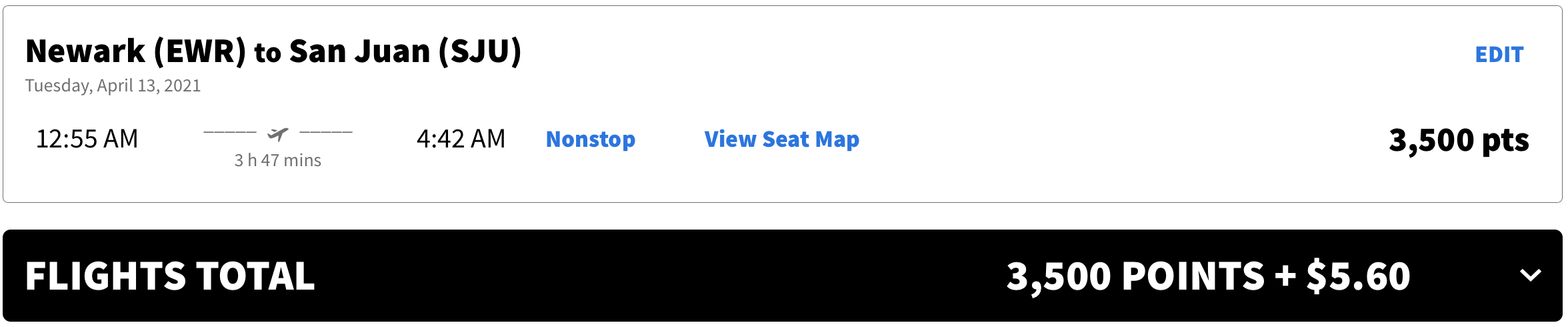
Of course, not all ultra-cheap award tickets yield this poor of a value. This Newark (EWR) to San Juan (SJU) award ticket cost just 3,500 points and $5.60 one-way. A cash ticket was $71.39, giving you a cents-per-point value of 1.88 cents apiece — an excellent value for Spirit points.
(Image courtesy of Spirit Airlines)
So make sure to check the cash cost of a ticket before you redeem your points. I’d aim to get at least 1 cent per point in value your Spirit points, but it’s easy to get more if you book international flights or get lucky with award pricing.
Spirit isn’t a transfer partner of any major credit card or hotel loyalty program, so your options for earning Spirit points are limited. However, if you’re looking to earn Spirit points quickly, your best bet is to open a Spirit cobranded credit card.
There are two Spirit cards on the market: one with an annual fee and one without an annual fee. Each card has a different set of benefits and a unique welcome bonus.
(Photo by The Points Guy)
The higher-end of the two cards — the Free Spirit Travel More World Elite Mastercard — has a handful of benefits like Zone 2 boarding and waived booking fee. You’ll also get a $100 companion discount when you spend $5,000 on the card in a single calendar year, helping offset the $79 annual fee.
The welcome bonus is 40,000 bonus points after spending $1,000 on the card in the first three months of account opening.
Additionally, the card earns 3x points on Spirit purchases, 2x on dining and grocery store purchases and 1x on everything else. You'll also earn 1 status qualifying point for every $10 spent on the card.
(Photo by The Points Guy)
The no-annual-fee variant of the card — the Free Spirit Travel Mastercard — has limited benefits and a smaller welcome bonus. You’re still eligible for a booking fee waiver and Zone 2 boarding, but the welcome bonus is 10,000 points after spending $500 on the cards.
The card earns 2x points on Spirit purchases and 1x points everywhere else.
The information for the Free Spirit Travel More and Free Spirit Travel cards has been collected independently by The Points Guy. The card details on this page have not been reviewed or provided by the card issuer.
All in all, the new Free Spirit program is a welcome change. Points are worth more now than they were under the old program, and they’re easier to use too.
Remember, the new Free Spirit program dynamically prices award tickets. Awards start at just 2,500 points one-way, but you won’t always get the best deals booking these tickets. Always make sure to compare the cash and points costs of a ticket and aim to get at least 1 cent per point in value from your tickets.
It’s possible to get more value from your tickets too. After looking at cash and award pricing for 100 Spirit flights, I found that flights without the pesky $50 booking fee average 1.23 cents per point in value. Most of the high-value tickets I found were international flights.
While not perfect, I think the new Free Spirit loyalty program makes Spirit Airlines more attractive to frequent flyers who want rewards in return for their business and personal travel.
Comments
By commenting, you agree to our Community Guidelines to help create a positive space for conversation. The responses below are not provided or commissioned by the bank advertiser, our partners, or The Points Guy (“TPG”). They have not been reviewed, approved, or otherwise endorsed by any of these parties. All responses are submitted by individual contributors, and neither the bank advertiser, our partners, nor TPG are responsible for ensuring that all posts and/or questions are answered.