The Wells Fargo Autograph Journey filled a surprising gap in my wallet


For years, I barely gave Wells Fargo credit cards a second thought.
After a decade of writing about travel rewards credit cards, I'd built my wallet of 25-plus cards around American Express, Capital One, Chase and Citi. Between those four issuers, I had access to plenty of transferable points, valuable travel protections and strong welcome bonuses.
As my points strategy evolved, I realized I had one notable gap: I wanted another transferable rewards currency.
Wells Fargo has quietly transformed its rewards program, and the Wells Fargo Autograph Journey® Card (see rates and fees) finally gave me a reason to take a closer look.
A generous welcome bonus, strong earning rates on travel and an expanding list of transfer partners convinced me to apply. While the application and onboarding experiences weren't nearly as smooth as I'd hoped, I'm still glad I finally gave Wells Fargo credit cards a chance.
Why I overlooked Wells Fargo for so long
When I first got into points and miles in 2016, Wells Fargo wasn't a major player in transferable rewards.
For years, the biggest transferable rewards programs dominated the conversation among travelers looking to transfer points to airline and hotel partners. As I built my wallet, I naturally gravitated toward those ecosystems.
Wells Fargo, meanwhile, was better known for cash-rewards cards than flexible travel rewards.

That changed in 2024 when Wells Fargo introduced transfer partners and launched the Autograph Journey. Even then, I didn't rush to apply. My wallet already covered most of my travel goals. Then I started looking at Wells Fargo differently.

I'd long since reached Chase's 5/24 limit and had already applied for most of the American Express cards I wanted. More importantly, I realized I wasn't looking for another travel card — I was looking for another transferable rewards currency.
Related: Best Wells Fargo credit cards
What convinced me to apply for the Autograph Journey
The welcome bonus was what initially caught my attention.
Earning 60,000 bonus points after spending $4,000 on purchases during the first three months from account opening is a compelling welcome offer for a card with a $95 annual fee.
Just as importantly, it gave me an opportunity to build a meaningful balance of Wells Fargo Rewards points and gain access to a completely new transferable rewards ecosystem.
While I did consider the no-annual-fee Wells Fargo Autograph® Card (see rates and fees), I kept coming back to the Autograph Journey. For an extra $95 per year, I was getting a much larger welcome bonus, higher earning rates on flights and hotels, and a $50 annual airline statement credit.
To be honest, I don't expect the Autograph Journey to become one of my highest-spending cards after I earn the welcome bonus. Instead I'll use it strategically.
Despite earning 4 points per dollar spent on airfare, I'd rather use my Chase Sapphire Reserve® (see rates and fees) because its trip delay and baggage delay insurance are the two protections I value most when I fly.

I do fully expect to use the annual $50 airline statement credit* — I just won't use it on airfare. Instead, I'll redeem it for purchases like seat selection or checked baggage fees that exceed $50 in a single transaction.
And I plan to use the Autograph Journey for incidental hotel purchases. Things like room service and breakfast charged to my room earn 5 points per dollar spent, which is a slightly better return than I'd receive on my Sapphire Reserve (one additional point).
*Receive a one-time $50 statement credit applied to your account when your card is used for your first airline purchase of at least $50 each year.
Related: I spent $350 after an airline delayed my bag — here's how I got every dollar back
Why another transferable rewards currency matters
The earning rates and airline credit were nice add-ons. What I really wanted was access to the Wells Fargo Rewards program.
While I have transferable points with American Express, Capital One, Chase and Citi, my balances across those programs are all below 30,000 points each. They're spread too thin to book the Star Alliance awards I'm interested in.

By comparison, my Oneworld and SkyTeam redemptions are already well covered through cobranded airline credit cards, and I can top up those accounts with transferable points whenever I need to.
Once I earn the welcome bonus, I expect to have around 65,000 Wells Fargo Rewards points (from the welcome offer plus regular spending).
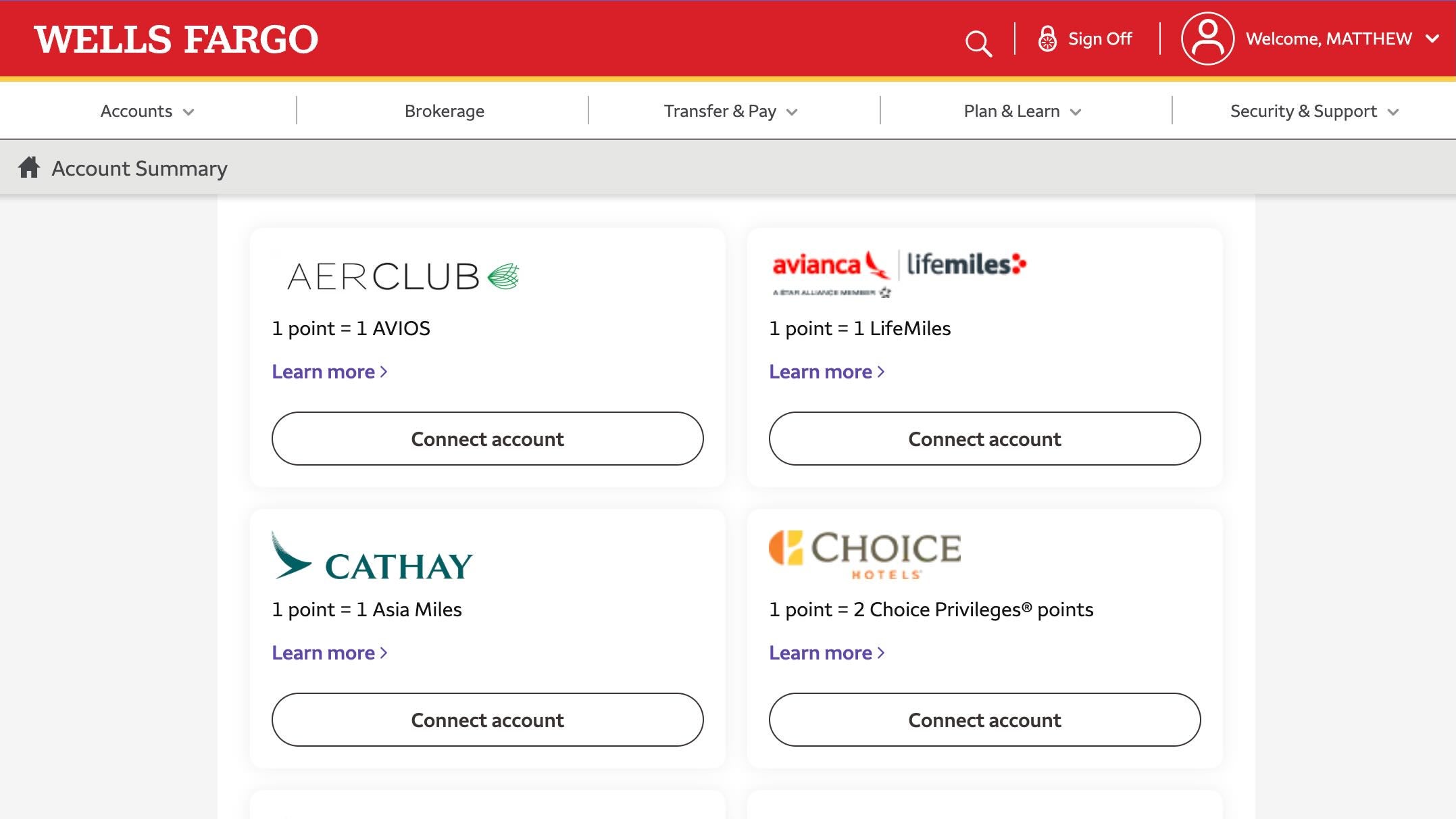
My first redemption goal is to transfer around 60,000 points to Avianca Lifemiles for a one-way business-class flight across the Atlantic (plus approximately $60 in taxes and fees). If award space opens up, I'd love to try Swiss' new business class. Alternatively, I'd finally get to fly Austrian Airlines business class.

Beyond Lifemiles, I'm also happy to have access to Iberia Club from another transferable program. Since I'm based in Madrid, I can see myself transferring smaller balances there for flights around Europe rather than letting a few thousand points sit unused.
The 1:2 transfer ratio to Choice Privileges is another underrated sweet spot, especially in Nordic countries where hotel rates can be eye-wateringly expensive.
Wells Fargo still has room to grow its list of transfer partners, but it's come a long way in a relatively short time.
Related: Wells Fargo Rewards transfer partners: How to redeem your points
My first impression wasn't positive
One thing that surprised me was how much friction there was during the application and setup process.
Instead of receiving an instant decision, it took two weeks for Wells Fargo to verify my identity and approve my application.
Then, after my card arrived, I couldn't access the Wells Fargo mobile app because my contact information hadn't been fully verified. Customer service initially suggested visiting a branch, but since I spend much of the year outside the U.S., that wasn't a practical option.

After a month, Wells Fargo eventually resolved the issue remotely.
I'm glad it did. But I'd be lying if I said the onboarding experience left a great first impression.
Who should consider the Autograph Journey?
I don't think the Autograph Journey is the right card for everyone. But I do think it's a good fit if you:
- Want to diversify beyond Amex, Capital One, Chase or Citi with another transferable rewards program
- Spend regularly on hotels or flights and can take advantage of the bonus-earning rates
- Want to quickly build a Wells Fargo Rewards balance by earning a welcome bonus
- Will use the $50 annual airline statement credit
On the other hand, I'd probably look elsewhere if you:
- Want the broadest selection of airline and hotel transfer partners
- Prioritize travel protections when booking flights
- Prefer a no-annual-fee card
Related: Wells Fargo Autograph vs. Autograph Journey: Should you pay an annual fee for more benefits?
Bottom line
I didn't expect Wells Fargo to be the next issuer I'd add to my wallet. Looking back, I hadn't appreciated the gap it could fill in my wallet.
The Wells Fargo Autograph Journey hasn't replaced the cards I use most often, and I don't expect it to. Instead, it rounds out my collection by giving me access to another flexible rewards currency and a path to premium Star Alliance redemptions.
The application process could certainly be smoother, but that experience hasn't changed my opinion of the card itself. I'm looking forward to earning my welcome bonus next month and making my first transfer from Wells Fargo Rewards.
To learn more, read our full review of the Autograph Journey.
Apply here: Wells Fargo Autograph Journey Card