The Points Guy believes that credit cards can transform lives, helping you leverage everyday spending for cash back or travel experiences that might otherwise be out of reach. That's why we publish a variety of editorial content and card comparisons: to help you find a great card to turn your goals into reality.
Our site may earn compensation when a customer clicks on a link, when an application is approved, or when an account is opened with our partners, and this may impact how or where these products appear. While we don't cover all available credit cards, our editorial team creates and maintains all of the analysis of these cards, and our content is not influenced nor subject to review by any credit card company, bank or partner prior to (or after) publication. Please view our advertising policy and product review methodology for more information.
Advertiser disclosure
The Points Guy believes that credit cards can transform lives, helping you leverage everyday spending for cash back or travel experiences that might otherwise be out of reach. That's why we publish a variety of editorial content and card comparisons: to help you find a great card to turn your goals into reality.
Our site may earn compensation when a customer clicks on a link, when an application is approved, or when an account is opened with our partners, and this may impact how or where these products appear. While we don't cover all available credit cards, our editorial team creates and maintains all of the analysis of these cards, and our content is not influenced nor subject to review by any credit card company, bank or partner prior to (or after) publication. Please view our advertising policy and product review methodology for more information.
Guides
Why never using some of your credit cards may cause you to lose them
Katie Genter is a digital nomad who has traveled full time since June 2017. She writes and edits stories about points and miles, and loyalty programs, often letting her personal experiences color these stories.
September 9, 2024 • 8 min read
The cards we feature here are from partners who compensate us when you are approved through our site, and this may impact how or where these products appear. We don't cover all available credit cards, but our analysis, reviews, and opinions are entirely from our editorial team. Terms apply to the offers listed on this page. Please view our advertising policy and product review methodology for more information.Editorial disclaimer: Opinions expressed here are the author's alone, not those of any bank, credit card issuer, airline or hotel chain, and have not been reviewed, approved or otherwise endorsed by any of these entities.
Comments
By commenting, you agree to our Community Guidelines to help create a positive space for conversation. The responses below are not provided or commissioned by the bank advertiser, our partners, or The Points Guy (“TPG”). They have not been reviewed, approved, or otherwise endorsed by any of these parties. All responses are submitted by individual contributors, and neither the bank advertiser, our partners, nor TPG are responsible for ensuring that all posts and/or questions are answered.
Related stories
Quick summary
Credit card issuers may close or reduce limits on unused accounts, which can negatively impact your credit score.
Maintaining open accounts helps preserve your credit utilization ratio and the length of your credit history, both important credit score factors.
To keep accounts active, it's recommended to use each card at least once every six months, such as for small purchases or recurring subscriptions.
Some issuers may notify you before closing an account, but others may not, so monitoring your accounts and updating contact information is important.
What to consider
Closed accounts can increase your credit utilization ratio, potentially lowering your credit score.
Older accounts are particularly valuable for your credit history, so prioritize keeping them active.
Issuers may or may not provide advance notice before closing an inactive account.
What you'll miss from the article
Detailed strategies for keeping infrequently used card accounts open and examples of how to set reminders or make small purchases to avoid closure.
Generated by AI with support from our editorial team.
Update: Some offers mentioned below are no longer available. View the current offers here.
Credit card issuers want you to use your cards. After all, a no-annual-fee credit card sitting unused in your sock drawer won't generate revenue for the financial institution that issued the card.
On top of this, unused credit cards can present risks. If you aren't using the card, you probably aren't checking the bill regularly, and that means criminals who gain access to your card could make a significant amount of purchases before you notice it and notify the bank. Thus, banks are in the habit of reducing credit limits or closing accounts on unused credit cards.
However, even if you don't use some of your cards frequently, you may not want the issuer to close your account or reduce your credit line. Here's why you may want to keep rarely used accounts open and how to do so responsibly.
Why banks close card accounts
Don't be surprised if a credit card issuer closes a card you keep tucked away in your wallet or a kitchen drawer. After all, issuers generally make money from consumers in three ways:
Interest payments: You'll be charged interest when you carry a balance from month to month. You can avoid interest by paying off your balance in full each month
Issuers want cardholders who make profits for the bank, achieved through these fees. As such, issuers want to continue offering credit to cardholders who will use their card and not default on their payments.
When one of your card accounts closes, your credit score will usually decrease. For example, when my mother-in-law closed her cobranded Southwest credit card last year, her credit score dropped by about 20 points.
Once an account is closed, you'll have less credit available to you. Having less available credit hurts your credit utilization ratio. For example, if you have $3,000 in credit card debt and four cards, each with a $5,000 credit limit, you are using $3,000 of your $20,000 overall limit — 15%. But if an issuer closes one of your cards, you are now using $3,000 of a $15,000 overall limit, which is a higher 20% utilization. In this case, your credit utilization ratio will jump, despite your debt remaining the same.
Generally, you want to keep your credit utilization ratio under 20-30%. Suppose an issuer closes your account or decreases your credit line. In that case, you'll need to reduce your credit card debt or increase your available credit to keep the same credit utilization ratio. To do this, you'll either need to pay down debt or ask one of your other issuers for an increase in your credit line. Doing so will allow you to reduce the impact on your credit score of having a card closed.
There are many reasons you may not use a card very frequently. However, you'll likely want to keep all of your cards active, especially if the card in question may be useful in the future or is one of your oldest accounts. Here are two things to do.
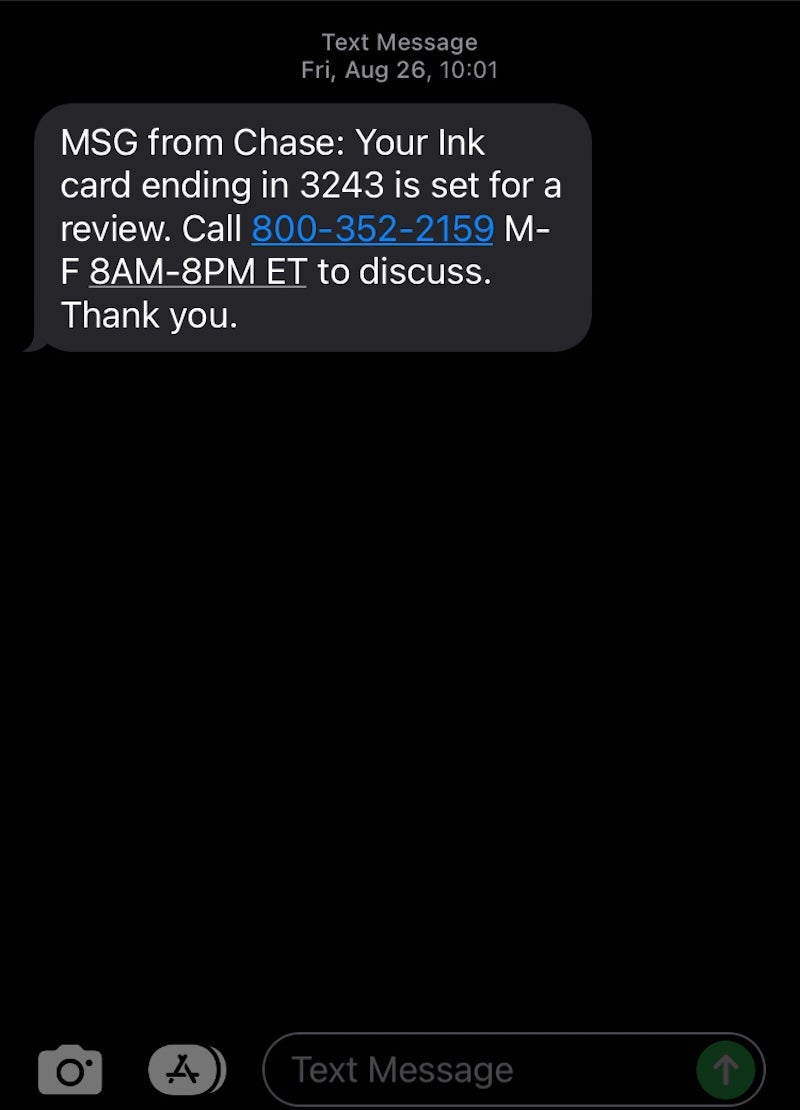
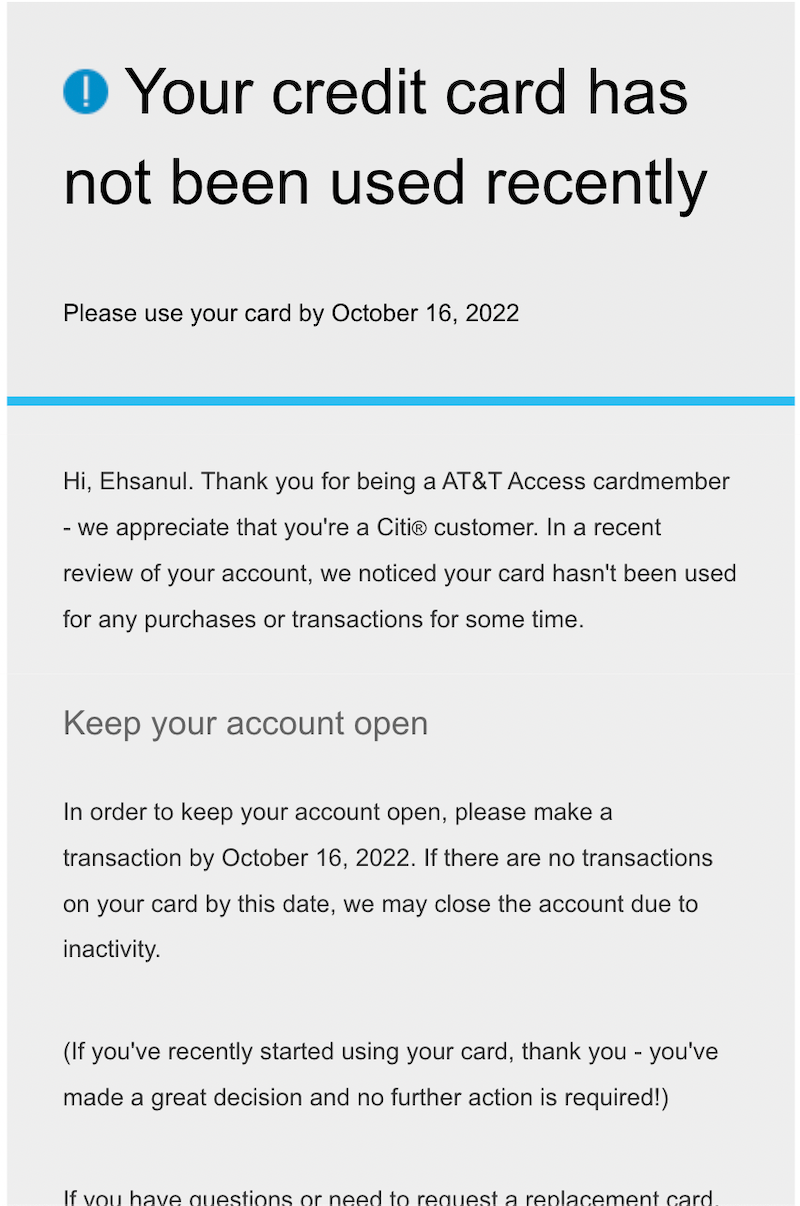
However, if this notice that two TPG employees received is anything to go by, you may want to spend on your cards more frequently than once per year.
RYAN SMITH/THE POINTS GUY
In August 2022, TPG contributor Ryan Smith received a text message from Chase stating that one of his Ink business cards was slated for review and possible closure due to inactivity. Despite a calendar reminder to use his old credit cards every 90 days, Ryan had overlooked this card and not used it at all in 2022 — a gap of nearly nine months of inactivity prior to this text message.
Points and miles contributor Ehsan Haque received a similar notification, giving him a little over a month to use his dormant credit card so they bank wouldn't close it. Prior to receiving this notice, Ehsan hadn't used this particular credit card in more than eight months.
EHSAN HAQUE/THE POINTS GUY
Watch for closure notices
Some credit card issuers will notify cardholders about an impending card closure, while others will just drop the hammer with no warning. So, if you receive a notice that your card account will be — or has been — closed, you may be able to keep the card account open by calling your issuer and pleading your case.
For example, a couple of years ago, I received a notice that my cobranded United Airlines credit card was being closed. I called the number on the back of my card and explained to the agent why I wanted to keep the card. I hadn't used this card in the last year but said that I hoped my travel on United would soon increase, which would mean I'd be using my card more. The agent agreed to keep my account open, but I could have prevented this situation by using my card even just a few times each year.
Make sure you keep your contact information updated with your credit card issuers. That way, you'll receive emails, text messages or letters notifying you of any pending account closures.
Bottom line
As inflation continues, it's vital to recession-proof your credit score. One way to protect your credit score is to periodically spend on rarely-used cards. After all, card issuers are less likely to close active accounts. The ideal frequency to keep your credit cards active is to spend on them at least once every six months.
You'll want to keep your card accounts open to maintain account history and credit utilization, especially on cards with high credit limits or long account history — both of which can help to improve your credit score.
By commenting, you agree to our Community Guidelines to help create a positive space for conversation. The responses below are not provided or commissioned by the bank advertiser, our partners, or The Points Guy (“TPG”). They have not been reviewed, approved, or otherwise endorsed by any of these parties. All responses are submitted by individual contributors, and neither the bank advertiser, our partners, nor TPG are responsible for ensuring that all posts and/or questions are answered.