The Points Guy believes that credit cards can transform lives, helping you leverage everyday spending for cash back or travel experiences that might otherwise be out of reach. That's why we publish a variety of editorial content and card comparisons: to help you find a great card to turn your goals into reality.
Our site may earn compensation when a customer clicks on a link, when an application is approved, or when an account is opened with our partners, and this may impact how or where these products appear. While we don't cover all available credit cards, our editorial team creates and maintains all of the analysis of these cards, and our content is not influenced nor subject to review by any credit card company, bank or partner prior to (or after) publication. Please view our advertising policy and product review methodology for more information.
Advertiser disclosure
The Points Guy believes that credit cards can transform lives, helping you leverage everyday spending for cash back or travel experiences that might otherwise be out of reach. That's why we publish a variety of editorial content and card comparisons: to help you find a great card to turn your goals into reality.
Our site may earn compensation when a customer clicks on a link, when an application is approved, or when an account is opened with our partners, and this may impact how or where these products appear. While we don't cover all available credit cards, our editorial team creates and maintains all of the analysis of these cards, and our content is not influenced nor subject to review by any credit card company, bank or partner prior to (or after) publication. Please view our advertising policy and product review methodology for more information.
Guides
6 reasons I’m rethinking the Chase Sapphire Reserve after its refresh
Matt Moffitt is a contributing editor and expert in getting the most out of credit cards and points (he carries at least 25 cards in his wallet at any given time). Originally from Sydney, Australia, he won the Green Card Lottery and lived in Austin, Texas for 10 years before relocating to Spain in 2025.
March 30, 2026 • 10 min read
The cards we feature here are from partners who compensate us when you are approved through our site, and this may impact how or where these products appear. We don't cover all available credit cards, but our analysis, reviews, and opinions are entirely from our editorial team. Terms apply to the offers listed on this page. Please view our advertising policy and product review methodology for more information.Editorial disclaimer: Opinions expressed here are the author's alone, not those of any bank, credit card issuer, airline or hotel chain, and have not been reviewed, approved or otherwise endorsed by any of these entities.
Comments
By commenting, you agree to our Community Guidelines to help create a positive space for conversation. The responses below are not provided or commissioned by the bank advertiser, our partners, or The Points Guy (“TPG”). They have not been reviewed, approved, or otherwise endorsed by any of these parties. All responses are submitted by individual contributors, and neither the bank advertiser, our partners, nor TPG are responsible for ensuring that all posts and/or questions are answered.
Related stories
Quick summary
A popular premium travel card recently increased its annual fee and introduced new benefits, credits and restrictions, making it more complex to use.
The card now offers higher rewards at hotels and airlines booked directly, but reduced rewards for other travel categories like vacation rentals and ride-hailing services.
Technical issues with the rewards platform and referral program have caused frustration for some cardholders, affecting the overall experience.
Despite these drawbacks, the card still provides valuable travel credits, strong travel protections and high rewards for certain travel purchases.
What to consider
Some new benefits require minimum stays or have delayed availability for existing cardholders.
Technical problems with rewards transfers and referrals may impact the ability to fully use earned points.
Competitors offer different mixes of lounge access, credits and annual fees, which may better suit certain travelers.
What you'll miss from the article
A detailed comparison of how this premium card stacks up against other top-tier travel cards and guidance on maximizing its changing benefits.
Generated by AI with support from our editorial team.
Comments
By commenting, you agree to our Community Guidelines to help create a positive space for conversation. The responses below are not provided or commissioned by the bank advertiser, our partners, or The Points Guy (“TPG”). They have not been reviewed, approved, or otherwise endorsed by any of these parties. All responses are submitted by individual contributors, and neither the bank advertiser, our partners, nor TPG are responsible for ensuring that all posts and/or questions are answered.
Strong earning rates, valuable travel perks and access to the Chase Ultimate Rewards ecosystem made the card feel well worth its annual fee.
But last year's refresh changed that equation. Chase raised the annual fee to $795 and introduced a wave of new benefits, credits and restrictions.
I've held some version of the Sapphire Reserve or its sibling, the Chase Sapphire Preferred® Card (see rates and fees), for the past 10 years. When the refresh was announced in June 2025, my renewal happened to fall a few months later — meaning I renewed at the old $550 annual fee.
That timing has effectively given me a year to evaluate the refreshed card before deciding whether it's worth paying $795 at my next renewal in October.
So far, the experience has been mixed.
If you currently hold the Sapphire Reserve or are considering applying, here’s how I’m evaluating the card today.
How the Sapphire Reserve changed after the refresh
For years, the Sapphire Reserve stood out because of its simplicity.
You earned 3 points per dollar spent on travel and dining, the card didn’t feel like a coupon book and authorized users cost just $75 each (it's now $195).
Last year’s refresh changed that equation in several ways, including raising the annual fee to $795.
Some of the changes were positive. For example, Chase increased the earning rate on flights and hotel stays booked directly with airlines or hotels from 3 to 4 points per dollar spent, which is a very strong return.
ZACH GRIFF/THE POINTS GUY
But other changes, including adjustments to another key earning rate and the addition of more layered benefits and statement credits, have made what used to be a more straightforward card feel noticeably more complicated.
None of this means the Sapphire Reserve can’t still deliver value. In fact, I’ll still come out ahead this year. But the overall experience hasn’t felt quite as seamless as it once did.
6 things that have made me rethink the Sapphire Reserve
Vacation rentals, ride-hailing services, trains and many other travel purchases earned 3 points per dollar spent. That made the card my default for nearly every travel purchase.
AIRBNB
The updated earning structure removed that broad category (while, admittedly, increasing the earning rate on flights and hotels booked directly to 4 points per dollar).
That’s great if you frequently book directly with airlines or hotels. But if your travel spending includes vacation rentals, ride-hailing services or ground transport, you’re earning fewer points (1 per dollar, to be exact) than before.
It’s a subtle change, but it has noticeably changed how often I reach for the card.
When technology fails, redeeming Ultimate Rewards points becomes frustrating
Ultimate Rewards points are one of the main reasons why I’ve kept a Sapphire card for so long. They’re among the most valuable flexible points currencies you can earn, especially when transferring to partners like World of Hyatt. (That said, Hyatt is revamping its award chart in May, which may reduce the value of transferring Chase points to the program.)
Unfortunately, I’ve had ongoing issues with the Ultimate Rewards interface, specifically when transferring and combining points between my cards. What first seemed like a temporary outage has dragged on, forcing me to call Chase every time I want to complete a transfer.
These features have now been unavailable to me online for more than a year. Based on reports from other cardholders, the issue I'm having does not seem to be an isolated case.
When the technology doesn’t work, it undermines one of the biggest advantages of the Ultimate Rewards ecosystem.
TPG reached out to Chase and their team is actively investigating the issue.
Referral glitches have made it harder to earn points
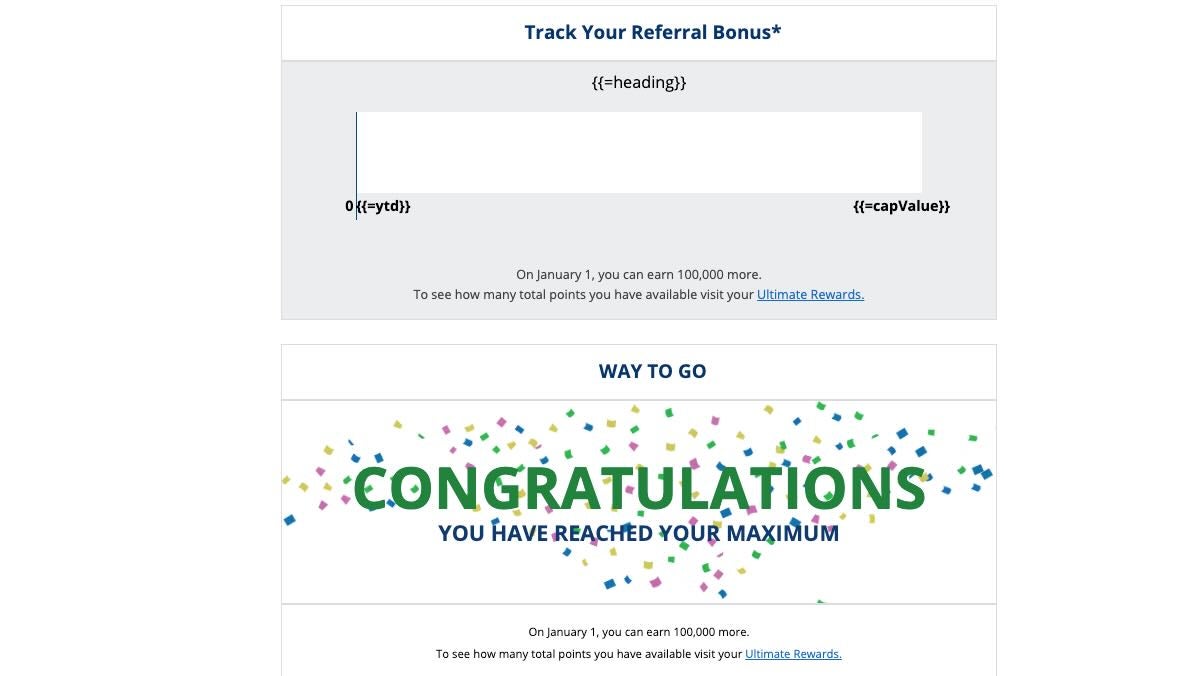
In my case, however, the referral tracker hasn’t worked properly for the past year. Caps haven’t reset correctly, and repeated attempts to resolve the issue haven’t fixed it. Based on my records, I estimate I’ve missed out on 60,000 points from referrals as a result.
My referral tracker has been malfunctioning for the past 12 months. CHASE
Individually, these issues may seem minor. But when systems that track rewards malfunction, it becomes harder to rely on the program with confidence.
A key benefit was changed just months after launch
One of the new features introduced during last year’s refresh was Points Boost, which allowed certain redemptions at elevated values of up to 2 cents per point. Just six months later, Chase changed the benefit.
Rewards programs evolve, but changes so soon after a major refresh can make cardholders question how stable those benefits really are.
Premium benefits come with more fine print than necessary
Several of the refreshed benefits come with restrictions that limit their real-world usefulness.
Additionally, when the refresh was announced last June, existing cardholders had to wait until October to access most of the new and refreshed benefits. That four-month delay made it feel like I was missing out on value from the card.
Frequent changes to benefits after they’ve already been announced can also create unnecessary confusion for cardholders, even when the changes are positive.
Customer service has felt inconsistent
I recently experienced fraud on my Sapphire Reserve account. Chase correctly removed the fraudulent charges and issued a replacement card. However, despite clearly confirming my address during the call, the replacement card was sent to the wrong location.
This wasn’t a catastrophic issue, but it added to a broader pattern of small service hiccups I’ve experienced over the past year. For a card that costs $795 annually, a consistently smooth customer experience is key to the value proposition.
The card also earns 4 points per dollar spent on flights and hotel stays booked directly with airlines and hotels. That’s a very strong earning rate for one of the most common types of travel spending.
For some travelers, the math can still work at the $795 annual fee. If you maximize the $300 travel credit and both The Edit credits each year (two $250 statement credits), you can more than offset the annual fee.
I also appreciate that, starting this year, Chase has made those The Edit credits more flexible by allowing them to be used at any time during the year (instead of splitting them into biannual credits, which American Express still does).
How it compares to other premium cards in my wallet
The Sapphire Reserve still has strengths, particularly with the simplicity of its $300 travel credit and the power of the Ultimate Rewards ecosystem. But compared to its competitors, my overall experience with the card has felt less polished lately.
If you frequently book flights and hotels directly, the 4 points per dollar earning rate can be extremely valuable.
Travelers who consistently maximize the $300 travel credit and The Edit credits may also find it easy to justify the annual fee.
And those who value strong travel protections may continue to see the Sapphire Reserve as one of the best cards for coverage when things go wrong.
What I’m doing before my next annual fee posts
I’ve tested the refreshed version of the card for almost five months so far. That still leaves me about seven months before my next renewal arrives in October, when I’ll have to decide whether it’s worth paying the $795 annual fee.
Between now and then, I’ll be paying close attention to whether the issues I’ve encountered improve, particularly the Ultimate Rewards tech problems and my customer service experiences.
DELMAINE DONSON/GETTY IMAGES
Most importantly, I want to feel confident that the Sapphire Reserve remains one of the best premium cards for my spending and travel habits and that it fills a role the other premium cards in my wallet don’t.
If these issues aren’t resolved, I'll most likely downgrade to the Sapphire Preferred and save $700 per year in annual fees.
Bottom line
The Chase Sapphire Reserve can still deliver strong value, especially for travelers who maximize its annual travel credit, earn elevated points on direct flight and hotel bookings and take advantage of its strong travel protections.
For most of the past decade, the Sapphire Reserve was an easy card to keep year after year. With a $795 annual fee now on the line, Chase has seven months to convince me that it still deserves that spot in my wallet.