Yes, There's a Good Chance You're Eating Year-Old Airplane Food

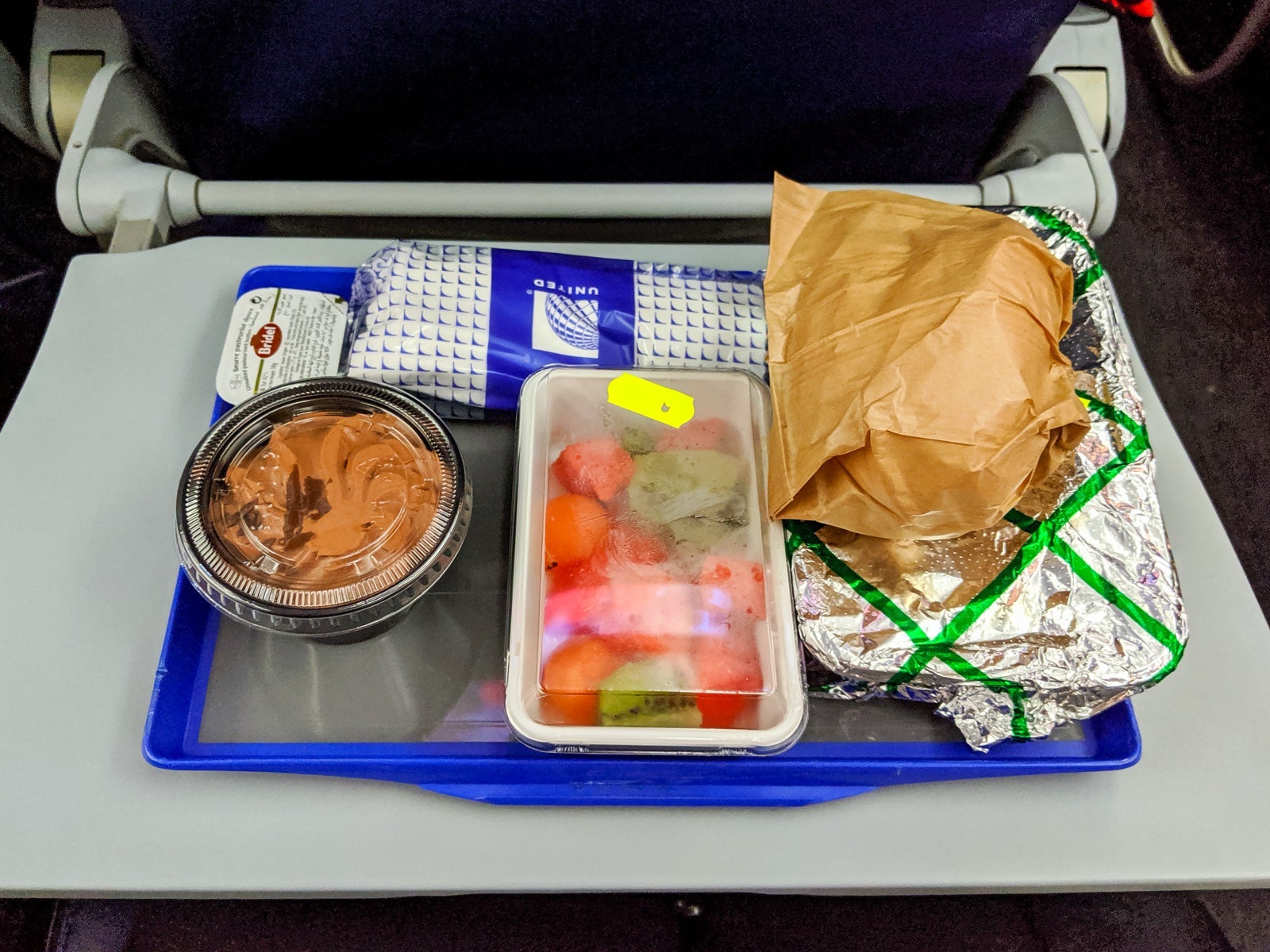
Next time you're chowing down at 35,000 feet, you might catch a glimpse of your meal's manufacture date and discover that your produce and protein were put into that little plastic tub months ago — maybe even more than a year before your flight.
Don't worry.
According to Randy Worobo, a professor of food safety and food microbiology at Cornell University's Department of Food Science, "if [food]'s been properly packaged with moisture barriers — very good packaging that prevents moisture loss during storage — it's totally fine," Worobo said. "It doesn't represent a safety issue."
Worobo said it's important for people to realize that when they're on the ground they regularly eat food that's been packaged and frozen (the best way to store food long-term) for months, so there's no reason to worry about doing the same in the air.
"Open your freezer and look at the date on some of those items that are in there," Worobo said. "I guarantee you, I've got stuff in my freezer that's 18 months old and I'm not going to throw it out."
In the United States, the Food and Drug Administration sets broad guidelines for food service, but airlines are able to set their own policies for food storage retention, and those can vary widely between companies.
Even the big three US carriers have their own different policies.
An American Airlines spokeswoman said the company will store frozen meals for up to 18 months after they're first packaged, though it generally tries to serve food much sooner than that. United will only keep meals for 180 days after receiving them from the manufacturer and a Delta Air Lines spokeswoman said its meals typically have a 12-month shelf life after being produced and packaged.
As View from the Wing recently reported, American served one passenger a specialty meal that had been packaged in February 2018 on a flight from Dallas to London earlier this month and the passenger wondered on Twitter whether it was acceptable to eat. Worobo said people may not expect their flight attendant to deliver food that's been stored for so long, but that it's not something to criticize.

"It's not like they took salad and the cooked meat and put it in the fridge for 18 months," he said. "Go in your grocery store, look at the foods that are frozen and look at what the shelf life is. Most of them are a year, and it's totally fine."
Also this month, United Airlines came under criticism when a passenger found mold in a hummus cup that was part of an onboard snack box. The passenger didn't discover the mold until after eating some of the dip, but Worobo said that although it sounds (and may have looked) off-putting, the spoiled food was unlikely to pose a health hazard.
[embed]https://www.instagram.com/p/ByjPGfHgaNC/[/embed]
"Think about tempeh, think about blue cheese. Those are all mold-fermented foods and they don't represent a safety issue. So it really depends what kind of mold contamination is on the foods," he said. In prepared foods, like the hummus cup, mold spoilage usually comes from the Penicillium species, which is generally nontoxic.
He also noted that airplane food is usually prepared and packaged by third-party contractors, so the airlines themselves are rarely to blame in the unusual cases when passengers receive a meal or snack that is contaminated.
In the end, Worobo said it's best to avoid eating food that you know has been contaminated, even if the contamination is unlikely to pose an immediate danger to your health.
"When in doubt, just throw it out."
For the latest travel news, deals and points and miles tips please subscribe to The Points Guy daily email newsletter.
TPG featured card
at American Express's secure site
Terms & restrictions apply. See rates & fees.
| 4X | Earn 4X Membership Rewards® points per dollar spent on purchases at restaurants worldwide, on up to $50,000 in purchases per calendar year, then 1X points for the rest of the year. |
| 4X | Earn 4X Membership Rewards® points per dollar spent at US supermarkets, on up to $25,000 in purchases per calendar year, then 1X points for the rest of the year. |
| 5X | Earn 5X Membership Rewards® points on prepaid hotel stays booked through AmexTravel.com or the Amex Travel App™. |
| 3X | Earn 3X Membership Rewards® points on flights booked through AmexTravel.com, the Amex Travel App™, or purchased directly from airlines. |
| 2X | Earn 2X Membership Rewards® points on prepaid car rentals booked through AmexTravel.com or the Amex Travel App™ and cruises booked and paid through AmexTravel.com. |
| 1X | Earn 1X Membership Rewards® point per dollar spent on all other eligible purchases. |
Pros
- Valuable dining and food-related credits
- Flexible rewards with airline and hotel transfer partners
- Multiple travel and purchase protections
- No foreign transaction fees
- Access to Amex Offers for additional savings (enrollment required)
Cons
- Not as useful for those living outside the U.S.
- Some may have trouble using Uber and other dining credits
- You may be eligible for as high as 100,000 Membership Rewards® Points after you spend $8,000 in eligible purchases on your new Card in your first 6 months of Card Membership. Welcome offers vary and you may not be eligible for an offer. Apply to know if you’re approved and find out your exact welcome offer amount – all with no credit score impact. If you’re approved and choose to accept the Card, your score may be impacted.
- Earn 4X Membership Rewards® points per dollar spent on purchases at restaurants worldwide, on up to $50,000 in purchases per calendar year, then 1X points for the rest of the year.
- Earn 4X Membership Rewards® points per dollar spent at US supermarkets, on up to $25,000 in purchases per calendar year, then 1X points for the rest of the year.
- Earn 5X Membership Rewards® points on prepaid hotel stays booked through AmexTravel.com or the Amex Travel App™.
- Earn 3X Membership Rewards® points on flights booked through AmexTravel.com, the Amex Travel App™, or purchased directly from airlines.
- Earn 2X Membership Rewards® points on prepaid car rentals booked through AmexTravel.com or the Amex Travel App™ and cruises booked and paid through AmexTravel.com.
- Earn 1X Membership Rewards® point per dollar spent on all other eligible purchases.
- Pay It® lets you tap in the American Express® App to quickly pay for small purchase amounts throughout the month and still earn rewards the way you usually do. Plan It® gives you the option to split up big purchases into equal monthly payments with a fixed fee. You’ll know upfront exactly how much you’ll pay.
- $120 Dining Credit: Earn up to a total of $10 in statement credits monthly when you pay with the Gold Card at Grubhub (including Seamless), Buffalo Wild Wings, Five Guys, The Cheesecake Factory, and Wonder. This can be an annual savings of up to $120. Enrollment required.
- $100 Resy Credit: Get up to $100 in statement credits each calendar year at over 10,000 qualifying U.S. Resy restaurants after you pay for eligible purchases with the American Express® Gold Card. That’s up to $50 in statement credits semi-annually. Enrollment required.
- $84 Dunkin' Credit: Earn up to $7 in monthly statement credits after you pay with the American Express® Gold Card at U.S. Dunkin’ locations. Enrollment required.
- $120 Uber Cash on Gold: Enjoy up to $120 in Uber Cash annually with your Gold Card. Just add your Card to your Uber account and you'll get $10 in Uber Cash each month to use on orders and rides in the U.S. when you select an Amex Card for your transaction.
- Enjoy complimentary Hertz Five Star® Status benefits like skipping the counter at select locations, adding an additional driver at no additional cost*, and vehicle upgrades**. Benefit enrollment and Hertz Gold+ registration are required. *Additional drivers must meet standard rental qualifications and must be a spouse or domestic partner to qualify as complimentary. Other additional drivers subject to fees. **Benefits are subject to availability and vary by location. Additional Hertz program Terms and Conditions including age restrictions apply.
- Book two nights or more with The Hotel Collection through AmexTravel.com or the Amex Travel App™ and receive a $100* credit towards eligible charges at over 1,400 upscale hotels worldwide. *Eligible charges vary by property.
- Book your travel through the Amex Travel App™ with added peace of mind – backed by American Express® service and support. Only for American Express® Card Members.
- Whenever you need us, we're here. Our Member Services team will ensure you are taken care of. From lost Card replacement to statement questions, we are available to help 24/7.
- No Foreign Transaction Fees.
- Annual Fee is $325.
- Terms Apply.